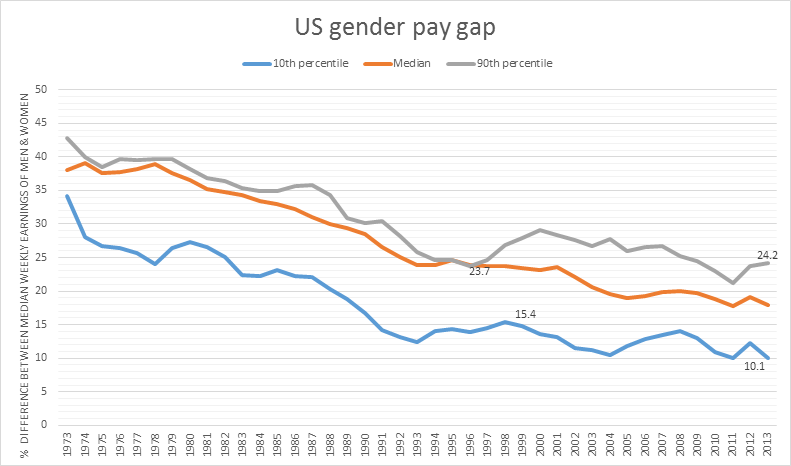
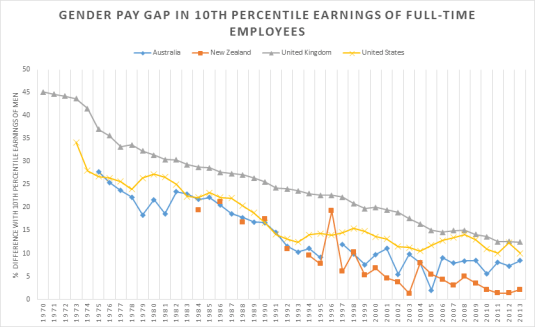
The Economic Policy Institute were good enough to dig out unit record data on the unadjusted US gender wage gap by percentiles. In attempting to show there was a persistent gender pay gap, the impeccably left-wing Economic Policy Institute showed that the unadjusted gender pay gap has all but disappeared in the USA.
There is next to no gender wage gap even in unadjusted terms towards the bottom of the labour market. This is despite all the protestations of the Left of an inherent inequality of bargaining power between the bosses and workers.
The low paid are supposed to be powerless unless unionised. Declining unionisation is a leading explanation on the Left of the rising income shares of the top 10%, top 1% in the top 0.1%.

If that inherent inequality of bargaining power trundled out at every opportunity by the Twitter Left explains anything in the labour market, this inequality of bargaining power should be operating with greatest strength at the bottom of the labour market.
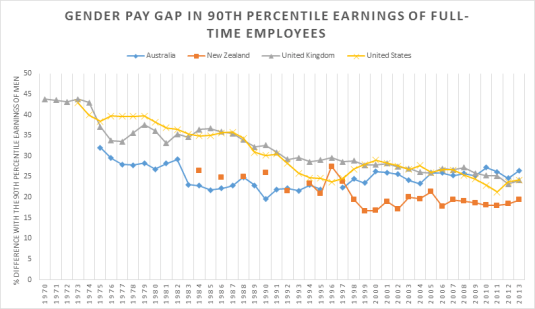
Clearly the inherent inequality of bargaining power between the bosses and workers is not doing its job regarding the gender wage gap. The gender wage gap in the USA increases as you move up the income ladder rather than the other way around.
The explanation of the Economic Policy Institute for greater gender pay equality at the bottom is the minimum wage and male wage stagnation:
It is interesting to note that the wage gap between genders is smaller at the 10th percentile than at the 95th. At the 10th percentile, women earn 91 percent of men’s wages while women make only 79 percent of men’s wages at the 95th percentile.
The minimum wage is partially responsible for this greater equality among the lowest earners—it sets a wage floor that applies to everyone, which means that people near the bottom of the distribution are likely to make more equal wages. Also, low-wage workers are disproportionately women, which means that the minimum wage particularly bolsters women’s wages.
…Although women have seen modest wage gains in the last several decades, the main reason the gender wage gap has slowly narrowed is that the vast majority of men’s wages have stagnated or declined.
It is a bit rich for the Economic Policy Institute to praise the minimum wage as a force for increasing incomes after spending so much of its time saying how the minimum wage has fallen way behind wages growth in general.
The gender gap lingers at the top of the labour market despite the quite substantial wage gains for women as compared to men over the past 15 years. The Economic Policy Institute dismissed the substantial gains as modest despite their own documenting of them.
It is even richer for the Economic Policy Institute to start extending the male wage stagnation hypothesis to the top 20% and top 10%.
The top of the income distribution has not been known previously known as victims of wage stagnation.
The gender wage gap remains stubbornly high at the top end of the US labour market at 20% for the last few decades. The gender wage is so large and has stayed large at the top half of the labour market for the past few decades because of compensating differentials. Women on higher incomes are balancing families and careers in choosing the occupations that best suits each individual woman, their talents and educational choices.
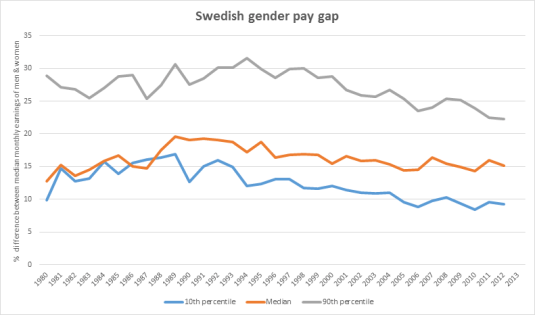
Source: OECD Employment Database.
Studies of top earning professionals show that they make quite deliberate choices between family and career. The better explanation of why so many women are in a particular occupation is job sorting: that particular job has flexible hours and the skills do not depreciate as fast for workers who take time off, working part-time or returning from time out of the workforce. Low job turnover workers will be employed by firms that invest more in training and job specific human capital.
- Higher job turnover workers, such as women with children, will tend to move into jobs that have less investment in specialised human capital, and where their human capital depreciates at a slower pace.
- Women, including low paid women, select careers in jobs that match best in terms of work life balance and allows them to enter and leave the workforce with minimum penalty and loss of skills through depreciation and obsolescence.
This is the choice hypothesis of the gender wage gap. Women choose to educate for occupations where human capital depreciates at a slower pace. This gender wage gap for professionals can be explained by the marriage market combined with assortative mating:
- Graduates are likely to marry each other and form power couples; and
- There tends to be an age gap between men and women in long-term relationships and marriages of two years.
This two-year age gap means that the husband has two additional years of work experience and career advancement. This is likely to translate into higher pay and more immediate promotional prospects. Maximising household income would imply that the member of the household with a higher income, and greater immediate promotional prospects stay in the workforce.
This is consistent with the choice hypothesis and equalising differentials as the explanation for the gender wage gap. As Solomon Polachek explains:
At least in the past, getting married and having children meant one thing for men and another thing for women. Because women typically bear the brunt of child-rearing, married men with children work more over their lives than married women. This division of labour is exacerbated by the extent to which married women are, on average, younger and less educated than their husbands.
This pattern of earnings behaviour and human capital and career investment will persist until women start pairing off with men who are the same age or younger than them.
In low-paying jobs, there is little in the way of trade-offs other than full-time or part-time work. Low-paid jobs do not involve choosing majors at university, choosing careers, industries and employers that call for long hours and uninterrupted careers or not so long hours, fewer human capital and promotional penalties for time off and more work-life balance. The choice hypothesis is the far better explanation for the persistence of the unadjusted gender wage gap in the USA as Polachek explains:
The gender wage gap for never marrieds is a mere 2.8%, compared with over 20% for marrieds. The gender wage gap for young workers is less than 5%, but about 25% for 55–64-year-old men and women.
If gender discrimination were the issue, one would need to explain why businesses pay single men and single women comparable salaries. The same applies to young men and young women. One would need to explain why businesses discriminate against older women, but not against younger women. If corporations discriminate by gender, why are these employers paying any groups of men and women roughly equal pay?
Why is there no discrimination against young single women, but large amounts of discrimination against older married women? … Each type of possible discrimination is inconsistent with negligible wage differences among single and younger employees compared with the large gap among married men and women (especially those with children, and even more so for those who space children widely apart)
The main drivers of the gender wage gap are unknown to employers such as whether the would-be recruit or employer is married, their partner is present, how many children they have, how many of these children are under 12, and how many years are there between the births of their children.







Recent Comments