
Progressive Feminism Exposed
02 Nov 2014 Leave a comment
in applied welfare economics, discrimination, gender, human capital, occupational choice, politics - USA Tags: gender wage gap, myths and fallacies
Why the Gender Pay Gap is a Myth
29 Oct 2014 Leave a comment
in discrimination, gender, health and safety, human capital, labour economics, labour supply, occupational choice Tags: employment discrimination, gender wage gap, labour economics, sex discrimination
Men are far more likely to choose careers that are more dangerous, so they naturally pay more under the principle of compensating differences. Top 10 most dangerous jobs: Fishers, loggers, aircraft pilots, farmers and ranchers, roofers, iron and steel workers, refuse and recyclable material collectors, industrial machinery installation and repair, truck drivers, construction labourers. They are male-dominated jobs.
Men are far more likely to enter higher-paying fields and occupations (by choice). Men are far more likely to take work in uncomfortable, isolated, and undesirable locations that pay more. Men work longer hours than women do. The average fulltime working man works 6 hours per week or 15 percent longer than the average fulltime working woman.

Women tend to work in fields dominated by women because these fields best satisfy women’s’ dual careers as workers and household managers. This can include less stressful work environments (noise, strenuous activity, etc.), more flexible policies regarding time off, and a number of other factors.

Men work longer hours than women do. The average fulltime working man works 6 hours per week or 15 percent longer than the average fulltime working woman. Even within the same career category, men are more likely to pursue high-stress and higher-paid areas of specialisation.

Despite all of the above, unmarried women who’ve never had a child actually earn more than unmarried men. In 2008, single, childless women between ages 22 and 30 were earning more than their male counterparts in most U.S. cities, with incomes that were 8% greater on average.
Women business owners make less than half of what male business owners make, which, since they have no boss, means it’s independent of discrimination. The reason for the disparity is money is the primary motivator for 76% of men versus only 29% of women. Women place a higher premium on shorter work weeks, proximity to home, fulfillment, autonomy, and safety.
Women lean toward jobs with fewer risks, more comfortable conditions, regular hours, more personal fulfillment and greater flexibility. Many women are willing to trade higher pay for other desirable job characteristics.
Men often take on jobs that involve physical labour, outdoor work, overnight shifts and dangerous conditions (which is why men suffer the overwhelming majority of injuries and deaths at the workplace). They choose to put up with unpleasant factors because they can earn more.
An Analysis of Reasons for the Disparity in Wages Between Men and Women for the U.S. Department of Labor in 2009 concluded that:
This study leads to the unambiguous conclusion that the differences in the compensation of men and women are the result of a multitude of factors and that the raw wage gap should not be used as the basis to justify corrective action.
Indeed, there may be nothing to correct. The differences in raw wages may be almost entirely the result of the individual choices being made by both male and female workers.
The Character Factory – NYTimes.com
28 Oct 2014 Leave a comment
in human capital, labour economics, liberalism, occupational choice Tags: labour economics, Personality traits


Piketty on inequality: views of the IGM economic experts
16 Oct 2014 Leave a comment
in applied price theory, applied welfare economics, comparative institutional analysis, constitutional political economy, discrimination, economic growth, entrepreneurship, gender, human capital, income redistribution, industrial organisation, labour economics, Marxist economics, Rawls and Nozick Tags: Daron Acemoglu, James Robinson, Piketty, poverty and inequality, The Great Enrichment
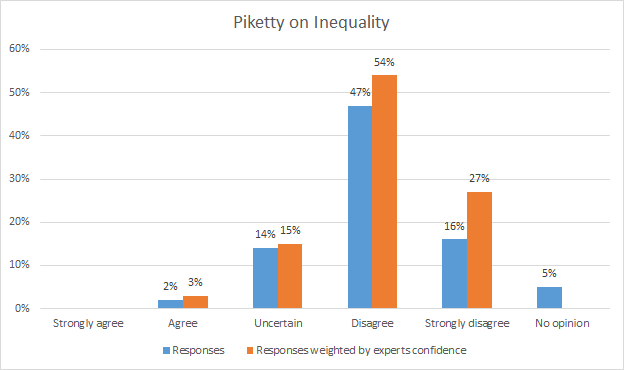
Question: The most powerful force pushing towards greater wealth inequality in the US since the 1970s is the gap between the after-tax return on capital and the economic growth rate?
Daron Acemoglu and James Robinson have a simple explanation for why Piketty is wrong:
But like Marx, Piketty goes wrong for a very simple reason. The quest for general laws of capitalism or any economic system is misguided because it is a-institutional.
It ignores that it is the institutions and the political equilibrium of a society that determine how technology evolves, how markets function, and how the gains from various different economic arrangements are distributed.
Despite his erudition, ambition, and creativity, Marx was ultimately led astray because of his disregard of institutions and politics. The same is true of Piketty.
The impact of street capital on the labour market prospects of inner-city youth
15 Oct 2014 Leave a comment
in human capital, labour economics, labour supply Tags: code of the street, human capital, labour economics, sociology
Dionissi Aliprantis wrote a superb paper on how the social skills developed to survive in the inner cities of America are not the skills that help you graduate from high school and get a job.
In the NLSY97, 26% of black inner-city youth report seeing someone shot by age 12, and 43% of black inner-city youth report the same by age 18.

The code of the street, the street smarted skills that inner-city black youth learn as teenagers to stay alive, do not pay off in regular society:
growing up in the ’hood means learning to some degree the code of the streets, the prescriptions and proscriptions of public behaviour. He must be able to handle himself in public, and his parents, no matter how decent they are, may strongly encourage him to learn the rules
The behaviours that do not help you survive in the street of the poor inner cities of America include include doing well in school, being civil to others, and speaking Standard English.
These skills that are the antithesis of the code of the street are exactly the skills valued by employers, especially employers of low paid workers. Employers of the low paid essentially want to recruit people who are friendly and reliable.
Dionissi Aliprantis found that exposure to street violence during childhood explains 20-35% of the high school dropout rate of inner-city youth.
The reverse gender gap in part-time employment
04 Oct 2014 Leave a comment
in discrimination, gender, human capital, labour economics, occupational choice Tags: compensating differentials, gender wage gap, part-time work, reversing gender gap

HT: economix
Robots will take my job alert: when musicians campaigned against the introduction of canned music into cinemas
28 Sep 2014 Leave a comment
in economics of media and culture, human capital, industrial organisation, labour economics, labour supply, survivor principle, technological progress Tags: automation, creative destruction, mechanisation, technological unemployment, The Great Enrichment



Much-needed gender analysis of median earnings growth since 1947
06 Sep 2014 Leave a comment
in discrimination, gender, human capital, labour economics Tags: gender analysis, median earnings growth by gender, myths and reality
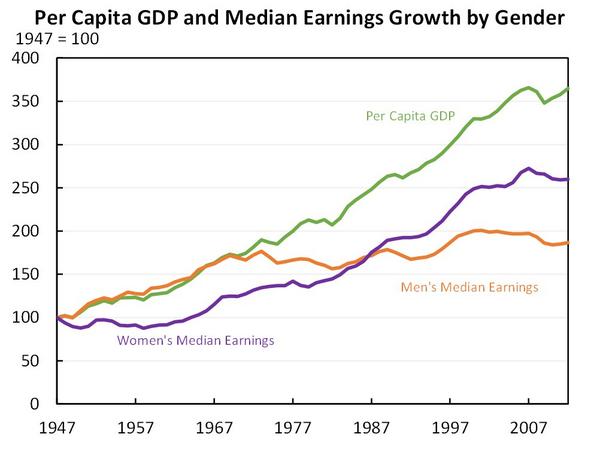
Source: Council of Economic Advisors.
Are men just getting their comeuppance for decades of discrimination against women?
Much is made of the stagnation of median earnings over the last few decades. There is no such stagnation for women


Recent Comments