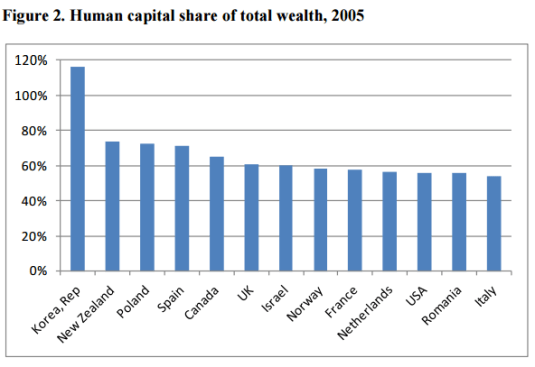
Human capital = 70% NZ’s wealth @WJRosenbergCTU @EricCrampton
24 Mar 2016 Leave a comment
in economics of education, human capital
The US gender wage gap by level of education
20 Mar 2016 Leave a comment
in discrimination, economics of education, gender, human capital, labour economics Tags: gender wage gap
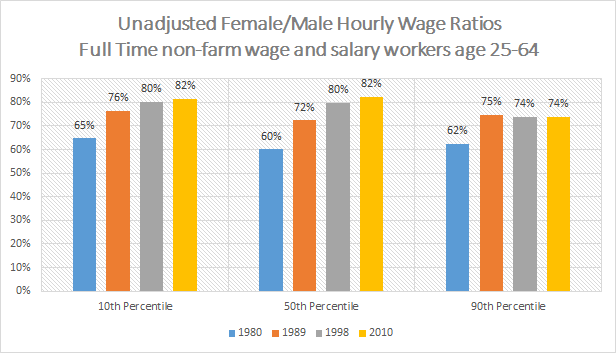
Unadjusted US gender wage gap at the 10th, 50th and 90th percentiles in 1980, 1989, 1998 and 2010
19 Mar 2016 Leave a comment
in discrimination, economic history, gender, human capital, labour economics, labour supply, occupational choice Tags: compensating differentials, gender wage gap
Much ducking and diving is required to explain why the women with most options in life have the largest gender wage gap.
Source: The Gender Wage Gap: Extent, Trends, and Explanations by Francine D. Blau, Lawrence M. Kahn :: SSRN via Panel Study of Income Dynamic (PSID).
How is the gender pay gap going in the USA since 1980, adjusted and unadjusted?
19 Mar 2016 Leave a comment
in discrimination, gender, human capital, labour economics, labour supply, occupational choice, politics - USA Tags: compensating differentials, gender wage gap
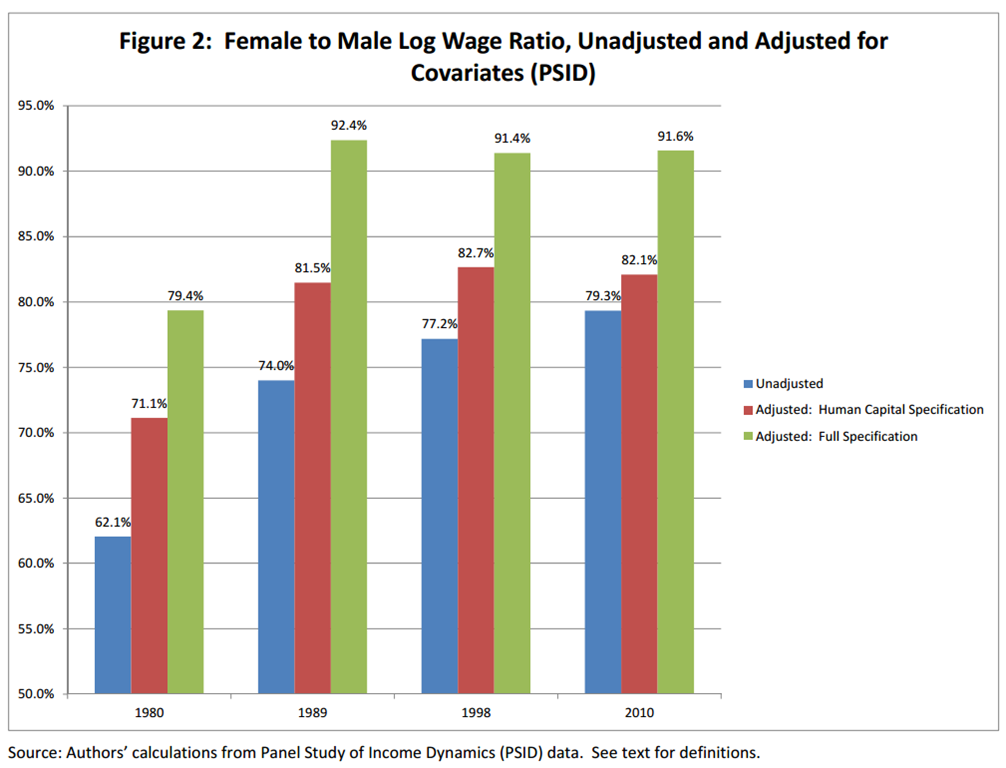
Source: The Gender Wage Gap: Extent, Trends, and Explanations by Francine D. Blau, Lawrence M. Kahn :: SSRN
Pizza and Conversation with James Heckman
19 Mar 2016 Leave a comment
in applied price theory, applied welfare economics, economics, economics of education, human capital, labour economics, labour supply, poverty and inequality Tags: James Heckman
New Zealand physical and human capital (by a skill level), 1986 – 2001
17 Mar 2016 Leave a comment
in applied welfare economics, economic history, economics of education, entrepreneurship, human capital, labour economics, politics - New Zealand, poverty and inequality Tags: pension fund socialism, top 1%, Withering away of the proletariat
New Zealand working class is wealthier than the entire capitalist class. Their human capital, shown in the chart below as the human capital of the unskilled and non-degree workers, far exceeds the value of the physical capital stock of New Zealand.
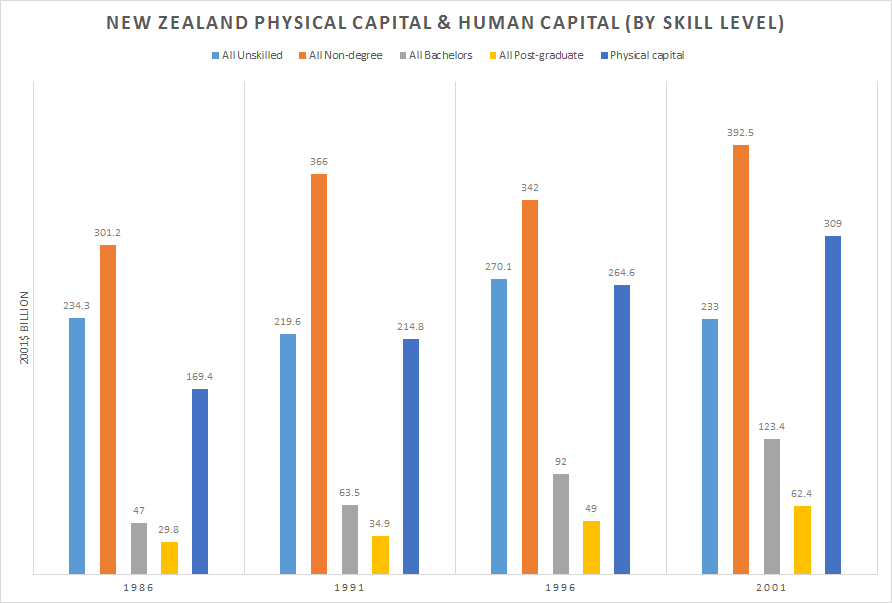
Source: Lˆe Thi. Vˆan Tr`ınh, Estimating the monetary value of the stock of human capital for New Zealand, University of Canterbury PhD thesis (September 2006).
Only part of this physical capital stock is owned by the capitalist class given we live in the era of pension fund socialism. About a 3rd of that physical capital stock is owner occupied homes.
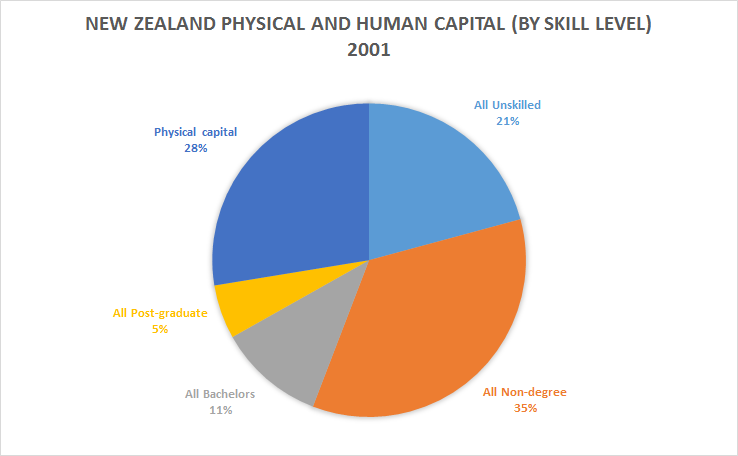
Source: Lˆe Thi. Vˆan Tr`ınh, Estimating the monetary value of the stock of human capital for New Zealand, University of Canterbury PhD thesis (September 2006).
The only reason that the share of unskilled and non-degree workers is in any way declining is the withering away of the proletariat. More and more people are joining the middle-class and going on to higher education.
Andrew Little is looking to update Labour's definition of the 'working class': stuff.co.nz/national/polit… http://t.co/AQ9mJL7CQf—
NZ Stuff Politics (@NZStuffPolitics) November 30, 2014
.
The value of New Zealand owner occupied homes, net capital stock and human capital stock since 1987
17 Mar 2016 Leave a comment
in applied welfare economics, economic history, economics of education, entrepreneurship, human capital, labour economics, politics - New Zealand, poverty and inequality, urban economics Tags: household wealth, housing prices, pessimism bias, top 1%
Tring Le found that the human capital stock was consistently 2.6 times the value of the physical capital stock of New Zealand.
I decided to apply that ratio to the net capital stock of New Zealand estimates of Statistics New Zealand back to 1987 to see what we get. It is pretty standard for the value of human capital to be two to two and one-half times the value of physical capital.

Source: National Accounts (Industry Benchmarks): Year ended March 2013 and Lˆe Thi. Vˆan Tr`ınh, Estimating the monetary value of the stock of human capital for New Zealand, University of Canterbury PhD thesis (September 2006), Table 4.8: Human and physical capital stocks.
All the above chart says it is most wealth in New Zealand is held by ordinary people either as their human capital or the value of their homes.
The gender pay gap for high school leavers and graduates aged 35-44 in the US, UK, Canada, Denmark, Sweden, Australia and New Zealand
10 Mar 2016 Leave a comment
in discrimination, economics of education, gender, human capital, labour economics, labour supply, occupational choice Tags: compensating differentials, education premium, female labour force participation, gender wage gap, graduate premium, maternal labour force participation
The USA, the gender pay gap gets worse if you go to college. By contrast, in Sweden and especially Canada the gender pay gap is much less for graduates than for those with a high school education.
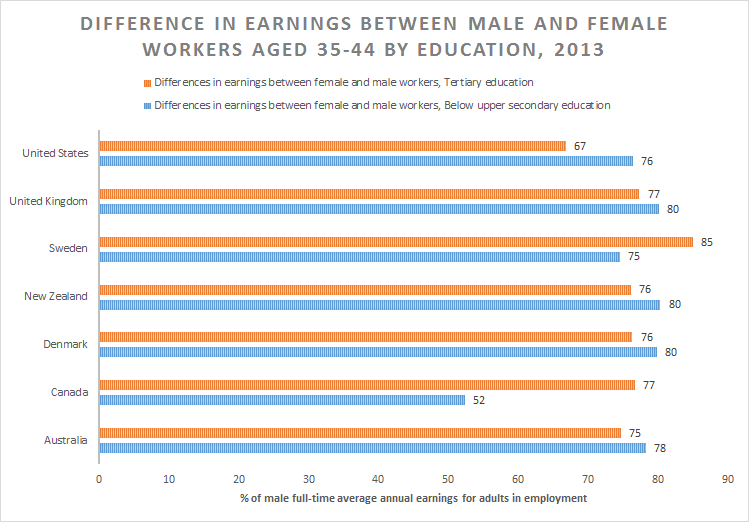
Data extracted on 09 Mar 2016 22:28 UTC (GMT) from OECD.Stat.
In most countries in the chart above, going on to university and graduating does not reduce the gender pay gap by the time you reach your late 30s and early 40s. Best explanation for that is that part of the graduate wage premium is traded for work-life balance.
The role of inheritance in top incomes
25 Feb 2016 Leave a comment
in applied welfare economics, economic history, entrepreneurship, human capital, labour economics, poverty and inequality Tags: entrepreneurial alertness, superstars, top 1%
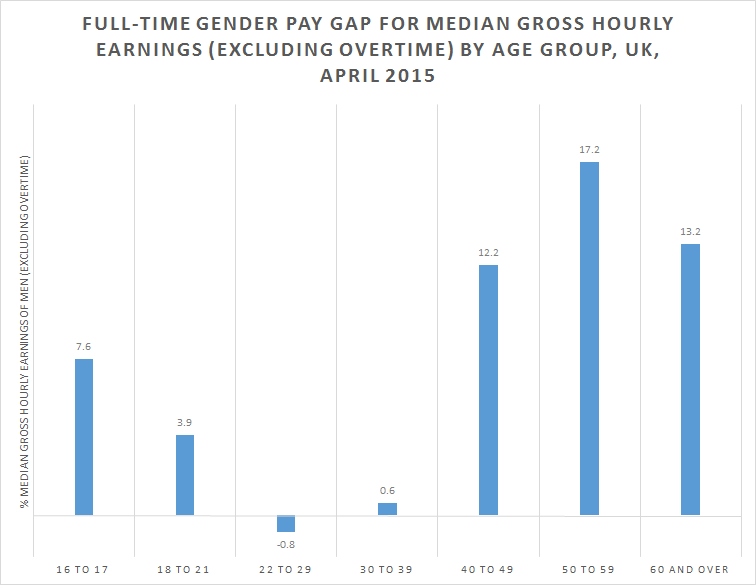
British full-time gender wage gap by age band
23 Feb 2016 Leave a comment
in discrimination, gender, human capital, labour economics, labour supply, occupational choice Tags: British economy, full-time work, gender wage gap, part-time work
@ChrisHipkins @jacindaardern New Zealand graduate premium @dbseymour
17 Feb 2016 3 Comments
in applied price theory, economics of education, human capital, income redistribution, politics - New Zealand, poverty and inequality, rentseeking
How conceited students are to complain about a $20,000 student loan when they got $1/2 million coming down the pipe. 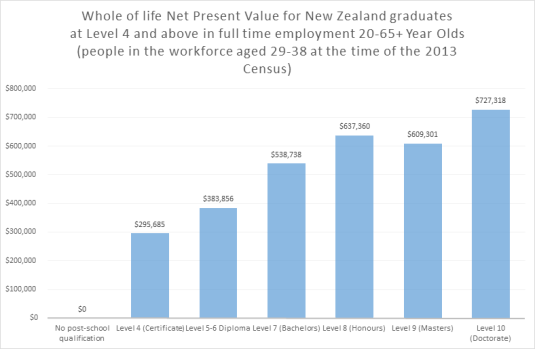
Source: A Degree is a smart investment | Universities New Zealand – Te Pōkai Tara.
Self-appointed social justice warriors in the New Zealand Labour Party and New Zealand Greens pander to this middle class greed. They should be ashamed of themselves.
26% of eligible students do not take out a student loan so they would really get a leg up from the abolition of tuition fees.
The median repayment time for those who left study in 2011 and remained in New Zealand was 5.8 years.
How did British billionaires make their money
16 Feb 2016 Leave a comment
in applied welfare economics, economic history, economics of regulation, entrepreneurship, financial economics, human capital, industrial organisation, labour economics, poverty and inequality, survivor principle Tags: billionaires, British economy, entrepreneurial alertness, superstars, top 1%

Inheriting wealth is not what it used to be in Britain. There are all these upstarts running businesses or working in the City.

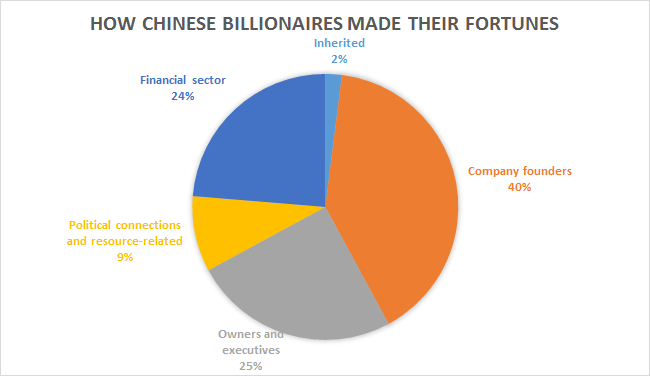
How did the Chinese billionaires make their money?
15 Feb 2016 Leave a comment
in applied price theory, development economics, economic history, entrepreneurship, growth miracles, human capital, industrial organisation, labour economics Tags: billionaires, China, entrepreneurial alertness, superstars, top 1%
@jacindaardern @ChrisHipkins why abolishing tuition fees entrenches inequality
14 Feb 2016 Leave a comment
in applied price theory, applied welfare economics, human capital, politics - New Zealand, poverty and inequality Tags: distributive justice, expressive politics, free tuition, rational irrationality, social justice, top 1%

 Utopia, you are standing in it!
Recent Comments