First and second generation immigrants. Where do they form the highest proportion of the population?
By @OECD pic.twitter.com/aDfHCWUjKX— Paul Kirby (@paul1kirby) January 16, 2016
1st and 2nd generation immigrants as percentage of the population
05 Feb 2016 Leave a comment
in labour economics, labour supply, politics - Australia, politics - New Zealand, politics - USA Tags: economics of immigration
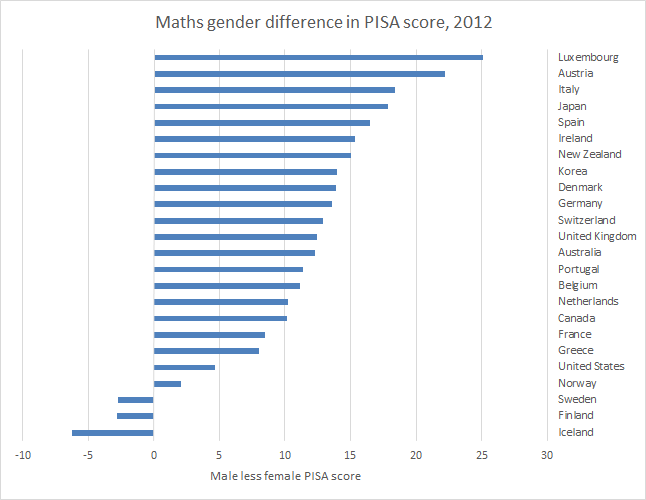
Scandinavian girls are better than boys at maths: gender differences in PISA scores in maths across the OECD, 2012
05 Feb 2016 Leave a comment
in discrimination, economics of education, human capital, labour economics, labour supply Tags: PISA, reversing gender gap
Source: OECD Family Database – OECD.
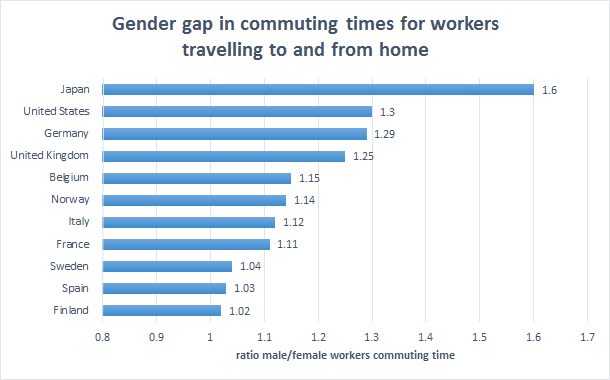
Gender commuting gap for workers who travel to and from home to work
04 Feb 2016 Leave a comment
in discrimination, gender, labour economics, labour supply, occupational choice, transport economics, urban economics Tags: commuting times, reverse gender gap
I lived in Japan so that 60% extra time the Japanese men spend travelling to and from work in those cramped trains is not to be underrated.
Source: OECD Family Database – OECD.
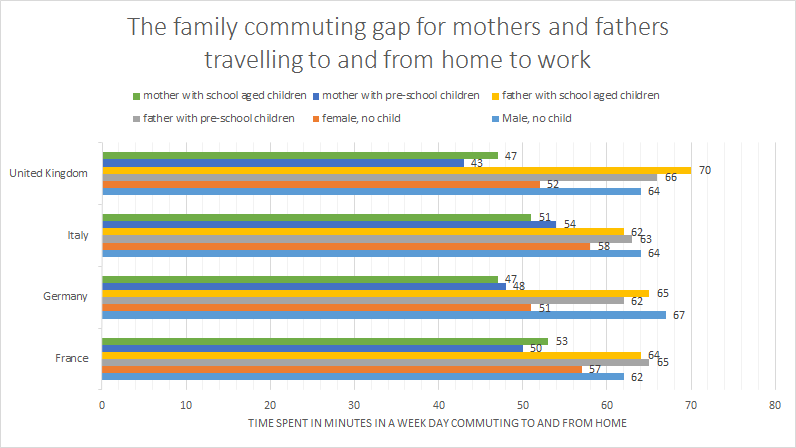
No asymmetric marriage premium in commuting: the family commuting gap for mothers and fathers travelling to and from work by school age of child in the UK, Germany, France and Italy
04 Feb 2016 Leave a comment
in discrimination, economics of love and marriage, gender, human capital, labour economics, labour supply, occupational choice, transport economics, urban economics Tags: asymmetric marriage premium, commuting times, gender wage gap, reversing gender gap
Few labour market statistics have any meaning unless broken down by gender. The compensating differentials that explain much of the family pay gap extend strongly to commuting times.
Source: OECD Family Database – OECD, Table LMF2.6.A.
Mothers commute a good 15 to 20 minutes less than fathers in the UK, Italy, Germany and France. Single women commute 5 to 10 minutes further than mothers. Single men and fathers commute much the same distance.
Happy birthday – you’re fired! #livingwage and youth job losses
04 Feb 2016 Leave a comment
in labour economics, labour supply, minimum wage, unemployment Tags: living wage, rational irrationality, teenage unemployment, The fatal conceit
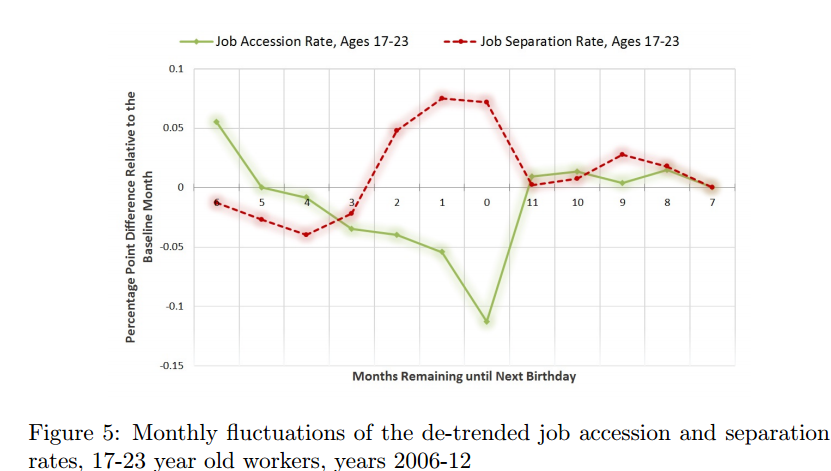
The Dutch minimum wage increases with every birthday until the age of 23. Not surprisingly, there is a surge in job losses and a recession in hiring around birthdays. What is even worse is employment opportunities are redistributed from a group with a high rate of unemployment, teenagers and young people, towards prime age adults who have a much lower rate of unemployment.
Ethnicity of people receiving Sole Parent Support in NZ
01 Feb 2016 Leave a comment
in labour economics, labour supply, politics - New Zealand, poverty and inequality, welfare reform Tags: Maori economic development, single mothers, single parents, welfare state
The reverse gender gap in commuting times across the OECD @JulieAnneGenter
31 Jan 2016 2 Comments
in discrimination, gender, labour economics, labour supply, occupational choice, transport economics, urban economics Tags: commuting times, compensating differentials, gender wage gap, reversing gender gap
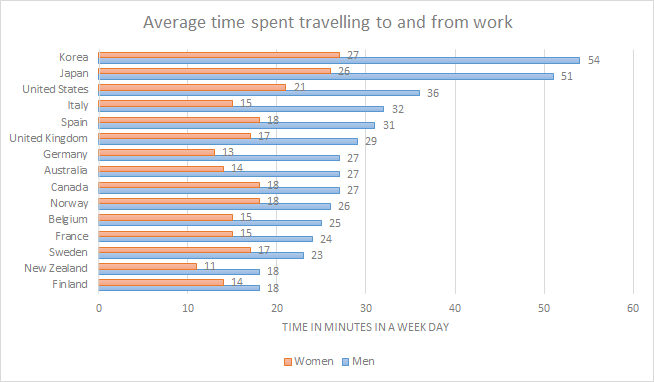
Commuting times need to be incorporated into calculations of the gender wage gap because they do represent a serious fixed cost of working that is higher for men than for women.
Source: OECD Family Database.
Not only is the commuting time for female workers less, there is much less variation across the OECD member countries than for men.
The figures for New Zealand are so low that they are suspicious.
Greater maternity leave will increase the gender wage gap
31 Jan 2016 Leave a comment
in discrimination, gender, labour economics, labour supply, occupational choice, poverty and inequality Tags: asymmetric marriage premium, gender wage gap, high-powered jobs, offsetting behaviour, Parental leave, paternity leave, unintended consequences
Unions are not the cause of our 40 hour workweek
31 Jan 2016 Leave a comment
in applied price theory, applied welfare economics, economic history, labour economics, labour supply, unions Tags: 40 hour week, hours worked, living standards, union power, union wage premium, working hours, working week
% of American children living with a single parent
31 Jan 2016 Leave a comment
in economic history, economics, economics of love and marriage, gender, labour economics, labour supply, population economics
Feminism vs. Truth on the gender pay gap
30 Jan 2016 Leave a comment
in discrimination, gender, human capital, labour economics, labour supply, occupational choice Tags: gender wage gap
Child poverty & adult male employment @GreenCatherine @geoffsimmonz
30 Jan 2016 Leave a comment
in discrimination, gender, labour economics, labour supply
What’s the avg number of hours per year that people in your country work
28 Jan 2016 Leave a comment
in economics, labour economics, labour supply Tags: hours worked
There is nothing new about the coming of robots
28 Jan 2016 Leave a comment
in economic history, economics of media and culture, entrepreneurship, industrial organisation, labour supply, survivor principle, technological progress Tags: automation, rational irrationality, skill bias technical change, technological unemployment
@garethmorgannz @geoffsimmonz the public choice illogic of the UBI
27 Jan 2016 Leave a comment
in labour economics, labour supply, politics - New Zealand, poverty and inequality, public economics Tags: family tax credit, growth of government, negative income tax, size of government, social insurance, universal basic income, welfare state
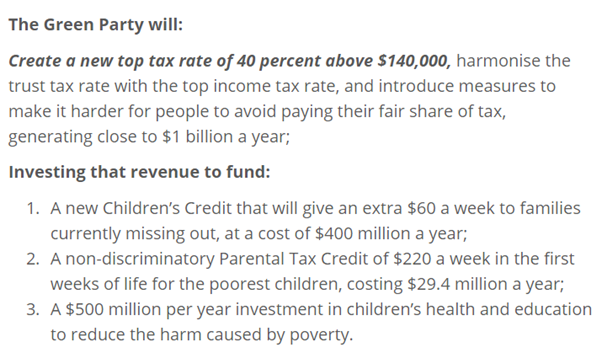
Things are pretty grim when your ideas for fixing child poverty by throwing a lot more money at the problem are easily outclassed by the Greens in terms of economic rationale, fiscal sense and political practicality.
Source: Greens launch billion dollar plan to reduce child poverty | Green Party of Aotearoa New Zealand.
But that is the case for Gareth Morgan’s proposals for a universal basic income for New Zealand. His proposal for a universal basic income funded by comprehensive capital tax make much less sense than those of the Greens for giving the in work family tax credit for those do not work but are on a welfare benefit.
The Greens have a far superior proposal for reducing child poverty and a far better chance of getting it implemented in parliament. Their proposal is simply to introduce a parental tax credit and give the in work tax credit to those currently on the benefit to increase their incomes.
Gareth Morgan’s solution to child poverty is to give billions of dollars to adults not in poverty and leave those who are in poverty worse off under the universal basic income. It is obvious which of these is more likely to attract political support and provoke resistance from taxpayers and political parties willing to court those are opposed to great big new taxes.
One of the economic reforms in the 1980s and 1990s that saved the welfare state was more efficient taxes and more efficient government spending. The targeting of government social spending reduce growth in the overall tax burden and therefore the political resistance it provoked.
Government spending grew in many countries in the 20th century because of demographic shifts, more efficient taxes, more efficient spending, a shift in the political power from those taxed to those subsidised, shifts in political power among taxed groups, and shifts in political power among subsidised groups. Sam Peltzman argues that:
governments grow where groups which share a common interest in that growth and can perceive and articulate that interest become more numerous.
The median voter in all countries was alive to the power of incentives and to not killing the goose that laid the golden egg. After 1980, the taxed, regulated and subsidised groups had an increased incentive to converge on new lower cost modes of redistribution.
More efficient taxes, more efficient spending, more efficient regulation and a more efficient state sector reduced the burden of taxes on the taxed groups. Most subsidised groups benefited as well because their needs were met in ways that provoked less political opposition.
Gary Becker and Casey Mulligan in Deadweight Costs and the Size of Government (NBER Working Paper Number No. 6789) concluded that flatter and broader taxes encourage bigger government. This is because taxpayers offer less resistance to increases in flat tax rates than to more onerous and less efficient forms of taxation. Any decline in the resistance of taxpayers to taxes leads to larger governments since an endless number of groups lobby to divide up the large revenue base.
An inefficient tax system or spending program from the standpoint of optimal tax theory can improve taxpayer welfare this so-called inefficient system creates additional political pressure for suppressing the growth of government. Inefficient taxes do not raise much revenue and therefore do not support a large sized government.
A switch to more efficient taxes through tax reforms allows governments to raise the same amount or larger amount of revenue for the same level of political resistance from taxpayers. This is because less revenue and output is wasted by discouraging labour supply, investment, savings and investment in capital with high marginal rates of tax on narrower tax basis.
The rising deadweight losses of taxes, transfers and regulation all limit the political value of inefficient redistributive policies. Tax and regulatory policies that are found to significantly cut the total wealth available for redistribution by governments are avoided relative to the germane counter-factual, which are other even costlier modes of redistribution.
Long live the Slopegraph. Long live Edward Tufte. tinyurl.com/naeh7rc http://t.co/C8Lgnupxz9—
Amity Shlaes (@AmityShlaes) May 16, 2015
Everyone can gain from converging on more efficient modes redistribution. The tax burden is less than otherwise. Government spending is more than a wise because taxes are raised with less deadweight social costs.
An improvement in the efficiency of either taxes or spending reduces political pressure from taxed and regulated groups for suppressing the growth of government and thereby increases total tax revenue and spending because there is less political opposition. Improvements in the efficiency of taxes, regulation and in spending reduce political pressure from the taxed and regulated groups in society.
The post-1980 reforms of Thatcher, Reagan, Clinton, Hawke and Keating, Lange and Douglas and others saved the modern welfare state. Their moves towards more efficient taxes and better targeted social spending did reduce growth in government spending but also prevented even larger cuts to social spending since 1980 at the behest of the increasingly restive taxpayer.
Social spending growth did temper after 1980 but the level of spending was larger than otherwise because of the extra revenue raised through more efficient taxes – more efficient taxes which provoked less political opposition.
More efficient taxes, more efficient spending, more efficient regulation and a more efficient state sector reduced the burden on the taxed groups while still supporting extensive but more tempered social spending.
Governments everywhere hit a brick wall in terms of their ability to raise further tax revenues. Political parties of the Left and Right recognised this new reality. Gareth Morgan has not when he proposes a great big new tax to fund his universal basic income.
Billions of extra dollars in revenue must be raised and political resistance provoked to his proposed comprehensive capital tax to fund a universal basic income for those who are not poor. Child poverty is not reduced by a universal basic income because single parents and the children receive no more income support from government than before.
Which has more political legs? The Greens’ proposal to raise taxes by $1 billion to fight child poverty or the proposal by Gareth Morgan to raise taxes by 10 times that and have less impact on child poverty?
The current and future governments of New Zealand have enough on their plate to work out how to fund a universal old age pension and health spending without giving away billions of dollars to the non-poor through an universal basic income.
 Utopia, you are standing in it!
Recent Comments