More on the reversing gender pay gap or men getting their comeuppances?
10 Jan 2016 Leave a comment
in discrimination, economic history, gender, human capital, labour economics, labour supply, occupational choice, politics - USA Tags: gender wage gap, middle class stagnation, reversing gender gap, wage stagnation
What is the success sequence?
08 Jan 2016 Leave a comment
in economics of education, labour economics, labour supply, occupational choice, politics - USA, poverty and inequality, welfare reform Tags: child poverty, family poverty, high school dropouts, marriage and divorce, single parents, success sequence
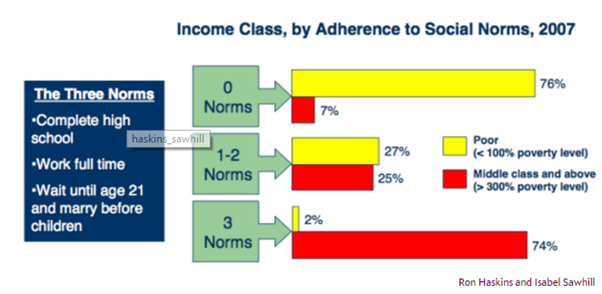
Source: The success sequence: Conservatives think they have a formula for raising people out of poverty.
.
@GarethMorgannz is repeating Bob Hawke’s mistake that child poverty can be solved by more money
06 Jan 2016 Leave a comment
in applied welfare economics, labour economics, labour supply, politics - New Zealand, welfare reform Tags: 1996 US welfare reforms, child poverty, family poverty, universal basic income
Jess Berentson-Shaw’s series on child poverty in the Dominion Post on child poverty had two major flaws. She argues that the solution to child poverty is to give more families more money.
The first flaw is she does not discuss previous failed attempts to solve poverty with more money. For example, Bob Hawke promised in the 1987 election that no child need live in poverty by 1990. Raising the family allowance to $1 above the family poverty line did not fix child poverty. That promise was the one Hawke later said he regretted most in his public life.
During the 1987 Australian Federal election campaign, Labour Party Prime Minister Bob Hawke announced a Family Allowance Supplement that would ensure no Australian child need live in poverty by 1990. These changes in social welfare benefits and family allowance supplements would ensure that every family would be paid one per week dollar more than the poverty threshold applicable to their family situation. I know child poverty was to be done in this way because I worked in the Prime Minister’s Department at this time.
About 580,000 Australian children lived in poverty in 1987. In 2007, at least 13 per cent of children, or 730,000 people, were poor. This was after social welfare benefits and family allowance supplements were increased to $1 above the child poverty threshold.
There is an infallible test of the practicality of Left over Left dreams such as the abolition of child poverty by writing bigger and bigger cheques to those currently poor.
If you could abolish child poverty simply by increasing welfare benefits and family allowances, the centre-right parties would be all over it like flies to the proverbial as a way of camping over the middle ground and winning the votes of socially conscious swinging voters for decades to come. Many people who would naturally vote for the centre-right parties on all other issues vote for centre-left parties out of a concern for poverty and a belief that centre-left parties will give a better deal to the poor.
The notion that poverty is simply the result of a lack of money and giving people more money will abolish child poverty has never worked. As the OECD (2009, p. 171) observed:
It would be naïve to promote increasing the family income for children through the tax-transfer system as a cure-all to problems of child well-being.
Berentson-Shaw’s second major flaw is she does not discuss the success of the 1996 US federal welfare reforms. Any serious participant in discussions of child poverty must address those 1996 US reforms.
These reforms cut Hispanic and black child poverty rates by 1/3rd in a few years by moving single mothers into employment. Time limits on welfare for single parents reduced caseloads by two thirds, 90% in some states.
After the 1996 US Federal welfare reforms, the subsequent declines in welfare participation rates and gains in employment were largest among the single mothers previously thought to be most disadvantaged: young (ages 18-29), mothers with children aged under seven, high school drop-outs, and black and Hispanic mothers. These low-skilled single mothers were thought to face the greatest barriers to employment. Blank (2002) found that:
…nobody of any political persuasion predicted or would have believed possible the magnitude of change that occurred in the behaviour of low-income single-parent families.
Employment are never married mothers increased by 50% after the US well for a reforms: employment of single mothers with less than a high school education increased by two-thirds; and employment of single mothers aged 18 to 24 approximately doubled.
Working population poverty is unchanged despite declines in elderly and child poverty #PovertyIs http://t.co/i7O7dTEUg2—
Political Line (@PoliticalLine) June 19, 2015
With the enactment of welfare reform in 1996, black child poverty fell by more than a quarter to 30% in 2001. Over a six-year period after welfare reform, 1.2 million black children were lifted out of poverty. In 2001, despite a recession, the poverty rate for black children was at the lowest point in national history.
Proposal to make child-care tax credit refundable would boost employment of working mothers bit.ly/1i1Xzcq https://t.co/2xlQQtPRJs—
The Hamilton Project (@hamiltonproj) October 29, 2015
The only modern welfare reforms to significantly cut child poverty were the US federal welfare reforms. They emphasised helping those who helped themselves, which is the classic Samaritans’ dilemma.
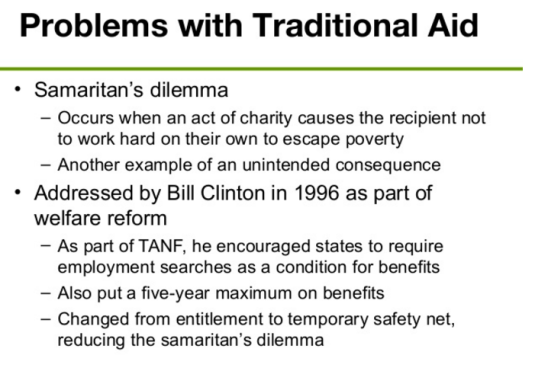
Countless studies show that when comparing the carrot and the stick in welfare reform, the stick is always more effective in reducing poverty and increasing employment.
The typical white family still makes $25,000 more than the typical black one: washingtonpost.com/news/wonkblog/… http://t.co/CEOADLSJdx—
Demos Action (@DemosAction) September 16, 2015
The best solution to child poverty is to move their parents into a job. Simon Chapple is clear in his book last year with Jonathan Boston:
Sustained full-time employment of sole parents and the fulltime and part-time employment of two parents, even at low wages, are sufficient to pull the majority of children above most poverty lines, given the various existing tax credits and family supports.
The best available analysis, the most credible analysis, the most independent analysis in New Zealand or anywhere else in the world that having a job and marrying the father of your child is the secret to the leaving poverty is recently by the Living Wage movement in New Zealand.
According to the calculations of the Living Wage movement, earning only $19.25 per hour with a second earner working only 20 hours affords their two children, including a teenager, Sky TV, pets, annual international travel, video games and 10-hours childcare.
This analysis of the Living Wage movement shows that finishing school so your job pays something reasonable and marrying the father of your child affords a comfortable family life. In the USA this is called the success sequence.
A Day in the Life of Americans
01 Jan 2016 Leave a comment
in labour economics, labour supply, population economics Tags: labour demographics
A surprising number of clergy are not working on Christmas Day
25 Dec 2015 Leave a comment
in economics of religion, labour economics, labour supply, occupational choice Tags: Christmas Day, compensating differentials
How many people in the UK work on Christmas day? gu.com/p/44baf/stw http://t.co/EjdUEFSbr7—
Guardian Data (@GuardianData) December 22, 2014
Education and the risk of criminality
22 Dec 2015 Leave a comment
in economics of crime, economics of education, labour economics, labour supply, law and economics, occupational choice, politics - USA Tags: crime and punishment
@geoffsimmonz The family wage gap or why are the Swiss implicitly biased in favour of single women but heavily against married women?
22 Dec 2015 Leave a comment
in discrimination, gender, labour economics, labour supply Tags: family wage gap, gender wage gap, implicit bias
The gender wage gap from married women is 3 to 30 times that of single women. This was actually have a positive gender wage gap.
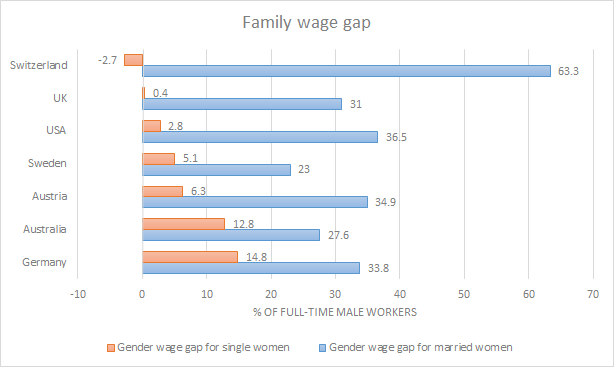
Source: IZA World of Labor – Equal pay legislation and the gender wage gap.
The smallest of the gender wage gap for single women, which has been well known for a long time, does not bode well for those such as Geoff Simmons who argue that implicit bias is an important driver of the gender pay gap.
Why are there vast differences in this implicit bias against women between countries. Why is this implicit bias so much stronger against married women? Having an implicit bias against married women but not single women is a very odd implicit bias.
These puzzles are before considering the information extraction problem facing employers who are implicitly bias against married women. Employers do not know whether an applicant is married or single and pay less accordingly. As Polachek observed:
Corporate discrimination cannot explain these wage patterns. Were corporate discrimination the reason, one would need an explanation why corporations hardly discriminate against single women, but discriminate enormously against married women, especially married women with children spaced widely apart, given that they often cannot legally ask questions about marital status in employment applications.
Even if they could get this marital status information, they wouldn’t have information on the number and spacing of one’s children. But even if supervisors knew number of children, they are far less knowledgeable about children’s ages, and hence less likely to know much about child spacing.
Employers who are slightly less implicitly biased against married women would have a far higher quality recruitment pool which gives them a competitive advantage. Employers who are implicitly biased against women and married women are less likely to survive in competition.
Earning power by personality type
22 Dec 2015 Leave a comment
in human capital, labour economics, labour supply, occupational choice Tags: economics of personality traits
Which occupations are up and which are down
21 Dec 2015 Leave a comment
in economic history, human capital, industrial organisation, labour economics, labour supply, occupational choice, survivor principle Tags: creative destruction, skill biased technical change
@GarethMorgannz the universal basic income is inferior to the minimum family tax credit
20 Dec 2015 4 Comments
in labour economics, labour supply, politics - New Zealand, poverty and inequality, public economics, welfare reform Tags: Aaron Director, Director's Law, Gareth Morgan, negative income tax, social insurance, universal basic income, welfare state
Gareth Morgan’s universal basic income appears to make everybody better off except those for whom the modern welfare state was established to protect. Examples of these from his online calculator are single mothers and retirees.

Source: The Big Kahuna – Tax and Welfare.
To stay even just with single mothers blows a good $10 billion hole in the budget deficit according to the online calculator provided by Gareth Morgan. Retirees are still worse off.

Source: The Big Kahuna – Tax and Welfare.
Central to the package is a comprehensive capital gains tax despite evidence growing with each day that the optimal tax rates on income from capital and on capital gains are zero.
A universal basic income for New Zealand is a long trip to where we are now. There is already a guaranteed minimum family income in New Zealand.
The minimum family tax credit makes sure that a family’s annual income (net income after tax has been deducted) doesn’t fall below $23,036 a year ($443 per week). To qualify, you must work for a salary or wage for at least 30 hours each week as a couple, or 20 hours each week as a single parent, and receive a family tax credit.
The Treasury modelled a Guaranteed Minimum income at the request of the Welfare Working Group in 2010. A guaranteed minimum income of $300 per week – the mean benefit income among those on benefits – would cost $44.5 billion or $52.6 billion if we extended it to super annuitants as a replacement for NZ Superannuation or old age pension. The former could be covered by a flat personal income tax rate of 45.4%; the latter, 48.6%. Full fiscal neutrality would require tax rates of 50.6% and 54.4%.
The universal basic income seems to be a big day out for Director’s Law of Public Expenditure. Director’s Law is public expenditure is used primary for the benefit of the middle class, and is financed with taxes which are borne in considerable part by the poor and the rich.

The universal basic income and a comprehensive capital gains tax seems to cause a lot of economic upheaval but still struggles to make the worse off groups in society even break-even on this throwing of all the cards in the air. Brian Easton put it well the other day when he said:
Many advocates put the UMI forward without doing the sums. Those who do, find that the required tax rates are horrendous or the minimum income is so low that it is not a viable means of eliminating poverty. Among the latter are New Zealanders Douglas, Gareth Morgan and Keith Rankin.
Roland Fryer on Education, Inequality, & Incentives
19 Dec 2015 1 Comment
in applied price theory, discrimination, economics of education, gender, human capital, labour economics, labour supply, politics - New Zealand, politics - USA, poverty and inequality Tags: charter schools, racial discrimination, Roland Fryer

@CHSommers More reasons for women to avoid STEM careers @stevenljoyce @GreenCatherine
19 Dec 2015 Leave a comment
in discrimination, gender, labour economics, labour supply, law and economics, occupational choice
Many young women choose to not pursue science, technology, engineering and maths (STEM) careers because there are other career options that allow them to better use their superior verbal and reading abilities.
Further reasons for women to hesitate entering STEM occupations is their faster rate of human capital depreciation. It has been well known for a long time that human capital atrophy rates differ greatly by occupation and are much higher in professional, managerial and craft occupations.
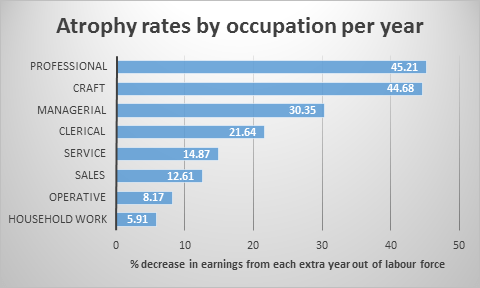
Source: Polachek (1981).
Even a year out of the workforce can greatly reduce earning power because of a rapid depreciation of the human capital accumulated from certain occupations. Women make education and career choices that minimise these losses in light of periods away from work because of motherhood.
Women self-selecting to those occupations with low rates of human capital depreciation. As De Grip explains using German data:
…women who anticipate career interruptions for family reasons take account of the wage penalties related to such a break when they choose their occupational field, i.e. women select occupations where human capital deprecation during a career interruption is the lowest…
Our estimation results have important implications for public policies which attempt to encourage the interest of female students in technical studies and occupations. Obviously, the higher human-capital depreciation rates for workers with family-related career breaks in these male occupations can be a serious threshold for women to choose these occupations
Women choose the occupations that maximise the returns from their skills. Occupations that neither well-reward superior verbal and reading skills and have rapid rates of depreciation on occupational human capital are not a good investment for many of the women anticipating spells out of the workforce because of motherhood.
Rendall and Rendall (2015) recently investigated differential depreciation rates on verbal and maths skills in competing occupational choices for college educated women. Not surprisingly, they found that in the USA verbal skills suffered only minor depreciation during career interruptions but maths skills experience costly depreciation. They found that:
…college educated women avoid occupations requiring significant math skills due to the costly skill atrophy experienced during a career break. In contrast, verbal skills are very robust to career interruptions. The results support the broadly observed female preference for occupations primarily requiring verbal skills – even though these occupations exhibit lower average wages.
Thus, skill-specific atrophy during employment leave and the speed of skill repair upon returning to the labour market are shown to be important factors underpinning women’s occupational outcomes. This research suggests that a substantial portion of female occupational sorting could be determined by skill-specific atrophy-repair characteristics.
This is no surprise as verbal skills improve with age because of expanding vocabularies and better judgement based on accumulated experience. Maths skills tend to be the type of skills where your best years in your 20s and after that things fall away.
These findings by Rendall and Rendall reinforce the initial bias women have against STEM occupations because of their superior reading and verbal skills. STEM occupations are a poor career choice for women because they undervalue their innate skills and heavily penalise career interruptions.
Such is the fatal conceit of politicians is they want to encourage women to make poor education and occupational investments. Women self-selecting into vastly different occupations to men because they are smarter than the average politician about what is the best of them.
Differential atrophy rates on human capital as drivers of the gender wage gap and occupational segregation have nothing to do with the choices of employers – nothing to do with blameworthy behaviour on their part. The blameworthy behaviour can be explicit prejudice, implicit bias or statistical discrimination.
Much of occupational segregation is the result from self-selection by women into occupations on the basis of superior innate skills and the slow rates at which these verbal and reading skills depreciate with time both in general and with time away from the workforce.
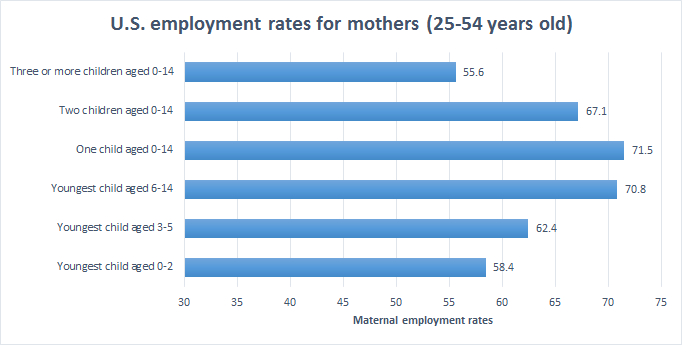
US maternal employment rates by number and age of children
18 Dec 2015 Leave a comment
in discrimination, gender, labour economics, labour supply, politics - USA, poverty and inequality, welfare reform Tags: economics of fertility, female labour force participation, maternal labour force participation, single mothers

 Utopia, you are standing in it!
Recent Comments