@jacindaardern the role of drug addiction in poverty and unemployment

Jacinda Adern does have a point that the Prime Minister overplayed the role of drug dependency in child poverty, but he is not completely off the mark. A whole bunch of self-destructive behaviours play a role in family poverty.

Source: Minister of Social Development Cabinet Paper on Pre-employment Drug Testing Requirements.

Too many children have irresponsible parents. Caplan along with Charles Murray point out that a number of pathologies are particularly prevalent among poor:

  1. alcoholism: Alcohol costs money, interferes with your ability to work, and leads to expensive reckless behaviour.
  2. drug addiction: Like alcohol, but more expensive, and likely to eventually lead to legal troubles you’re too poor to buy your way out of.
  3. single parenthood: Raising a child takes a lot of effort and a lot of money.  One poor person rarely has enough resources to comfortably provide this combination of effort and money.
  4. unprotected sex: Unprotected sex quickly leads to single parenthood.  See above.
  5. dropping out of high school: High school drop-outs earn much lower wages than graduates.  Kids from rich families may be able to afford this sacrifice, but kids from poor families can’t.
  6. being single: Getting married lets couples avoid a lot of wasteful duplication of household expenses.  These savings may not mean much to the rich, but they make a huge difference for the poor.
  7. non-remunerative crime: Drunk driving and bar fights don’t pay.  In fact, they have high expected medical and legal expenses.  The rich might be able to afford these costs.  The poor can’t.

Caplan is disputing that healthy adults who are poor are victims. That is central to the poverty is not a choice movement: the poor are victims.

The New Zealand experience with work testing of beneficiaries for drugs is most of them quickly stopped using dope. Many jobs have tests for drug-taking.

The rapidly approaching demographic crisis in New Zealand

The average age of managers as a cause of the 1970s productivity slowdown

Jim Feyrer put forward a clever hypothesis about the sudden decline in the average quality of managers as a major contributor to the 1970s productivity slowdown. His hypothesis is a good contribution to real business cycle theory because what could be more random a shock than a demographic shock arising from the baby boom.

Feyrer’s hypothesis builds on Robert Lucas’s theory of the entrepreneur and the optimal size of the firm. The better entrepreneurs can manage larger spans of control.

Specifically, these more talented entrepreneurs can spread their skills and vision over a larger workforce thereby raising its productivity and that of the firm. Better quality managers are better trainers, better leaders, better problem solvers and better at recruiting and retaining staff.

If managerial skill and talent accumulates with experience, an influx of young workers into the workforce with the influx of the baby boomers into the workforce will lower the average quality of entrepreneurs. This will show up empirically as a decrease in the average age of managers and with that their experience and skills.

With the average age of the labour force lower during the influx of the baby boomers, more marginal managers have to be promoted into managerial positions to supervise younger employees. Lower managerial quality will lower the productivity of the workforce as a whole.

If managerial talent and skill is to have any meaning, a more talented manager should be able to extract greater productivity from the same quality labour force. Lazear points out that

Supervision and management are fundamental in personnel economics and in the theory of the firm… Boss effects are large and significant. Most important, bosses vary substantially in their quality. A very good boss increases the output of the supervised team over that supervised by a very bad boss by about as much as adding one member to the team.

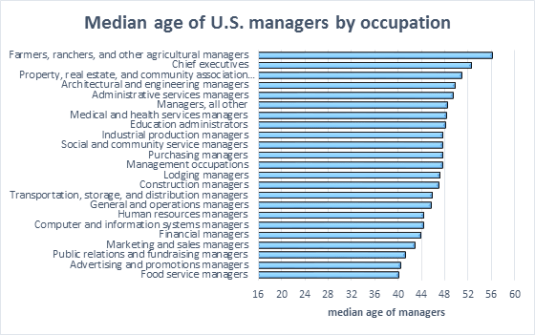
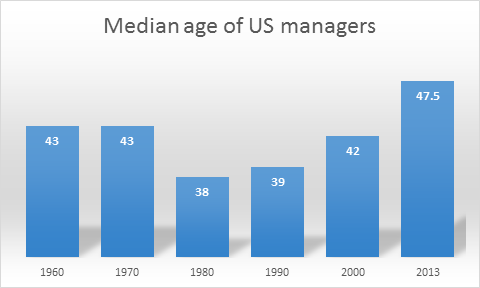
The influx of less able managers in the 1970s, as shown by a five-year reduction in the median age of US managers in the chart below, accounted for 20% of the observed productivity slowdown and resurgence in the 1970s and 1980s according to Feyrer. To fill vacancies, employers had to drop their hiring standards for managers.


Source: Jim Feyrer The US Productivity Slowdown, the Baby Boom, and Management Quality, Journal of Population Economics (2011) and Bureau of Labor Statistics Employed persons by detailed occupation and age (2013).

When the median age of managers rose in the 1990s, and along with it the average of quality of management, this productivity slowdown was reversed. Both the increase in the decrease in the age of managers are random productivity shocks in the tradition of real business cycle theory.

The average age of the US manager was 38 in 1980 and 39 in 1990. There is no US managerial occupation with an average age of less than 40 in 2013. The fifth managerial occupation with the lowest managing age is food service managers. The highest outside of agriculture is chief executives,


Source: Bureau of Labour Statistics Employed persons by detailed occupation and age (2013).

One of the mocking tones directed at real business cycle theory is it was supposed to require a regular forgetting of technologies so that productivity fell and then the loss technologies were remembered a few years later to have a business cycle.

That forgetting and remembering is what happened with the average age of managers and labour productivity in the 1970s. Management quickly lost five years of experience then slowly regained it with matching productivity swings and roundabouts.

Feyrer is another addition to a long line showing that business cycles can arise from the sum of random shocks, rather than one big shock, as Prescott suggested in 1986:

Another Summers question is, Where are the technology shocks? Apparently, he wants some identifiable shock to account for each of the half dozen postwar recessions. But our finding is not that infrequent large shocks produce fluctuations; it is, rather, that small shocks do, every period.

Choices that lead to poverty @GarethMorgannz @povertymonitor

The best evidence that poverty can be a choice is the success of the 1996 US welfare reforms and other carrot and stick approaches to poverty reduction. Poverty in the USA dropped dramatically in the mid-1990s after being stable for decades.

The stick is the most important part of poverty reduction programs that have succeeded. The poverty is not a choice movement deny to themselves the most successful child poverty reduction tool of modern times.

The success of the 1996 US federal welfare reforms were not discussed in an experts report on solutions to child poverty published a few years ago by the Children’s Commissioner. It should have been.

After decades of no progress against child poverty, five-year time limits on federal welfare assistance along with mandatory work requirements encouraged a large number of single mothers to find work. Many of these single mothers who joined the workforce in the USA were high school dropouts with small children.

Child poverty fell dramatically among minorities after the 1996 US federal welfare reforms. Everybody was surprised by the massive increases in the employment of single mothers and the reductions in child poverty. Nobody expected young mothers with small children to have so much control over their destiny.

That ability of single mothers to find a job as a condition of welfare benefits after the 1996 US federal welfare reform contradicts the belief that poverty is not a choice.

Child poverty is concentrated among single mothers and in particular single mothers on a welfare benefit. The subsequent declines in welfare participation rates and gains in employment were largest among the single mothers previously thought to be most disadvantaged: young (ages 18-29), mothers with children aged under seven, high school drop-outs, and black and Hispanic mothers.

When welfare benefits are linked to work requirements, the 1996 US federal welfare reforms showed that a surprisingly large number of single mothers can find and keep a job. Employment are never married mothers increased by 50% after these US reforms; employment of single mothers with less than a high school education increased by two-thirds; employment of single mothers aged of 18 to 24 approximately doubled.

Brian Caplan has been among those to link self-destructive behaviours to many of those in poverty. He argues there are a number of reasonable steps that healthy adults can take to avoid poverty for them and their children:

  1. Work full-time, even if the best job you can get isn’t fun.
  2. Spend your money on food and shelter before getting cigarettes and cable TV.
  3. Use contraception if you can’t afford a child.

Caplan specifically includes among the undeserving poor the children of poor or irresponsible parents.

Caplan along with Charles Murray point out that a number of pathologies are particularly prevalent among poor:

  1. alcoholism: Alcohol costs money, interferes with your ability to work, and leads to expensive reckless behaviour.
  2. drug addiction: Like alcohol, but more expensive, and likely to eventually lead to legal troubles you’re too poor to buy your way out of.
  3. single parenthood: Raising a child takes a lot of effort and a lot of money.  One poor person rarely has enough resources to comfortably provide this combination of effort and money.  
  4. unprotected sex: Unprotected sex quickly leads to single parenthood.  See above.
  5. dropping out of high school: High school drop-outs earn much lower wages than graduates.  Kids from rich families may be able to afford this sacrifice, but kids from poor families can’t.
  6. being single: Getting married lets couples avoid a lot of wasteful duplication of household expenses.  These savings may not mean much to the rich, but they make a huge difference for the poor.
  7. non-remunerative crime: Drunk driving and bar fights don’t pay.  In fact, they have high expected medical and legal expenses.  The rich might be able to afford these costs.  The poor can’t.

Caplan is disputing that healthy adults who are poor are victims. That is central to the poverty is not a choice movement: the poor are victims. Many are not, especially the healthy adults.

Policy debates about how to reduce poverty must break out of poverty is not a choice mentality because as Caplan says:

Being poor is a reason to save money, work hard, and control your impulses.

The choices people can make to avoid poverty are finish high school, seek a full-time job, delay children until you marry, and avoid crime. Working against this is as women’s labour market opportunities improved, their interest in low-status men has declined. As Charles Murray explains, working class males have become less industrious:

In 2003-5, men who were not employed spent less time on job search, education, and training, and doing useful things around the house than they had in 1985. They spent less time on civic and religious activities. They didn’t even spend their leisure time on active pastimes such as exercise, sports, hobbies, or reading…

How did they spend that extra leisure time? Sleeping and watching television.  The increase in television viewing was especially large – from 27.7 hours per week in 1985 to 36.7 hours in 2003-5…

The demand to date and marry such men has declined because raising children as a solo mission has become more viable for mothers.

Saying poverty is not a choice undermines important messages about help but hassle that must be woven into the heart of the incentive structures of social insurance and the welfare state.

More evidence of the success of the 1996 US federal welfare reforms

#itsnotchoice @povertymonitor ‏@PlunketNZ % Australian, NZ and ‏US sole parents who do not work

The only major success in reducing sole parent beneficiary numbers anywhere has been time limits introduced as part of the 1996 US federal welfare reforms. Time limits on welfare for single parents reduced caseloads by two thirds, 90% in some states.

Source and Notes: OECD Family Database; Australian data are available only from 2005.

The subsequent declines in welfare participation rates and gains in employment were largest among the single mothers previously thought to be most disadvantaged: young (ages 18-29), mothers with children aged under seven, high school drop-outs, and black and Hispanic mothers. These low-skilled single mothers were thought to face the greatest barriers to employment. Blank (2002) found that

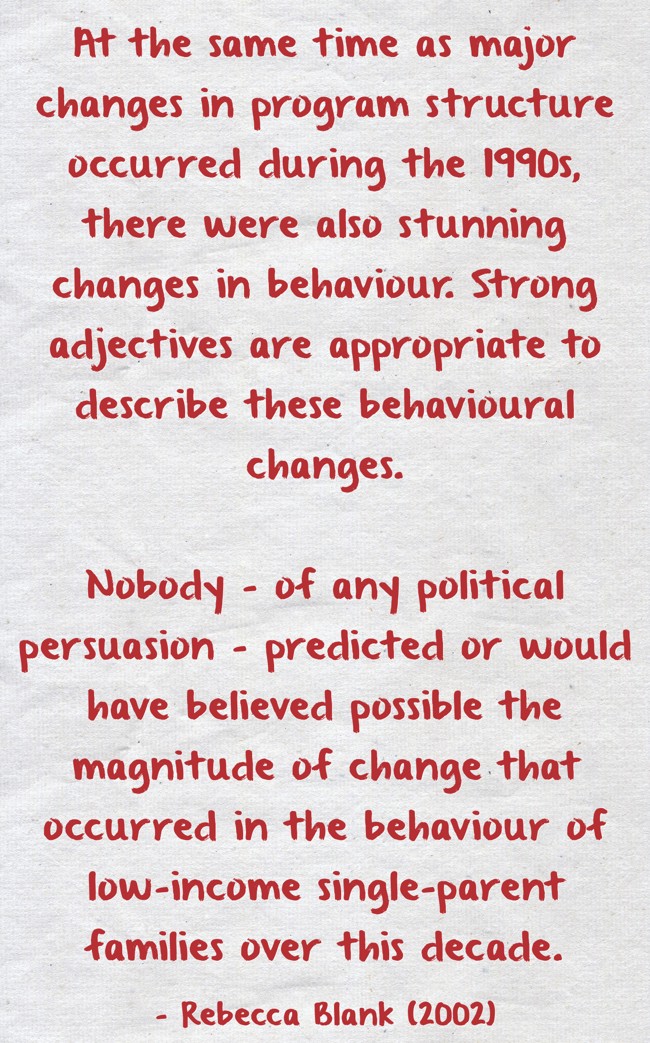
nobody of any political persuasion predicted or would have believed possible the magnitude of change that occurred in the behaviour of low-income single-parent families.

With the enactment of welfare reform in 1996, black child poverty fell by more than a quarter to 30% in 2001. Over a six-year period after welfare reform, 1.2 million black children were lifted out of poverty. In 2001, despite a recession, the poverty rate for black children was at the lowest point in national history. Employment are never married mothers increased by 50% after the US reforms; employment a single mothers with less than a high school education increased by two thirds; employment of single mothers aged of 18 in 24 approximately doubled.

This great success of US welfare reforms was that after decades of no progress in their war on poverty, poverty among both single mothers and black children declined dramatically.

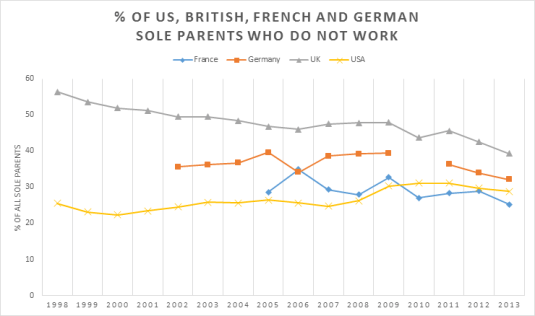
% of US, British, German and French sole parents who do not work

Source: OECD Family Database.

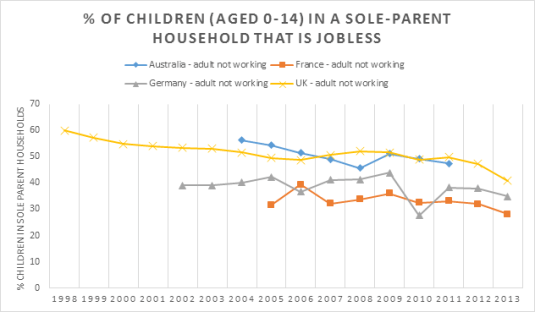
% British, German, French and Australian children in jobless sole parent households

Source: OECD Family Database.

The rise of power couples in New Zealand

Source: Bryan Perry, 

Are CEOs denied their labour surplus?

Bang Dang Nguyen and Kasper Meisner Nielsen looked at how share prices reacted to 149 cases of the chief executive or another prominent manager dying suddenly in American companies between 1991 and 2008.

If the shares rise on an executive’s death, he was overpaid; if they fall, he was not. Only 42% of the bosses studied were overpaid. Those with the bigger pay packages gave the best value for money as measured by the share-price slump when they passed away unexpectedly.

Share prices do speak to the value of the company and the contribution of its CEO. The share price of Apple went up and down by billions on the back of rumours about the health of Steve Jobs.

In terms of splitting of what some call the labour surplus increase from a firm hiring an executive, these employees retain on average about 71% and their employer keeps 29%. Others call this rent sharing.

71% going to the CEO might initially sound high, “but it’s not like he’s taking home more than he produced for the company,” says Nguyen.

The exploitation of CEOs gets worse when you consider the extensive use of promotion tournaments by their employers when setting their wages. They are thrust into rat races. Promotion tournaments are an integral and often invisible part of their workplaces.

Executive level employees are often ranked by their employers relative to each other and promoted not for being good at their jobs but for being better than their rivals. These promotion tournaments sent one employee against another – one worker against another – to the  profit of the owners of the firm.

The rat race set up by the owners of the firm are so cutthroat that in competitions to determine promotions the capitalists who own the firm may find that their employees discover that the most efficient way of winning a promotion is by sabotaging the efforts of their rivals.

Lazear and Rozen’s tournament theory of executive pay has stood the test of time. The key to this rat race is the larger is your boss’s pay, the bigger the motivation for you as an underling to work for a promotion. As Lazear wrote in his book, Personnel Economics for Managers

The salary of the vice president acts not so much as motivation for the vice president as it does as motivation for the assistant vice presidents.

What proportion of 60-64 yr olds are working?

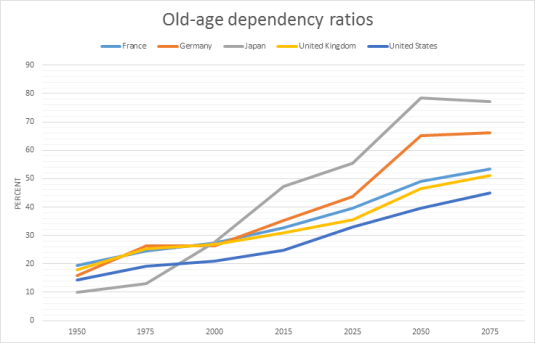
The robots better be coming: Old age dependency ratios (1950 – 2075) USA, UK, France, Germany and Japan

I hope the robots have taken over by 2050 because there won’t be enough working age people left to pay the taxes to pay old-age pensions.

Source: Pensions at a Glance 2015 – Statistics – OECD iLibrary.

What is scarier is maybe hopefully the robots will have arrived to take over by 2025. Even 10 years from now there aren’t that many working age people to pay the taxes to fund old-age pensions. The Japanese and Germans in particular will be praying for robots to become taxpayers as quickly as possible.

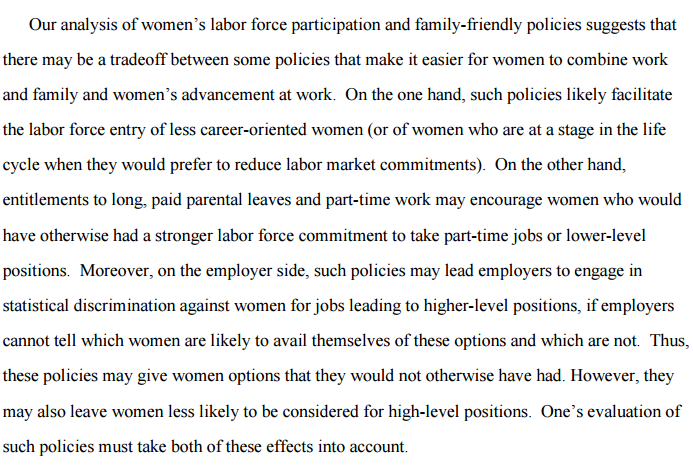
@suemoroney more generous maternity leave increases the gender wage gap @JanLogie

Source: Why Are Women Paid Less? – The Atlantic.

image

Source: AEAweb: AER (103,3) p. 251 – Female Labor Supply: Why Is the United States Falling Behind?

Why Are There Still so Many Jobs?

Welfare benefit receipt of the New Zealand working age population

https://www.facebook.com/FigureNZ/photos/pb.374053709279073.-2207520000.1449201572./1091952534155850/?type=3&theater

Previous Older Entries Next Newer Entries