Proportion of children living in workless households in select countries, 2012–2013, % http://t.co/yqhGNjfpvG pic.twitter.com/8vT3FSCWhW
— Figure.NZ (@FigureNZ) September 15, 2014
Nearly one in six New Zealand children live in workless households
04 Dec 2015 Leave a comment
in labour supply, politics - New Zealand, poverty and inequality, welfare reform
The gender employment gap across the OECD
04 Dec 2015 Leave a comment
in discrimination, gender, labour economics, labour supply
The gender employment gap is much smaller in Scandinavian. The reason is their taxes are high but then are paid back through churning. A considerable amount of those taxes fund employment contingent payments for child care and elder care.
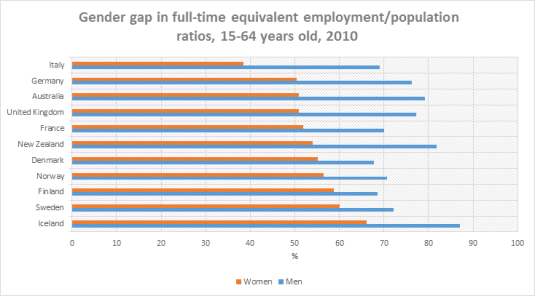
Source: Closing the Gender Gap: Act Now – © OECD 2012.
Richard Rogerson found in Taxation and market work: is Scandinavia an outlier? that how the government spends tax revenues imply different rates of labour supply with regard to tax rate increases.
Rogerson considered that differences in the composition of government spending can potentially account for the high rate of labour supply in Sweden and elsewhere in Scandinavia. Examining the conditions on which how tax revenue is returned to Swedes as income transfers or other conditional payments is central to understanding the labour supply effects of taxes:
- If higher taxes fund disability payments which may only be received when not in work, the effect on hours worked is greater relative to a lump-sum transfer with no conditions; and
- If higher taxes subsidise day care for individuals who work, then the effect on hours of work will be less than under the lump-sum transfer with no conditions.
A much higher rate of government employment and greater expenditures on child care and elderly care explain the high rates of Swedish labour supply. Swedes are taxed heavily, but key parts of this tax revenue are then given back to them conditionally if they keep working.
Net childcare cost in % of average wage for a dual earner family
04 Dec 2015 Leave a comment
in discrimination, economics of love and marriage, gender, labour economics, labour supply
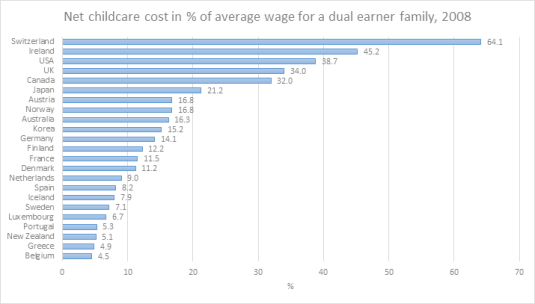
Closing the Gender Gap: Act Now -OECD 2012.
Note: Net childcare costs among couple families where one adult earns 100% of the average wage and the other earns 50% of the average wage.
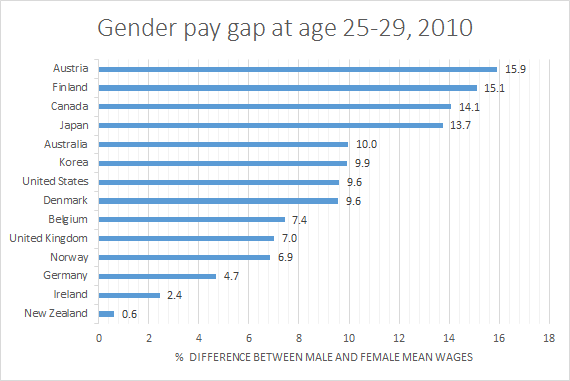
Gender pay gap at age 25-29, OECD countries @GreenCatherine
03 Dec 2015 Leave a comment
in discrimination, gender, human capital, labour economics, labour supply, politics - Australia, politics - New Zealand, politics - USA Tags: compensating differentials, gender wage gap, labour demographics
The gender pay gap in New Zealand rounds down to zero for women in their mid-20s!
Where are British taxes spent?
26 Nov 2015 1 Comment
in budget deficits, defence economics, economics of education, fiscal policy, health economics, labour supply Tags: ageing society, British economy, British politics, demographic crisis
The robot revolution is overrated
22 Nov 2015 Leave a comment
in applied price theory, economic history, industrial organisation, international economics, labour supply Tags: automation, creative destruction, entrepreneurial alertness, industrial revolution, mechanisation, robots, technological unemployment
@economicpolicy gathers more evidence of a waning gender pay gap @joshbivens_DC @eliselgould
22 Nov 2015 Leave a comment
in applied price theory, discrimination, economic history, gender, human capital, labour economics, labour supply, minimum wage, occupational choice, poverty and inequality Tags: asymmetric marriage premium, Claudia Goldin, compensating differentials, economics of fertility, gender wage gap, marriage and divorce, power couples
As part of a large paper calling for massive government intervention, the Economic Policy Institute, impeccably left-wing, massed a considerable amount of evidence about the withering away of the gender wage gap and anomalies in what is left of that gap. None of these anomalies bolster the case for more regulation of the labour market.
The first of their charts showed the large reduction in the gender wage gap in the USA. Women’s wages have been increasing consistently over the last 40 years or so. The second of their tweeted charts shows that women of all races consistently outperformed men in wages growth, often by a large margin.
Their most interesting chart is about how the gender gap is not only highest among top earners, their pay gap has not fallen at all in the last 40 years. If anything, that gender wage gap is rising at the top end of the labour market albeit slowly. Progress in closing the gender gap been pretty consistent at the lower pay levels. That progress is certainly better than no progress at all.
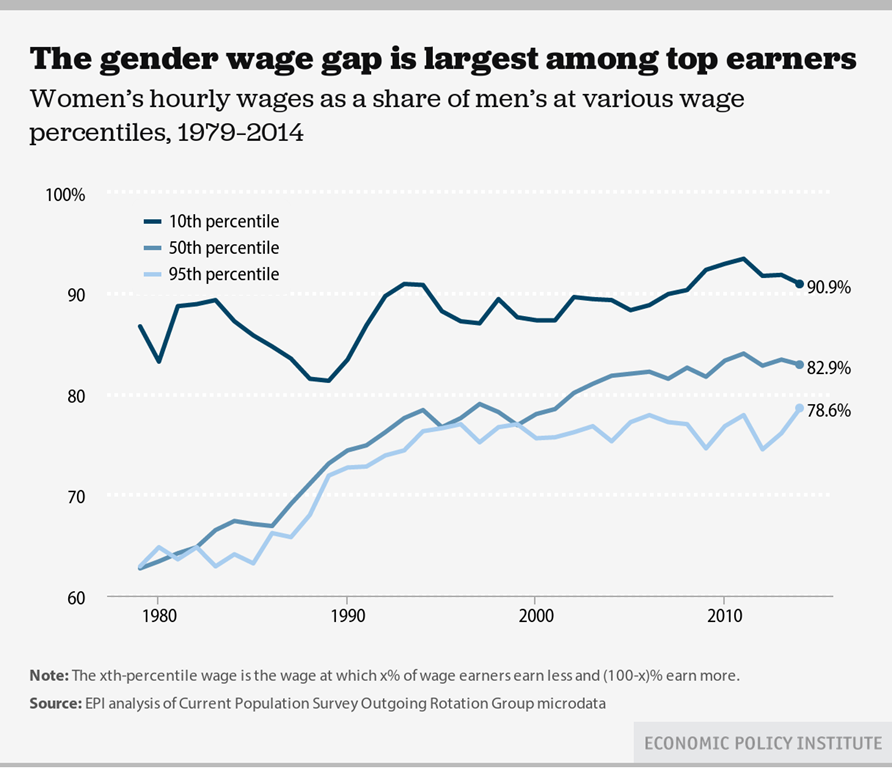
The Economic Policy Institute didn’t enquire in any detail into why women with the most options in the labour market had made the least progress in closing the gender wage gap.
None of their solutions such as more collective-bargaining and a higher minimum wage will help the top end of the job market.
There is an anomaly in the Economic Policy Institute’s reasoning. The women who would suffer least from a purported inequality of bargaining power inherent in the capitalist system and have plenty of human capital have had least success in closing the gender pay gap. These women can shop around for better job offers and start their own businesses. Many do because they are professionals where self-employment and professional partnerships are common.
The better discussions of the gender wage gap emphasise choice. Women choosing at the top end of the labour market to balance career and family and choosing the occupation and education where the net advantages of doing that are the greatest. As the Economic Policy Institute itself notes:
In 2014, the gap was smallest at the 10th percentile, where women earned 90.9 percent of men’s wages. The minimum wage is partially responsible for this greater equality among the lowest earners, as it results in greater wage uniformity at the bottom of the distribution.
The gap is highest at the top of the distribution, with 95th percentile women earning 78.6 percent as much as their male counterparts. Economist Claudia Goldin (2014) postulates that the gap is larger for women in high-wage professions because they are penalized for not working long, inflexible hours that often come with many professional jobs, due in large part to the arrival of children and long-standing social expectations about the division of household labour between men and women.
What the Economic Policy Institute does not explain is why these long-standing social expectations about the division of household labour should be strongest among well-paid women with plenty of options.
Among these options of high-powered women in well-paid jobs is the ability to buy every labour-saving appliance, hire a nanny and ample childcare and acquire everything else on the list of demands of the Economic Policy Institute on closing the gender pay gap. Something doesn’t add up?

Of course, the Economic Policy Institute discusses the unadjusted gender wage rather than the adjusted gender wage. When you study the gender wage gap after making adjustments for demographic and other obvious factors, it is clear that this pay gap is driven by the choices women make between career and family.
Claudia Goldin did a great study of Harvard MBAs using online surveys of their careers. This is the very group that according to the Economic Policy Institute have made the least progress in bringing down patriarchy in the labour market. Specifically, the overturning of traditional expectations about the marital division of labour in childcare and parenthood.
https://twitter.com/alyssalynn7/status/669219008747610113
Goldin found that three proximate factors accounted for the large and rising gender gap in earnings among MBA graduates as their careers unfold:
- differences in training prior to MBA graduation,
- differences in career interruptions, and
- differences in weekly hours.
The greater career discontinuity and shorter work hours for female MBAs are largely associated with motherhood. There are some careers that severely penalise any time at all out of the workforce or working less than punishingly long and rigid hours.
A 2014 Harvard Business School study found that 28 percent of recent female alumni took off more than six months to care for children; only 2 percent of men did.

Claudia Goldin found one counterfactual that cancels out the gender wage gap amongst MBA professionals: hubby earns less! Female MBAs who have a partner who earn less than them earn as much as the average MBA professional on an hourly basis but work a few less hours per week.
The gender wage gap is persisted in high-paying jobs because career women have so many options. Studies of top earning professionals show that they make quite deliberate choices between family and career. The better explanation of why so many women are in a particular occupation is job sorting: that particular job has flexible hours and the skills do not depreciate as fast for workers who take time off, working part-time or returning from time out of the workforce.
Low job turnover workers will be employed by firms that invest more in training and job specific human capital:
- Higher job turnover workers, such as women with children, will tend to move into jobs that have less investment in specialised human capital, and where their human capital depreciates at a slower pace.
- Women, including low paid women, select careers in jobs that match best in terms of work life balance and allows them to enter and leave the workforce with minimum penalty and loss of skills through depreciation and obsolescence.
This is the choice hypothesis of the gender wage gap. Women choose to educate for occupations where human capital depreciates at a slower pace.
The gender wage gap for professionals can be explained by the marriage market combined with assortative mating:
- Graduates are likely to marry each other and form power couples; and
- There tends to be an age gap between men and women in long-term relationships and marriages of two years.
This two-year age gap means that the husband has two additional years of work experience and career advancement. This is likely to translate into higher pay and more immediate promotional prospects.
An interesting and informed look at the pay gap between men and women economist.com/blogs/freeexch… https://t.co/0nxtC9ILWo—
Charles Read (@EconCharlesRead) November 06, 2015
Maximising household income would imply that the member of the household with a higher income, and greater immediate promotional prospects stay in the workforce. This is entirely consistent with the choice hypothesis and equalising differentials as the explanation for the gender wage gap. As Solomon Polachek explains:
At least in the past, getting married and having children meant one thing for men and another thing for women. Because women typically bear the brunt of child-rearing, married men with children work more over their lives than married women. This division of labour is exacerbated by the extent to which married women are, on average, younger and less educated than their husbands.
This pattern of earnings behaviour and human capital and career investment will persist until women start pairing off with men who are the same age or younger than them. That is, more women will have to start marrying down in both income and social maturity.

The western environmental movement’s role in China’s one-child policy
19 Nov 2015 Leave a comment
in development economics, environmental economics, environmentalism, growth disasters, growth miracles, health economics, labour economics, labour supply, population economics Tags: China, cranks, doomsday profits, doomsday prophecies, one child policy
How labour and other markets work
18 Nov 2015 Leave a comment
in applied price theory, Austrian economics, entrepreneurship, human capital, industrial organisation, labour economics, labour supply, Milton Friedman, minimum wage, occupational choice, poverty and inequality, survivor principle, unions Tags: market process, The meaning of competition
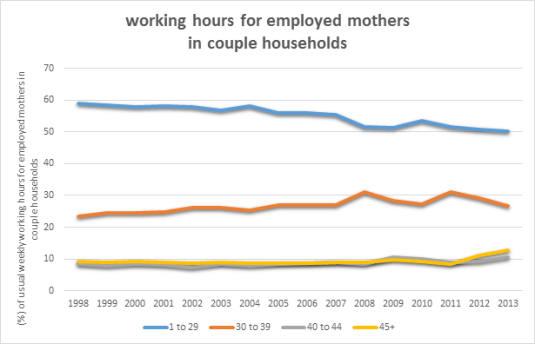
Drifting to full-time – working hours of British mothers in couple households since 1998
17 Nov 2015 Leave a comment
in gender, labour economics, labour supply
More British mothers with partners and children under 14 are moving from semi full-time to full-time over the last 15 years.
Source: OECD Family Database.
The rise and rise of the German breadwinner – weekly hours worked of German fathers
17 Nov 2015 Leave a comment
in economics of love and marriage, labour economics, labour supply
Unlike their British compatriots, German fathers are working longer hours than in the past.

Source: OECD Family Database.
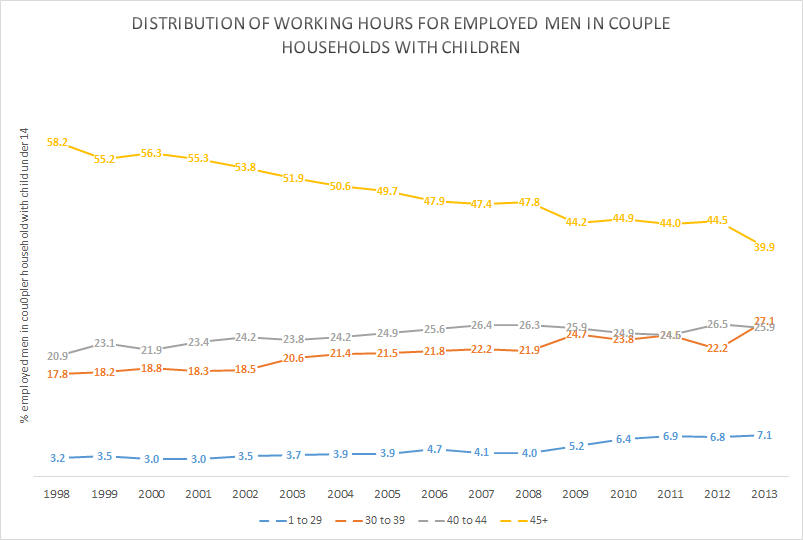
The decline of the British breadwinner – distribution of working hours of married fathers since 1998
16 Nov 2015 1 Comment
in economics of love and marriage, labour economics, labour supply Tags: asymmetric marriage premium, British economy, male labour force participation, marriage and divorce
The number of British fathers in a couple who worked more than 45 hours a week has dropped from about 60% to under 40% since 1998.
Source: OECD Family Database.
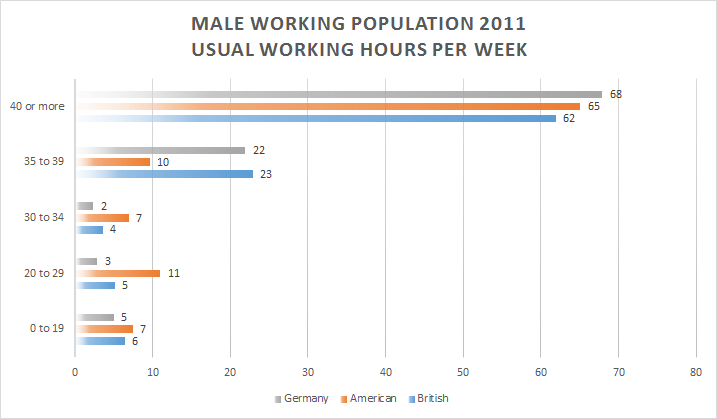
Distribution of the male American, British and German number of working hours
15 Nov 2015 Leave a comment
in labour economics, labour supply, occupational choice Tags: British economy, compensating differentials, Germany, health insurance, labour force participation, male labour force participation, Obamacare, part-time work, social insurance
Few men work part-time. Many that do are teenagers. Two-thirds of male workers in America, Britain and Germany work at least 40 hours a week and another quarter worked 35 to 40 hours a week except in the USA. A surprising number of Americans, 11%, worked 20 to 29 hours. If they work that 30th hour, the employer must provide them with health insurance under Obamacare.
Source: OECD Family Database.
 Utopia, you are standing in it!
Recent Comments