
https://www.facebook.com/share/p/NHTzxxtBonuQyzdp/?mibextid=xfxF2i
Celebrating humanity's flourishing through the spread of capitalism and the rule of law
23 May 2024 Leave a comment
in economics of education, economics of information, human capital, labour economics, labour supply, managerial economics, market efficiency, occupational choice, organisational economics, personnel economics
20 May 2024 Leave a comment
in applied price theory, human capital, labour economics, labour supply, politics - New Zealand, population economics Tags: economics of immigration
If a Blogger accused immigrants of nicking houses & jobs off young native NZ’ers, causing them to leave the country, then we’d likely be prosecuted under anti-freedom of speech legislation. But seems our State-owned broadcaster, OneNews, can get away with it. After all, like the Reserve Bank, TVNZ can do what it wants. Its above…
OneNews blames immigration to NZ for emigration (of young Kiwis out of NZ). Maybe they’re leaving because our Media has depressed them?
19 May 2024 Leave a comment
in applied price theory, economic history, economics of education, entrepreneurship, human capital, income redistribution, industrial organisation, labour economics, labour supply, occupational choice, politics - USA, poverty and inequality, Public Choice Tags: taxation and entrepreneurship, taxation and investment

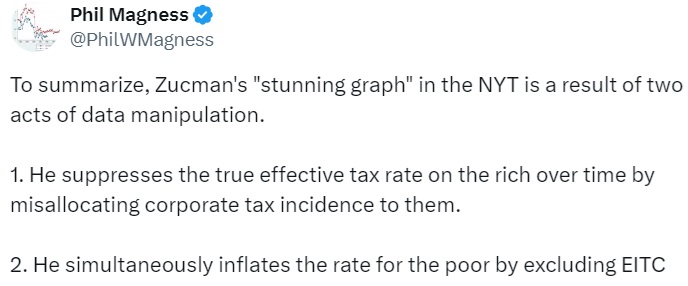
Like Thomas Piketty, Gabriel Zucman is a French economist who promotes economically destructive class-warfare tax policy. He’s also infamous for dodgy data manipulation, as Phil Magness explains in this Reason discussion. The interview lasts for 64 minutes, and I recommend the entire discussion. Yes, that’s a lot of time, but Phil has encyclopedic knowledge and […]
Debunking Bad Class Warfare and Debunking Nonsensical Class Warfare
17 May 2024 Leave a comment
in applied price theory, development economics, entrepreneurship, labour economics, labour supply, minimum wage
The New York Times (paywalled, but also available here) reported last month:At Sansan Chicken in Long Island City, Queens, the cashier beamed a wide smile and recommended the fried chicken sandwich.Or maybe she suggested the tonkatsu — it was hard to tell, because the internet connection from her home in the Philippines was spotty.Romy, who…
New York restaurants find a new way to respond to the minimum wage
16 May 2024 Leave a comment
in economics of crime, labour economics, labour supply, law and economics, politics Tags: economics of immigration, The Netherlands
It is being reported (e.g., Politico, FT) that a coalition government is soon to be announced for the Netherlands, which a general election in late November. The government would consist of the following parties, with their seats noted: The far-right Freedom Party (PVV, 37), led by Geert Wilders, the center-right VVD (24), the Christian democratic/anti-establishment […]
Netherlands government about to be formed, per reports
10 May 2024 Leave a comment
in applied price theory, economic growth, economic history, human capital, labour economics, labour supply, macroeconomics, politics - New Zealand

Late last week The Treasury released a new 40 page report on “The productivity slowdown: implications for the Treasury’s forecasts and projections” (productivity forecasts and projections that is, rather than any possible fiscal implications – the latter will, I guess, be articulated in the Budget documents). In short, if (as it has) productivity growth has slowed down […]
The Treasury and productivity
07 May 2024 Leave a comment
in applied price theory, economic growth, economic history, entrepreneurship, human capital, income redistribution, industrial organisation, labour economics, labour supply, macroeconomics, Marxist economics, politics - USA, Public Choice, public economics Tags: taxation and entrepreneurship, taxation and investment, wealth tax
Everything you need to know about wealth taxation can be summarized in two sentences. The biggest problem with most tax systems is the pervasive tax bias against income that is saved and invested, which discourages the accumulation of capital that helps to finance future growth. Wealth taxes would dramatically increase the tax bias against saving […]
Dishonest Pimping for a Global Wealth-Tax Cartel
04 May 2024 Leave a comment
in applied price theory, economics of bureaucracy, Economics of international refugee law, labour economics, labour supply, law and economics, Public Choice, public economics Tags: economics of migration, offsetting behavior, unintended consequences
Deiana, Maheshr,and Mastrobuoniand have recently published an analysis of the effects of Search and Rescue operations on migration from Africa to Europe.Nearly half a century ago, Sam Peltzman showed that, because mandatory seat-belts made driving safer, drivers tended to drive more recklessly, partially offsetting the increased safety. Similar effects occurred in the search and rescue…
The Peltzman Effect at Sea
01 May 2024 Leave a comment
in applied price theory, economic history, industrial organisation, labour economics, labour supply Tags: asymmetric information, moral hazard, tipping
Why leave a tip? You have already received whatever food or service you are going to receive. Maybe if you are a very regular customer, tipping could lead to better service in the future. But most people who leave tips do so even if they are stopping off at, say, a restaurant in a city…
Some Economics of Tipping
23 Apr 2024 Leave a comment
in applied price theory, discrimination, econometerics, economics of education, economics of information, human capital, labour economics, labour supply, law and economics, managerial economics, organisational economics, personnel economics, politics - USA, poverty and inequality Tags: gender wage gap, implicit bias, racial discrimination, sex discrimination
Several common measures — like employing a chief diversity officer, offering diversity training or having a diverse board — were not correlated with decreased discrimination in entry-level hiring, the researchers found. But one thing strongly predicted less discrimination: a centralized H.R. operation. The researchers recorded the voice mail messages that the fake applicants received. When a company’s […]
Hiring discrimination sentences to ponder
21 Apr 2024 Leave a comment
in applied price theory, economic growth, entrepreneurship, human capital, industrial organisation, labour economics, labour supply, macroeconomics, poverty and inequality Tags: artificial intelligence
That is the new Daron Acemoglu paper, and he is skeptical about its overall economic effects. Here is part of the abstract: Using existing estimates on exposure to AI and productivity improvements at the task level, these macroeconomic effects appear nontrivial but modest—no more than a 0.71% increase in total factor productivity over 10 years.…
“The Simple Macroeconomics of AI”
18 Apr 2024 Leave a comment
in economics of crime, economics of information, economics of media and culture, labour economics, labour supply, law and economics, managerial economics, organisational economics, personnel economics Tags: agency costs, asymmetric information, moral hazard, screening
14 Apr 2024 Leave a comment
in applied price theory, discrimination, economics of education, entrepreneurship, gender, human capital, labour economics, labour supply, occupational choice, poverty and inequality Tags: gender wage gap, sex discrimination
From “Diversity and Performance in Entrepreneurial Teams” (SSRN): Among the randomly-assigned teams [of MBA students], greater diversity along the intersection of gender and race/ethnicity significantly reduced performance. However, the negative effect of this diversity is alleviated … [when teams can choose their teammates]…teams with more female members perform substantially better when their faculty section leader was also…
Diverse MBA teams perform worse
13 Apr 2024 Leave a comment
in applied price theory, comparative institutional analysis, development economics, economic history, economics of bureaucracy, economics of regulation, history of economic thought, human capital, income redistribution, industrial organisation, labour economics, labour supply, law and economics, liberalism, Marxist economics, poverty and inequality, property rights, Public Choice, public economics, survivor principle, theory of the firm Tags: economics of socialism, regressive left

Not that the socialist in question, Professor Richard D. Wolff, realises that’s what he’s doing in the Q&A video below – and he’s not talking about traditional Communist Command and Controlled Economies. What he’s actually describing is a very pure form of socialism, the sort only vaguely imagined by Marx, Engels and other communists when […]
A Socialist Explains Why Socialism Can’t Work
10 Apr 2024 Leave a comment
in applied price theory, development economics, economics of information, human capital, industrial organisation, labour economics, labour supply, occupational choice, poverty and inequality Tags: consumer fraud, creative destruction
I’ve posted about many new jobs like this. See related posts below. Also, this post is based on yesterday’s post You Spent $6,000 on a Secondhand Chanel Bag. Now Find Out if It Is Real. It had excerpts from an article by Chavie Lieber of The WSJ. Here are excerpts related to today’s post:”Many secondhand luxury shoppers…
Handbag authenticators (creative destruction and how the economy just keeps creating new types of occupations & professions)
Celebrating humanity's flourishing through the spread of capitalism and the rule of law
Celebrating humanity's flourishing through the spread of capitalism and the rule of law
Celebrating humanity's flourishing through the spread of capitalism and the rule of law
Celebrating humanity's flourishing through the spread of capitalism and the rule of law
Celebrating humanity's flourishing through the spread of capitalism and the rule of law
Celebrating humanity's flourishing through the spread of capitalism and the rule of law
Celebrating humanity's flourishing through the spread of capitalism and the rule of law
Celebrating humanity's flourishing through the spread of capitalism and the rule of law
Celebrating humanity's flourishing through the spread of capitalism and the rule of law
A History of the Alt-Right
Econ Prof at George Mason University, Economic Historian, Québécois
Celebrating humanity's flourishing through the spread of capitalism and the rule of law
Scholarly commentary on law, economics, and more
Beatrice Cherrier's blog
Celebrating humanity's flourishing through the spread of capitalism and the rule of law
Celebrating humanity's flourishing through the spread of capitalism and the rule of law
Celebrating humanity's flourishing through the spread of capitalism and the rule of law
Why Evolution is True is a blog written by Jerry Coyne, centered on evolution and biology but also dealing with diverse topics like politics, culture, and cats.
Celebrating humanity's flourishing through the spread of capitalism and the rule of law
A rural perspective with a blue tint by Ele Ludemann
DPF's Kiwiblog - Fomenting Happy Mischief since 2003
Celebrating humanity's flourishing through the spread of capitalism and the rule of law
The world's most viewed site on global warming and climate change
Tim Harding's writings on rationality, informal logic and skepticism
A window into Doc Freiberger's library
Let's examine hard decisions!
Commentary on monetary policy in the spirit of R. G. Hawtrey
Thoughts on public policy and the media
Celebrating humanity's flourishing through the spread of capitalism and the rule of law
Politics and the economy
A blog (primarily) on Canadian and Commonwealth political history and institutions
Reading between the lines, and underneath the hype.
Economics, and such stuff as dreams are made on
"The British constitution has always been puzzling, and always will be." --Queen Elizabeth II
Celebrating humanity's flourishing through the spread of capitalism and the rule of law
Celebrating humanity's flourishing through the spread of capitalism and the rule of law
WORLD WAR II, MUSIC, HISTORY, HOLOCAUST
Undisciplined scholar, recovering academic
Celebrating humanity's flourishing through the spread of capitalism and the rule of law
Res ipsa loquitur - The thing itself speaks
In Hume’s spirit, I will attempt to serve as an ambassador from my world of economics, and help in “finding topics of conversation fit for the entertainment of rational creatures.”
Researching the House of Commons, 1832-1868
Reflections on books and art
Posts on the History of Law, Crime, and Justice
Celebrating humanity's flourishing through the spread of capitalism and the rule of law
Exploring the Monarchs of Europe



Recent Comments