Thomas Sowell Dismantles Feminism and Racialism
20 Jan 2015 Leave a comment
in discrimination, gender, human capital, labour economics, labour supply, occupational choice Tags: gender wage you, labour economics, racial discrimination, racial wage gap, sex discrimination, Thomas Sowell
The link between parental leave and the gender pay gap | Pew Research Center
19 Jan 2015 Leave a comment
in discrimination, gender, human capital, labour supply, occupational choice, population economics Tags: gender wage gap, Parental leave, unintended consequences


By the Numbers: How Dangerous Is It to Be a Cop?
17 Jan 2015 Leave a comment
in occupational choice, personnel economics Tags: health and safety

What is the evidence on human capital spillovers? Evidence from the mobility of knowledge workers
17 Jan 2015 Leave a comment
in economic growth, Gary Becker, human capital, job search and matching, labour economics, occupational choice Tags: human capital externalities
While there is a vast literature documenting the large private returns from education and on-the-job human capital (Card 1999; Rubenstein and Weiss 2007; Almeida and Carneiro 2008), evidence of human capital spillovers is limited. Many studies find little evidence of spillovers from education (Lange and Topel (2005), Ciccone and Peri (2006)). Studies even struggle to find small spillovers from another year in high school (Acemoglu and Angrist 2001). Differences in human capital also explain only a small part of cross-national differences in incomes per capita (Hsieh and Klenow 2010; Parente and Prescott 2000, 2005).

The R&D industries offer a case study of the likely size of skills spillovers from worker mobility from large firms. The mobility of technical personnel and the human capital embodied in them across R&D firms is a substantial source of knowledge transfer (Møen 2005). For there to be a spillover, the new employer must pay recruits less than the value added by the job experience and skills they bring to the fold.
A key advantage of studying the mobility of R&D workers for skills spillovers is these industries are populated with many spin-offs founded by the ex-employees of larger firms. R&D spin-offs tend to be larger on average that other new firms and initially employ more advanced, more experienced workers and more technical specialists than do other new firms (Andersson and Klepper 2013).

Capturing the value of skills spillovers from job-hopping is a major business opportunity. The efforts of entrepreneurs to create and enforce property rights over information and other resources as their value increases are central to the organisation of both markets and firms.
A litmus test for the capture of the value of skills spillover is whether wages adjust in line with evolving career opportunities. Becker (2007, p. 134) explains this process of market adaptation and entrepreneurship as follows:
Firms introducing innovations are alleged to be forced to share their knowledge with competitors through the bidding away of employees who are privy to their secrets. This may well be a common practice, but if employees benefit from access to saleable information about secrets, they would be willing to work more cheaply than otherwise.
Møen (2005), Magnani (2006) and Maliranta, Mohnen and Rouvinen (2009) found that employers capture much of the skills spillovers to others by paying R&D workers less early in their careers; later employers pay higher wages to reflect the valued added by the human capital that these R&D recruits bring.

Andersson, Freedman, Haltiwanger, Lane and Shaw (2009) found that software firms in markets with large returns from product breakthroughs pay higher starting salaries to attract star employees. Accounting and legal firms and sports teams also pay more to recruit and retain top performers (Wezel, Cattini and Pennings 2006; Campbell, Ganco, Franco and Agarwal 2012; Rosen 2001).
Employers balance skills and knowledge acquisition through recruitment with in-house development of skills and knowledge. Mason and Nohara (2010) did not find ‘any evidence’ that the external experience of scientists and engineers is any more valuable to firms than is their internal experience.
Firms will pay a wage that equalises the returns on skills acquisition through recruitment with the returns on investing in in-house training. This equalisation of the returns between internal and external sources of skills and knowledge is consistent with competition penalising firms that pay too much or too little for inputs and rewarding entrepreneurs for superior alertness to new opportunities.
The option value of founding or working for a spin-off is also captured in the wages of R&D workers (Kitch 1980; Pakes and Nitzan 1983). Central to a spin-off is carrying on with new ideas and prototypes that the leaving employees judged to be under-valued by the parent firm and they want to build on at their own entrepreneurial risk (Klepper and Sleeper 2005; Klepper 2007).
Large firms are known for incremental innovations while small firms pioneer product break-troughs whose prospects were not as well valued inside large hierarchies (Baumol 2002, 2005; Audretsch and Thurik 2003). Many R&D spin-offs continue with emerging ideas and products that their parents were in the process of abandoning (Hellmann 2007; Chatetterjee and Rossi-Hansberg 2012; Klepper and Thompson 2010). One reason is the developing idea does not fit in with the risk profile and skills of the parent so many spin-offs are friendly (Fallick, Fleischman, and Rebitzer 2006; Chen and Thompson 2011).
Founding or working for a spin-off or start-up is a real prospect. In many innovative industries, upwards of 20 percent of new entrants are intra-industry spinoffs; these firms outperform other new entrants and disproportionately populate the ranks of industry leaders (Klepper and Thompson 2010).
The evidence of large firms spawning more entrepreneurs among scientists and engineers is mixed. Large parent firm size reduces both the probability of leaving, and more so, the probability of leaving to found a spin-off (Andersson and Klepper 2013; Sørensen 2007; Sørensen and Philipps 2011). Spin-offs are less likely from large parents because more of the skills and experience accumulated within large firms is firm-specific human capital and is therefore less mobile into a spin-off.
Scientists and engineers who worked in small firms are ‘far more likely’ to found a spin-off than are their large firm counterparts, and their spin-offs are more likely to be a success (Elfenbein, Hamilton and Zenger 2010; Sørensen and Phillips 2011). Working in smaller firms allows spin-off minded employees to gain the balance and wide array of technical knowledge and management skills that are prized in entrepreneurship (Elfenbein, Hamilton and Zenger 2010; Lazear 2004, 2005).
Working in managerial hierarchies works against founding a spin-off. Tåg, Åstebro and Thompson (2013) found that conditional on size, employees in firms with more layers of management are less likely to enter entrepreneurship, self-employing or quit to go to another firm. They attributed this to the employees in firms with fewer management layers developing a broader range of skills; multiple layers of management offering more promotion opportunities; and skill mismatch is less problematic in more hierarchical firms because there are more chances to move. The higher pay and better career opportunities in larger firms reduces job quits, and with it, skills spillovers and spin-offs.
The wage adjustments for current skills and knowledge transfer opportunities to future employers, start-ups and spin-offs are large. New science graduates accept 20 per cent less in starting pay to work where they can publish more in their own names (Stern 2004).

Scientists and engineers working in R&D accept 20 per cent less pay than other scientists and engineers who work in technical and managerial occupations to secure this more interesting work (Dupuy and Smits 2010). Gibbs (2006) suggested that the U.S. Department of Defense is able to recruit and retain engineers and scientists on low pay because they offer work on some of the most advanced technical research in the world.
Employers who pay full value in wages, share options, learning and R&D opportunities in exchange for the labour and human capital of employees are not benefiting from a skills spillover.

The evidence just reviewed identifies market processes that minimise skills spillovers from large R&D firms to spin-offs. Large firms train their employees in skills that are more often firm-specific and adjust wages to account for the career opportunities that might arise from on-the-job training that is more mobile. The employees of larger firms have longer job tenures in part because their human capital is less mobile.
The political bias of selected professions
16 Jan 2015 Leave a comment
in economics of media and culture, Marxist economics, occupational choice, politics - USA Tags: media bias
These graphs show the contributions by individual donors in each industry to political candidates


via http://blog.crowdpac.com/post/101785128940/the-political-bias-of-each-profession
More than a third of American workers don’t get sick leave
16 Jan 2015 Leave a comment
in labour economics, occupational choice, politics - USA

The marvel of the market: the remarkable foresight of young adults in choosing what to study
16 Jan 2015 1 Comment
in Alfred Marshall, Armen Alchian, economics of education, George Stigler, human capital, job search and matching, labour economics, occupational choice, politics - New Zealand, rentseeking Tags: 2nd laws of supply and demand, Alfred Marshall, Armen Alchian, george stigler, search and matching, skills shortgaes
Known but yet to be exploited opportunities for profit do not last long in competitive markets, including hitherto unnoticed opportunities for the greater utilisation and development of skills and experience (Hakes and Sauer 2006, 2007; Ryoo and Rosen 2004; and Kirzner 1992). Moneyball is the classic example of entrepreneurial alertness to hitherto unexploited job skills which were quickly adopted by competing firms (Hakes and Sauer 2006, 2007).
There is considerable evidence that the demand and supply of human capital responds to wage changes. For example, over- or under-supplied human capital moves either in or out in response to changes in wages until the returns from education and training even out with time (Ryoo and Rosen 2004; Arcidiacono, Hotz and Kang 2012; Ehrenberg 2004).
As evidence of this equalisation of returns on human capital investments across labour markets, the returns to post-school investments in human capital are similar – 9 to 10 percent – across alternative occupations, and in occupations requiring low and high levels of training, low and high aptitude and for workers with more and less education (Freeman and Hirsch 2001, 2008). There is evidence that workers with similar skills in similarly attractive jobs, occupation and locations earn similar pay (Hirsch 2008; Vermeulen and Ommeren 2009; Rupert and Wasmer 2012; Roback 1982, 1988).
Ryoo and Rosen (2004) found that the labour supply and university enrolment decisions of engineers is “remarkably sensitive” to career earnings prospects. Graduates are the main source of new engineers. Engineers who moved out into other occupations such as management did not often moved back to work again as professional engineers. Ryoo and Rosen (2004) observed when summarising their work that:
Both the wage elasticity of demand for engineers and the elasticity of supply of engineering students to economic prospects are large. The concordance of entry into engineering schools with relative lifetime earnings in the profession is astonishing.
Ryoo and Rosen (2004) found several periods of surplus in the market for engineers. These periods of shortage or surplus corresponded to unexpected demand shocks in the market for engineers such as the end of the Cold War.
Figure 1: New entry flow of engineers: a, actual vs. imputed from changes in stock of engineers; b, time-varying coefficients.
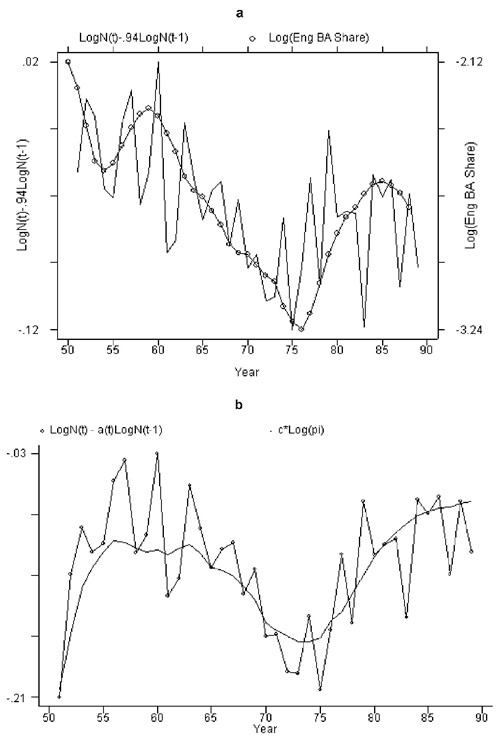
Source: Ryoo and Rosen (2004)
Ryoo and Rosen (2004) noted that importance of permanent versus transitory changes in earnings. Transitory rises and falls in earnings prospects have much less influence on occupational choices and the educational investments of students.
In light of these findings that the supply of engineers rapidly adapted to changing market conditions, Ryoo and Rosen (2004) questioned whether public policy makers have better information on future labour market conditions than labour market participants do. When politicians get worked up about skill shortages, the markets for scientists and engineers often where they make extravagant claims about the ability of the market to adapt to changing conditions because of the long training pipeline involved in university study, including at the graduate level.
There can be unexpected shifts in the supply or demand for particular skills, training or qualifications. These imbalances even themselves out once people have time to learn, update their expectations and adapt to the new market conditions (Rosen 1992; Ryoo and Rosen 2004; Bettinger 2010; Zafar 2011; Arcidiacono, Hotz and Kang 2012; Webbink and Hartog 2004).
For example, Arcidiacono, Hotz and Kang (2012) found that both expected earnings and students’ abilities in the different majors are important determinants of student’s choice of a college major, and 7.5% of students would switch majors if they made no forecast errors.
The wage premium for a tertiary degree was low and stable in New Zealand in the 1990s (Hylsop and Maré 2009) and 2000s (OECD 2013). This stability in the returns to education suggests that supply has tended to kept up with the demand for skills at least over the longer term at the national level. There were no spikes and crafts that would be the evidence of a lack of foresight among teenagers in choosing what to study.
All in all, the remarkable sensitivity of engineers to a career earnings prospects, the frequent changes of college majors by university students in response to changing economic opportunities, and the stability of the returns on human capital over time suggest that the market for human capital is well functioning.
The argument that the market was not working well was assumed rather than proven. Likewise, the case for additional subsidies for science, technology, engineering and mathematics because of perceived skill shortages has not been made out. There is a large literature showing that the market for professional education works well.
The onus is on those who advocate intervention to come up with hard evidence, rather than innate pessimism about markets that are poorly understood because of a lack of attempts to understand it. Studies dating back to the 1950s by George Stigler and by Armen Alchian found that the market for scientists and engineers works well and the evidence of shortages were more presumed than real.
Creative destruction at work: jobs that no longer exist – pinsetters and human alarm clocks
14 Jan 2015 Leave a comment
in labour economics, occupational choice, survivor principle, technological progress Tags: creative destruction

Radical Islam is the defining oppositional identity of our generation
13 Jan 2015 Leave a comment
in applied price theory, economics of religion, human capital, occupational choice Tags: economics of oppositional identities, Jihadists, radical Islam
Each generation has its defining oppositional identity.

Radical Islam is the oppositional identity of choice for today’s angry young men and women. Mind you, they have to buy Islam for dummies to understand what they’re signing up for in the most crude way.
In previous generations, it was communism, the Red Brigade, weird religious sects, eco-terrorism, animal liberationist terrorism and a variety of domestic terrorists of the left and right with conspiratorial motivations. Look at the level of diversity of the angry young men and women on the domestic terrorists list of the FBI.

Plenty of young people were attracted to communism in previous generations as a way of sticking it to the man.

The appeal of radical Islam Islamic State rests on what psychologists call personal significance. The quest for personal significance by these angry young men and women is the desire to matter, to be respected, to be somebody in one’s own eyes and in the eyes of others.
A person’s sense of significance may be lost for many reasons, including economic conditions. The anger can grow out of a sense of disparagement and discrimination; it can come from a sense that one’s brethren in faith are being humiliated and disgraced around the world.
Extremist ideologies be they communism, fascism or extreme religions are effective in such circumstances because it offers a quick-fix remedy to a perceived loss of significance and an assured way to regain it. It accomplishes this by exploiting primordial instincts for aggression, sex and revenge.
The Islamic State is using a social-networking website to answer mundane questions from aspiring militants. They want answers on what to wear, how cold it gets, access to medical and dental services, if they have to buy their own weapons, whether there is wi-fi, and how soon they can capture women to rape. the answer to the last question is “Dawlah [ISIS] sorts that out”.
The two brothers responsible for the attacks in Paris were known to French intelligence but were not seen as not much of a threat because they were judged to be dope smoking, 30 something has been Jihadists. They were thought by the French intelligence services to have aged out of radical jihad.
The main difference between the two brothers in France and a common garden spree killer is their grievance was given a narrative of radical Islam rather than just the plain old hate that drives other spree killers.
Radical Islam is a magnet for wannabe spree killers who need a support network and a bit of rationalisation to pluck up the courage to kill unarmed people who can’t fight back.
Key facts about the gender pay gap–Pew Centre research
10 Jan 2015 Leave a comment
in discrimination, gender, human capital, labour economics, occupational choice Tags: gender wage gap, labour economics, sex discrimination
Thomas C. Schelling on why international terrorism is so rare
09 Jan 2015 Leave a comment
in applied price theory, defence economics, economics of crime, industrial organisation, managerial economics, occupational choice, organisational economics, personnel economics, politics - USA, Thomas Schelling, war and peace Tags: terrorism, Thomas Schelling, war against terror


Recent Comments