As I wrote nine years ago, Oxfam is a pathetic organization. Originally created to help the poor, it has been captured by activists who peddle class warfare. But they play that role in an incredibly sloppy fashion. In all the debates I’ve been part of over the years, no left-leaning academic has been willing to […]
There is a new and optimistic paper by Lukas Althoff and Hugo Reichardt: Artificial intelligence is changing which tasks workers do and how they do them. Predicting its labor market consequences requires understanding how technical change affects workers’ productivity across tasks, how workers adapt by changing occupations and acquiring new skills, and how wages adjust…
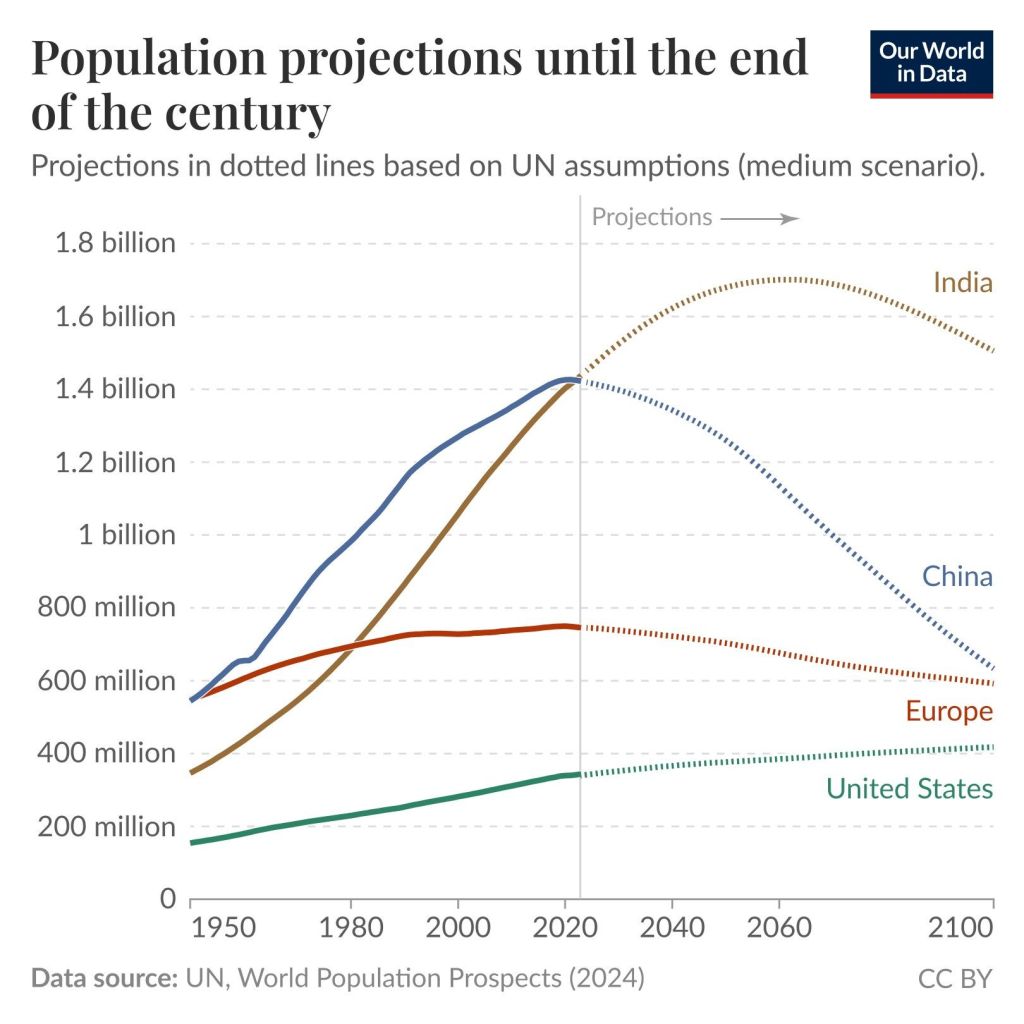
Demography is the study of the structure of human populations, including factors like births, deaths, aging, as well as health and economic factors. Some demographic changes happen slowly, over decades, but in a predicable way. For example, if you want to look at projections for the year 2050 of the ratio of the US working-age…
In this shortish (23-minute) video, Sam Harris and John McWhorter discuss whether wokeness is finally dead. The short answer is “nope.” It may have lain down, but it refuses to die. The YouTube notes (there’s a transcript you can see as well): Sam Harris speaks with John McWhorter about language, ideology, and moral certainty. They […]
More recently, his research has found new attention and urgency in President Donald Trump’s second term: Borjas, 75, worked as a top economist on the Council of Economic Advisers, a post he stepped down from last week. Borjas is an immigrant and refugee who escaped Cuba for the United States in 1962 and later obtained…
The relationship between Anti-Zionism and Anti-Semitism is real, contested, and often confused. They are not identical, but they overlap in important and historically dangerous ways. The clearest way to understand the connection is to distinguish conceptual differences from practical realities. 1. What the terms mean (in principle) Anti-Semitism Anti-Semitism is hostility toward Jews as Jews—whether […]
Last month, Econoboi hosted a debate on poverty between myself and Matt Bruenig. Here are my reflections on that debate.I was pleasantly surprised by Bruenig’s openness to most of my proposed supply-side reforms. He wasn’t just pro-immigration, but also pro-deregulation of housing and pro-nuclear. He was happy to admit that these policies aren’t just good…
This paper argues that the decline in the labor share is not driven by the overall quantity of capital, but by its changing composition. Constructing annual macro data for 16 advanced countries over two centuries, we show that, since 1980, the relative decline in buildings capital and the associated increase in real prices of buildings…
Our colleague Thomas Stratmann writes about the political economy of Indian reservations in his excellent Substack Rules and Results. Across 123 tribal nations in the lower 48 states, median household income for Native American residents ranges from roughly $20,000 to over $130,000—a sixfold difference. Some reservations have household incomes comparable to middle-class America. Others face persistent…
Is it a sign of the times that this long book review, appearing in the “Science and Society” section of the prestigious journal Science, actually approves of a book questioning the ubiquity of gender surgeries? I haven’t read the book, but you can be that Nature wouldn’t give a positive review such prominence. Here’s the…
It’s become a nearly standard claim that economics inequality makes people feel worse-off, or perhaps even leads to mental illness. However, Nicolas Sommet, Adrien A. Fillon, Ocyna Rudmann, Alfredo Rossi Saldanha Cunha and Annahita Ehsan did what is called a “meta-analysis” of the available studies–that is, they went back and looked at the underlying data, methods, and findings…
This is not a “Star Wars vs Star Trek” post. I’m non-partisan. I enjoy both Star Wars and Star Trek about equally. And it turns out that I am not alone. Last December, John Hawkins (University of Canberra) wrote in The Conversation about what Star Wars can teach us about economics. This year, Hawkins (with Tesfaye…
US economic growth can be divided into two parts: more hours worked, or more productivity per hour worked. In the past, the US labor force has been rising over time: the US labor force totaled 107 million people in 1980, 142 million in 2000, and was up to 171 million this year. However, after several…
Since 2015, Canada has tripled its Indigenous spending – paying more than on national defense. Over those same years, Indigenous people have suffered a catastrophic collapse in health and well-being: on average almost a full decade of lost life expectancy. That is from David Frum. The post Canada fact of the day appeared first on…
Why Evolution is True is a blog written by Jerry Coyne, centered on evolution and biology but also dealing with diverse topics like politics, culture, and cats.
In Hume’s spirit, I will attempt to serve as an ambassador from my world of economics, and help in “finding topics of conversation fit for the entertainment of rational creatures.”






Recent Comments