Bob Edlin writes – Labour leader Chris Hipkins has told RNZ’s Morning Report the Labour Party will not support the Māori Party’s outrageous call for the establishment of a parliamentary commissioner for the Treaty of Waitangi with the extraordinary power to veto parliamentary decisions. His position is stated in this account of his response to […]
It’s comforting to hear Hipkins’ stance on an all-powerful Treaty Commissioner – but what might change his mind?
06 Feb 2025 Leave a comment
in discrimination, law and economics, politics - New Zealand, property rights Tags: Age of Enlightenment, constitutional law, free speech, political correctness, racial discrimination, regressive left
Gender gaps in education and declining marriage rates
06 Feb 2025 Leave a comment
in applied price theory, econometerics, economics of love and marriage, economics of marriage, human capital, labour economics, law and economics, poverty and inequality Tags: assortative mating, economics of fertility
Over the past half-century, the share of men enrolled in college has steadily declined relative to women. Today, 1.6 million more women than men attend four-year colleges in the U.S. This trend has not lowered marriage rates for college women, a substantial share of whom have historically married economically stable men without college degrees. Both […]
Gender gaps in education and declining marriage rates
Identity-based hiring goes wild in New Zealand
05 Feb 2025 Leave a comment
in discrimination, economic history, economics of education, human capital, labour economics, labour supply, law and economics, liberalism, Marxist economics, occupational choice, politics - New Zealand, property rights, Public Choice, public economics, rentseeking Tags: affirmative action, Age of Enlightenment, constitutional law, free speech, political correctness, racial discrimination, regressive left

Just to show you how, in the hiring process, New Zealand gives much more weight to identity than to merit, I enclose part of the job description for the position of Chief Operating Officer of Wellington Water, the water utility for the Greater Wellington region (Wellington, a lovely city, is the capital of New Zealand). […]
Identity-based hiring goes wild in New Zealand
By 2025 we were supposed to have closed the gap
05 Feb 2025 Leave a comment
in economic growth, economics of regulation, entrepreneurship, human capital, industrial organisation, labour economics, labour supply, macroeconomics, politics - New Zealand, poverty and inequality
Don Brash and Michael Reddell write – When Don was young and Michael’s parents were young, New Zealand had among the very highest material standards of living in the world. It really was, in the old line, one of the very best places to bring up children. But no longer. For 75 years now, with […]
By 2025 we were supposed to have closed the gap
Mocking European Statism
04 Feb 2025 1 Comment
in applied price theory, Austrian economics, comparative institutional analysis, economic growth, economics of bureaucracy, economics of regulation, entrepreneurship, environmental economics, financial economics, industrial organisation, international economics, labour economics, labour supply, law and economics, liberalism, macroeconomics, Marxist economics, property rights, Public Choice, public economics, rentseeking, survivor principle, theory of the firm Tags: employment law, European Union

I have a special page for humor involving Europe, but I have not added to it since sharing some Brexit humor in 2016. Let’s being the process of catching up with some amusing cartoons and memes mocking our government-loving cousins on the other side of the Atlantic Ocean. I’ve made the serious point that bureaucrats […]
Mocking European Statism
Spoiling for a Fight: Why Challenging Birthright Citizenship is a Win-Win for Trump
04 Feb 2025 Leave a comment
in International law, labour economics, labour supply, law and economics, politics - USA Tags: 2024 presidential election, constitutional law, economics of immigration, regressive left

Below is my column in the Hill on the move of the Trump Administration against birthright citizenship. The Trump Administration believes that this is fight worth either winning or even losing in the courts. Roughly half of the country oppose birthright citizenship. The key is where those voters are coming from. The minority of voters […]
Spoiling for a Fight: Why Challenging Birthright Citizenship is a Win-Win for Trump
The Child Penalty: An International View
03 Feb 2025 Leave a comment
in applied price theory, discrimination, econometerics, economics of education, gender, human capital, labour economics, labour supply, occupational choice Tags: economics of fertility, gender wage gap, marriage and divorce

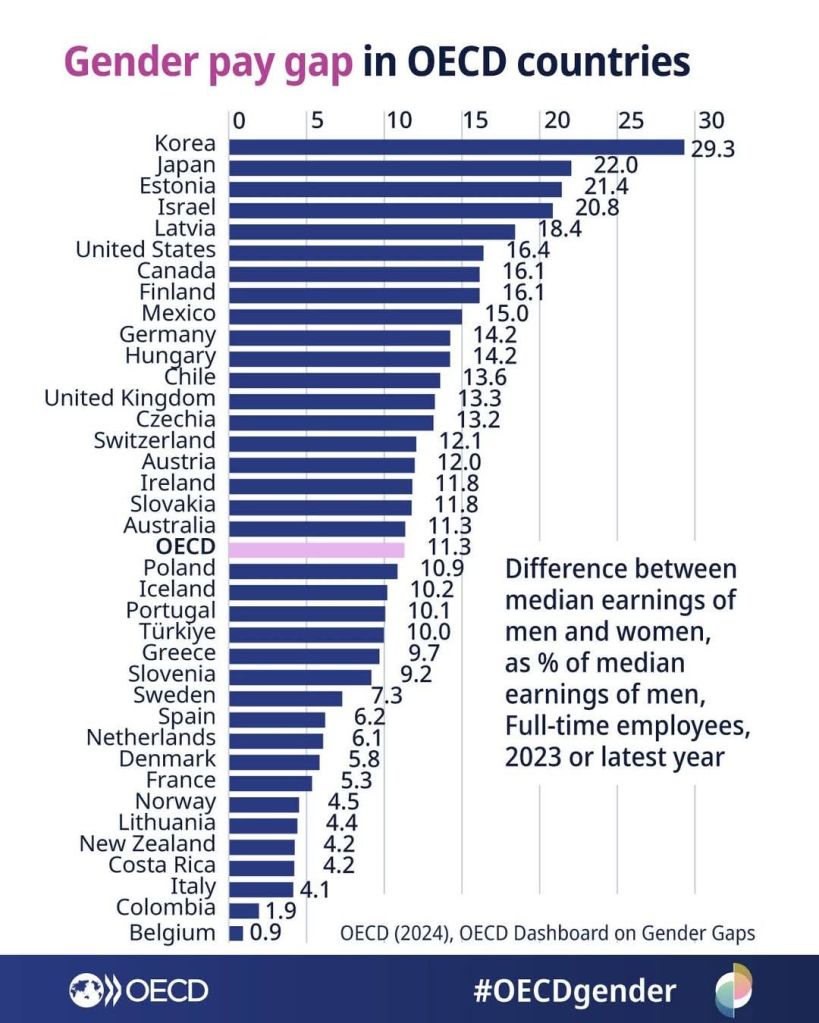
It’s well-known that when a couple has a child, the average woman experiences a “child penalty” in labor market outcomes, while outcomes for the man are largely unchanged. For a discussion of this pattern using US data, here’s an article by Jane Waldfogel from back in 1998 in the Journal of Economic Perspectives. As that…
The Child Penalty: An International View
Babies and the Macroeconomy
02 Feb 2025 Leave a comment
in applied price theory, development economics, economic history, economics of love and marriage, economics of marriage, human capital, labour economics, labour supply Tags: ageing society, economics of fertility, marriage and divorce
By Claudia Goldin. From NPR’s Planet Money.”Countries around the world have seen a jaw-dropping decline in fertility rates. In this paper, Claudia Goldin, the 2023 winner of the Nobel Prize in economic sciences, offers a new theory to help explain why (listen to The Indicator’s conversation with her back in 2021). Goldin starts by providing…
Babies and the Macroeconomy
Technological Disruption in the Labor Market
02 Feb 2025 Leave a comment
in econometerics, economic history, human capital, industrial organisation, labour economics, labour supply, occupational choice, poverty and inequality, unemployment Tags: creative destruction
By David J. Deming, Christopher Ong, and Lawrence H. Summers. From NPR’s Planet Money. Summers was Secretary of the Treasury from 1999 to 2001, director of the National Economic Council from 2009 to 2010 and president of Harvard University from 2001 to 2006.”Obviously, there is a big fear right now that artificial intelligence will kill…
Technological Disruption in the Labor Market
Stephen Fry on how the faults of the Left promoted the rise of the Right
31 Jan 2025 Leave a comment
in discrimination, environmentalism, law and economics, liberalism, Marxist economics, politics - Australia, politics - New Zealand, politics - USA, property rights Tags: Age of Enlightenment, British politics, free speech, political correctness, regressive left
Here! I’ve been dealing with trivial stuff all day involving billing and the post office (the Black Hole of government agencies) and have had no time to right. Enjoy Stephen Fry’s hourlong talk on Triggernometry on why the American Left promoted the rise of the American Right. I’ve been saying that for a long time, […]
Stephen Fry on how the faults of the Left promoted the rise of the Right
When did sustained economic growth begin?
31 Jan 2025 Leave a comment
in applied price theory, econometerics, economic growth, economic history, history of economic thought, labour economics, labour supply, macroeconomics, poverty and inequality Tags: The Great Enrichment
The subtitle is New Estimates of Productivity Growth in England from 1250 to 1870, and the authors are Paul Bouscasse, Emi Nakamura, and Jón Steinsson. Abstract: We estimate productivity growth in England from 1250 to 1870. Real wages over this period were heavily influenced by plague-induced swings in the population. Our estimates account for these […]
When did sustained economic growth begin?
Reviewing Covid experiences and policies
30 Jan 2025 Leave a comment
in applied price theory, applied welfare economics, economic history, economics of bureaucracy, economics of regulation, fiscal policy, health and safety, health economics, labour economics, labour supply, law and economics, macroeconomics, politics - Australia, politics - New Zealand, property rights, Public Choice Tags: economics of pandemics

I’ve spent the last week writing a fairly substantial review of a recent book (“Australia’s Pandemic Exceptionalism: How we crushed the curve but lost the race”) by a couple of Australian academic economists on Australia’s pandemic policies and experiences. For all its limitations, there isn’t anything similar in New Zealand. What we do have is […]
Reviewing Covid experiences and policies
ANANISH CHAUDHURI: Oral submission on the Treaty Principles Bill
30 Jan 2025 Leave a comment
in comparative institutional analysis, development economics, discrimination, economic history, growth disasters, law and economics, politics - New Zealand, property rights Tags: affirmative action, Age of Enlightenment, constitutional law, free speech, political correctness, racial discrimination, regressive left
Presented Jan 30, 2025 Kia Ora. Morena. Tena Koutou, Tena Koutou, Tena Koutou Katoa. My name is Ananish Chaudhuri. I am Professor of Economics at the University of Auckland. My views are my own and not those of my employer. Thank you very much for giving me an opportunity to speak this morning.…
ANANISH CHAUDHURI: Oral submission on the Treaty Principles Bill
My 92nd St. Y debate with Robert Kuttner on income inequality
29 Jan 2025 Leave a comment
in applied price theory, entrepreneurship, human capital, income redistribution, industrial organisation, labour economics, labour supply, liberalism, Marxist economics, politics - USA, poverty and inequality, Public Choice Tags: top 1%
Here goes: Ex po st, the Manhattan audience swung thirty (!) points in my favor, compared to the pre-debate poll. This was a fun event for me.
My 92nd St. Y debate with Robert Kuttner on income inequality
The 1920s immigration restrictions
29 Jan 2025 Leave a comment
in applied price theory, discrimination, econometerics, economic history, human capital, labour economics, labour supply, politics - USA Tags: economics of immigration, racial discrimination
The 1920s immigration restrictions in the US did not affect manufacturing wages. The US immigration restrictions of the 1920s lowered the occupational standings of whites and incumbent immigrants. US counties with more immigrants excluded by the quotas of the 1920s saw increased in-migration. During the Great Black Migration of the US, black southerners moved to […]
The 1920s immigration restrictions
Recent Comments