@ALeighMP, Lindsay Mitchell v. Susan St. John on family tax credit incidence

There is some feuding in the letters to editor page of the Sunday Star Times today between Lindsay Mitchell and Susan St John about whether employers pocket some of the Working for Families tax credit by reducing the wages they offer.

I have contracted-out my reply on the economic incidence of in-work tax credits to a former ANU economics professor who is now an Australian Labour Party federal MP.

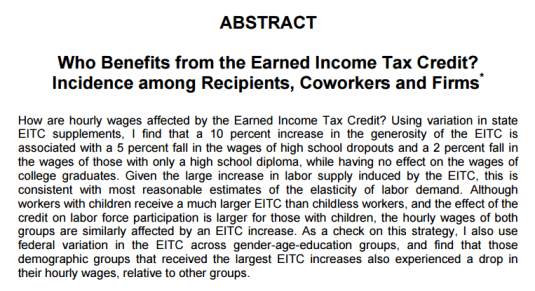
Source: Who Benefits from the Earned Income Tax Credit? Incidence Among Recipients, Coworkers and Firms by Andrew Leigh :: SSRN.

There is general agreement such as summarised by the Economist that a significant part of family tax credits goes into the pockets of employers:

An analysis of the EITC published in 2010 by Andrew Leigh of the Australian National University found that most of the benefit of the credit went to workers. Not all of it did though: a 10% increase in the credit was associated with a 5% dip in wages of high-school dropouts. By the same token, a study conducted the following year by Mr Rothstein found that for each dollar spent on tax credits, existing workers’ income rose by $0.73 (although $0.09 of this was because they chose to work more). Employers gained $0.36, as they spent less on wages.

Economists at Britain’s National Institute of Economic and Social Research are conducting a similar study of the British system of tax credits. Childless workers become eligible for the credits at the age of 25. By comparing wages either side of this threshold, they have been able to estimate how much the credits are depressing wages. Their preliminary (and unpublished) results suggest that, of the 76p an hour the government forks out in tax credits for someone on the minimum wage, 72-79% goes to workers.

In work tax credits increases labour supply, which depresses wages except where wages are pressing up against a binding minimum wage. Steve Landsberg has pointed out a paradoxe of a binding minimum wage when there is an earned income tax credit:

If you increase the EITC in a market with an effective minimum wage, you’ll get a whole lot more workers competing for the same limited number of jobs, and this competition must continue until all of the benefits have either been dissipated or transferred to employers, who are now able to demand harder work and offer fewer perquisites.

It’s easier just to tell people to stay away from the Cliff Edge

image

Image

The @MarcoRubio theory of elections is spreading to #UBI! Losing badly is winning

Image

Does @nztreasury @moturesearch understand its own 90-day trials research?

https://twitter.com/moturesearch/status/743595301345333248

Media reporting and Motu’s own tweet on its research contradict its own conclusions about what it found about the introduction of 90-day trial periods for new jobs in New Zealand.

https://twitter.com/moturesearch/status/743563189451841537

Motu’s executive summary is both as bold as the Motu tweet and directly contradicts it

We find no evidence that the ability to use trial periods significantly increases firms’ overall hiring; we estimate the policy effect to be a statistically and economically insignificant 0.8 percent increase in hiring on average across all industries.

However, within the construction and wholesale trade industries, which report high use of trial periods, we estimate a weakly significant 10.3 percent increase in hiring as a result of the policy.

No evidence means no evidence. Not no evidence but we did find some evidence in two large industries – evidence of a 10.3% increase in hiring. That is a large effect.
image

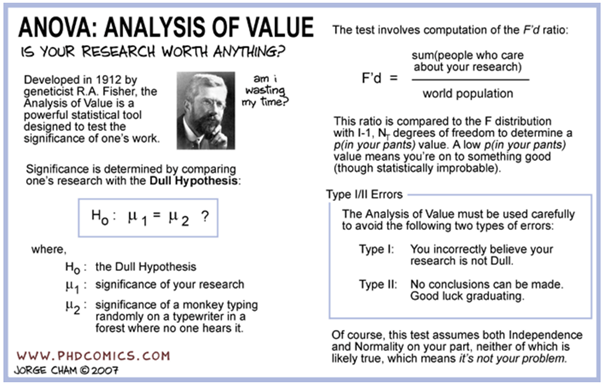
Both economic and statistical significance matter. Not only is the effect of 90-day trial periods in the construction and wholesale trades other than zero, 10% is large – a hiring boom. No evidence of any effects on employment of 90 day trial periods means no evidence.

Neither Treasury nor Motu understand their own research and the evidence of large effects in two industries. Can you conclude you have no evidence when you have some evidence, which they did in construction and wholesale trades? There is evidence, there is not no evidence.
image

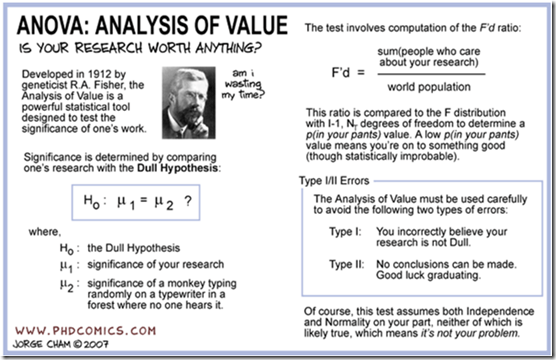
The paper was weak in hypothesis development and in its literature review. It was not clear whether the paper was testing the political hypothesis or the economic hypotheses. Neither were well explained or situated within modern labour economics or labour macroeconomics. If a political hypothesis does not stand up as a question of applied price theory, you cannot test it.

The Motu paper does not remind that graduate textbooks in labour economics show that a wide range of studies have found the predicted negative effects of employment law protections on employment and wages and on investment and the establishment and growth of businesses:

1. Employment law protections make it more costly to both hire and fire workers.

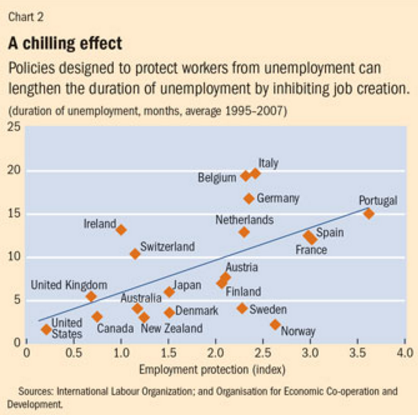
2. The rigour of employment law has no great effect on the rate of unemployment. That being the case, stronger employment laws do not affect unemployment by much.

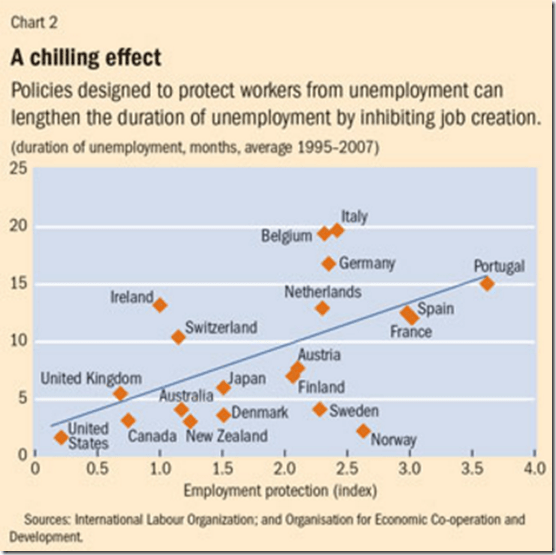
3. What is very clear is that is more rigourous employment law protections increase the duration of unemployment spells. With fewer people being hired, it takes longer to find a new job.

4. Stronger employment law protections also reduce the number of young people and older workers working age who hold a job.

5. The people who suffer the most from strong employment laws are young people, women and older adults. They are outside looking in on a privileged subsection of insiders in the workforce who have stable, long-term jobs and who change jobs infrequently.

Trial periods are common in OECD countries. There is plenty of evidence that increased job security leads to less employee effort and more absenteeism. Some examples are:

  • Sick leave spiking straight after probation periods ended;
  • Teacher absenteeism increasing after getting tenure after 5-years; and
  • Academic productivity declining after winning tenure.

Jacob (2013) found that the ability to dismiss teachers on probation – those with less than five years’ experience – reduced teacher absences by 10% and reduced frequent absences by 25%.

Studies also show that where workers are recruited on a trial, employers have to pay higher wages. For example, teachers that are employed with less job security, or with longer trial periods are paid more than teachers that quickly secure tenure.

Workers who start on a trial tend to be more productive and quit less often. The reason is that there was a better job match. Workers do not apply for jobs to which they think they will be less suited. By applying for jobs that the worker thinks they will be a better fit, everyone gains in terms of wages, job security and productivity. For more information see

  • Pierre Cahuc and André Zylberberg, The Natural Survival of Work, MIT Press, 2009;
  • Tito Boeri and Jan van Ours, The Economics of Imperfect Labor Markets, MIT Press, 2nd edition (2013);
  • Dale T. Mortensen, “Markets with Search Friction and the DMP Model”, American Economic Review 101, no. 4 (June 2011): 1073-91;
  • Christopher Pissarides. “Equilibrium in the Labor Market with Search Frictions”, American Economic Review 101 (June 2011) 1092-1105;
  • Christopher Pissarides, “Employment Protection”, Labour Economics 8 (2001) 131-159.
  • Eric Brunner and Jennifer Imazeki, “Probation Length and Teachers Salaries: Does Waiting Payoff?” Industrial and Labor Relations Review 64, no. 1 (October 2010): 164-179.
  • Andrea Ichino and Regina T. Riphahn, “The Effect of Employment Protection on Worker Effort – A Comparison of Absenteeism During and After Probation”, Journal of the European Economic Association 3 no. 1 (March 2005), 120-143;
  • Christian Pfeifer “Work Effort During and After Employment Probation: Evidence from German Personnel Data”, Journal of Economics and Statistics (February 2010); and
  • Olsson, Martin “Employment protection and sickness absence”, Labour Economics 16 (April 2009): 208-214.

In the labour market, screening and signalling take the form of probationary periods, promotion ladders, promotion tournaments, incentive pay and the back loading of pay in the form of pension vesting and other prizes and bonds for good performance over a long period.

There is good reasons to have strong priors about how employment regulation will work. Employment law protects a limited segment of the workforce against the risk of losing their job. These are those who have a job and in particular those that have a steady job, a long-term job.
image

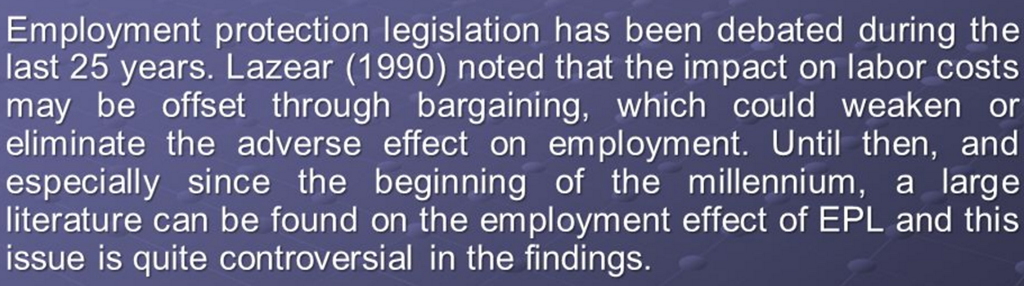
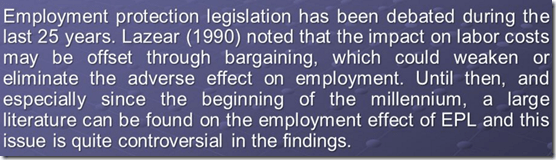
The impact of the introduction of trial periods on employment will be ambiguous because the lack of a trial period can be undone by wage bargaining.

  • If you have to hire a worker with full legal protections against dismissal, you pay them less because the employer is taking on more of the risk if the job match goes wrong. If they work out, you promote them and pay them more.
  • If you hire a worker on a trial period, they may seek a higher wage to compensate for taking on more of the risks if the job match goes wrong and there is no requirement to work it out rather than just sack them.

The twist in the tail is whether there is a binding minimum wage. If there is a binding minimum wage,  either the legal minimum or in a collective bargaining agreement, the employer cannot reduce the wage offer to offset the hiring risk so fewer are hired.

The introduction of trial periods will affect both wages and employment and employment more in industries that are low pay or often pay the minimum wage. Motu found large effects on hiring in two industries that used trial periods frequently. That vindicates the supporters of the law. 

Motu said that 36% of employers have used trial periods at least once. The average is 36% of employers have used them with up to 50% using them in construction and wholesale trade. That the practice survives in competition for recruits suggested that it has some efficiency value.

The large size of the employment effect in construction and wholesale trades is indeed a little bit surprising. Given that a well-grounded in economic theory hypothesis about the effect of trial period is ambiguous in regard to what will happen to wages and unemployment, a large employment effect is a surprise. If Motu had spent more time explaining employment protection laws and what hypotheses they imply, that surprise would have come to light sooner.

Motu’s research for the remaining New Zealand industries was a bit of an outlier. It should have spent more time explaining how to manage that anomalous status in light of the strong priors impartial spectators are entitled to have on the economics of employment protection laws.

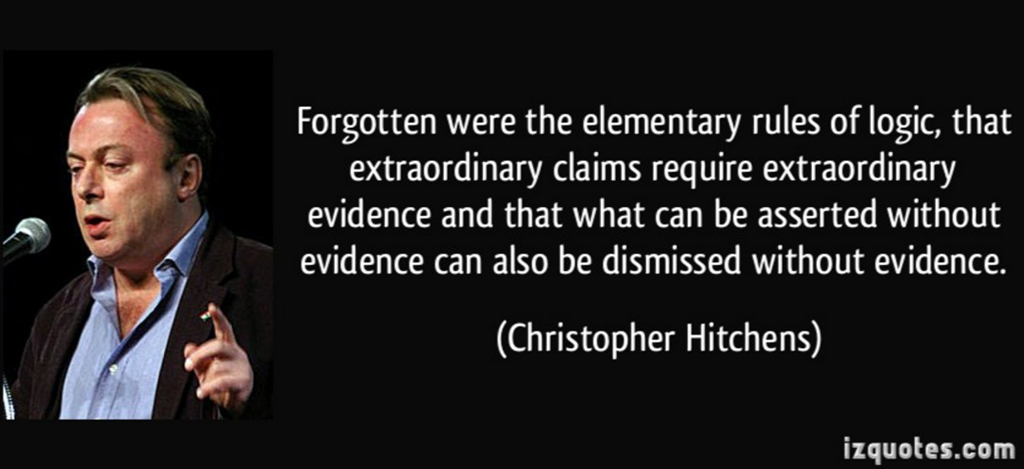
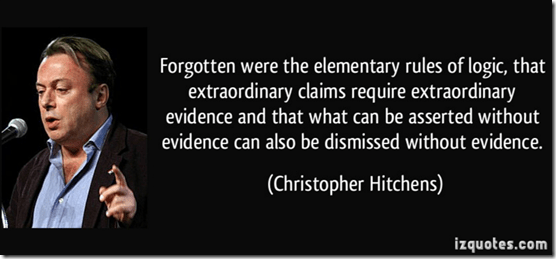
A conflicting study about the effects of any regulation should be no surprise. If there are not conflicting empirical studies, the academics are not working hard enough to win tenure and promotion. Extraordinary claims nonetheless require extraordinary evidence.
image

The British motherhood pay penalty starts at about 29

Source: Confronting gender inequality: findings from the LSE commission on gender, inequality and power – LSE Research Online.

James Heckman on the Economics of Human Development

Source: The Economics of Human Development | Institute for Economic Studies, Keio University.

What is a Luddite?

@Noahpinion says 20% losing their jobs is a small price to pay in #fightfor15

https://twitter.com/EconBizFin/status/626687442834300928

Noah Smith is a type of friend that should make poor Americans prefer their republican enemies. At least they are not fanatics. Fanatics never give up. Evil people have other things to do with their dastardly days.

Source: A Higher Minimum Wage Won’t Lead to Armageddon – Bloomberg View.

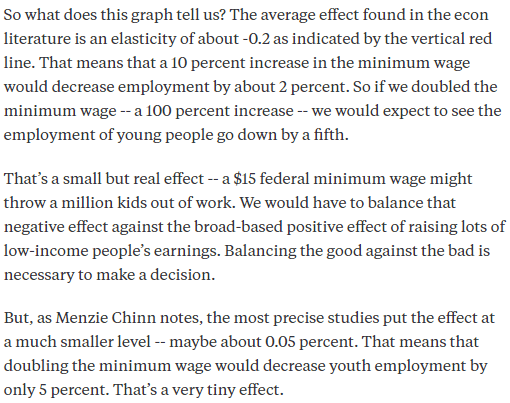
Describing 1/5th of young people losing their jobs after a doubling of the federal minimum wage to $15 per hour as a small but real effect is a type of callousness that not even Donald Trump could stoop. What is Even Noah Smith admits that large minimum wage increases experiment with the fortunes of young people

We don’t really know what happens when you raise the minimum wage to $15 — but soon, we will know. We will be able to see whether employment rates fall in L.A., Seattle, and San Francisco.

We will be able to see whether people who can’t get work migrate from these cities to cities with lower minimum wages. We will be able to see if employment growth suddenly slows after the enactment of the policy. In other words, federalism will do its job, by allowing cities to act as policy laboratories for the rest of the country. 

These one million young people who may well lose their jobs under a $15 minimum wage are real living people starting out their work in lives in a country with a rather inadequate unemployment benefits especially for the long-term unemployed.

Noah Smith wants to throw them onto the scrapheap through a large increase in the minimum wage because he is too cheap to support a large increase in the earned income tax credit.

If doubling the minimum wage to throw 20% of the workforce out of a job passes the brutal utilitarian calculus of bleeding-heart progressives, why not double everybody’s wages? Show the strength of your conviction about these Kruger–Card minimum wage results which repeal the laws of supply and demand.

https://twitter.com/AlvaroLaParra/status/738776906988822528

The leading reason for empirical research and economic history is to warns us not to repeat the mistakes of the past and not try experiments that are obvious folly. People and the economy should not be used as lab rats as Lucas explains in his short speech “What Economists Do”

I want to understand the connection between the money supply and economic depressions.

One way to demonstrate that I understand this connection–I think the only really convincing way–would be for me to engineer a depression in the United States by manipulating the U.S. money supply.

I think I know how to do this, though I’m not absolutely sure, but a real virtue of the democratic system is that we do not look kindly on people who want to use our lives as a laboratory. So I will try to make my depression somewhere else.

Where European Imperial powers sent their convicts

Thank you kind local government authority.

Image

Does Child Labor Help Children in Poverty?

A Life Cycle Model of Trans-Atlantic Employment Experiences | Tom Sargent


Source: A Life Cycle Model of Trans-Atlantic Employment Experiences | Institute for Economic Studies, Keio University

Child poverty, @jacindaardern and what higher wages cannot buy

The Left thinks the solution to poverty is giving the poor more money because poverty is caused by the poor not having enough money.

Labour MP Jacinda Ardern introduced the exception in an op-ed in the Sunday Star Times. People are poor because they do not have enough money unless that is because of a lack of money because you are not married or not living with the father of the child.

Ardern was raging against a report by Lindsey Mitchell arguing that a major driver of child poverty is the breakdown of the family and the rise of single parent households. Ardern said that

I’ve spent the better part of six years reading and researching the issue of child poverty, and what we need to do to resolve this complex problem in New Zealand.

And yet here it was, the silver bullet we have all been looking for. Marriage. Getting hitched. Tying the knot. It turns out that we didn’t need an Expert Advisory Group on child poverty, or any OECD analysis for that matter – apparently all we really need is a pastor and a party

Ardern preferred to attribute the increase in child poverty to welfare benefit cuts in the early 1990s.

There is an exception within this exception for the living wage as Ardern says 

But the other factors Family First was so quick to dismiss – low wages and staggering housing costs – mean we have 305,000 children in poverty. And this is the stuff that needs to change. It’s time we faced reality.

A living wage increase can solved family poverty. Actually getting a job and earning a wage does not reduce poverty among single-parent households but living wage increases do for families.

image

Source: Jacinda Ardern: Govt must improve the lot of our children – National – NZ Herald News.

You cannot have it both ways. That low wages cause family poverty but no wages does not.

The best solution to child poverty is to move their parents into a job. Simon Chapple is quite clear in his book last year with Jonathan Boston that.

Sustained full-time employment of sole parents and the fulltime and part-time employment of two parents, even at low wages, are sufficient to pull the majority of children above most poverty lines, given the various existing tax credits and family supports.

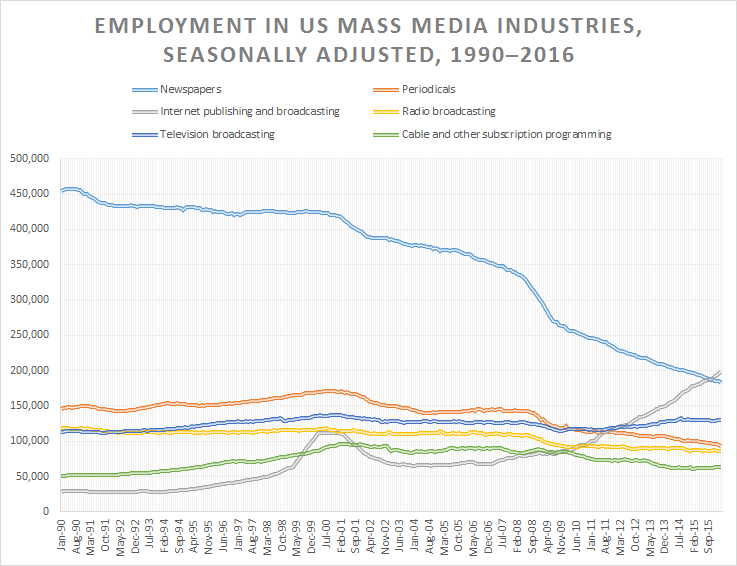
Creative destruction in mass media employment since 1990

The Bureau of Labour Statistics chart included books which I took it out along with a few others to confine the information to newspapers and other competitors in the mass media. People still study journalism but more and more go to public relations jobs in government and business.

image

Source: Employment trends in newspaper publishing and other media, 1990–2016 : The Economics Daily: U.S. Bureau of Labor Statistics.

..

#feelthebern will raise your taxes

Previous Older Entries Next Newer Entries

David Andolfatto

Celebrating humanity's flourishing through the spread of capitalism and the rule of law

Monetary Non-Neutrality

Celebrating humanity's flourishing through the spread of capitalism and the rule of law

Reason Magazine

Celebrating humanity's flourishing through the spread of capitalism and the rule of law

Coyote Blog

Celebrating humanity's flourishing through the spread of capitalism and the rule of law

Thoughts from the North

Celebrating humanity's flourishing through the spread of capitalism and the rule of law

Fardels Bear

A History of the Alt-Right

Vincent Geloso

Econ Prof at George Mason University, Economic Historian, Québécois

Bassett, Brash & Hide

Celebrating humanity's flourishing through the spread of capitalism and the rule of law

Truth on the Market

Scholarly commentary on law, economics, and more

The Undercover Historian

Beatrice Cherrier's blog

Matua Kahurangi

Celebrating humanity's flourishing through the spread of capitalism and the rule of law

Temple of Sociology

Celebrating humanity's flourishing through the spread of capitalism and the rule of law

Velvet Glove, Iron Fist

Celebrating humanity's flourishing through the spread of capitalism and the rule of law

Why Evolution Is True

Why Evolution is True is a blog written by Jerry Coyne, centered on evolution and biology but also dealing with diverse topics like politics, culture, and cats.

NoTricksZone

Celebrating humanity's flourishing through the spread of capitalism and the rule of law

Homepaddock

A rural perspective with a blue tint by Ele Ludemann

Kiwiblog

DPF's Kiwiblog - Fomenting Happy Mischief since 2003

The Dangerous Economist

Celebrating humanity's flourishing through the spread of capitalism and the rule of law

Watts Up With That?

The world's most viewed site on global warming and climate change

The Logical Place

Tim Harding's writings on rationality, informal logic and skepticism

Doc's Books

A window into Doc Freiberger's library

The Risk-Monger

Let's examine hard decisions!

Uneasy Money

Commentary on monetary policy in the spirit of R. G. Hawtrey

Barrie Saunders

Thoughts on public policy and the media

Liberty Scott

Celebrating humanity's flourishing through the spread of capitalism and the rule of law

Point of Order

Politics and the economy

James Bowden's Blog

A blog (primarily) on Canadian and Commonwealth political history and institutions

Science Matters

Reading between the lines, and underneath the hype.

Peter Winsley

Economics, and such stuff as dreams are made on

A Venerable Puzzle

"The British constitution has always been puzzling, and always will be." --Queen Elizabeth II

The Antiplanner

Celebrating humanity's flourishing through the spread of capitalism and the rule of law

Bet On It

Celebrating humanity's flourishing through the spread of capitalism and the rule of law

History of Sorts

WORLD WAR II, MUSIC, HISTORY, HOLOCAUST

Roger Pielke Jr.

Undisciplined scholar, recovering academic

Offsetting Behaviour

Celebrating humanity's flourishing through the spread of capitalism and the rule of law

JONATHAN TURLEY

Res ipsa loquitur - The thing itself speaks

Conversable Economist

In Hume’s spirit, I will attempt to serve as an ambassador from my world of economics, and help in “finding topics of conversation fit for the entertainment of rational creatures.”

The Victorian Commons

Researching the House of Commons, 1832-1868

The History of Parliament

Articles and research from the History of Parliament Trust

Books & Boots

Reflections on books and art

Legal History Miscellany

Posts on the History of Law, Crime, and Justice

Sex, Drugs and Economics

Celebrating humanity's flourishing through the spread of capitalism and the rule of law

European Royal History

Exploring the Monarchs of Europe

Tallbloke's Talkshop

Cutting edge science you can dice with

Marginal REVOLUTION

Small Steps Toward A Much Better World

NOT A LOT OF PEOPLE KNOW THAT

“We do not believe any group of men adequate enough or wise enough to operate without scrutiny or without criticism. We know that the only way to avoid error is to detect it, that the only way to detect it is to be free to inquire. We know that in secrecy error undetected will flourish and subvert”. - J Robert Oppenheimer.