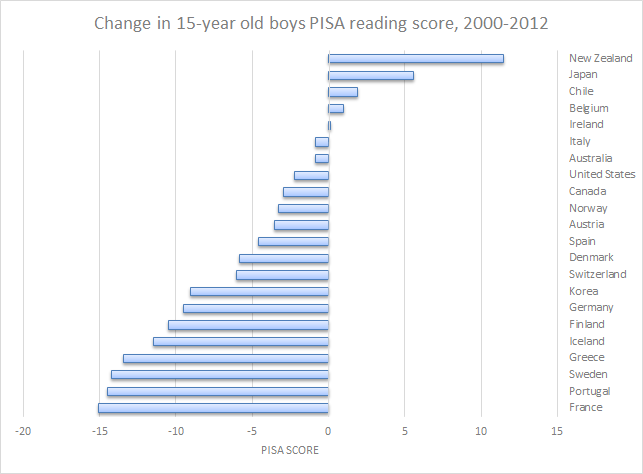
Source: OECD Family Database – OECD.
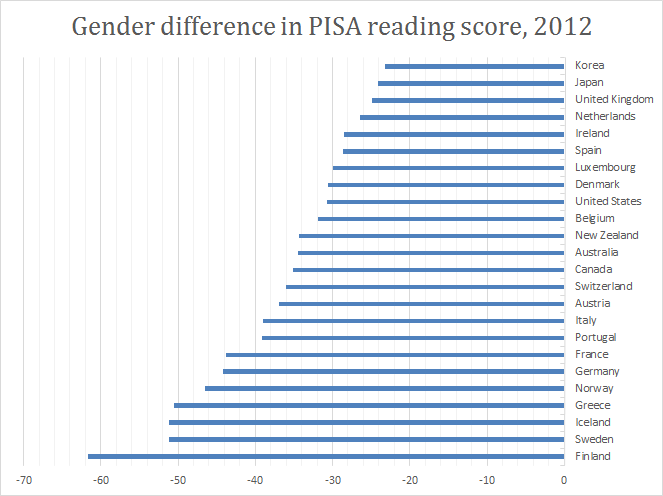
Source: OECD Family Database – OECD.
Celebrating humanity's flourishing through the spread of capitalism and the rule of law
04 Feb 2016 Leave a comment
in discrimination, economics of education, gender, human capital, labour economics Tags: PISA, reversing gender gap
04 Feb 2016 Leave a comment
in labour economics, labour supply, minimum wage, unemployment Tags: living wage, rational irrationality, teenage unemployment, The fatal conceit
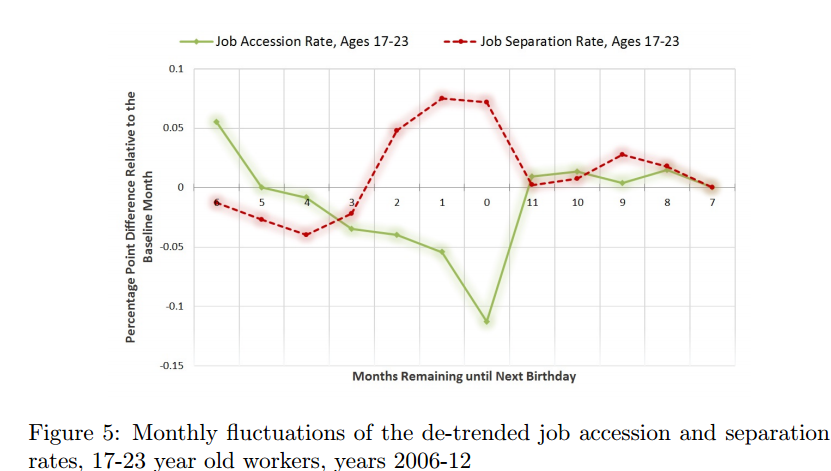
The Dutch minimum wage increases with every birthday until the age of 23. Not surprisingly, there is a surge in job losses and a recession in hiring around birthdays. What is even worse is employment opportunities are redistributed from a group with a high rate of unemployment, teenagers and young people, towards prime age adults who have a much lower rate of unemployment.
01 Feb 2016 Leave a comment
in labour economics, labour supply, politics - New Zealand, poverty and inequality, welfare reform Tags: Maori economic development, single mothers, single parents, welfare state
31 Jan 2016 2 Comments
in discrimination, gender, labour economics, labour supply, occupational choice, transport economics, urban economics Tags: commuting times, compensating differentials, gender wage gap, reversing gender gap
Commuting times need to be incorporated into calculations of the gender wage gap because they do represent a serious fixed cost of working that is higher for men than for women.
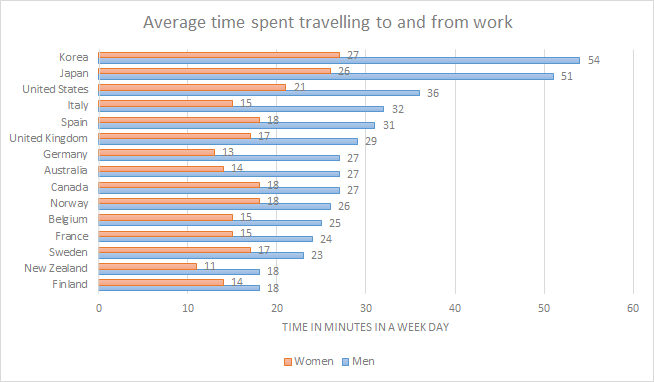
Source: OECD Family Database.
Not only is the commuting time for female workers less, there is much less variation across the OECD member countries than for men.
The figures for New Zealand are so low that they are suspicious.
31 Jan 2016 Leave a comment
in discrimination, gender, labour economics, labour supply, occupational choice, poverty and inequality Tags: asymmetric marriage premium, gender wage gap, high-powered jobs, offsetting behaviour, Parental leave, paternity leave, unintended consequences
31 Jan 2016 Leave a comment
in applied price theory, applied welfare economics, economic history, labour economics, labour supply, unions Tags: 40 hour week, hours worked, living standards, union power, union wage premium, working hours, working week
31 Jan 2016 Leave a comment
in economic history, economics, economics of love and marriage, gender, labour economics, labour supply, population economics
30 Jan 2016 Leave a comment
in discrimination, gender, labour economics, politics - USA Tags: gender wage gap
30 Jan 2016 Leave a comment
in discrimination, gender, human capital, labour economics, labour supply, occupational choice Tags: gender wage gap
30 Jan 2016 Leave a comment
in discrimination, gender, labour economics, labour supply
29 Jan 2016 Leave a comment
in economic history, economics of education, human capital, labour economics
29 Jan 2016 1 Comment
in discrimination, economics of love and marriage, gender, job search and matching, labour economics, occupational choice Tags: asymmetric marriage premium, gender wage gap, marital division of labour, marriage and divorce
Geoff Simmons attributes part of the gender wage gap to the reluctance especially among women in high-paying jobs to haggle over pay. These women at the top end of the labour market are more likely to accept the first offer.
This relative reluctance of women to haggle over their pay is important to explaining why the gender wage gap is much larger at the top end of the labour market than at the bottom according to Geoff Simmons. Women have to haggle more if the gender pay gap is to close further.
Haggling over the wage has costs as well as benefits as Richard Epstein explained 20 years ago within a search and matching framework when commenting on a paper written by Carol Rose in 1992:
If one party is known to gobble up virtually all the cooperative surplus, then that party will find it difficult to attract deals. People anticipate getting some portion of the gain and will have a tendency to migrate to other individuals and transactions when they do not have to be ever watchful of their fair share of the gain.
If women have the characteristics that Rose attributes to them, then they would be able to enter more deals and find jobs more easily than men. At this point it becomes an empirical question: whether the greater frequency of deals (or shorter periods of unemployment) offset the tendency to gain a larger share of the profits of any given transaction.
Women will find it easier to get a job because they haggle less and therefore negotiations are less likely to breakdown, which will increase their lifetime income. This reduction in the cost of search because of a greater prospect of a match offset the losses in wages from successful haggling.
Indeed, does not this reluctance to haggle among women make it more likely that employers will hire women and promote the because their reluctance to haggle makes them cheaper. This starts off a competition between employers that will slowly drive up the wages offered to women.
It is also the case that women invest in human capital that is more mobile between the jobs and they are more likely to quit the workforce and return again after motherhood.
The ability to quickly find a job after a career interruption is a competitive advantage rather than a disadvantage.
Men have more specialised human capital and are more likely to stay in one job so they have more to gain from haggling. In comparison, women invest in human capital that is more mobile between jobs because they anticipate downscaling or quitting because of motherhood.
In such a case, it is advantageous to have human capital that appeals to a wide range of employers and become can be quickly matched so that full-time or part-time employment and the associated income stream can start quick as quickly as possible. Workers who changed jobs more often and have shorter job tenures have less to gain and more to lose from haggling and not getting the job at all.
If women do not like to haggle, does this not imply they are less likely to be attracted the jobs with performance pay? Alan Manning investigated this specific question a few years ago.
The propensity of women to seek or avoid jobs with performance pay in a more competitive workplace is an important question because up to 40% of jobs have some form of performance pay which would put women off if they do not like to haggle as Geoff Simmons implies.
Manning used jobs with performance pay in the the 1998 and 2004 British Workplace Employees Relations Survey as a proxy for the level of competition in the workplace.
If Geoff Simmons is right, women should shy away from jobs with performance pay. Women should be less likely to hold these jobs with performance pay, other things being equal. That is precisely the hypothesis that Alan Manning explored. He is a world-class labour economist. What did he find?
We find very modest evidence for differential sorting into performance pay schemes by gender, and small effects of performance pay on hourly wages. Furthermore, and unlike the laboratory studies, we find no significant effect of the gender mix in the job on the responsiveness to performance pay.
We do find some evidence for an effect of performance pay on a measure of work effort in line with the experimental evidence but the bottom line is that a very small part of the gender pay gap can be attributed to these factors.
The gender pay is already tiny in New Zealand and only a tiny part of that can be explained as any reluctance of women to compete in the workforce such as through signing on for performance pay.
Manning found that the gender mix of jobs in occupation is not affected by the presence of performance pay but it should be if women are reluctant to angle and to be competitive as suggested by Geoff Simmons.
The reluctance of women to sign on for performance pay maybe be an aspect of the asymmetric marriage premium and the marital division of effort. Mothers, unlike fathers, cannot afford to go home at the end of the workday completely exhausted if there are children to care for.
Women have a long history of carefully selecting education and other human capital and occupations to anticipate the responsibilities of motherhood and minimising human capital depreciation during the associated career interruptions. Anticipating that motherboard is a lot of work is no stretch on that occupational sorting by women.
Women still do most of the household chores? Data on who does what in the house: goo.gl/3doqy4 #statistics https://t.co/fnY0d9OgkT—
DataStories (@LindaRegber) October 24, 2015
That division of effort between the sexes has got nothing to do with the behaviour of employers and everything to do with the marital division of labour. As to what to do about that Richard Posner raised a very good conundrum in a paper from 20 years ago:
The idea the government should try to alter the decisions of married couples on how to allocate time to raising children is a strange mixture of the utopian and the repulsive. The division of labour within marriage is something to be sorted out privately rather than made a subject of public intervention.
Liberal and radical frameless can if they wanted women to stay in the labour force and have no children or fewer children, or, persuade their husbands to assume a greater role in child rearing. Others can search the contrary. The ultimate decision is best left to private choice.
I remember from decades ago a couple at work who were very modern and trying to share the child rearing equally. Their three-year-old daughter was not very cooperative because she found that her mother was much better at braiding her hair than a father. That tantrum by their three-year-old was the beginning of the end of a grand plan.
28 Jan 2016 Leave a comment
in economics, labour economics, labour supply Tags: hours worked
28 Jan 2016 Leave a comment
in economic history, economics of media and culture, entrepreneurship, industrial organisation, labour supply, survivor principle, technological progress Tags: automation, rational irrationality, skill bias technical change, technological unemployment
Celebrating humanity's flourishing through the spread of capitalism and the rule of law
Celebrating humanity's flourishing through the spread of capitalism and the rule of law
Celebrating humanity's flourishing through the spread of capitalism and the rule of law
Celebrating humanity's flourishing through the spread of capitalism and the rule of law
Celebrating humanity's flourishing through the spread of capitalism and the rule of law
A History of the Alt-Right
Econ Prof at George Mason University, Economic Historian, Québécois
Celebrating humanity's flourishing through the spread of capitalism and the rule of law
Scholarly commentary on law, economics, and more
Beatrice Cherrier's blog
Celebrating humanity's flourishing through the spread of capitalism and the rule of law
Celebrating humanity's flourishing through the spread of capitalism and the rule of law
Celebrating humanity's flourishing through the spread of capitalism and the rule of law
Why Evolution is True is a blog written by Jerry Coyne, centered on evolution and biology but also dealing with diverse topics like politics, culture, and cats.
Celebrating humanity's flourishing through the spread of capitalism and the rule of law
A rural perspective with a blue tint by Ele Ludemann
DPF's Kiwiblog - Fomenting Happy Mischief since 2003
Celebrating humanity's flourishing through the spread of capitalism and the rule of law
The world's most viewed site on global warming and climate change
Tim Harding's writings on rationality, informal logic and skepticism
A window into Doc Freiberger's library
Let's examine hard decisions!
Commentary on monetary policy in the spirit of R. G. Hawtrey
Thoughts on public policy and the media
Celebrating humanity's flourishing through the spread of capitalism and the rule of law
Politics and the economy
A blog (primarily) on Canadian and Commonwealth political history and institutions
Reading between the lines, and underneath the hype.
Economics, and such stuff as dreams are made on
"The British constitution has always been puzzling, and always will be." --Queen Elizabeth II
Celebrating humanity's flourishing through the spread of capitalism and the rule of law
Celebrating humanity's flourishing through the spread of capitalism and the rule of law
WORLD WAR II, MUSIC, HISTORY, HOLOCAUST
Undisciplined scholar, recovering academic
Celebrating humanity's flourishing through the spread of capitalism and the rule of law
Res ipsa loquitur - The thing itself speaks
In Hume’s spirit, I will attempt to serve as an ambassador from my world of economics, and help in “finding topics of conversation fit for the entertainment of rational creatures.”
Researching the House of Commons, 1832-1868
Articles and research from the History of Parliament Trust
Reflections on books and art
Posts on the History of Law, Crime, and Justice
Celebrating humanity's flourishing through the spread of capitalism and the rule of law
Exploring the Monarchs of Europe
Cutting edge science you can dice with
Small Steps Toward A Much Better World
“We do not believe any group of men adequate enough or wise enough to operate without scrutiny or without criticism. We know that the only way to avoid error is to detect it, that the only way to detect it is to be free to inquire. We know that in secrecy error undetected will flourish and subvert”. - J Robert Oppenheimer.


Recent Comments