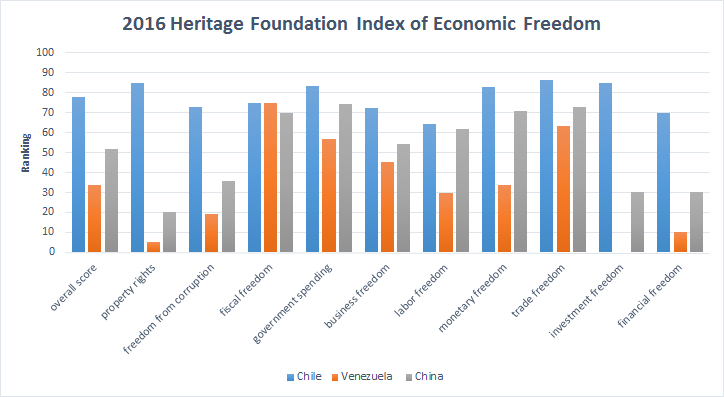
Source: Index of Economic Freedom: Promoting Economic Opportunity and Prosperity by Country.
Celebrating humanity's flourishing through the spread of capitalism and the rule of law
06 Feb 2016 Leave a comment
in development economics, economics of regulation, entrepreneurship, fiscal policy, growth disasters, growth miracles, industrial organisation, labour economics, law and economics, macroeconomics, monetary economics, property rights, public economics Tags: capitalism and freedom, Chile, China, The Great Escape, Venezuela
06 Feb 2016 Leave a comment
in discrimination, gender, human capital, labour economics, labour supply, occupational choice, politics - New Zealand, politics - USA
06 Feb 2016 Leave a comment
in economics of media and culture, fiscal policy, income redistribution, labour economics, labour supply, law and economics, poverty and inequality, property rights, public economics, rentseeking Tags: basic income, car racing, Finland, guaranteed minimum income, negative income tax
06 Feb 2016 Leave a comment
in economic history, labour economics, labour supply, politics - New Zealand, public economics Tags: ageing society, labour demographics, old-age pension, older workers, social insurance, welfare state
The increase in the eligibility age from the age of 60 to the age of 65 for the old age pension in New Zealand clearly sparked an explosion in female labour force participation between these ages.
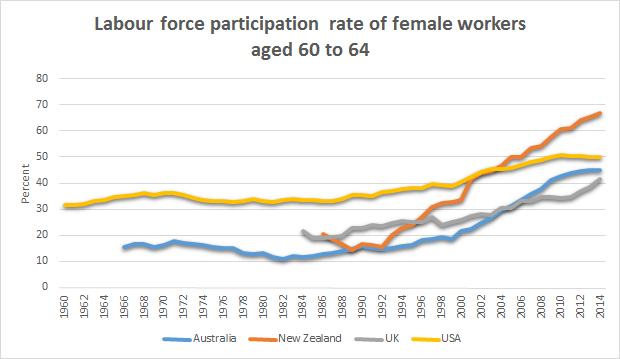
Data extracted on 05 Feb 2016 04:49 UTC (GMT) from OECD.Stat.
06 Feb 2016 Leave a comment
in discrimination, economics of education, gender, human capital, labour economics Tags: PISA, reversing gender gap

Source: OECD Family Database – OECD.
05 Feb 2016 Leave a comment
in labour economics, labour supply, politics - Australia, politics - New Zealand, politics - USA, public economics Tags: 2016 presidential election, British election, Canada, Denmark, family tax credit, in work tax credit, taxation and labour supply
For some reason the Labour government in New Zealand in the mid-2000s could not bring itself to admit it was introducing a huge tax cut for families. To avoid admitting it ever gave a tax cut, that Labour government called the huge family tax credit introduced in 2004 and 2005 Working for Families.
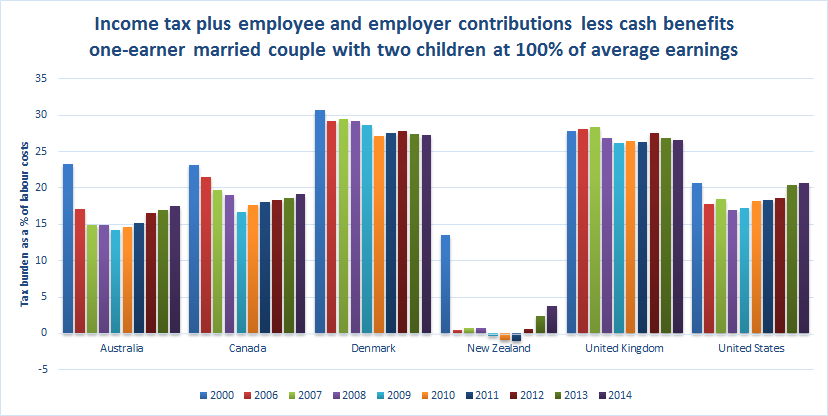
Source: Taxing Wages 2015 – OECD 2015
The above data does not include the effects of GST and VAT.
05 Feb 2016 Leave a comment
in economic history, labour economics, labour supply, politics - New Zealand, public economics
Up until the early 1990s, New Zealand had a universal old age pension that was paid from the age of 60. There was no means test or assets test. The eligibility age for this old age pension was increased to age 65 over the course of the 1990s and early 2000s. It obviously showed up in the labour supply of workers aged 66 and over in New Zealand after the change in the eligibility age.
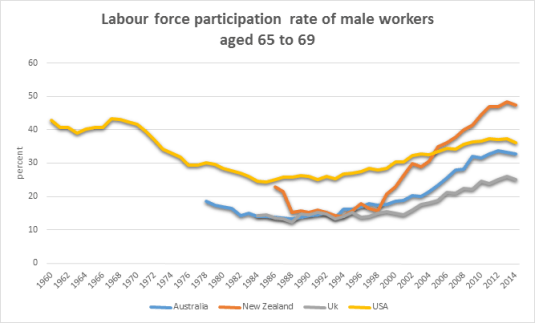
Data extracted on 05 Feb 2016 04:49 UTC (GMT) from OECD.Stat.
05 Feb 2016 Leave a comment
in applied price theory, economic history, labour economics, labour supply, politics - New Zealand, public economics
Up until the early 1990s, New Zealand had a universal old age pension that was paid from the age of 60. There was no means test or assets test. The eligibility age for this old age pension was increased to age 65 over the course of the 1990s and early 2000s. It obviously showed up in the labour supply of workers aged 60 to 64 in New Zealand both before and after the change in the eligibility age.

Data extracted on 05 Feb 2016 04:49 UTC (GMT) from OECD.Stat.
05 Feb 2016 Leave a comment
in labour economics, labour supply, politics - New Zealand, poverty and inequality, public economics
05 Feb 2016 Leave a comment
in labour economics, labour supply, politics - Australia, politics - New Zealand, politics - USA Tags: economics of immigration
05 Feb 2016 Leave a comment
in discrimination, economics of education, human capital, labour economics, labour supply Tags: PISA, reversing gender gap
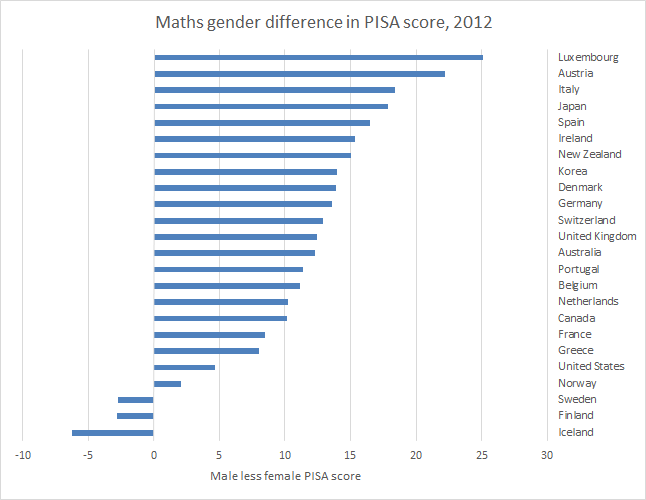
Source: OECD Family Database – OECD.
04 Feb 2016 Leave a comment
in constitutional political economy, economics of regulation, international economic law, international economics, International law, labour economics, law and economics, politics - New Zealand, unions Tags: employment law, employment protection, employment regulation, ILO, labour market regulation, social clauses, TPPA
New Zealand has signed and ratified dozens of International Labour Organisation Conventions dating back to 1921. They all fetter the sovereignty of New Zealand. As a member of the ILO, New Zealand is required to report on its application of ILO Conventions.
That limitation on the sovereignty of New Zealand is no more and no less than in an international trade agreement. New Zealand can renounce an international trade agreement and has renounced nine International Labour Organisation conventions.
Jane Kelsey makes the following points about the legal implications of the Trans-Pacific Partnership agreement:
The 30 chapter Trans-Pacific Partnership Agreement (TPPA) constrains domestic law and policy at central government level, and in places by local government and SOEs, in diverse areas beyond traditional aspects of international trade.
…The TPP provides cumulative opportunities for foreign states and corporations to influence domestic decisions which may be burdensome and intrusive.
The exact same objections apply to the ILO conventions. The union movement does not hesitate to argue that the democratic process in New Zealand should be overridden because the proposal at hand purportedly conflicts with an ILO convention.
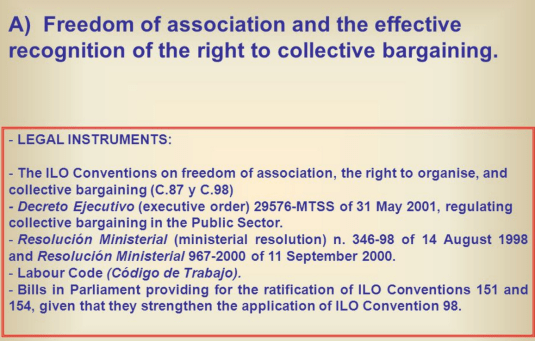
For example, when the government was choosing to deregulate collective bargaining, the sovereignty of Parliament was questioned because of an ILO convention. Helen Kelly, CTU President said:
in Parliament on 4 June, the Minister was asked if he agreed with advice from officials that the ability for employers to opt out of multi-employer bargaining may breach our obligations under ILO Convention 98 on the right to organise and collective bargaining.
…There is no point attending such an important UN ILO conference at the time your Government is being advised it is breaching its undertakings to that very organisation…
The CTU President also referred to the regulatory impact statement prepared for that collective bargaining legislation:
The paper also points out that these changes open NZ up to international examination by the International Labour Organisation (ILO) for non-compliance with Convention 98 – on the Right to Organise and Collectively Bargain, which New Zealand has signed up to.
Helen Kelly says “at least four of the proposals are deemed to be inconsistent with our international obligations, and two of them are classified as uncertain. Why the Government wants law changes that damage our international obligations is unclear.”
Council of Trade Unions submissions to minimum wage reviews have at least a dozen references to ILO conventions and the requirement to honour their provisions.
Posner and Goldsmith rightly argue that international law is a product of states pursuing their interests on the international stage. It does not induce states to comply contrary to their interests. The possibilities for what it can achieve are limited.
Government sign-up to various international agreements depending on their political priorities. You cannot complain that governments that you did not vote do what government you voted for also did, which was sign up to international agreements that suited their political agendas. The solution is to work harder to win the next general election.
As for opposing trade agreements on sovereignty grounds, it is rank hypocrisy for the union movement to do so given the number of times it cites international labour agreements when it suits them and seeks their inclusion in trade agreements to raise labour costs in developing countries.
04 Feb 2016 Leave a comment
in discrimination, gender, labour economics, labour supply, occupational choice, transport economics, urban economics Tags: commuting times, reverse gender gap
I lived in Japan so that 60% extra time the Japanese men spend travelling to and from work in those cramped trains is not to be underrated.
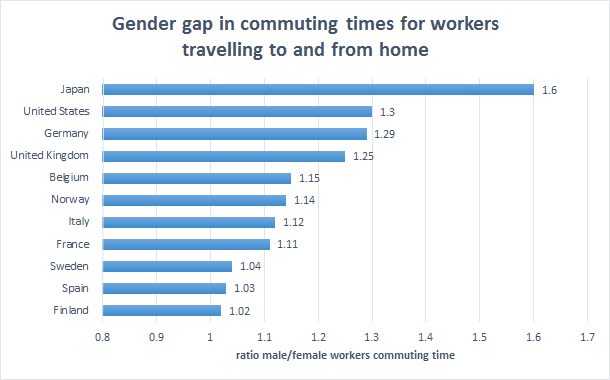
Source: OECD Family Database – OECD.
04 Feb 2016 Leave a comment
in discrimination, economics of love and marriage, gender, human capital, labour economics, labour supply, occupational choice, transport economics, urban economics Tags: asymmetric marriage premium, commuting times, gender wage gap, reversing gender gap
Few labour market statistics have any meaning unless broken down by gender. The compensating differentials that explain much of the family pay gap extend strongly to commuting times.
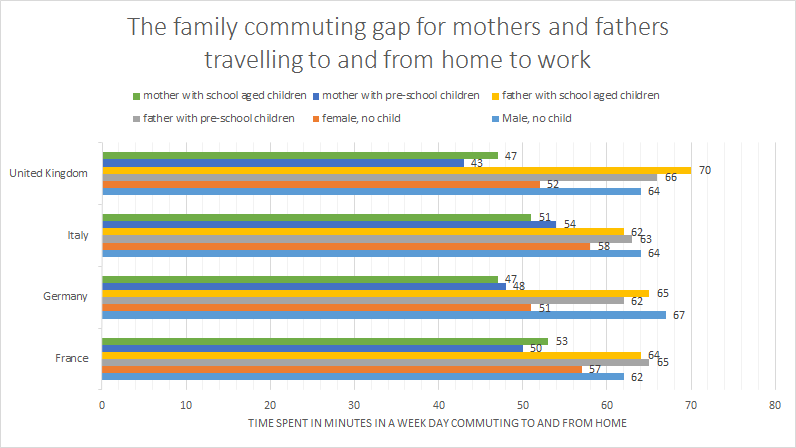
Source: OECD Family Database – OECD, Table LMF2.6.A.
Mothers commute a good 15 to 20 minutes less than fathers in the UK, Italy, Germany and France. Single women commute 5 to 10 minutes further than mothers. Single men and fathers commute much the same distance.
Celebrating humanity's flourishing through the spread of capitalism and the rule of law
Celebrating humanity's flourishing through the spread of capitalism and the rule of law
Celebrating humanity's flourishing through the spread of capitalism and the rule of law
Celebrating humanity's flourishing through the spread of capitalism and the rule of law
Celebrating humanity's flourishing through the spread of capitalism and the rule of law
A History of the Alt-Right
Econ Prof at George Mason University, Economic Historian, Québécois
Celebrating humanity's flourishing through the spread of capitalism and the rule of law
Scholarly commentary on law, economics, and more
Beatrice Cherrier's blog
Celebrating humanity's flourishing through the spread of capitalism and the rule of law
Celebrating humanity's flourishing through the spread of capitalism and the rule of law
Celebrating humanity's flourishing through the spread of capitalism and the rule of law
Why Evolution is True is a blog written by Jerry Coyne, centered on evolution and biology but also dealing with diverse topics like politics, culture, and cats.
Celebrating humanity's flourishing through the spread of capitalism and the rule of law
A rural perspective with a blue tint by Ele Ludemann
DPF's Kiwiblog - Fomenting Happy Mischief since 2003
Celebrating humanity's flourishing through the spread of capitalism and the rule of law
The world's most viewed site on global warming and climate change
Tim Harding's writings on rationality, informal logic and skepticism
A window into Doc Freiberger's library
Let's examine hard decisions!
Commentary on monetary policy in the spirit of R. G. Hawtrey
Thoughts on public policy and the media
Celebrating humanity's flourishing through the spread of capitalism and the rule of law
Politics and the economy
A blog (primarily) on Canadian and Commonwealth political history and institutions
Reading between the lines, and underneath the hype.
Economics, and such stuff as dreams are made on
"The British constitution has always been puzzling, and always will be." --Queen Elizabeth II
Celebrating humanity's flourishing through the spread of capitalism and the rule of law
Celebrating humanity's flourishing through the spread of capitalism and the rule of law
WORLD WAR II, MUSIC, HISTORY, HOLOCAUST
Undisciplined scholar, recovering academic
Celebrating humanity's flourishing through the spread of capitalism and the rule of law
Res ipsa loquitur - The thing itself speaks
In Hume’s spirit, I will attempt to serve as an ambassador from my world of economics, and help in “finding topics of conversation fit for the entertainment of rational creatures.”
Researching the House of Commons, 1832-1868
Articles and research from the History of Parliament Trust
Reflections on books and art
Posts on the History of Law, Crime, and Justice
Celebrating humanity's flourishing through the spread of capitalism and the rule of law
Exploring the Monarchs of Europe
Cutting edge science you can dice with
Small Steps Toward A Much Better World
“We do not believe any group of men adequate enough or wise enough to operate without scrutiny or without criticism. We know that the only way to avoid error is to detect it, that the only way to detect it is to be free to inquire. We know that in secrecy error undetected will flourish and subvert”. - J Robert Oppenheimer.


Recent Comments