https://twitter.com/pmarca/status/627305013820272640
@pmarca @ModeledBehavior hard budget constraints and sustained losses focus the progressive business mind. why unionise when employer broke?
— Jim Rose (@JimRosenz) August 1, 2015
Celebrating humanity's flourishing through the spread of capitalism and the rule of law
02 Aug 2015 2 Comments
in discrimination, gender, health and safety, labour economics, occupational choice, transport economics Tags: aviation, gender fatalities gaps, occupational deaths and injuries, reverse gender gap
Dear "lumbersexuals": real loggers are 30x more likely to die on the job than the avg worker priceonomics.com/how-the-lumber… http://t.co/1BLTBI37da—
Zachary Crockett (@zzcrockett) June 12, 2015
02 Aug 2015 Leave a comment
in labour economics, labour supply, politics - Australia, politics - New Zealand, politics - USA, public economics Tags: Australia, British economy, Canada, France, Germany, taxation and labour supply
How high is the US #tax burden on labor? Here's an OECD comparison tax.foundation/1KojUv9 by @samcjordan_ @kpomerleau http://t.co/fSAT8ut52z—
Tax Foundation (@taxfoundation) July 24, 2015
31 Jul 2015 1 Comment
in history of economic thought, human capital, labour economics, personnel economics Tags: human capital
Human Capital. http://t.co/rSwMFjOcEl—
Gem Reucroft (@HR_Gem) July 17, 2015
In a paper I wrote some years ago I explained the origin of that concept of human capital as follows:
The term ‘human capital’ was initially controversial, but the analytical concept was not. The analysis of human capital has many famous parents and grandparents (Kiker 1966).
Sir William Petty published the first analysis of the value of human capital in 1690. There were sophisticated analyses of investments in education and training and their implications for wage differentials, labour productivity and occupational choice by Adam Smith in 1776, Alfred Marshall in 1890 and Milton Friedman and Simon Kuznets in 1945.
Richard Cantillon, John Locke, John Stuart Mill, Adam Smith and Karl Marx all proposed that training rather than natural ability was more important in understanding occupational wage differentials. Adam Smith and Alfred Marshall referred to education and training as capital investments in human beings.
Irving Fisher in 1912 and Arthur Pigou in 1928 pioneered the explicit use of the term ‘human capital’. Jacob Mincer, Theodore Shultz and Gary Becker popularised the use of the term in the mid-20th century. See Kiker (1966) for a history of the concept of human capital.
31 Jul 2015 Leave a comment
in discrimination, gender, human capital, labour economics, labour supply, politics - New Zealand Tags: gender wage gap, media bias
31 Jul 2015 Leave a comment
in economics of education, human capital, labour economics, labour supply Tags: College premium, graduate premium
30 Jul 2015 Leave a comment
in business cycles, currency unions, economic growth, Euro crisis, job search and matching, labour economics, labour supply, macroeconomics, unemployment Tags: employment law, employment regulation, EU, Euro sclerosis, Euroland, Eurosclerosis, Japan, labour market regulation
30 Jul 2015 Leave a comment
in applied price theory, comparative institutional analysis, economics of bureaucracy, entrepreneurship, financial economics, human capital, industrial organisation, labour economics, managerial economics, occupational choice, organisational economics, rentseeking, survivor principle Tags: active investing, corporate welfare, efficient markets hypothesis, entrepreneurial alertness, hedge funds, industry policy, passive investing, picking winners, The fatal conceit, The pretence to knowledge
Page 32 of "An Illustrated Guide to Income" more economic #dataviz at: bit.ly/12SEI9p http://t.co/HYm0II2UNI—
Catherine Mulbrandon (@VisualEcon) May 08, 2013
Page 33 of "An Illustrated Guide to Income" more economic #dataviz at: bit.ly/10M7lqR http://t.co/FcmaqZWB32—
Catherine Mulbrandon (@VisualEcon) May 09, 2013
The hedge fund industry held $2.9 trillion of assets in June. Exchange-traded funds did better econ.st/1DdXgWS http://t.co/CK2foqMOpw—
The Economist (@EconEconomics) August 01, 2015
30 Jul 2015 Leave a comment
in income redistribution, labour economics, minimum wage, politics - Australia, politics - New Zealand, politics - USA, population economics, poverty and inequality, Public Choice, rentseeking Tags: British politics, Director's Law, expressive voting, living wage, rational ignorance, rational irrationality
OBR's idea of who will benefit from National Living Wage http://t.co/ztxfW906Gg—
James Bartholomew (@JGBartholomew) July 08, 2015
30 Jul 2015 Leave a comment
in discrimination, gender, labour economics, labour supply, occupational choice Tags: gender gap, maternal labour supply, maternity leave, paternity leave
29 Jul 2015 Leave a comment
in discrimination, gender, human capital, labour economics, labour supply, occupational choice, politics - New Zealand Tags: employer discrimination, ethnic wage gap, gender wage gap, racial discrimination, racial wage gap
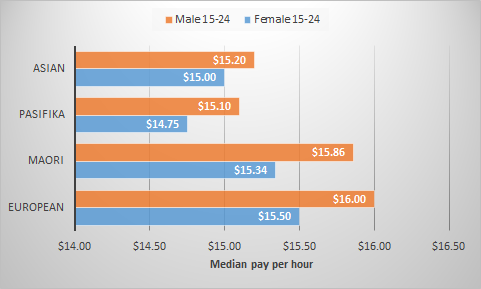
via New Zealand Income Survey 2014 via Human Rights Commission: Tracking Equality at Work
Celebrating humanity's flourishing through the spread of capitalism and the rule of law
Celebrating humanity's flourishing through the spread of capitalism and the rule of law
Celebrating humanity's flourishing through the spread of capitalism and the rule of law
Celebrating humanity's flourishing through the spread of capitalism and the rule of law
Celebrating humanity's flourishing through the spread of capitalism and the rule of law
Celebrating humanity's flourishing through the spread of capitalism and the rule of law
A History of the Alt-Right
Econ Prof at George Mason University, Economic Historian, Québécois
Celebrating humanity's flourishing through the spread of capitalism and the rule of law
Scholarly commentary on law, economics, and more
Beatrice Cherrier's blog
Celebrating humanity's flourishing through the spread of capitalism and the rule of law
Celebrating humanity's flourishing through the spread of capitalism and the rule of law
Celebrating humanity's flourishing through the spread of capitalism and the rule of law
Why Evolution is True is a blog written by Jerry Coyne, centered on evolution and biology but also dealing with diverse topics like politics, culture, and cats.
Celebrating humanity's flourishing through the spread of capitalism and the rule of law
A rural perspective with a blue tint by Ele Ludemann
DPF's Kiwiblog - Fomenting Happy Mischief since 2003
Celebrating humanity's flourishing through the spread of capitalism and the rule of law
The world's most viewed site on global warming and climate change
Tim Harding's writings on rationality, informal logic and skepticism
A window into Doc Freiberger's library
Let's examine hard decisions!
Commentary on monetary policy in the spirit of R. G. Hawtrey
Thoughts on public policy and the media
Celebrating humanity's flourishing through the spread of capitalism and the rule of law
Politics and the economy
A blog (primarily) on Canadian and Commonwealth political history and institutions
Reading between the lines, and underneath the hype.
Economics, and such stuff as dreams are made on
"The British constitution has always been puzzling, and always will be." --Queen Elizabeth II
Celebrating humanity's flourishing through the spread of capitalism and the rule of law
Celebrating humanity's flourishing through the spread of capitalism and the rule of law
WORLD WAR II, MUSIC, HISTORY, HOLOCAUST
Undisciplined scholar, recovering academic
Celebrating humanity's flourishing through the spread of capitalism and the rule of law
Res ipsa loquitur - The thing itself speaks
In Hume’s spirit, I will attempt to serve as an ambassador from my world of economics, and help in “finding topics of conversation fit for the entertainment of rational creatures.”
Researching the House of Commons, 1832-1868
Articles and research from the History of Parliament Trust
Reflections on books and art
Posts on the History of Law, Crime, and Justice
Celebrating humanity's flourishing through the spread of capitalism and the rule of law
Exploring the Monarchs of Europe
Cutting edge science you can dice with
Small Steps Toward A Much Better World


Recent Comments