Income by educational attainment in the USA
10 May 2015 Leave a comment
in economics of education, human capital, labour economics, labour supply, occupational choice Tags: College premium, education premium, labour demographics
US and Canadian unemployment rates, 1956–2014
10 May 2015 Leave a comment
in business cycles, economic growth, job search and matching, labour economics, labour supply, macroeconomics, politics - USA, unemployment Tags: Canada, unemployment rates
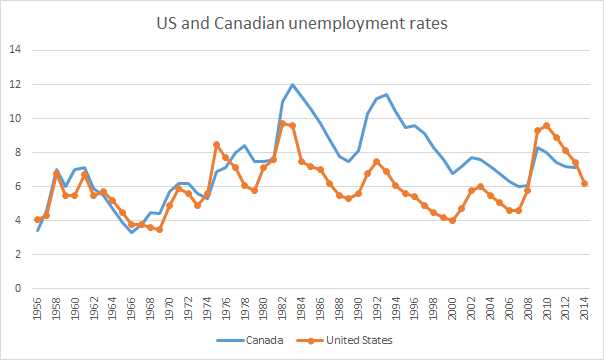
Source: OECD StatExtract
Unemployed people are defined as those who report that they are without work, that they are available for work and that they have taken active steps to find work in the last four weeks.
The ILO Guidelines specify what actions count as active steps to find work; these include answering vacancy notices, visiting factories, construction sites and other places of work, and placing advertisements in the press as well as registering with labour offices.
Unemployment isn’t much of an issue for the well educated in recessions
09 May 2015 Leave a comment
in business cycles, economic growth, economics of education, human capital, job search and matching, labour economics, labour supply, macroeconomics, occupational choice, unemployment Tags: labour demographics, prosperity and depression
#StayinSchool
April jobless rate for people 25+ with
B.A. or more: 2.7%
No h.s. diploma: 8.6%
on.wsj.com/1H63SHl http://t.co/UwzHjiaQz9—
Sudeep Reddy (@Reddy) May 08, 2015
April jobless rate by race/ethnicity:
Black 9.6%
Hispanic: 6.9%
White 4.7%
Asian 4.4%
on.wsj.com/1H619hg http://t.co/qgRWa7MB85—
Sudeep Reddy (@Reddy) May 08, 2015
The sick men of Europe? British and Irish unemployment rates, 1956–2013
09 May 2015 Leave a comment
in economic growth, economic history, great depression, job search and matching, labour economics, labour supply, macroeconomics, unemployment Tags: British economy, Celtic Tiger, Ireland, prosperity and depression, sick man of Europe, unemployment rates
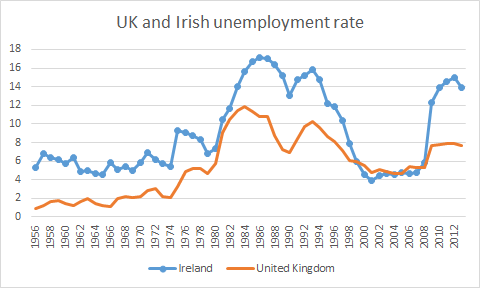
Source: OECD StatExtract
Ireland and Britain justly earned the name the sick man of Europe in the 1980s. Irish unemployment was in the mid teens much of the 1980s because the Irish economy was in a great depression from 1973 to 1992.
Unemployed people are defined as those who report that they are without work, that they are available for work and that they have taken active steps to find work in the last four weeks. The ILO Guidelines specify what actions count as active steps to find work; these include answering vacancy notices, visiting factories, construction sites and other places of work, and placing advertisements in the press as well as registering with labour offices.
Measures of racism across the world
08 May 2015 Leave a comment
in discrimination, politics - USA Tags: racial discrimination, racism, voter demographics
Study: Men are lazy to their core
08 May 2015 Leave a comment
in economics of love and marriage, gender, labour supply Tags: child rearing, childcare, gender gap, household production, marital division of labour

Adding it all up — both paid work and unpaid housework, including childcare — the average man’s work week was three hours longer than his partner’s before birth, but after parenthood he worked 8.5 hours less than his partner.
This is particularly interesting, given that this is a socio-economic cohort — wealthy and educated — that generally says equality of household labour is important in a relationship.
via Study: Men are lazy to their core – The Washington Post.
New Zealand has one of the highest minimum wages
08 May 2015 2 Comments
in economics of religion, labour economics, minimum wage, unemployment Tags: minimum wage
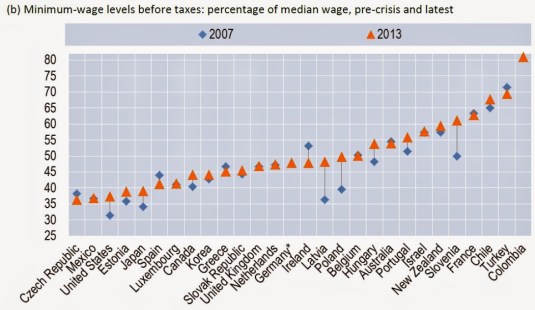

There are big differences in part-time employment rates across countries
06 May 2015 Leave a comment
in discrimination, gender, labour economics, labour supply, occupational choice Tags: gender wage gap, part-time employment, reversing gender gap
Gender & #jobs: pretty clear who's working only part-time. Follow @OECDlive & #gender tomorrow bit.ly/1BCpQOH http://t.co/arzboo6udl—
(@OECD) March 03, 2015
The rise and rise of mothers as breadwinners
05 May 2015 Leave a comment
in economics of love and marriage, gender, labour economics, labour supply, occupational choice Tags: female labour supply, gender wage gap, household division of labour, maternal labour supply
Labour stays silent over gender segregation at party rally
05 May 2015 Leave a comment
in discrimination, election campaigns, gender Tags: British general election, Left-wing hypocrisy, sex discrimination, UK politics
Labour stays silent over gender segregation at party rally specc.ie/1QcJHJf via @spectator http://t.co/Qs2FZV9Z7e—
Steerpike (@MrSteerpike) May 03, 2015
Up to a thousand expected at the great Labour Rally tomorrow at 4.00 being organised by @ansar_ali_khan http://t.co/Paec01bT8c—
Jack Dromey (@JackDromeyMP) May 01, 2015

More and more employees have rules about not been a dork online
04 May 2015 Leave a comment
in economics of media and culture, labour economics, law and economics, occupational choice, property rights Tags: employment law
Women are winning the human capital race | Kevin M. Murphy and Robert H. Topel
04 May 2015 Leave a comment
in applied welfare economics, discrimination, economics of education, gender, human capital, labour economics, labour supply, occupational choice Tags: gender wage gap, reversing gender gap

Why have women outpaced men? There’s little cognitive difference between the sexes, and males do better on standardized tests.
But Murphy, Becker, and Hubbard argue that women tend to have better “non-cognitive skills” than men do. Those personal skills and character traits such as persistence, self-control, and conscientiousness may help women excel academically and stay in school until they graduate.
The academic achievement gap actually starts before college: 25 percent more females than males took high-school advanced-placement tests in 2010, the Cleveland Fed economists find.
“There is a substantial gap between the measured high school performance of males and females,” Topel and Murphy write in a 2014 study, noting that female graduating high school seniors have, as a group, higher grade point averages than their male counterparts. “This high school gender gap in academic performance persists in the population that continues on to college.”
via Women are winning the human capital race | The University of Chicago Booth School of Business.
Further evidence of the success of the 1996 US welfare reforms and a lack of wage stagnation
03 May 2015 1 Comment
in economic growth, economic history, labour economics, labour supply, politics - USA, welfare reform Tags: middle-class wage stagnation, top 1%, US welfare reforms, wage stagnation
http://t.co/l7NzR1byNF—
EPI Chart Bot (@epichartbot) April 27, 2015
http://t.co/VZTp2A0H8n—
EPI Chart Bot (@epichartbot) April 05, 2015


Recent Comments