How to refute the case for a minimum wage when genuinely calling for a smarter federal minimum wage

What if minimum wage rates could somehow be tied to specific locations as suggested by former White House economist Jared Bernstein puts it in an essay in the New York Times:

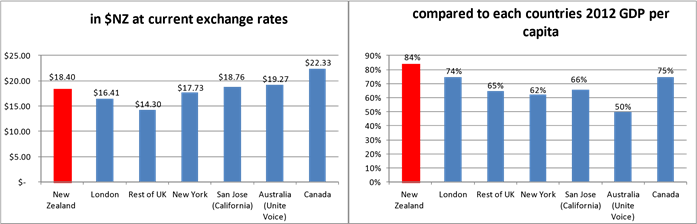
When we adjust a national minimum wage of $10.10 for regional differences, these are the amounts you’d need to have the same buying power: $11.94 in Washington, D.C., and $11.40 in California, but only $8.90 in Alabama and $9.08 in Kansas.

And of course, prices vary within states as well. In the New York City area, it would take $12.34 to meet the national buying power of $10.10; upstate around Buffalo, you’d need only $9.47. In the Los Angeles area, it would take $11.94; go up north a bit to Bakersfield, where prices are closer to the national average, and it’s $9.83.

To repeat what George Stigler said on the unsuitability of a nation-wide minimum wage in 1946 when there was monopsony, and therefore a small minimum wage increase is less likely to result in a reduction in employment:

If an employer has a significant degree of control over the wage rate he pays for a given quality of labour, a skilfully-set minimum wage may increase his employment and wage rate and, because the wage is brought closer to the value of the marginal product, at the same time increase aggregate output…

This arithmetic is quite valid but it is not very relevant to the question of a national minimum wage. The minimum wage which achieves these desirable ends has several requisites:

1. It must be chosen correctly… the optimum minimum wage can be set only if the demand and supply schedules are known over a considerable range…

2. The optimum wage varies with occupation (and, within an occupation, with the quality of worker).

3. The optimum wage varies among firms (and plants).

4. The optimum wage varies, often rapidly, through time.

A uniform national minimum wage, infrequently changed, is wholly unsuited to these diversities of conditions

A smarter federal minimum wage is a federal minimum wage of zero. Let each state and city set a minimum wage in accordance with its own economic conditions and the blackboard economics of monopsony and competition in the labour market.

As soon as you concede that there is not one single national labour market, other concessions must be made. This slippery slope includes that the monopsony power of employers might vary from state to state, city to city, and local labour market from local labour market.

Even a state or city minimum wage  regulator  would have to pretend to know an immense amount of information about the labour market with most of this information in a tacit form that cannot be summarised in statistics or other decision aids for regulators. As Hayek reminded in his classic in 1945 on The Use of Knowledge in Society:

the fact that the sort of knowledge with which I have been concerned is knowledge of the kind which by its nature cannot enter into statistics and therefore cannot be conveyed to any central authority in statistical form.

The statistics which such a central authority would have to use would have to be arrived at precisely by abstracting from minor differences between the things, by lumping together, as resources of one kind, items which differ as regards location, quality, and other particulars, in a way which may be very significant for the specific decision.

It follows from this that central planning based on statistical information by its nature cannot take direct account of these circumstances of time and place and that the central planner will have to find some way or other in which the decisions depending on them can be left to the "man on the spot."

How 15-year-olds score at problem solving

Image

Is unemployment voluntary or involuntary?

Robert Lucas in a famous 1978 paper argued that all unemployment was voluntary because involuntary unemployment was a meaningless concept. He said as follows:

The worker who loses a good job in prosperous time does not volunteer to be in this situation: he has suffered a capital loss. Similarly, the firm which loses an experienced employee in depressed times suffers an undesirable capital loss.

Nevertheless the unemployed worker at any time can always find some job at once, and a firm can always fill a vacancy instantaneously. That neither typically does so by choice is not difficult to understand given the quality of the jobs and the employees which are easiest to find.

Thus there is an involuntary element in all unemployment, in the sense that no one chooses bad luck over good; there is also a voluntary element in all unemployment, in the sense that however miserable one’s current work options, one can always choose to accept them.

I agree that we all make choices subject to constraints. To say that a choice is involuntary because it is constrained by a scarcity of job-opportunities information is to say that choices are involuntary because there is scarcity.

Alchian said there are always plenty of jobs because to suppose the contrary suggests that scarcity has been abolished. Lucas elaborated further in 1987 in Models of Business Cycles:

A theory that does deal successfully with unemployment needs to address two quite distinct problems.

One is the fact that job separations tend to take the form of unilateral decisions – a worker quits, or is laid off or fired – in which negotiations over wage rates play no explicit role.

The second is that workers who lose jobs, for whatever reason, typically pass through a period of unemployment instead of taking temporary work on the ‘spot’ labour market jobs that are readily available in any economy.

Of these, the second seems to me much the more important: it does not ‘explain’ why someone is unemployed to explain why he does not have a job with company X. After all, most employed people do not have jobs with company X either.

To explain why people allocate time to a particular activity – like unemployment – we need to know why they prefer it to all other available activities: to say that I am allergic to strawberries does not ‘explain’ why I drink coffee. Neither of these puzzles is easy to understand within a Walrasian framework, and it would be good to understand both of them better, but I suggest we begin by focusing on the second of the two.

Another way to understand unemployment is to use a device at the start of Alan Manning’s book on labour market monopsony:

What happens if an employer cuts the wage it pays its workers by one cent? Much of labour economics is built on the assumption that all existing workers immediately leave the firm as that is the implication of the assumption of perfect competition in the labour market.

In such a situation an employer faces a market wage for each type of labour determined by forces beyond its control at which any number of these workers can be hired but any attempt to pay a lower wage will result in the complete inability to hire any of them at all

Suppose workers offered to work for 1 cent. Would employers accept? Many do because they have intern and work experience programmes for students, but is this result of general application?

Understanding the reallocation of labour at the end of the recession requires careful attention to the 1980s writing of Alchian on the theory of the firm. Alchian and Woodward’s 1987 ‘Reflections on a theory of the firm’ says:

… the notion of a quickly equilibrating market price is baffling save in a very few markets. Imagine an employer and an employee. Will they renegotiate price every hour, or with every perceived change in circumstances?

If the employee is a waiter in a restaurant, would the waiter’s wage be renegotiated with every new customer? Would it be renegotiated to zero when no customers are present, and then back to a high level that would extract the entire customer value when a queue appears?

… But what is the right interval for renegotiation or change in price? The usual answer ‘as soon as demand or supply changes’ is uninformative.

Alchian and Woodward then go on to a long discussion of the role of protecting composite quasi-rents from dependent resources as the decider of the timing of wage and price revisions.

Alchian and Woodward explain unemployment as a side-effect of the purpose of wage and price rigidity, which is the prevention of hold-ups over dependent assets. They note that unemployment cannot be understood until an adequate theory of the firm explains the type of contracts the members of a firm make with one another.

My interpretation is the majority of employment relationships are capital intensive long-term contracts. Employers spend a lot of time searching and screening applicants to find those that will stay longer. In less skilled jobs, and in spot market jobs, employers will hire the best applicant quickly because job turnover costs are low. Back to Manning again:

That important frictions exist in the labour market seems undeniable: people go to the pub to celebrate when they get a job rather than greeting the news with the shrug of the shoulders that we might expect if labour markets were frictionless. And people go to the pub to drown their sorrows when they lose their job rather than picking up another one straight away. The importance of frictions has been recognized since at least the work of Stigler (1961, 1962).

Whatever may be among these frictions, wage rigidity is not one of them. Wages are flexible for job stayers and certainly new starters.

See What can wages and employment tell us about the UK’s productivity puzzle? by Richard Blundell, Claire Crawford and Wenchao Jin showing that in the recent UK recession 12% of employees in the same job as 12 months ago experienced wage freezes and 21% of workers in the same job as 12 months ago experienced wage cuts. Their data covered 80% of workers in the New Earnings Survey Panel Dataset.

Larger firms lay off workers; smaller firms tended to reduce wages. This British data showing widespread wage cuts dates back to the 1980s. Recent Irish data also shows extensive wage cuts among job stayers.

See too Chris Pissarides (2009), The Unemployment Volatility Puzzle: Is Wage Stickiness the Answer? arguing the wage stickiness is not the answer since wages in new job matches are highly flexible:

  1. wages of job changers are always substantially more procyclical than the wages of job stayers.
  2. the wages of job stayers, and even of those who remain in the same job with the same employer are still mildly procyclical.
  3. there is more procyclicality in the wages of stayers in Europe than in the United States.
  4. The procyclicality of job stayers’ wages is sometimes due to bonuses, and overtime pay but it still reflects a rise in the hourly cost of labour to the firm in cyclical peaks

How do existing firms who will not cut wages survive in competition with new firms who can start workers on lower wages? Industries with many short term jobs and seasonal jobs would suffer less from wage inflexibility.

Robert Barro (1977) pointed out that wage rigidity matters little because workers can, for example, agree in advance that they will work harder when there is more work to do—that is, when the demand for a firm’s product is high—and work less hard when there is little work. Stickiness of nominal wage rates does not necessarily cause errors in the determination of labour and production.

The ability to make long-term wage contracts and include clauses that guard against opportunistic wage cuts should make the parties better off. Workers will not sign these contracts if they are against their interests. Employers do not offer these contracts, and offer more flexible wage packages, will undercut employers who are more rigid. Furthermore many workers are on performance pay that link there must wages to the profitability of the company.

How can downward wage rigidity be a scientific hypothesis if extensive international evidence of widespread wage cuts since the 1980s and 30%+ of the workforce on performance bonuses is not enough to refute it?

Alchian and Kessel in “The Meaning and Validity of the Inflation-Induced Lag of Wages Behind Prices,” Amer. Econ. Rev. 50 [March 1960]:43-66) tested the hypothesis that workers suffered from money illusion by comparing the rates of return to firms in capital intensive industries with those of labour intensive industries. Labour intensive industries were not more profitable than capital intensive industries. Employers in labour intensive industries should profit from the misperceptions of workers about wages and future prices, but they did not.  Alchian and Kessel found little evidence of a lag between wage and price changes.

In Canadian industries in the 1960s and 1970s, wage indexation ranged from zero to nearly 100%. Industries with little indexation should show substantial responses of real wage rates, employment and output to nominal shocks. Industries with lots of indexation would be affected little by nominal disturbances. Monetary shocks had positive effects but an industry’s response to these shocks bore no relation to the amount of indexation in the industry. Shaghil Ahmed (1987) found that those industries with lots of indexation were as likely as those with little indexation to respond to shocks.

If the signing of new wage contracts was important to wage rigidity, there should be unusual behaviour of employment and real wage rates just after these signings, but the results are mixed. Olivei and Tenreyro (2010) used the tendency of contracts to be signed at the start of years to show that monetary policy had significant effects in January but little effect in December because the effects were quickly undone.

Alchian (1969) lists three ways to adjust to unanticipated demand fluctuations:
• output adjustments;
• wage and price adjustments; and
• Inventories and queues (including reservations).

Alchian (1969) suggests that there is no reason for wage and price changes to be used regardless of the relative cost of these other options:
• The cost of output adjustment stems from the fact that marginal costs rise with output;
• The cost of price adjustment arises because uncertain prices and wages induce costly search by buyers and sellers seeking the best offer; and
• The third method of adjustment has holding and queuing costs.

There is a tendency for unpredicted price and wage changes to induce costly additional search. Long-term contracts including implicit contracts arise to share risks and curb opportunism over relationship-specific capital. These factors lead to queues, unemployment, spare capacity, layoffs, shortages, inventories and non-price rationing in conjunction with wage stability.

Minimum wage coverage in Europe

Germany, Denmark, Italy, Austria, Finland, Sweden, Iceland, Norway and Switzerland do not have a statutory minimum wage. Capitalist hell-holes all.

A common feature of this group of countries is the high coverage rate of union agreed minimum wages, generally laid down in sectoral agreements by employers associations with unions.

The percentage of employees covered by union agreed minimum wages ranges from approximately 70% in Germany and Norway to almost 100% in Austria and Italy (though excluding irregular workers, who make up a relatively large share of the Italian labour market). Italy has a huge underground economy.

In Denmark, the percentage of employees covered by union agreed wages is estimated at between 81% and 90%, while in Finland and Sweden, this figure is 90%.

Scandinavia is a capitalist hell-hole that every true blue social democrat must denounce without reservation. Their so called left-wing parties as traitors to the working class and to the least powerful of all workers – the low-paid and unskilled.

The poor should not have to rely on scraps from the tables of the middle-class unions. They have been deserted by their so called social democratic governments.

Whether the low-paid and low-skilled get a fair consideration from unions in collective bargaining given these unions will be driven by majority rule – by the median voter/union member who is older, senior and of high job tenure – is a question worth exploring.

The evidence is not good. In the Finnish depression in the early 1990s, the unions refused to agree to nominal wage cuts despite 20% unemployment – the worst since the 1930s. They protect those that still had a job.

Most European labour markets are dual labour markets. Unions and employment protection laws ensure that they are made up of two-tier systems with ultra-secure permanent jobs with the rest on temporary contracts.

The Massive Tax Increase Hidden Inside Obamacare | Casey Mulligan

via The Massive Tax Increase Hidden Inside Obamacare | RealClearMarkets.

Image

Adam Smith as a pioneering labour economist

Adam Smith anticipated much of labour economics by basing it on his principle that individuals invest resources to earn the highest possible return. All uses of a resource must yield an equal rate of return adjusted for relative riskiness for otherwise reallocation would result.

The whole of the advantages and disadvantages of the different employments of labour and stock must, in the same neighbourhood, be either perfectly equal or continually tending to equality.

If in the same neighbourhood, there was any employment evidently either more or less advantageous than the rest, so many people would crowd into it in the one case, and so many would desert it in the other, that its advantages would soon return to the level of other employments.

Smith used this insight on  be equality of returns to explain why wage rates differed. Workers care about the whole aspects of the job, not only the cash wage payment: it is the “whole advantages and disadvantages” of the job that is equated across jobs in a competitive market, not wage alone. Smith set out criteria that determined how wages compensated or were discounted for the different characteristics of specific jobs:

  1. the agreeableness or disagreeableness of the employments themselves: better for more enjoyable working conditions will lead an individual to accept lower wages for their labour. Likewise, unpleasant work will have a higher wage. Wages vary with the ease or hardship, the cleanliness or dirtiness, the honourableness or dishonourableness of a job.
  2. The easiness and cheapness, or the difficulty and expense of learning them: jobs that are difficult or time-intensive to learn will pay more. Those who invest the time are being compensated for their additional effort with higher wages. The opportunity cost of forgoing the time-spent in training will be compensated for through higher wages. The difference between the wages of skilled labour and common labour is founded upon this principle.
  3. The constancy or inconstancy of employment: workers who face only partial or inconsistent employment throughout the course of the year, such as seasonal workers of agriculture, must be paid more for their labour. Their wages carry them not only during times of employment, but also during times of unemployment.
  4. The small or great trust which must be reposed in those who exercise them: individuals who have high levels of responsibility  in their jobs will be compensated with higher wages.
  5. The probability or improbability of success: this is an entrepreneurial element in wages. Employment where the chance of success is high will be paid lower than those who take more risks. If individuals were not compensated for risk, there would lack an incentive to seek employment that may not be successful.

The supply and demand for labour in different industries  determines relative wages and the relative numbers of employees in different occupations. Individuals are willing to make a trade-off between less desirable occupations and increased income. Smith spoke of how these five circumstances  listed above  lead to considerable inequalities in the wages and profits.

George Stigler thought that the second greatest triumph of Adam Smith in his Wealth of Nations was his famous list of cost factors that generate apparent but not real differences in rates of wages and profits because of training, hardships, unemployment, risk and trust. This list was quoted almost verbatim by his successors  down to this day and is the direct ancestor of both Alfred Marshall’s famous chapters on wages and of the modern theory of human capital.

Deirdre McCloskey on the minimum wage

“Jobs” are deals between workers and employers, and so “creating” them out of unwilling parties is impossible. The state, though, can outlaw deals, and has.

So: eliminate the minimum wage for people younger than 25. The resulting boom in jobs for young people will amaze.

Maybe it will inspire voters to get the state out of the job-outlawing business. Probably not, so sure are we that the state “protects” by stopping deals between willing parties.

Taxes and the labour supply in Europe

Richard Rogerson, 2008. "Structural Transformation and the Deterioration of European Labor Market Outcomes", Journal of Political Economy found that:
1. Hours worked per adult in France, Germany, Italy Europe decline by almost 45% compared to the US since 1956
2. The decline occurs at a steady pace from 1956 until the mid 1990s, in contrast to the fact that the relative increase in unemployment occurs in the mid 1970s.
3. The decline in hours worked in Europe is almost entirely accounted for by the fact that Europe develops a much smaller service sector than the US.
4. Relative increases in taxes and technological catch-up can account for most of the differences between the European and American time allocations to the market and outside over this per.

Ohanian, Rao and Rogerson 2008 in "Work and taxes: allocation of time in OECD countries" found
1. A steep decline in average hours worked per adult and large variations across OECD member countries in the magnitude of this decline.
2. Changes in labour taxes accounted for a large share of the trend differences.
3. Countries with high tax rates devote less time to market work, but more time to home activities, such as cooking and cleaning.
4. This reallocation of time from market work to home work is much stronger for females than for males.

The higher elasticities of labour supply of women, and married women and mothers are beyond dispute. Modern empirical labour economics as led by Mincer was built around explaining female and joint labour supply.

Richard Rogerson, 2007 in "Taxation and market work: is Scandinavia an outlier?" Economic Theory, found that how the government spends tax revenues when assessing the effects of tax rates on aggregate hours of market work.
1. Different forms of government spending imply different elasticities of hours of work with regard to tax rates.
2. While tax rates are highest in Scandinavia, hours worked in Scandinavia are significantly higher than they are in Continental Europe with differences in the form of government spending can potentially account for this pattern.
3. There is a much higher rate of government employment and greater expenditures on child and elderly care in Scandinavia.

Examining how tax revenue is spent is central to understanding labour supply effects:
1. If higher taxes fund disability payments which may only be received when not in work, the effect on hours worked is greater relative to a lump-sum transfer.
2. If higher taxes subsidise day care for individuals who work, then the effect on hours of work will be less than under the lump-sum transfer case.

Murray Rothbard on outlawing jobs


All demand curves are falling, and the demand for hiring labour is no exception. Hence, laws that prohibit employment at any wage that is relevant to the market (a minimum wage of 10 cents an hour would have little or no impact) must result in outlawing employment and hence causing unemployment…

Since the demand curve for any sort of labour (as for any factor of production) is set by the perceived marginal productivity of that labour, this means that the people who will be disemployed and devastated by this prohibition will be precisely the "marginal" (lowest wage) workers, e.g. blacks and teenagers, the very workers whom the advocates of the minimum wage are claiming to foster and protect.

The advocates of the minimum wage and its periodic boosting reply that all this is scare talk and that minimum wage rates do not and never have caused any unemployment.

The proper riposte is to raise them one better; all right, if the minimum wage is such a wonderful anti-poverty measure, and can have no unemployment-raising effects, why are you such pikers?

Why you are helping the working poor by such piddling amounts? Why stop at $4.55 an hour? Why not $10 an hour? $100? $1,000?…

It is conventional among economists to be polite, to assume that economic fallacy is solely the result of intellectual error.

But there are times when decorousness is seriously misleading, or, as Oscar Wilde once wrote, "when speaking one’s mind becomes more than a duty; it becomes a positive pleasure."

Did the 1996 U.S. Welfare Reforms Work?

Welfare Caseloads have declined since 1996

At the same time as major changes in program structure occurred during the 1990s, there were also stunning changes in behaviour. Strong adjectives are appropriate to describe these behavioural changes.

Nobody – of any political persuasion – predicted or would have believed possible the magnitude of change that occurred in the behaviour of low-income single-parent families over this decade.

Rebecca Blank (2002).

The subsequent declines in welfare participation rates and gains in employment were largest among the single mothers previously thought to be most disadvantaged: young (ages 18-29), mothers with children aged under seven, high school drop-outs, and black and Hispanic mothers. These low-skilled single mothers who were thought to face the greatest barriers to employment.

Austrian economics, labour economics and the economics of unemployment

Austrian economists seem not to be as thorough as they could be in applying the concepts of dispersed knowledge, tendency to equilibrium and entrepreneurial appraisal, discovery and learning to the labour market.

In a nutshell, the position of Mises and Rothbard is the problem of unemployment is not jobs being fewer than workers. On some terms, a job is always available in an open market. But a wage and the hours of labour required to earn it can be so unrewarding that a person is rational to decline the job offer and remain unemployed. Of course, they acknowledge institutional unemployment that results from are laws and arrangements which inhibit adjustment of prices of labour services.

Kirzner and Rothbard argue that the market is a process that is always in disequilibrium. Does this disequilibrium not imply some unemployment in the labour market? Why should the tendency toward equilibrium be any stronger in the labour market that elsewhere?  Bill Allen explained search unemployment this way:

…many officially counted as unemployed are heavily and rationally investing their resources in looking for work. They are sampling the market, seeking information on employment alternatives. That information is valuable, but it is not obtained either freely or instantaneously, and generally, the faster it is to be acquired, the more costly it will be…

as output falls [because of a demand or supply shock], there will be some rise in unemployment, for the economy’s adjustment to the new circumstances of supply and prices will not be made instantaneously, without frictions and lags.

Rothbard was well aware of search unemployment:

It might be objected that workers often do not know what job opportunities await them. This, however, applies to the owner of any goods up for sale. The very function of marketing is the acquisition and dissemination of information about the goods or services available for sale.

Except to those writers who posit a fantastic world where everyone has “perfect knowledge” of all relevant data, the marketing function is a vital aspect of the pro­duction structure.

The marketing function can be performed in the labour market, as well as in any other, through agencies or other means for the discovery of who or where the potential buyers and sellers of a particular service may be. In the labour market this has been done through “want ads” in the newspa­pers, employment agencies used by both employer and employee, etc.

Mises also spoke of search unemployment:

Unemployment is a phenomenon of a changing economy. The fact that a worker discharged on account of changes occurring in the arrangement of production processes does not instantly take advantage of every opportunity to get another job but waits for a more propitious opportunity is not a consequence of the tardiness of the adjustment to the change in conditions, but is one of the factors slowing down the pace of this adjustment.

It is not an automatic reaction to the changes which have occurred , independent of the will and the choices of the job-seekers concerned, but the effect of their intentional actions. It is speculative, not frictional

These are good discussions of search unemployment. But when discussing mismatch unemployment as identified by Hayek after a shortening of the produc­tion structure on the market where there might be temporary unemployment of workmen in the higher stages, lasting until the workers can be reabsorbed in the shorter proc­esses of the later stages, Rothbard’s repost to this possible case of involuntary unem­ployment on the free market is:

It is also true that the shortening of the structure means that there is a transition period when, at final wage rates, there will be un­employment of the men displaced from the longer processes. How­ever, during this transition period there is no reason why these workers cannot bid down wage rates until they are low enough to enable the employment of all the workers during the transi­tion. This transition wage rate will be lower than the new equilibrium wage rate. But at no time is there a necessity for unem­ployment.

The labour market is a process just as is any other market: it is a communication network that mobilises dispersed knowledge to overcoming ignorance. Why should knowledge unfold in the labour market process through entrepreneurial discovery any faster than elsewhere? There should be disequilibrium wages, entrepreneurial errors, unemployed and mispriced resources, and a process of entrepreneurial learning and error correction. Hayek held that unemployment is always a pricing problem:

The normal cause of recurrent waves of widespread unemployment is … a discrepancy between the way in which demand is distributed between products and services, and the proportions in which resources are devoted to producing them.

Unemployment is the result of divergent changes in the direction of demand and the techniques of production. If labour is not deployed according to demand for products, there is unemployment…

It is the continuous change of relative market prices and particularly wages which can alone bring about that steady adjustment of the proportions of the different efforts to the distribution of demand, and thus a steady flow of the stream of products.

True, but the correction of erroneous wage rates and the reallocation of labour and other resources to new jobs, new firms and new industries is neither instantaneous nor a free process. Kirzner explains:

The entrepreneurial forces acting on the market for any one commodity are thus continually pushing that market toward the market-clearing point—that is, to where (a) the quantity produced is such that (only) all units “worth producing” are indeed produced, and (b) the market price for this commodity is just high enough to make it, as a practical matter, worthwhile for producers to produce this quantity, and is just low enough to make it worthwhile for consumers to buy it…

The process through which the market tends to generate the “right” quantity of a commodity, and the “right” price for it, can be seen as a series of steps during which market participants gradually tend to discover the gaps or errors in the information on which they had previously been basing their erroneous production and/or buying decisions…

The market process is one in which, driven by the entrepreneurial sense for grasping at pure profit opportunities (and for avoiding entrepreneurial losses), market participants, learning more accurate assessments of the attitudes of other market participants, tend toward the market-clearing price-quantity combination.

Alchian, Demsetz and Barzel were on the mark when they pointed out that too frequently the process of change and reaching a new equilibrium is assumed to be a free good, having no resource costs. Hayek also spoke of the time that is takes to reach a new equilibrium because the new constellation of prices and wages must emerge through the free-play of the market:

The primary cause of the appearance of extensive unemployment, however, is a deviation of the actual structure of prices and wages from its equilibrium structure. Remember, please: that is the crucial concept. The point I want to make is that this equilibrium structure of prices is something which we cannot know beforehand because the only way to discover it is to give the market free play; by definition, therefore, the divergence of actual prices from the equilibrium structure is something that can never be statistically measured.

As Kirzner has well argued, entrepreneurs thrive on alertness to disequilibrium prices and they buy and sell to profit from their discoveries, thereby correcting the mispricing, but this takes time. The knowledge and intentions of the different members of society both across all markets and in the labour market about how to match workers to new jobs must come into agreement through a process of discovery and mutual learning that takes time. Phelps (1969) put forward a fine metaphor for how this process of learning and discovery takes place:

I have found it instructive to picture the economy as a group of islands between which information flows are costly: to learn the wage paid on an adjacent island, the worker must spend the day travelling to that island to sample its wage instead of spending the day at work.

Beveridge has similar views of a multiplicity of markets in 1912:

Why should it be the normal condition of the labour market to have more sellers than buyers, two men to every job and at least as often two jobs for every man? The explanation of the paradox is really a very simple one … that there is no one labour market but only an infinite number of separate labour markets.

Gary Becker drew a parallel between the theory of marriage and the theory of job search and matching. In both cases, it takes time to sort among the options and find a suitable pairing. Some are clearly unacceptable.  Good  matches will often take a long time to find unless people are just plain lucky. Involuntary unemployment is like saying you are involuntarily unmarried. You could marry the first person you meet, if they will have you, but few would say that is wise.

Workers must search for and discover each other. Both are entrepreneurs. The information, knowledge and forecasts of future wages and prices each needs to improve co-ordination of supply and demand will not be discovered immediately:

  • The behavioural responses of employers and workers to change are so pronounced because the cost of acquiring new information is profound (Alchian 1969). Many such costs impede wages from instantly fluctuating to rebalance labour supply with demand.
  • A job seeker does not initially know the location of suitable vacancies, the wages for various skills, differences in job security and other factors. Job seekers must search for this information, keep this knowledge current and forecast whether better vacancies may open soon.
  • Employers must search to learn the location, availability and asking wages of applicants.

The time consumed in labour market search is why Rothbard’s views below that wages just adjust to clear the market has been over taken by developments in economic thinking:

To talk of unemployment or employment without reference to a wage rate is as meaningless as talking of “supply” or “de­mand” without reference to a price. And it is precisely analogous. The demand for a commodity makes sense only with reference to a certain price.

In a market for goods, it is obvious that what­ever stock is offered as supply, it will be “cleared,” i.e., sold, at a price determined by the demand of the consumers…

Whatever supply of labour service is brought to market can be sold, but only if wages are set at what­ever rate will clear the market…

We conclude that there can never be, on the free market, an unemployment problem. If a man wishes to be employed, he will be, provided the wage rate is adjusted according.

Mises in the quote below treated unemployment as a investment in prospecting for a better wage offer very much along the lines of W.H. Hutt:

If a job-seeker cannot obtain the position he prefers, he must look for another kind of job. If he cannot find an employer ready to pay him as much as he would like to earn, he must abate his pretensions. If he refuses, he will not get any job. He remains unemployed.

What causes unemployment is the fact that–contrary to the above-mentioned doctrine of the worker’s inability to wait–those eager to earn wages can and do wait. A job-seeker who does not want to wait will always get a job in the unhampered market economy in which there is always unused capacity of natural resources and very often also unused capacity of produced factors of production. It is only necessary for him either to reduce the amount of pay he is asking for or to alter his occupation or his place of work.

Alchian (1969) lists three ways to adjust to unanticipated demand fluctuations:
• output adjustments;
• wage and price adjustments; and
• Inventories and queues (including reservations).

Alchian (1969) suggests that there is no reason for wage and price changes to be used regardless of the relative cost of these other options:
• The cost of output adjustment stems from the fact that marginal costs rise with output;
• The cost of price adjustment arises because uncertain prices and wages induce costly search by buyers and sellers seeking the best offer; and
• The third method of adjustment has holding and queuing costs.

There is a tendency for unpredicted price and wage changes to induce costly additional search. Long-term contracts including implicit contracts arise to share risks and curb opportunism over sunken investments in relationship-specific capital such as firm-specific human capital and specialised machinery. These factors lead to queues, unemployment, spare capacity, layoffs, shortages, inventories and non-price rationing in conjunction with wage stability. Alchian and Woodward in their 1987 paper ‘Reflections on a theory of the firm’ say that :

… the notion of a quickly equilibrating market price is baffling save in a very few markets. Imagine an employer and an employee. Will they renegotiate price every hour, or with every perceived change in circumstances? If the employee is a waiter in a restaurant, would the waiter’s wage be renegotiated with every new customer? Would it be renegotiated to zero when no customers are present, and then back to a high level that would extract the entire customer value when a queue appears?

… But what is the right interval for renegotiation or change in price? The usual answer ‘as soon as demand or supply changes’ is uninformative.

Alchian and Woodward then go on to a long discussion of the role of protecting composite quasi-rents from dependent resources as the decider of the timing of wage and price revisions. Alchian and Woodward explain unemployment to the side effect of the purpose of wage and price rigidity, which is the prevention of hold-ups over dependent assets. They note that unemployment cannot be understood until an adequate theory of the firm that explains the type of contracts the members of a firm contract with one another.

Walter Oi has also written on slack capacity as being productive and he included references back to W.H. Hutt. Oi’s work on retailing and supermarkets spends a lot of time explaining how an empty store is efficient because the owners are waiting for a mass of customers to arrive at unpredictable time. Oi redeveloped the term the economies of massed reserves to describe this. Oi thought that this was a better term than Hutt’s pseudo-idleness. Oi argued that all resource idleness could, in principle, be eliminated, but to accomplish this, the synchronization of the arrival rates of customers, sales clerks, and just-in-time inventories would be prohibitively expensive.

Benjamin Klein’s theory of rigid wages in American Economic Review in 1984 is one of the few that explored rigid wages as an industrial organisation issue. Klein treated rigid wages as a response to opportunism and hold-up problems over specialised assets and are forms of exclusive dealership or take-or-pay contracts.

The labour market is better understood by forgetting it is the labour market and treating it as a market for long-term contracts for relationship-specific services, firm-specific human capital and mutually dependent assets owned by multiple parties.

Labour is more heterogeneous than capital. The notion that buyers and sellers in the labour market can pair up instantly contradicts the Austrian traditions that markets only tend to equilibrium and entrepreneurs are needed to move things along.

Morgan O. Reynolds makes a good point in his labour economics textbook about how labour markets are different from other markets because there are no speculators and no forward markets in labour to quickly clear the market and allow entrepreneurs to drive the market towards equilibrium through arbitrage as quickly as they do elsewhere.

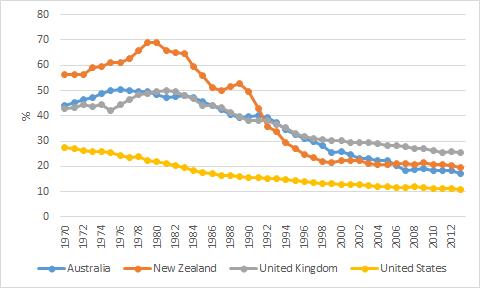
Percentage of the New Zealand population on a welfare benefit since 1970

Issue 13 2014

But a different story in the USA

Graph comparing the ln(percent) from FY1997 - FY2007 of California and District of Columbia child-only, TANF and state population

Richard Epstein on the true nature of labour markets

via Back to Basics for New Zealand Labour Markets

Teachers count

Image

Wages are set by the market process, not by employers

The more valuable the worker, the higher the bid for his services.

The high wage offer reflects rational concern of employers for their well-being, not a delicate sense of altruism or fairness. If you are technologically efficient in performing services which the community values highly, and if relatively few other workers are so productive, you will prosper.

It is competition among the hateful employers that raises wages, for they must bid against each other for labour to supply demanded products and thereby earn rewards. And it is competition among the lovable fellow workers that holds wages down by providing alternatives to employers…

The wage one employer is obliged to pay for labour is affected mightily by how much other employers are offering and it is a happy situation for me when rival employers bid against each other for my services. So competing workers offering labour lower my wage and competing employers bidding for labour raise my wage.

Bill Allen, The Midnight Economist

Previous Older Entries Next Newer Entries

Fardels Bear

A History of the Alt-Right

Vincent Geloso

Econ Prof at George Mason University, Economic Historian, Québécois

Bassett, Brash & Hide

Celebrating humanity's flourishing through the spread of capitalism and the rule of law

Truth on the Market

Scholarly commentary on law, economics, and more

The Undercover Historian

Beatrice Cherrier's blog

Matua Kahurangi

Celebrating humanity's flourishing through the spread of capitalism and the rule of law

Temple of Sociology

Celebrating humanity's flourishing through the spread of capitalism and the rule of law

Velvet Glove, Iron Fist

Celebrating humanity's flourishing through the spread of capitalism and the rule of law

Why Evolution Is True

Why Evolution is True is a blog written by Jerry Coyne, centered on evolution and biology but also dealing with diverse topics like politics, culture, and cats.

Down to Earth Kiwi

Celebrating humanity's flourishing through the spread of capitalism and the rule of law

NoTricksZone

Celebrating humanity's flourishing through the spread of capitalism and the rule of law

Homepaddock

A rural perspective with a blue tint by Ele Ludemann

Kiwiblog

DPF's Kiwiblog - Fomenting Happy Mischief since 2003

The Dangerous Economist

Celebrating humanity's flourishing through the spread of capitalism and the rule of law

Watts Up With That?

The world's most viewed site on global warming and climate change

The Logical Place

Tim Harding's writings on rationality, informal logic and skepticism

Doc's Books

A window into Doc Freiberger's library

The Risk-Monger

Let's examine hard decisions!

Uneasy Money

Commentary on monetary policy in the spirit of R. G. Hawtrey

Barrie Saunders

Thoughts on public policy and the media

Liberty Scott

Celebrating humanity's flourishing through the spread of capitalism and the rule of law

Point of Order

Politics and the economy

James Bowden's Blog

A blog (primarily) on Canadian and Commonwealth political history and institutions

Science Matters

Reading between the lines, and underneath the hype.

Peter Winsley

Economics, and such stuff as dreams are made on

A Venerable Puzzle

"The British constitution has always been puzzling, and always will be." --Queen Elizabeth II

The Antiplanner

Celebrating humanity's flourishing through the spread of capitalism and the rule of law

Bet On It

Celebrating humanity's flourishing through the spread of capitalism and the rule of law

History of Sorts

WORLD WAR II, MUSIC, HISTORY, HOLOCAUST

Roger Pielke Jr.

Undisciplined scholar, recovering academic

Offsetting Behaviour

Celebrating humanity's flourishing through the spread of capitalism and the rule of law

JONATHAN TURLEY

Res ipsa loquitur - The thing itself speaks

Conversable Economist

In Hume’s spirit, I will attempt to serve as an ambassador from my world of economics, and help in “finding topics of conversation fit for the entertainment of rational creatures.”

The Victorian Commons

Researching the House of Commons, 1832-1868

The History of Parliament

Articles and research from the History of Parliament Trust

Books & Boots

Reflections on books and art

Legal History Miscellany

Posts on the History of Law, Crime, and Justice

Sex, Drugs and Economics

Celebrating humanity's flourishing through the spread of capitalism and the rule of law

European Royal History

Exploring the Monarchs of Europe

Tallbloke's Talkshop

Cutting edge science you can dice with

Marginal REVOLUTION

Small Steps Toward A Much Better World

NOT A LOT OF PEOPLE KNOW THAT

“We do not believe any group of men adequate enough or wise enough to operate without scrutiny or without criticism. We know that the only way to avoid error is to detect it, that the only way to detect it is to be free to inquire. We know that in secrecy error undetected will flourish and subvert”. - J Robert Oppenheimer.

STOP THESE THINGS

The truth about the great wind power fraud - we're not here to debate the wind industry, we're here to destroy it.

Lindsay Mitchell

Celebrating humanity's flourishing through the spread of capitalism and the rule of law

Alt-M

Celebrating humanity's flourishing through the spread of capitalism and the rule of law