
A response to Judith Sloan on monopsony
11 Oct 2014 Leave a comment
in economics, labour economics, minimum wage Tags: Alan Manning, minimum wage, monopsony, search and matching
In the monopsony view view, search frictions in the labour market generate upward sloping labour supply curves to individual firms even when firms are small relative to the labour market.
Peter Kuhn in a great review of monopsony in motion pointed out the correct title was search fictions with wage posting and random matching in motion.This precision is important because, as Kuhn goes on to say:
“Manning clearly recognizes this weakness of search-based monopsony models, and does his best to address it in his discussion of ‘random’ vs. ‘balanced’ matching on pages 284–96. Manning’s basic general-equilibrium monopsony model, set out in chapter 2, assumes ‘random matching’, which means that, regardless of its size, every firm—from the local bakery to Microsoft—receives the same absolute number of job applications per period. The only way for a firm to expand its scale of operations in this model is to offer a higher wage… it is absolutely critical to the search-based monopsony model at the core of this book that there be diminishing returns to scale in the technology for recruiting new workers. In other words, for the theory to apply, firms must find it harder to recruit a single new worker the larger the absolute number of workers they currently employ.”
The evidence in favour of the monopoly view of minimum wage is is not as good as people think.
Under this monopsony view of minimum wages – an upward sloping supply curve of labour – an increase in the minimum wage increases both wages and employment.
That is, there is a very specific joint hypothesis of both more employment and more wages and as there are more workers in the workplace, higher output which the employer can only sell by cutting their prices.
David Henderson made very good points along this line when he reviewed David Card’s book back in 1994:
Interestingly, Card’s and Krueger’s own data on price contradict one of the implications of monopsony. If monopsony is present, a minimum wage can increase employment. These added employees produce more output. For a given demand, therefore, a minimum wage should reduce the price of the output. But Card and Krueger find the opposite. They write: ‘[P]retax prices rose 4 percent faster as a result of the minimum-wage increase in New Jersey…’ (p. 54). If their data on price are to be believed, they have presented evidenceagainst the existence of monopsony. David R. Henderson, “Rush to Judgment,”MANAGERIAL AND DECISION ECONOMICS, VOL. 17, 339-344 (1996)
The New Zealand social welfare system is the second most targeted towards the poor in the OECD
11 Oct 2014 Leave a comment
in applied welfare economics, labour economics, politics - New Zealand, welfare reform Tags: welfare reform

A Report on ‘Can Hearts and Minds be Bought?’ The Economics of Counterinsurgency in Iraq by Eli Berman, Jacob N. Shapiro and Joseph H. Felter
08 Oct 2014 Leave a comment
in applied price theory, defence economics, occupational choice, politics - Australia, politics - New Zealand, politics - USA Tags: war on terror


Can hearts and minds be bought? A metaphorical question posed to ask whether government spending can aid counterinsurgency. In their paper, Berman et al. seek to answer this basic question using current literature, recent data and a model of counterinsurgency.
They chose Iraq for their research because it is presently significant, there is a large amount of data and most importantly, because it is characterised by insurgency and not by ‘conventional warfare’. It is this characteristic, argued by Berman et al. that will be seen more often in future conflicts that is so crucial to understand. Another important facet to note is that current ‘US Army counterinsurgency doctrine’ is not based on any social scientific theory; thereby making the need to understand insurgency more vital to aid spending.
By using current data, Berman et al. find on the whole that the correlation between reconstruction spending and violence across Iraqi districts…
View original post 2,864 more words

The reverse gender gap in part-time employment
04 Oct 2014 Leave a comment
in discrimination, gender, human capital, labour economics, occupational choice Tags: compensating differentials, gender wage gap, part-time work, reversing gender gap

HT: economix

How to Make a Living as a Poet
01 Oct 2014 Leave a comment
in applied welfare economics, economics of media and culture, labour economics, occupational choice Tags: starving artists

Minimum Wage Hikes Hurt Job-Keepers
29 Sep 2014 Leave a comment
in labour economics, minimum wage, occupational choice Tags: compensating differentials, minimum wage
Robots will take my job alert: when musicians campaigned against the introduction of canned music into cinemas
28 Sep 2014 Leave a comment
in economics of media and culture, human capital, industrial organisation, labour economics, labour supply, survivor principle, technological progress Tags: automation, creative destruction, mechanisation, technological unemployment, The Great Enrichment


Idiosyncratic Whisk: Teen Employment and the Minimum Wage, 60 years of experience
27 Sep 2014 Leave a comment
in applied price theory, applied welfare economics, labour economics, minimum wage, unemployment Tags: minimum wage

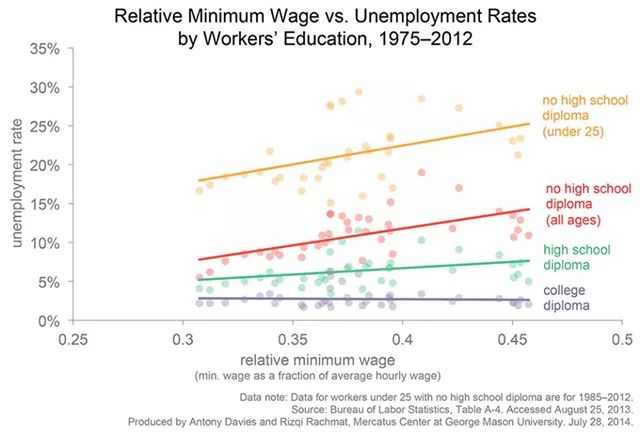
Is there any other issue where the data conforms so strongly to basic economic intuition, and yet is widely written off as a coincidence?
via Idiosyncratic Whisk: Teen Employment and the Minimum Wage, 60 years of experience.


Managerial Econ: Why are wages decreasing and employment increasing in Great Britain?
19 Sep 2014 1 Comment
in applied price theory, labour economics, labour supply, welfare reform Tags: British economy, wage flexibility, welfare reform
The simplest explanation is that supply is increasing: as supply increases output increases real prices fall and output increases.
The Financial Times shows the data and puts forward several explanations:
(1) welfare reforms are pushing people off the dole and into the labor force;
(2) older workers are choosing to retire at a later age.
Both explanations would imply an increase in supply.
via Managerial Econ: Why are wages decreasing and employment increasing in Great Britain?.


Recent Comments