
But a different story in the USA

Celebrating humanity's flourishing through the spread of capitalism and the rule of law
17 Jun 2014 Leave a comment
in labour economics, labour supply, welfare reform Tags: welfare dependency, welfare reform
But a different story in the USA
17 Jun 2014 Leave a comment
in applied welfare economics, labour economics, Richard Epstein Tags: labour markets, Richard Epstein
16 Jun 2014 Leave a comment
in labour economics Tags: Bill Allen, inequality of bargaining power

The more valuable the worker, the higher the bid for his services.
The high wage offer reflects rational concern of employers for their well-being, not a delicate sense of altruism or fairness. If you are technologically efficient in performing services which the community values highly, and if relatively few other workers are so productive, you will prosper.
It is competition among the hateful employers that raises wages, for they must bid against each other for labour to supply demanded products and thereby earn rewards. And it is competition among the lovable fellow workers that holds wages down by providing alternatives to employers…
The wage one employer is obliged to pay for labour is affected mightily by how much other employers are offering and it is a happy situation for me when rival employers bid against each other for my services. So competing workers offering labour lower my wage and competing employers bidding for labour raise my wage.
13 Jun 2014 1 Comment
in applied welfare economics, labour economics
12 Jun 2014 Leave a comment
in development economics, labour economics Tags: Bill Allen, sweatshops

What is to happen to the erstwhile workers–commonly uneducated, poorly trained, illegally in a land foreign to them, with little experience and marketplace sophistication–who have had their livelihoods abolished? They had been surviving–even if meanly by civilized standards–in market competition by selling their limited services of low value at meager wages.
Taking away those miserable jobs, pricing them out of what had been their best option, does not magically provide them with better alternative employment. Reducing their already poor power to compete, leaving them more handicapped than before, is a strange way to help them.
Bill Allen
11 Jun 2014 Leave a comment
in David Friedman, economics of crime, labour economics, law and economics Tags: crime and punishment, David Friedman, prison numbers
How can prison numbers be too high? There are unsolved crimes: murders, robberies, sexual assaults and burglaries to name a few.
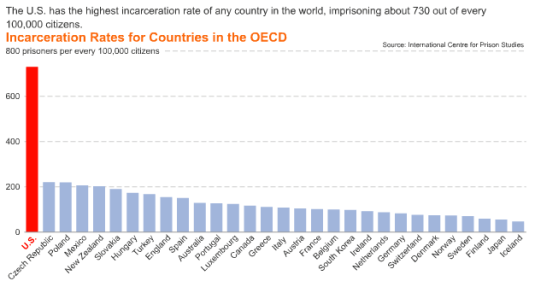
There are people out there who should have been arrested, convicted and sent to prison for serious crimes. Many of them are repeat offenders and career criminals.

I have never understood the reasoning behind the notion that prison numbers are too high.
Concerns about prison numbers being too high is exclusively a concern about the criminals who were sent to prison. Their victims are never mentioned nor are victims of unsolved crime who have been denied justice.
There is an economic literature on the efficient level of crime. Those that are concerned about prison numbers being too high explicitly reject the economics of crime literature for the purpose of framing public policy about criminal justice. The reason is obvious from this passage by David Friedman:
The economic analysis of crime starts with one simple assumption: Criminals are rational.
A mugger is a mugger for the same reason I am a professor-because that profession makes him better off, by his own standards, than any other alternative available to him.
Here, as elsewhere in economics, the assumption of rationality does not imply that muggers (or economics professors) calculate the costs and benefits of available alternatives to seventeen decimal places-merely that they tend to choose the one that best achieves their objectives.
If muggers are rational, we do not have to make mugging impossible in order to prevent it, merely unprofitable.
If the benefits of a profession decrease or its costs increase, fewer people will enter it-whether the profession is plumbing or burglary.
If little old ladies start carrying pistols in their purses, so that one mugging in ten puts the mugger in the hospital or the morgue, the number of muggers will decrease drastically-not because they have all been shot but because most will have switched to safer ways of making a living.
If mugging becomes sufficiently unprofitable, nobody will do it.
Putting more offenders in prison should decrease crime by both incapacitating incarcerated offenders and deterring potential offenders.

10 Jun 2014 Leave a comment
in gender, human capital, labour economics Tags: Christina Hoff Sommers, gender gap, lost boys, reverse gender gap
09 Jun 2014 Leave a comment
in economics of education, human capital, labour economics Tags: Charles Murray, The fatal conceit

HT: http://www.aei.org/publication/the-age-of-educational-romanticism/
09 Jun 2014 Leave a comment
in development economics, growth miracles, international economics, labour economics, labour supply Tags: Paul Krugman, Sweatshop labour, The Great Enrichment, The Great Fact

The lofty moral tone of the opponents of globalization is possible only because they have chosen not to think their position through.
While fat-cat capitalists might benefit from globalization, the biggest beneficiaries are, yes, Third World workers.
After all, global poverty is not something recently invented for the benefit of multinational corporations…
wherever the new export industries have grown, there has been measurable improvement in the lives of ordinary people.
Partly this is because a growing industry must offer a somewhat higher wage than workers could get elsewhere in order to get them to move.
More importantly, however, the growth of manufacturing–and of the penumbra of other jobs that the new export sector creates–has a ripple effect throughout the economy. The pressure on the land becomes less intense, so rural wages rise; the pool of unemployed urban dwellers always anxious for work shrinks, so factories start to compete with each other for workers, and urban wages also begin to rise.
06 Jun 2014 Leave a comment
in income redistribution, labour economics Tags: income inequality
04 Jun 2014 Leave a comment
in labour economics, population economics Tags: teenage pregnancies, The fatal conceit, The pretence to knowledge

Most people look upon teenage pregnancies from the perspective of their class.
Middle-class parents horrified that their daughter might not go to university and all the benefits that entails, including a better class of husband.
But look at what a teenage pregnancy is for a young woman was not destined for the University and the fast lane.
You go from being an extra on the stage of life to being a mother. Instant respect.
Everyone’s cheering for you. No matter how far your fall, now matter how badly you screw up, there are people ready to help you find your way back for the sake of the children.
Ethnographic studies show that teenage mothers looked down on their contemporaries that delay having a child into their 20s.
Teenage mums to be start to clean up their act, they get off drugs, they get off alcohol.
Most of all for the first time in their lives, these teenagers have a purpose – to be a mother.
They don’t marry the father because they do not look upon him as husband material.
In many cases, the young mothers hope that becoming a father might turn him into husband material.
The reason why they don’t in the end marry the father is the persistent antisocial behaviour of the fathers, and most of all, their persistent infidelity.
Teenage mums know what they’re doing.
All too many do-gooders and busy bodies will look upon teenage pregnancies as a mistake – an accident – somehow the product of a lack of knowledge of contraception or access to the same.
This myth persisted despite the invention of the Internet by Al Gore and the considerable amount of information you can find out about the facts of life on the Internet with the help of those cell phones most teenagers have.
It’s far easier to explain behaviour you think is foolish from your own perspective rather than that the perspective of the teenager concerned and the options that they have before them.
It’s no coincidence that a large number of teenage mums did not finish high school and don’t have much to look forward in their working life. The biggest thing in their life will be being a mother. Why wait?
03 Jun 2014 Leave a comment
in entrepreneurship, labour supply, public economics Tags: laffer curve, supply-side economics, Thomas Peketty

When a government taxes a certain level of income or inheritance at a rate of 70 or 80 percent, the primary goal is obviously not to raise additional revenue (because these very high brackets never yield much).
It is rather to put an end to such incomes and large estates, which lawmakers have for one reason or another come to regard as socially unacceptable and economically unproductive…
02 Jun 2014 Leave a comment
in Edward Prescott, labour economics, macroeconomics, Robert E. Lucas Tags: labour macroeconomics
 |
 |
Bob,
This is the way labour markets work: v(s, y, λ) max{λ, R(s, y) min[ λ, β ∫ v(s′, y, λ) f(s′, s)ds′]}.
Ed
Robert Lucas went on to explain in his professional memoir about this exchange in the early 1970s that:
we had agreed on notation: s stood for the state of product demand at a particular location, y stood for the number of workers who were already at that location, R(s, y) was the marginal product of labour implied by these two numbers, and v(s, y) stood for the present value of earnings that one of these workers could obtain if he made his decision whether to stay at this location or leave optimally.
Other features of the equation were as novel to me as they are (I imagine) to you…
a single parameter—Ed’s λ—stood for two different things: the present value of earnings that all searching workers would have to expect in order to leave a location and the present value that a particular location would need to offer to receive new arrivals…
If I had to pick a single day to represent what I like about a life of research, it would be this one.
Ed’s note captures exactly why I think we value mathematical modelling: it is a method to help us get to new levels of understanding the ways things work.
01 Jun 2014 2 Comments
in applied price theory, applied welfare economics, economic growth, entrepreneurship, human capital, labour economics, labour supply Tags: inequality and poverty, Piketty, seen and unseen, The Great Enrichment, The Great Fact

Piketty’s method of doing economics involves frequent grand proclamations about "social justice" and economic "evolutions," but he offers no analyses of the dynamics of individual decision-making, often referred to as "microeconomics," that should be central to the issues he raises…
Revealingly, Piketty writes of income and wealth as being claimed or "distributed," never as being earned or produced. The resulting statistics are too aggregated—too big-picture—to reveal what is happening to individuals on the ground…
He imagines that such aggregates interact in robotic fashion through a logic of their own, unmoved by individual human initiative, creativity, or choice…
If we follow the advice of Adam Smith and examine people’s ability to consume, we discover that nearly everyone in market economies is growing richer…
THE U.S. IS THE bête noir of Piketty and other progressives obsessed with monetary inequality.
But middle-class Americans take for granted their air-conditioned homes, cars, and workplaces—along with their smartphones, safe air travel, and pills for ailments ranging from hypertension to erectile dysfunction…
At the end of World War II, when monetary income and wealth inequalities were narrower than they’ve been at any time in the past century, these goods and services were either available to no one or affordable only by the very rich.
So regardless of how many more dollars today’s plutocrats have accumulated and stashed into their portfolios, the elite’s accumulation of riches has not prevented the living standards of ordinary people from rising spectacularly…
Piketty’s disregard for basic economic reasoning blinds him to the all-important market forces at work on the ground—market forces that, if left unencumbered by government, produce growing prosperity for all. Yet, he would happily encumber these forces with confiscatory taxes.
Celebrating humanity's flourishing through the spread of capitalism and the rule of law
Celebrating humanity's flourishing through the spread of capitalism and the rule of law
Celebrating humanity's flourishing through the spread of capitalism and the rule of law
Celebrating humanity's flourishing through the spread of capitalism and the rule of law
Celebrating humanity's flourishing through the spread of capitalism and the rule of law
Celebrating humanity's flourishing through the spread of capitalism and the rule of law
A History of the Alt-Right
Econ Prof at George Mason University, Economic Historian, Québécois
Celebrating humanity's flourishing through the spread of capitalism and the rule of law
Scholarly commentary on law, economics, and more
Beatrice Cherrier's blog
Celebrating humanity's flourishing through the spread of capitalism and the rule of law
Celebrating humanity's flourishing through the spread of capitalism and the rule of law
Celebrating humanity's flourishing through the spread of capitalism and the rule of law
Why Evolution is True is a blog written by Jerry Coyne, centered on evolution and biology but also dealing with diverse topics like politics, culture, and cats.
Celebrating humanity's flourishing through the spread of capitalism and the rule of law
A rural perspective with a blue tint by Ele Ludemann
DPF's Kiwiblog - Fomenting Happy Mischief since 2003
Celebrating humanity's flourishing through the spread of capitalism and the rule of law
The world's most viewed site on global warming and climate change
Tim Harding's writings on rationality, informal logic and skepticism
A window into Doc Freiberger's library
Let's examine hard decisions!
Commentary on monetary policy in the spirit of R. G. Hawtrey
Thoughts on public policy and the media
Celebrating humanity's flourishing through the spread of capitalism and the rule of law
Politics and the economy
A blog (primarily) on Canadian and Commonwealth political history and institutions
Reading between the lines, and underneath the hype.
Economics, and such stuff as dreams are made on
"The British constitution has always been puzzling, and always will be." --Queen Elizabeth II
Celebrating humanity's flourishing through the spread of capitalism and the rule of law
Celebrating humanity's flourishing through the spread of capitalism and the rule of law
WORLD WAR II, MUSIC, HISTORY, HOLOCAUST
Undisciplined scholar, recovering academic
Celebrating humanity's flourishing through the spread of capitalism and the rule of law
Res ipsa loquitur - The thing itself speaks
In Hume’s spirit, I will attempt to serve as an ambassador from my world of economics, and help in “finding topics of conversation fit for the entertainment of rational creatures.”
Researching the House of Commons, 1832-1868
Articles and research from the History of Parliament Trust
Reflections on books and art
Posts on the History of Law, Crime, and Justice
Celebrating humanity's flourishing through the spread of capitalism and the rule of law
Exploring the Monarchs of Europe
Cutting edge science you can dice with
Small Steps Toward A Much Better World




Recent Comments