
Fraudulent use of Dada | Catallaxy Files
26 May 2014 Leave a comment
in labour economics, politics - USA Tags: data mining, Thomas Piketty
Olympic Happiness: Better to win Bronze than Silver Medals?
23 May 2014 Leave a comment
in entrepreneurship, health and safety, labour economics
Olympic Happiness: Better to win Bronze than Silver Medals? | Psychology Today.
The bronze winner is happy as Larry looking at all those losers that won nothing.

The silver medal winners came second. At least they know that their mum will remember their great day when they almost made it. A 1924 silver medal winner was still brooding about it in his 80s.
What exact did David Card say about the minimum wage?
22 May 2014 Leave a comment
in labour economics, minimum wage Tags: David Card, minimum wage


Our findings suggest that the efficiency aspects of a modest rise in the minimum wage are overstated….
[W]e find no evidence for a large negative employment effect of higher minimum wages. Even in the earlier literature, however, the magnitude of the predicted employment losses from a much higher minimum wage would be small: the evidence at hand is relevant only for a moderate range of minimum wages, such as those that prevailed in the U.S. labour market during the past few decades.
Within this range, however, there is little reason to believe that increases in the minimum wage will generate large employment losses.
David Card and Alan B. Krueger, Myth and Measurement: The New Economics of the Minimum Wage, (Princeton: Princeton University Press, 1995, p. 393).
The Right Minimum Wage: $0.00 – New York Times 1987–Updated Again
19 May 2014 1 Comment
in Alfred Marshall, applied welfare economics, David Friedman, labour economics, minimum wage Tags: David Card, interpersonal comparision of utility, Milton Friedman, minimum wage, offsetting behaviour, The fatal conceit, The pretense to knowledge
Raising the minimum wage by a substantial amount would price working poor people out of the job market.
A far better way to help them would be to subsidize their wages or – better yet – help them acquire the skills needed to earn more on their own…
Raise the legal minimum price of labour above the productivity of the least skilled workers and fewer will be hired.
If a higher minimum means fewer jobs, why does it remain on the agenda of some liberals?
A higher minimum would undoubtedly raise the living standard of the majority of low-wage workers who could keep their jobs. That gain, it is argued, would justify the sacrifice of the minority who became unemployable.
The argument isn’t convincing. Those at greatest risk from a higher minimum would be young, poor workers, who already face formidable barriers to getting and keeping jobs. Indeed, President Reagan has proposed a lower minimum wage just to improve their chances of finding work.
What does the New York Times say in 2014?
The minimum wage is specifically intended to take aim at the inherent imbalance in power between employers and low-wage workers that can push wages down to poverty levels.…
The weight of the evidence shows that increases in the minimum wage have lifted pay without hurting employment
Both the White House and the New York Times are not the best of Bayesian updaters because the author of the one study on which they are very much hang their hats for their policy conclusions about no job losses from a minimum wage increase interprets his results with very much less zeal than they do:
I think careful research on the topic has found that for this range of minimum wage increase, the almost unmistakable conclusion is that there will be little in the way of job losses, while the wages of low-end workers will get a boost (his underlining).
The claims of the White House and the New York Times that the minimum wage can be lifted without hurting employment are a long bow from what Andrajit Dube said about small changes in the minimum wage having small adverse effects on unemployment:
What Andrajit Dube said s not much different from everyone else on the minimum wage – Nuemark is an example:
a 10 per cent increase in the minimum wage could reduce young adult employment by up to 2 per cent
David Card was always very careful amount about how his pioneering research was about how small increases in the minimum wage not reducing employment in the presence of search and matching costs:
From the perspective of a search paradigm, these policies make sense, but they also mean that each employer has a tiny bit of monopoly power over his or her workforce.
As a result, if you raise the minimum wage a little—not a huge amount, but a little—you won’t necessarily cause a big employment reduction. In some cases you could get an employment increase.
There is always offsetting behaviour: Barry Hirsch found that when the federal minimum wage went up in 2007, businesses just made their employees work harder to justify the expense.
I am always surprised that people might think that the minimum wage will have anywhere near its intended effects after market participants have had time to act to counter its effects as Peltzman explains:
Regulation creates incentives for behaviour to offset some or even all of the intended effect of the regulation…
Regulation seldom changes the forces that produces the particular results the regulators seek to change. So we need to ask whether the regulation really changes result or only the form in which the market forces assert themselves.
Is a minimum wage increase a Pareto improvement – a policy action done in an economy that harms no one and helps at least one person?

Obviously there are winners and losers from a minimum wage increase and these wins and loses must be summed up in some way as they are for all public policy changes.

When there are winners and losers from deregulation, the only thing seems to matter to many of those who support a minimum wage increase are the losses to the incumbent industry and its often well-paid workers rather than the gains to consumers, rich or poor.
For there to be a Marshall improvement, the sum of all of the gains and losses must sum to a positive.
A Marshall improvement from a minimum wage or any other change is measured by adding utilities as if everyone receives the same utility from a dollar. A dollar is a dollar to everyone as David Friedman explains:
A net improvement in the sense used by Marshall–what I have elsewhere called a Marshall improvement–is a change whose net value is positive, meaning that the total value to those who benefit, measured as the sum of the number of dollars they would each, if necessary, pay to get the change, is larger than the total cost to those who lose, measured similarly.
The advantage of the Marshall improvement criterion is we commonly observe people’s values of different things by seeing how much they are willing to pay for it.
Alfred Marshall was aware that treating people as if they all had the same utility for a dollar was a stretch but this was considered less relevant for policy changes that affect large and diverse groups of people. Individual differences could be expected to cancel out over a broad suite of policies in a well-functioning democracy so that most people gain in net terms through time. David Friedman explains:
I prefer to use the Marshallian approach, which makes the interpersonal comparison explicit, instead of hiding it in the ‘could be made but isn’t’ compensating payment…
a change that benefits a millionaire by $10 and costs a pauper $9 is a potential Pareto improvement, since if combined with a payment of $9.50 from the millionaire to the pauper it would benefit both. If the payment is not made, however, the change is not an actual Pareto improvement.
The ‘potential Paretian’ approach reaches the same conclusion as the Marshallian approach and has the same faults; it simply hides them better. That is why I prefer Marshall…
It is worth noting that although a Marshall improvement is usually not a Pareto improvement, the adoption of a general policy of ‘Wherever possible, make Marshall improvements’ may come very close to being a Pareto improvement…
Add up all the effects and, unless one individual or group is consistently on the losing side, everyone, or almost everyone, is likely to benefit.
This is the latest review of the minimum wage research from David Neumark:
The potential benefits of higher minimum wages come from the higher wages for affected workers, some of whom are in poor or low-income families.
The potential downside is that a higher minimum wage may discourage employers from using the low-wage, low-skill workers that minimum wages are intended to help.
If minimum wages reduce employment of low-skill workers, then minimum wages are not a “free lunch” with which to help poor and low-income families, but instead pose a trade-off of benefits for some versus costs for others.
Research findings are not unanimous, but evidence from many countries suggests that minimum wages reduce the jobs available to low-skill workers.
George Stigler set-out the conditions for a minimum wage to achieve its purported objectives in 1946, which have not been bettered:
If an employer has a significant degree of control over the wage rate he pays for a given quality of labour, a skilfully-set minimum wage may increase his employment and wage rate and, because the wage is brought closer to the value of the marginal product, at the same time increase aggregate output…
This arithmetic is quite valid but it is not very relevant to the question of a national minimum wage. The minimum wage which achieves these desirable ends has several requisites:
1. It must be chosen correctly… the optimum minimum wage can be set only if the demand and supply schedules are known over a considerable range…
2. The optimum wage varies with occupation (and, within an occupation, with the quality of worker).
3. The optimum wage varies among firms (and plants).
4. The optimum wage varies, often rapidly, through time.
A uniform national minimum wage, infrequently changed, is wholly unsuited to these diversities of conditions.
The case for a minimum wage was therefore hung, drawn and quartered in 1946 by Stigler. Not every cause and effect is open to policy manipulation because of the lack of the necessary knowledge about the relationship and insufficiently deft policy tools to exploit that knowledge in a timely fashion and as circumstances change. This information and organisational burden is such that the process of setting minimum wage increases is an example of public policy making that is groping about in the dark. Success can be neither appraised in advance nor later retrospectively determined.
The empirical foundations of supply-side economics – Michael Keane – YouTube
19 May 2014 Leave a comment
in labour economics, taxation Tags: labour supply, taxes
Most economists believe male labour supply elasticities are small, but a sizable minority of studies have large values. There is no clear consensus on this point.
The key factor driving these tensions is the failure of most studies to account for human capital returns to work experience.
In a model that includes human capital, even modest elasticities—as conventionally measured—can be consistent with large efficiency costs of taxation.
Conventional estimates of male labour supply elasticities have a severe downward bias because of their failure to include human capital accumulation. The opportunity cost of time includes their after tax wage and present value of increased earnings in all future years.
The return to work experience is high so working more has large long-term payoffs for younger male workers. Wages start low for young grow and then peak in 40s. When adjusted for the return for work experience, a large part of compensation when younger is human capital, and this peters away by the 40s.

Estimates where wages grow with work experience, with the accumulation of human capital, yield large male labour supply elasticities, as high as 3.8 rather than close to zero (Keane 2010, 2011). That is a profound difference.
Women have high labour supply elasticities, especially on the labour force participation margin, as most agree.
Estimates of long-run female labour supply elasticities—estimates that allow for dynamic effects of wages on fertility, marriage, education and work experience—are generally quite high.
Marginal tax rates and labour supply
17 May 2014 Leave a comment
in applied welfare economics, Edward Prescott, labour economics Tags: labour supply, taxes
Americans now work 50 per cent more than do the Germans, French, and Italians. This was not the case in the early 1970s, when the Western Europeans worked more than Americans.
Edward Prescott found that taxes accounted for these differences in labour supply across time and across countries; in particular, the effective marginal tax rate on labour income. The population of countries considered is the G-7 countries, which are major advanced industrial countries. Prescott concluded that
virtually all of the large differences between U.S. labour supply and those of Germany and France are due to differences in tax systems.
Prescott and many that followed him were truly puzzled by the lack of a role for employment mandates, employment protections and product market regulation in Europe’s poor economic performance
Richard Rogerson is a very sharp fellow who built on Prescott’s work. Most anything Rogerson writes is worth a look.

A non-technical note by Rogerson made these key points:
- Europe’s taxes punish working outside the home, so Europeans don’t work as much as they would otherwise;
-
Dramatic differences in the overall change in hours worked per person aged 16 to 64 across countries between 1960 and 2000;
-
at one extreme the U.S., with an increase of 10 per cent between these two dates;
-
At the other extreme are Germany and France, with declines of more than 30 per cent;
-
For the U.S. and France, the difference is staggering—more than 45 per cent;
-
Richard Freeman and Ronald Schettkat (2001) studied time allocation by married couples in Germany and the United States.
-
Their striking finding is about total time devoted to work (i.e., market work plus home production) turns out in the two countries is virtually the same.
In The Impact of Labor Taxes on Labor Supply: An International Perspective (AEI Press, 2010) Rogerson finds that:
• a 10 percentage point increase in the tax rate on labour leads to a 10 to 15 per cent decrease in hours of work.
• Even a 5 per cent decrease in hours worked would mean a decline in labour output equating to a serious recession.
• While recessions are temporary, permanent changes in government spending patterns have long-lasting repercussions.
• Although government spending provides citizens with important benefits, such benefits must be weighed against the disincentive effects of increased labour taxes.
• Policymakers who fail to account for the decrease in labour output risk expanding government programs beyond their optimal scale.
The Dead Grandmother/Exam Syndrome
16 May 2014 Leave a comment
in labour economics Tags: moral hazard
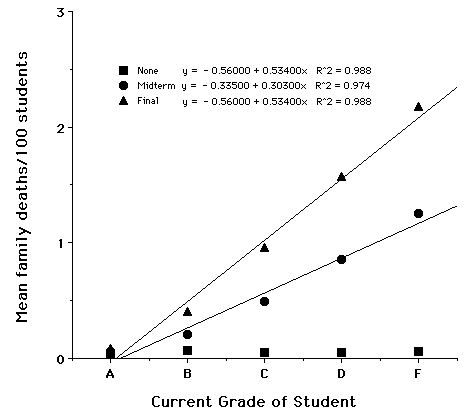
Grandmothers are far more likely to die suddenly just before the student takes an exam, than at any other time of year.

Poor grades among their grandchildren is especially dangerous to their golden years
Supply-Side Economics in Iceland
15 May 2014 Leave a comment
in economic growth, labour economics Tags: Iceland, tax reform
The move to a pay-as-you-earn income tax system in Iceland in 1988 made income earned in 1987 tax-free.
- Icelandic GDP increased by 4.16% in 1987.
- Total labour supply rose by 6.7% in 1987 over the average of 1986 and 1988.
- This included an 8.6% increase in weeks of work supplied by those already in the labour market in 1986.
Notice in the graph the big kink in employment in 1987. A spike just for the year of no taxes. Labour supply then fell away.
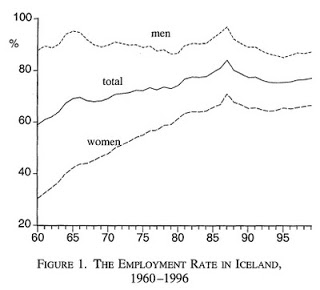
Iceland in 1987 was a unique opportunity to study the labour supply response of individuals who were temporarily faced with a zero marginal-and average-income tax rate.
Super-Economy “pre-reviewed ” Piketty in 2010
14 May 2014 Leave a comment
in applied welfare economics, entrepreneurship, labour economics, liberalism, politics - USA, technological progress Tags: Piketty, poverty versus inequality
The French are poorer that the 3rd poorest American state: Arkansas. The EU-15 as a whole would qualify to be the 49th poorest American state.
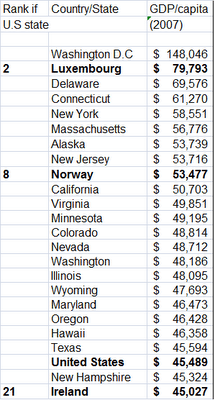
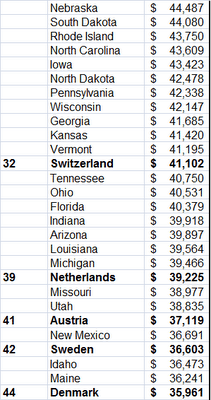

The rich in Europe are poor by American standards. The poor in the USA are middle class by European standards. The European middle class has smaller houses, few cars and few consumers durables that the average poor in the USA.

via Super-Economy: Dynamic America, Poor Europe and Tino Sanandaji

The path to higher U.S. prosperity
12 May 2014 Leave a comment
in applied welfare economics, economic growth, Edward Prescott, great recession, labour economics, macroeconomics Tags: capital taxation, Edward Prescott, retirement savings, tax reform
Suppose the USA:
- Had mandatory savings for retirement
- Eliminated capital income taxes
- Broadened tax base and lowered the marginal tax rate
- Phased in reforms so all birth-year cohorts are made better off
- Left welfare programs and local public good shares the same
- Savings not part of taxable income, saving withdrawals part of taxable income – with these changes U.S. income tax would be a consumption tax
US Detrended GDP per Capita
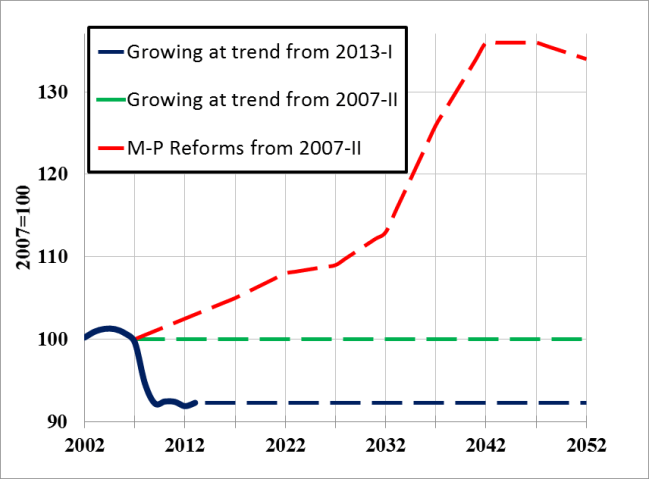
Source: Edward Prescott and Ellen McGrattan 2013.
Minimum wage was introduced to reduce the employment of women
10 May 2014 1 Comment
in gender, history of economic thought, labour economics Tags: minimum wage, progressive era
The minimum wage is a rare policy bird. Its employment effects change at the whim of its latest proponents.
Minimum wages were initially introduced in the USA shortly after 1900 solely for women and children. The express aim was to price women out of jobs and raise men’s wages by enough so that they could provide for their families.
These days, some argue that minimum wages actually increase employment. Times change, and the slopes of supply and demand curves must change with them.
Tim Leonard in Protecting Family and Race The Progressive Case for Regulating Women’s Work showed that these women-only minimum wages were justified by political progressive including women on grounds that they would:
(1) Protect the biologically weaker sex from the hazards of market work;
(2) Protect working women from the temptation of prostitution;
(3) Protect male heads of household from the economic competition of women; and
(4) Ensure that women could better carry out their eugenic duties as “mothers of the race.”

The above photo from the Minnesota Post has the following caption:
Fuelled by the Progressive Era, Minnesota becomes one of the first dozen states to pass a law establishing work standards for women and children and established a Minimum Wage Commission.
Women-only minimum wage laws were held unconstitutional by the Supreme Court in 1923 but were upheld by a Progressive-dominated Supreme Court in 1937. In the 1930s depression, single-sex, state minimum-wage laws were revived and flourished.
Xenophobia, race prejudice, and sexism should come as no surprise to any student of left-wing politics. Progressive politics in the first half of the 20th century was infested with racism:
- The support of the Australian Labor Party (ALP), and in the USA, the Democratic Party, for vicious, state-sponsored racism is well known.
- The ALP supported the passing of the White Australia policy with glee in 1901 by the newly formed Federal Parliament.
As Tim Leonard has shown, in days gone by, budding progressives not only revelled in exposes of capitalistic barons and attacks on laissez-faire economics by muckraking journalists, they also poured over racist tracts that drew on the latest anthropology, biology, psychology, sociology, eugenics, and medical science. Social Democrat Party Sweden practised eugenics until the 1960s.
Richard Epstein “The Coming Meltdown in Labor Relations”
07 May 2014 Leave a comment
in industrial organisation, labour economics, law and economics, liberalism, personnel economics, Public Choice, Richard Epstein
The Death of the Renaissance Man?
03 May 2014 Leave a comment
in human capital, industrial organisation, labour economics, technological progress Tags: Ben Jones, innovation, polymaths, renaissance man
Ben Jones in ‘The Burden of Knowledge and the Death of the Renaissance Man: Is Innovation Getting Harder? found that as knowledge accumulates as technology advances, successive generations of innovators may face an increasing educational burden.

Innovators can compensate through lengthening their time in education and narrowing expertise, but these responses come at the cost of reducing individual innovative capacities.
This has implications for the organization of innovative activity – a greater reliance on teamwork – and has negative implications for economic growth.
Jones found that the age at first invention, specialisation, and teamwork increased over time in a large micro-data set of inventors. Upward trends in academic collaboration and lengthening doctorates can also be explained in his framework.
Using data on Nobel Prize winners, Jones found that the mean age at which the innovations are produced to win the Prize has increased by 6 years over the 20th Century.
- Before 1901, two-thirds of the Nobel laureates did their prize-winning work before the age of 40 and 20 per cent did it before age of 30.
- By 2000, however, great achievements seldom occurred before the age of 40.
It’s now taking longer for scientists to get their basic training and start their careers. There is simply more to learn because knowledge in all fields has grown by quantum leaps in the past century.
Nobels are being handed out for different types of work than a century ago.
- There has been a trend away from awarding prizes for abstract, theoretical ideas.
- Now more honours are being bestowed on people who have made discoveries through painstaking lab work and experimentation – which takes a lot of time to do.
Jones’ theory provides an explanation for why productivity growth rates did not accelerate through the 20th century despite an enormous expansion in collective research effort and levels of education and many more graduates.
The more experienced readers of this blog might remember that the better of their professors seemed to be masters of the entire field of economics and could teach almost any subject.
These days, too many professors rely on textbooks with annual editions that come with the lecture notes, assignments and test-banks written for them by the publishing company.
Are there any polymaths left? Posner? Tullock?
Bill Gates “pre-reviewed” Piketty years ago
02 May 2014 Leave a comment
in entrepreneurship, human capital, labour economics Tags: Bill Gates, Piketty, top 1%, top talent
Bill Gates once said:
You take away the top 20 employees of Microsoft, we’ll just be an ordinary company. Top employees are what makes us.

via Gary Becker on Human Capital | Atanu Dey On India’s Development.
The living wage
28 Apr 2014 Leave a comment
in applied welfare economics, labour economics, politics - New Zealand Tags: family tax credit, fatal conceit, living wage, pretence to knowledge
Why not just increase the family tax credit? That would increase the incomes of poor families without putting their jobs at particular greater risk.

The local calculation of the living wage includes cable TV and an overseas holiday.
Milton Friedman provides some critical truths on the living wage:
Do-Gooders believe passing a law saying nobody shall get less than [a minimum wage] is helping poor people (who need the money).
You’re doing nothing of the kind.
What you’re doing is to ensure that people whose skills do not justify that wage will be unemployed.


Recent Comments