Error 1: Use of Pre-Tax, Pre-Transfer Income to Measure Inequality. Throughout the report, the IMF uses the concept of “market income” to measure inequality. Market income is defined as income before taxes are paid to the government, and before transfers from the government to low-income individuals…
Error 2: More Inequality Leads to Lower Mobility. … Data from University of Ottawa professor Miles Corak on the United States, Canada, and Sweden suggest that more inequality is associated with higher mobility, not less mobility. Winship’s findings echo those of Harvard University economist Raj Chetty, who found little association between the share of income of the top one percent and mobility, either in the United States or between different countries…
Error 3: Tax Increases Lead to Higher Economic Growth… If transfers of income from one group to another succeeded in creating economic growth, the fastest-growing countries would be those with the highest top tax rates. As Nobel Prize-winning economist Edward Prescott has shown, the reverse is true.
Inequality as a Barrier to Growth? Invented Out of Thin Air | e21
28 Apr 2014 Leave a comment
in labour economics, macroeconomics

Robert Doar on 10 welfare reform lessons
26 Apr 2014 Leave a comment
in applied welfare economics, labour economics, welfare reform Tags: 1996 federal welfare reforms, Rebecca Blank, Robert Doar
In the National Review, Robert Doar set-out these from his time as commissioner of the New York City social service agency between 2007 and 2013:
- Always promote personal responsibility.
- Employment is far better than training and education.
- Making work pay is welfare reform too.
- Be honest about the importance of married two-parent families.
- Caseworkers don’t cost much; benefits do.
- Medicaid is where the money is.
- Immigrants get welfare too.
- Welfare recipients (and workers too) will try to "get over." "To get over" is a very New York expression meaning to steal
- When it comes to the disabled, trust but verify.
- Always cheer for the economy.
Figure 1: WELFARE CASELOADS AND RECIPIENTS (AFDC AND TANF PROGRAMS), IN THOUSANDS

Source: Administration for Children and Families, TANF caseload data, 2011.
I should add that after the 1996 federal welfare reforms in the USA that time limited life-time federal welfare receipt to 5-years, the 2/3rd decline in welfare participation and the gains in employment were largest among the single mothers previously thought to be most disadvantaged: young (ages 18-29), mothers with children aged under seven, high school drop-outs, and black and Hispanic mothers. These low-skilled single mothers were thought to face the greatest barriers to employment. Blank (2002) found that:
nobody of any political persuasion predicted or would have believed possible the magnitude of change that occurred in the behaviour of low-income single-parent families.
Stumbling and Mumbling: 12 alternative principles to Thomas Sargent’s
21 Apr 2014 Leave a comment
in applied welfare economics, behavioural economics, economics of regulation, industrial organisation, labour economics, Public Choice Tags: Chris Dillow, Thomas Sargent
1. People have different motivations: wealth, power, pride, job satisfaction and so on. Incentive structures which suit one set of motives might not work for another.
2. Many things are true but not very significantly so.
3. Power matters: conventional economics under-states this.
4. Luck matters. The R-squareds in Mincer equations are generally low.
5. There is a great deal of ruin in a nation, and in an organization.
6. Individual rationality sometimes produces outcomes which are socially optimal as in Adam Smith’s invisible hand, and sometimes not.
7. Trade-offs between values are more common than politicians pretend, but are not ubiquitous.
8. Cognitive biases are everywhere.
9. Everything matters at the margin, but the margin might not be very extensive.
10. The social sciences are all about mechanisms. The question is: which ones work when and where? This means there are few if any universal laws in the social sciences; context matters.
11. Accurate economic forecasting is impossible. But time-varying risk premia might give us a little predictability.
12. Risk comes in many types. Reducing one type of it often means increasing exposure to another type.
Chris Dillow at Stumbling and Mumbling: 12 alternative principles.
Super-Economy: The class struggle in one picture
17 Apr 2014 Leave a comment
in applied welfare economics, labour economics, unions Tags: inequality of bargaining power
In the U.S. and Japan, 15% of workers have their wages determined by unions. In Sweden and France, 90% of workers are covered by union collective agreements.
- Social Democrats argue that unions and collective bargaining improve the earnings of the working class relative to the owners of capital.
- Neoclassical economic theory predicts that competition among firms for workers ensures that they earn wages equal to the additional revenue that the firm earns by employing them.
Tino Sanandaji at his Super-Economy blog plotted the share of workers who are covered by collective bargaining agreements and the share of national factor costs that goes to labour as wages and other employee compensations:

The way the economy gets divided between capitalists and workers is virtually identical in weak union countries such as the U.S. as it is in countries with powerful unions, such as France and Sweden.
If anything, American workers with weak unions get a bigger share of the cake compared to European workers with strong unions. Due to high labour costs, European workers have to some extent been replaced by machines.
President Obama’s persistent ’77-cent’ claim on the wage gap gets a new Pinocchio rating–updated
13 Apr 2014 Leave a comment
in human capital, labour economics, occupational choice, politics - USA Tags: gender wage gap, lies dam lies and statistics, obama
The fact checker at the Washington Post said:
Few experts dispute that there is a wage gap, but differences in the life choices of men and women — such as women tending to leave the workforce when they have children — make it difficult to make simple comparisons.
…From a political perspective, the Census Bureau’s 77-cent figure is golden. Unless women stop getting married and having children, and start abandoning careers in childhood education for naval architecture, this huge gap in wages will almost certainly persist. Democrats thus can keep bringing it up every two years.
…There appears to be some sort of wage gap and closing it is certainly a worthy goal. But it’s a bit rich for the president to repeatedly cite this statistic as an “embarrassment.” …The president must begin to acknowledge that “77 cents” does not begin to capture what is actually happening in the work force and society.
The Case Against Education – Bryan Caplan–updated with Japanese evidence
12 Apr 2014 2 Comments
in applied welfare economics, economics of education, human capital, labour economics, personnel economics Tags: Bryan Caplan, credentialism, human capital, signaling and screening, signalling
Bryan Caplan says that:
When you actually experience education, though, it’s hard not to notice that most classes teach no job skills.
The labour market heavily rewards educational credentials even though academic curriculum is seriously disconnected from the jobs people actually do.
The best explanation for this strange fact is that education is a strong signal of pre-existing worker productivity.
Caplan argues with annoying persuasiveness that education signals desirable employee traits such as intelligence, conscientiousness, conformity and a willingness to learn boring things:
- Most education is for sending a signal to employers that you can jump through hoops to show off your IQ, work ethic, and conformity.
- Schools and universities do not to produce wisdom, information, critical thinking or human capital.
- Subsidising education creates an arms race of credentialism as each student attempts to acquire more and more education than their rival job applicants.
His particular focus is the educational psychology literature on the transfer of learning. That literature started long ago with the question did learning Latin give you muscle to learn other subjects. The educational psychology literature has been looked at the transfer of learning for 100 years.
Educational psychologist found that Latin does not help much in studying other languages and other subjects. No significant differences were found in deductive and inductive reasoning or text comprehension among students with 4 years of Latin, 2 years of Latin, and no Latin at all.
The trouble is you do this in a race and many try to win the race by lengthening the race by going to and spending more time at university such as taking honours and master’s degrees etc.
Grades do not signal anything in Japan because everyone graduates with an A. It is the lecturer’s fault if you fail.
Japanese universities and employers make up for this everyone gets a A with strict entrance exams.
Getting into a top university signals intelligence and conscientiousness in preparing for their entrance exam. Few go to graduate school in Japan, preferring to learn more on the job.
Japanese students are lazy because everyone passes and therefore grades signal little in the way of intelligence, conscientiousness, conformity to employers.
I had great trouble getting my Japanese students to come to class. Other lecturers got around this by giving marks for attendance and replacing final exams with a pop quiz at the start of every class.
Nonetheless, something of value is acquired through 4-years at a Japanese university because otherwise why not skip straight from passing a university entrance exam to the employer exams.
The crucial objection to Caplan is that if most education expenditures are primarily about signalling, it should be possible to find other, cheaper ways to signal desirable traits to employers. As Bill Dickens noted:
For one thing I find it very hard to believe that we would waste so many resources on a nearly unproductive enterprise.
There are plenty of entrepreneurs out there trying to make money by selling cheaper, in time and money, versions of education and they aren’t very successful.
Mainstream schools have experimented with programmed learning, lectures on video, self-paced learning, etc. and none of the methods have caught on. Why wouldn’t they if they worked?
The spread of charter schools is an example of the rapid diffusion of an educational innovation valued by parents.
A major driver of the doubling of college tuition fees in the U.S. is demand for greater quality. As Becker and Murphy explain:
Indeed, it appears that the increases in tuition were partly induced by the greater return to college education. Pablo Peña, in a Ph.D. dissertation in progress at the University of Chicago, argues convincingly that tuition rose in part because students want to invest more in the quality of their education, and increased spending per student by colleges is partly financed by higher tuition levels
What specific and general skills are learnt at school and at university matters too, as Bill Dickens explains:
Education isn’t mainly about learning specific subject matter.
Rather education is mainly about practicing the sort of self-discipline that is necessary to be productive in a modern work environment.
High school allows you to practice showing up on time and doing what you are told.
College allows you to practice and work out techniques that work for you that allow you to take on and complete on time complicated multi-part tasks in an environment where you have considerable freedom about how you spend your time.
Some people may be more talented than others at this sort of thing (you come to mind as someone who is particularly talented at self-discipline), but this is also an acquired skill that one can develop with practice, and everyone needs to develop certain work habits that make one more productive at both types of tasks.
The debate really turns on the extent to which it is possible to find easier and cheaper ways to signal conscientiousness and conformity. As Bill Dickens noted as his fall-back position, which is based on comparative institutional analysis:
most of the return to education is due to it signalling desirable characteristics, but that there is no more efficient way to sort the capable from the incapable.
I also think that signalling performs a valuable sorting function that no alternative process can out-compete. But, as Caplan notes, a conventional education benefits from large government and private subsidies as compared to other sorting devices.
Table of Contents – The Case Against Education – Bryan Caplan
Introduction
Chapter 1: The Magic of Education
Chapter 2: Useless Studies with Big Payoffs: The Puzzle Is Real
Chapter 3: Signalling Explained
Chapter 4: Measuring Signalling
Chapter 5: Who Cares If It’s Signalling? The Private, Familial, and Social Returns to Education
Chapter 6: Is Education Good for the Soul?
Chapter 7: We Need Lots Less Education
Chapter 8: We Need More Vocational Education
Conclusion
The Book’s basic plot:
The labor market heavily rewards educational credentials even though academic curriculum is seriously disconnected from the jobs people actually do. The best explanation for this strange fact is that education is a strong signal of pre-existing worker productivity. (chapter 1)
While the return to education is often overstated, it remains high after making various statistical adjustments. Degrees in useless subjects really do substantially raise wages. (chapter 2)
Education signals a package of desirable employee traits: intelligence of course, but also conscientiousness and conformity. Many people dismiss the signalling model on a priori grounds, but educational signalling is at least as plausible as many widely accepted forms of of statistical discrimination. (chapter 3)
Empirically distinguishing signalling from human capital is notoriously difficult. But literatures on the sheepskin effect, employer learning, and the international return to education confirm that signalling is moderately to highly important. (chapter 4)
How much education should you get? The human capital-signalling distinction isn’t important at the individual level, but the policy implications are enormous. (chapter 5)
The non-pecuniary benefits of education are over-rated, and the non-pecuniary costs (especially boredom) are under-rated. There’s a massive selection bias because the kind of people who hate school rarely publicize their complaints. (chapter 6)
The most important implication of the signalling model is that we spend way too much money on education. Education spending at all levels should be drastically reduced, and people should enter the labor force at much younger ages. (chapter 7)
The education we offer should be more vocational. Especially for weaker students, vocational education has a higher private and social return than traditional academic education. (chapter 8)
Caplan has also posted this nice topology below to allow you to select your starting point:
| Model | Effect of Education on Income | Effect of Education on Productivity | Notes |
| Pure Human Capital | WYSIWYG
(What You See Is What You Get) |
WYSIWYG | Education may raise productivity by directly teaching job skills, but character formation, acculturation, etc. also count. |
| Pure Ability Bias | Zero | Zero | “Ability” includes not just pre-existing intelligence, but pre-existing character, acculturation, etc.
Pure Ability Bias is observationally equivalent to a Pure Consumption model of education. |
| Pure Signalling | WYSIWYG | Zero | Pure educational signalling can consist in (a) learning and retaining useless material, (b) learning but not retaining material regardless of usefulness, (c) simply wasting time in ways that less productive workers find relatively painful, leading to a positive correlation between education and productivity. |
| 1/3 Pure Human Capital, 1/3 Pure Ability Bias, 1/3 Pure Signalling |
2/3*WYSIWYG | 1/3*WYSIWYG | A good starting position for agnostics. |
| 0.1 Pure Human Capital, 0.5 Pure Ability Bias, 0.4 Pure Signalling |
.5*WYSIWYG | .1*WYSIWYG | Caplan’s preferred point estimates. He knows they’re extreme, but his book will explain his reasons and try to win you over. |
Ernest Shackleton’s famous job ad
06 Apr 2014 Leave a comment
in health and safety, labour economics, occupational choice, personnel economics

Opportunity for all: How to think about income inequality – AEI
02 Apr 2014 Leave a comment
in applied welfare economics, labour economics, public economics
… The conventional wisdom on inequality is built on three assumptions: (1) Income inequality is inherently unjust; (2) it is bad for the economy; and (3) government redistribution is the best way to remedy it. According to this narrative, narrowing the gap between what wealthy and working-class Americans earn should be our top political priority, and policies such as raising taxes or increasing the minimum wage are the answer.
This conventional wisdom is incorrect. A free enterprise society is not a zero-sum game in which citizens fight over resources. It should be a shared journey that empowers everyone to improve their station and earn their own success. Income differences are inevitable, and they are not inherently problematic as long as the opportunity to rise is available to everyone. Survey data show that the American people agree: narrowing the income gap is an afterthought for people who believe everyone has a shot at success, but it ranks as a top priority among those who feel the game is rigged.
While fixating on the distribution of income per se is misguided, the free enterprise movement must not neglect the reason for the debate. Mobility and opportunity are indeed falling in low-income America. And as the policy failures of the past half-decade have made painfully clear, outdated policies actually exacerbate the problematic trends they are intended to reverse.
Fighting to lift up vulnerable people is a mission with universal resonance. It is time for advocates of free enterprise to join the conversation, explain the truth about inequality and redistribution, and articulate the principles that will restore opportunity for all.
—Arthur C. Brooks, AEI President
Read the full compilation.
via Opportunity for all: How to think about income inequality – Economics – AEI.
Contents
INTRODUCTION 1
Arthur Brooks
CONSUMPTION AND THE MYTHS OF INEQUALITY 3
Kevin A. Hassett and Aparna Mathur
IF YOU REALLY CARE ABOUT ENDING POVERTY, STOP TALKING ABOUT INEQUALITY 7
W. Bradford Wilcox
THE INEQUALITY ILLUSION 12
Aparna Mathur
DEFINE INCOME INEQUALITY 18
Jonah Goldberg
MORE THAN THE MINIMUM WAGE 21
Michael R. Strain
2014’S REAL ECONOMIC CHALLENGE 24
James Pethokoukis
INCOME INEQUALITY IN THE UNITED STATES 27
Aparna Mathur
A NEW MEASURE OF CONSUMPTION INEQUALITY 45
Kevin A. Hassett and Aparna Mathur
SHOULD THE TOP MARGINAL INCOME TAX RATE BE 73 PERCENT? 82
Aparna Mathur, Sita Slavov, and Michael R. Strain

Individual tradable birth licences – ecological economics’ finest hour?
02 Apr 2014 1 Comment
in economic growth, environmentalism, labour economics, population economics Tags: birth credits
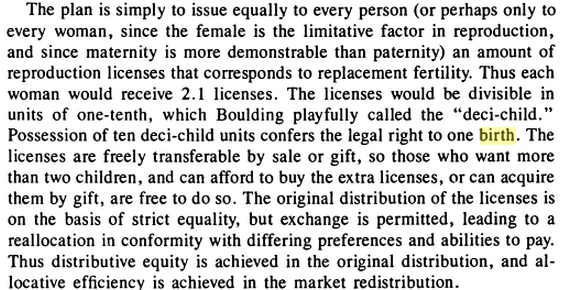
A mate suggested that I look into ecological economics. The self-appointed visionaries of ecological economics were so concerned about the population bomb that they proposed a “choice-based, marketable, birth license plan” or “birth credits” for population control. The Earth’s carrying capacity is a central issue in ecological economics.
Birth credits were promoted by urban designer and environmental activist Michael E. Arth since the 1990s and earlier by economist Kenneth Boulding (1964) and ecological economist Herman Daly (1991). I am not making this up.

Birth credits would allow any woman to have as many children as she wants, as long as she buys a license for any children beyond an average allotment that would result in zero population growth (ZPG). Birth credits are similar to individual tradable quotas for fishing.
- If the allotment was determined to be 1.1 children, then the first child would be free, and the market would determine the cost of the license or birth credit for each additional child.
- The units could be sold in units of 1/10th of a credit with each of us getting 1.1 credits each for free, under some proposals.
Being nice members of the middle class, the penalty proposed for an illegal baby would be community service for the parents. I am sure most parents would welcome the time out of the house and the free child care. Obviously, these nice family unfriendly educated middle class ZPG types do not seem to appreciate the seas and oceans that some with cross to have a child.
Arth, Dally and his fellow prophets were smug enough to think they could see the future and a looming population bomb and food riots, but plainly they got the sign of the demographic crisis wrong.

Sub-replacement fertility is now the demographic crisis. Over half of the world’s population lives in countries with fertility rates at or below replacement level, and nearly all countries will reach low fertility levels in the next decade or two.
A larger population can, as Gary Becker has pointed out, increase the rate of technological progress by increasing the number of creative people working away at inventing new products and ideas. More people means more markets that will reach a critical mass for which people can then profitably invent new products, which further increase innovation and economic growth.
The price of these birth credits would be now lower than an EU carbon credit. You could not give them away.
HT: Steady-State Economics: Second Edition With New Essays – Herman E. Daly – Google Books.
The withering away of the union wage premium
01 Apr 2014 Leave a comment
in economics of regulation, labour economics, law and economics, politics - USA, unions Tags: union wage premium
The union wage premium is supposed to be 10-15%. There is evidence that it may be close to zero and has been close to zero for some time at least in the USA.

In this paper (QJE 2004), John DiNardo and David Lee compared business establishments from 1984 to 1999 where US unions barely won the union certification election (e. g., by one vote) with workplaces where the unions barely lost.
If 50% plus 1 workers vote in favour of the union proposing to organise them, management has to bargain for a collective agreement in good faith with the certified union, if the union loses, management can ignore that union.
Most winning union certification elections resulted in the signing of a collective agreement not long after. Unions who barely win have as good a chance of securing a collective agreement as those unions that win these elections by wide margins. Few firms subsequently bargained with a union that just lost the certification election. Employers can choose to recognise a union.
Because the vote is so close, a particular workplace becoming unionised was close to a random event.
- This closeness of the union certification election may disentangle unionisation from just being coincident with well-paid workplaces, more skilled workers and well-paid industries.
- Unions could be organising at highly profitable firms that are more likely to grow and pay higher wages independent of any collective bargaining. The unions are claiming credit for wage rises that would have happened anyway.
DiNardo and Lee found only small impacts of unionisation on all outcomes that they examined:
- The estimated changes for wages are close to zero.
- Impacts on survival rates of the unionised business and their profitability were equally tiny.
- This evidence suggests that in recent decades, requiring an employer to bargain with a certified union has had little impact because unions have been unsuccessful in winning significant wage gains.
This means that there may not be a union wage premium at all since the early 1980s in the USA.
Private sector union membership is about 7% in the USA. Private sector union membership is barely in the teens in Australia and New Zealand. Fewer people are joining unions because they are not of any value to them.
The transferability of these results to Australia are in doubt, to the extent that there is the option for compulsory arbitration, which there is. The union wage premium may be the product of the ability to lobby for wage regulation.
New Zealand and U.S. unions are more similar in that both are on their own in bargaining with employers for a wage rise. The U.S. result sends a message to New Zealand that unions are a bit of a relic in terms of wage bargaining.
Regulated industries are a little different because it is wise for employers to share the rents from the higher prices with their employees as higher wages. They then unite in a political coalition to support continued regulation and tariffs. There are far fewer industries these days where entry is regulated and prices are higher because of such anti-competitive regulation.
These results about the small size of the union wage premium, of course, would come as no surprise to Milton Friedman. He said in 1950 that most unions could not overcome market forces that would tend to keep wages aligned with competitive rates.
Lee Ohanian: The Economic Crisis: A Comparison Across Time and Countries
01 Apr 2014 Leave a comment
in global financial crisis (GFC), great recession, labour economics
Alchian, Demsetz and the efficiency enhancing roles of unions
31 Mar 2014 Leave a comment
in Armen Alchian, labour economics, theory of the firm Tags: transaction costs, unions
Many look at unions as a cartel that raises wages at the expense of non-members.
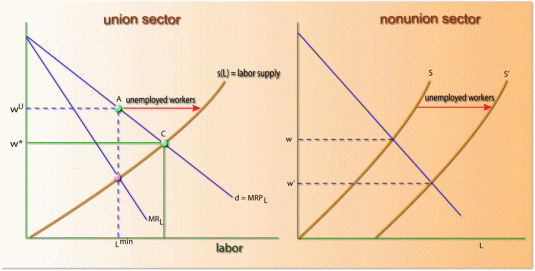
What has been under-sold is the efficiency enhancing role of unions in Alchian and Demsetz (1972) – their modern classic on the theory of the firm.
Employee unions, whatever else they do, act as monitors for employees.
- Are correct wages paid on time? Usually, this is easy to check.
- But some forms of employer performance on the employment contract are less easy to meter and is at risk to employer shirking.
Medical, hospital, and accident insurance and retirement pensions are contingent payments paid in kind by employers to employees. Each employee cannot judge the character of such payments as easily as with money wages.
A specialist monitor – a union hired by the employees – monitors those aspects of employer payments that are more difficult for employees to monitor. As an example, many unions sit on the board of directors of pension funds as an employee watch dog.
Because of economies of scale in monitoring and enforcing contracts, unions may arise as an institution to reduce the costs of contracting for employees with investments in specific human capital and back-loaded pay, including employee pension plans.
In addition to these narrow contract-monitoring economies of scale, a union creates a continuing long-term employment relationship that eliminates the last-period (or transient employee) contract-enforcement problem and creates bargaining power (a credible strike threat) to more cheaply punish a firm that violates the employment contract.
- As a union makes it more costly for a firm to cheat an individual worker in his last period of work, workers are more likely to invest in specific human capital and accept back-loaded pay schemes, both of which raises their career wages and productivity.
- A strike is a cheaper way to enforce a contract than is litigation. Many firms stop dealing with a bad customer/unreliable supplier until a bill or problem is fixed. A quick strike is no different.
Unions are more likely to exist when the opportunistic cheating problem is greater, namely, when there is more firm-specific human capital present in the employment relationship.
Unions perform many of the functions carried out by professional agents in the sports and entertainment industries. These specialists know the going rate for specific talents; act as a credible and informed negotiating agent; warn their clients off working for bad employers; and punish bad employers by not referring future clients to them.
The traditional literature on unions argues that unions act as a productivity shock and give employee voice in workplace affairs, which lowers job turnover. Unions as an institution to reduce contract negotiation and enforcement costs is better nested in the modern theory of the firm. Of course, unions can also act as cartels.
The next blog on unions will be on the withering away of the union wage premium. The final blog will be on how strikes can enhance the profits of employers!
James Heckman and southern racism–updated
30 Mar 2014 3 Comments
in labour economics, Public Choice Tags: James Heckman, racism, social change, unanticipated social revolutions
James Heckman is a great economist who spent two years as a teenager in the late 1950s in racist Southern States of America and returned in 1963 and in 1970. His parents when they arrived received a delegation of neighbours to explain Southern ways.
There was organised segregation in 1963 when he visited again. His 1963 visit with a college roommate from Nigeria was monitored by the local sheriff.
In Birmingham, they stayed at the black YMCA. The people there were frightened to death because he was breaking the local Jim Crow laws. Shops closed in New Orleans to avoid serving them. Heckman and his Nigerian college mate were brave young men.
In 1970, Heckman re-visited New Orleans as an academic, going back to the same places. They were completely integrated, totally changed. This rapid social change fascinated him.
The Civil Rights Act of 1964 broke the control of segregationists over their political and legal institutions.
The racial segregation collapsed because it could no longer rely on Jim Crow laws and the private violence and boycotts through the White Citizens Councils which police turned a blind eye too when they were not actively involved.

Unlike the Ku Klux Klan, the White Citizens’ Councils met openly and was seen as “pursuing the agenda of the Klan with the demeanour of the Rotary Club” by “unleashing a wave of economic reprisals against anyone, Black or white, seen as a threat to the status quo”. In Mississippi, the State Sovereignty Commission funded the Citizens’ Councils.
 |
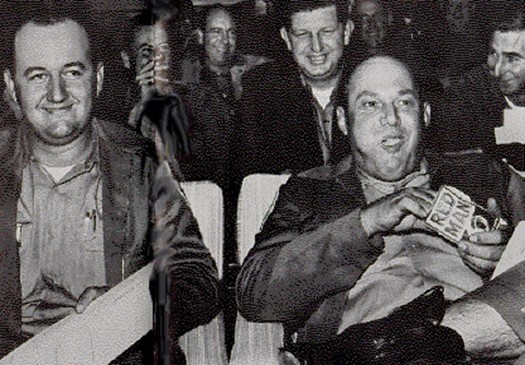 Deputy sheriff Price and Sheriff Rainey at their trial, 1967 |
Timur Kuran in “Sparks and Prairie Fires: A Theory of Unanticipated Political Revolutions,” suggested that political revolutions and large shifts in political opinion will catch us by surprise again and again because of people’s readiness to conceal their true political preferences proclivities under perceived social pressure.
Those ready to oppose racism or who were lukewarm about it, kept their opposition private until a coincidence of factors gave them the courage to bring their views into the open. In switching sides, they encouraged other hidden opponents to switch.
Fear changes sides. Genuine supporters of the old older falsify their publically professed preferences, pretending that they support the new order.
These are late-switchers. Do not trust them. These opportunists will just as easily switch back.
Plenty of people have had personal experiences of this in the 1980s and the 1990s when there was rapid changes in social and political attitudes about racism, sexism and gay rights. A few people had to stand up for what was right and a surprisingly large number quickly joined their side.
Back in the day, an old University mate of mine, Rodney Croome used to be (very bravely) protesting about reforms to the criminal law.
- Rod even went into a police station and confessed to abominations against the order of nature, as the Tasmanian criminal code called it. It was a gender-neutral prohibition.
- The police said they could not prosecute without the other party coming forward as the witness. He did.
- The Tasmanian DPP then declined to prosecute on public interest grounds.
These days, Rod is campaigning for the right to marry. All inside one generation! What a great country is Australia.
I often use the rapid social change such as this with gay rights when I must listen to someone drone on telling me how preference and social roles are socially constructed. They missed the 20th century, and the 60s and the 70s at least.
When I was growing-up, racist sentiments were common. Good friends, decent upright people, disgraced themselves to go along with the crowd. I could not understand why someone would want to be so cruel just to be popular. Times have changed, thankfully.
How to Restore US Prosperity – Prof. Edward C. Prescott
29 Mar 2014 Leave a comment
in global financial crisis (GFC), great recession, labour economics, regulation
John Rawls and are the super-rich unjustly over-taxed?
28 Mar 2014 1 Comment
in labour economics, public economics, Rawls and Nozick Tags: company tax, economic growth, flat rate consumption tax, higher wages, income tax, inequality
John Rawls is often put forward by political progressives as the starting point for political philosophy. Rawls pointed out that behind the veil of ignorance, people will agree to inequality as long as it is to everyone’s advantage.
Rawls was attuned to the importance of incentives in a just and prosperous society. If unequal incomes are allowed, this might turn out to be to the advantage of everyone.
Rawls lent qualified support to the idea of a flat-rate consumption tax (see A Theory of Justice, pp. 278-79). He said that:
A proportional expenditure tax may be part of the best scheme [and that adding such tax] can contain all the usual exemptions.
The reason why Rawls lent qualified support to the idea of a flat-rate consumption tax was because these taxes:
impose a levy according to how much a person takes out of the common store of goods and not according to how much he contributes.
A simple way to have a progressive consumption tax is to exempt all savings from taxation. Taxable consumption is calculated as income minus savings minus a large standard deduction. Different countries use different terms to describe the minimum amount that must be earned before any taxes are paid.
Income tax must be opposed on social justice grounds, but not progressive consumption taxes.
Given that the super-rich – the top 0.1% of income earners – do not spend much of their incomes, especially on the way up building their businesses, they could be rather over-taxed!
Steven Kaplan and Joshua Rauh’s “It’s the Market: The Broad-Based Rise in the Return to Top Talent”, Journal of Economic Perspectives (2013) found that:
- Rising inequality is due to technical changes that allow highly talented individuals or “superstars” to manage or perform on a much larger scale.
- These superstars can now apply their talents to greater pools of resources and reach larger numbers of people and markets at home and abroad. They thus became more productive, and higher paid.
- Those in the Forbes 400 richest are less likely to have inherited their wealth or have grown up wealthy.
- Today’s rich are working rich who accessed education in their youth and then applied their natural talents and acquired skills to the most scalable industries such as ICT, finance, entertainment, sport and mass retailing.
- The U.S. evidence on income and wealth shares for the top 1% is most consistent with a “superstar” explanation. This evidence is less consistent with the gains in earnings of the top 1% coming from greater managerial power over the determination of their own pay in the corporate world, or changes in social norms about what managers could earn.
Today’s super-rich are highly productive because they produce new and better products and services that people want and are willing to pay for. These rewards for entrepreneurship and hard work guide people of different talents and skills into the occupations and industries where their talents are valued the most. The efficient allocation of talent and income maximising occupational choices were important to Rawls’ framework.
Another important role for incentives is it rewards entrepreneurial alertness. People will look for and take advantage of hitherto unnoticed business opportunities if they are rewarded for doing so. These private rewards for greater effort, excellence and superior alertness are the driving force of the market. Most of the innovation that drives modern prosperity would not have occurred but for the lure of profit.
Rawls was keen on stiff inheritance taxes to prevent the “large-scale private concentrations of capital from coming to have a dominant role in economic and political life”. His support for inheritance taxes was out of concern with a concentration of political power rather than improving incentives.
Rawls overrated the power of the rich to buy political influence as do many on the Left. They do not understand Director’s law of public expenditure and the theories of the median voter and the expressive voter. The major political parties all chase the swinging voter in the middle class.
Rawls’ views on incomes taxes and the rich are rather under-discussed among his champions on the progressive Left. Google John Rawls and income taxes and you do not get many hits or papers of any substance.
With his emphasis on fair distribution of income, Rawls’ initial appeal was to the Left, but left-wing thinkers started to dislike his acceptance of capitalism and tolerance of large discrepancies in income. Many moved on. Rawls excluded envy from deliberations behind the veil of ignorance. This may be why he lost some of his initial appeal to some.
You must admire his consistency. Rawls was happy for people to be super-rich as long as they saved and invested their resources. Everyone in society gains from those investments and is better off.
Robert Lucas (1990) estimated that a revenue neutral elimination of all taxes on income from capital and on capital gains would increase the U.S. capital stock by about 35% and consumption by 7%. Hans Fehr, Sabine Jokisch, Ashwin Kambhampati, and Laurence J. Kotlikoff (2014) found that eliminating the corporate income tax would raise the U.S capital stock (machines and buildings) by 23%, output by 8% and the real wages of unskilled and skilled workers by 12%. Is taxing the rich worth this large a lost wage rise?


Recent Comments