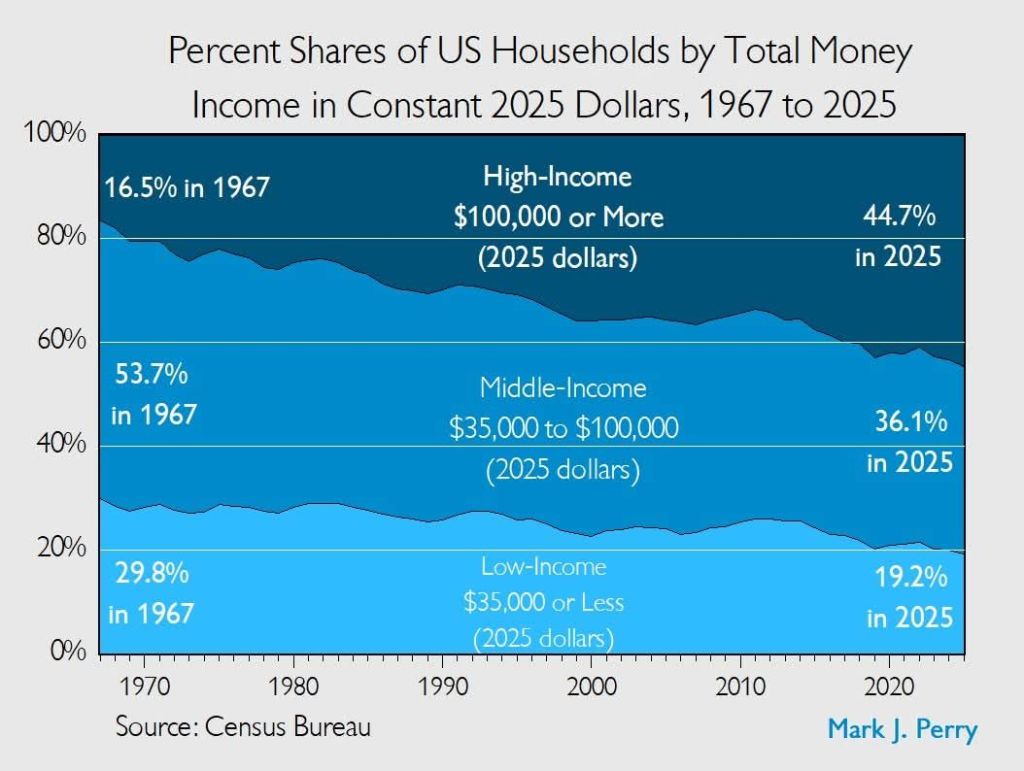
I have a series of columns (2021, 2024, 2025, and 2026). documenting that Americans are getting richer. And here’s a chart that adds additional evidence. More and more households over time are high income (over $100k) and fewer and fewer are low income (under $35k). And, yes, these numbers are adjusted for inflation. The chart was […]
The gender wage gap has dropped by two-thirds in the last 30 years. It has halved since the first pay equity claim was filed 14 years ago. The gender wage gap is now barely 5.5% in June 2026 according to the recently released Statistics New Zealand data. It is a stretch to file pay equity claims asking for 30% more when the gender wage gap struggles to stay above 5%.
The gender wage gap data released by Statistics New Zealand recently is the raw data. There are no adjustments to that pay gap for differences in educational backgrounds, continuity of employment and dedication to demanding careers, unsocial hours, risk of injury, and the greater desire of women for work-life balance and jobs with more working from home options.
It is not mischievous to say that the gender wage gap may round down to zero once these factors are considered.
From time-to-time, detailed datasets become available on male and female workers that show that the gender wage gap goes down or close to zero. There are even detailed datasets where hiring and job assignments are made without any management intervention or possible bias.
There is a large gender wage gap driven by work-life balance under a bus and train drivers’ collective agreement in Massachusetts. The work-force was one-third female with hiring via a lottery among applicants with a clean record. Shifts are chosen by drivers strictly according to their seniority at each depot.
There was still a 11% gender wage gap because women drivers elected to work less overtime, they avoided overtime shifts on short notice, and they worked fewer shifts at nights and weekends. This gender wage gap among bus and train drivers cannot be the fault of their sexist employer because work was allocated by an exceptionally detailed union contract.
A 7% gender wage gap emerged even when a computer algorithm is allocating the work first come, first served.
A study of Uber drivers found a gender pay gap of zero once account is taken for male Uber drivers driving more at nights, weekends and in the more dodgy neighbourhoods with drinking establishments. Male Uber drivers also worked more hours per year which meant they had much more work experience than female Uber drivers. These additional hours meant men became more skilled in deciding when and where to best cruise for the best paying jobs. The fact that men drive faster explained the last two percentage points of the gender pay gap at Uber. Speed meant men were available for the next Uber job quicker.
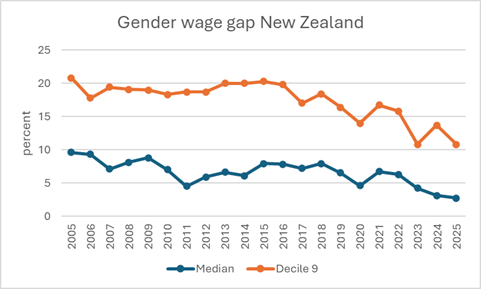
The gender wage gap is just into the double digits for the top 10% of female earners in New Zealand in 2025 (see OECD graphic). This is because their chosen careers are often not family friendly. But even at the top end of town the gender pay gap has halved in the last 20 years.
OECD data explorer
Women’s willingness to trade work-life balance for lower wages and fewer promotions is a big driver of the gender wage gap and the channelling of women into family friendly occupations. The wages of men and women at all levels are similar in the years leading up to motherhood then everything changes.
Top American labour economist Claudia Goldin found that some careers severely penalise any time off such as for motherhood or working less than punishingly long or rigid hours. Goldin refers to these jobs as greedy jobs. Women’s preference for family friendly occupations that can pay less and a tendency to avoid greedy jobs will mean that the gender wage gap may always be with us at least at the big end of town.
Is new technology that replaces a worker a good thing? We have a tendency, it seems to me, to believe that most previous inventions turned out to have overall net social benefits, but to be worried that all future inventions will instead have overall net social costs. Philipp Ager and Davide Coluccia tackle the question of…
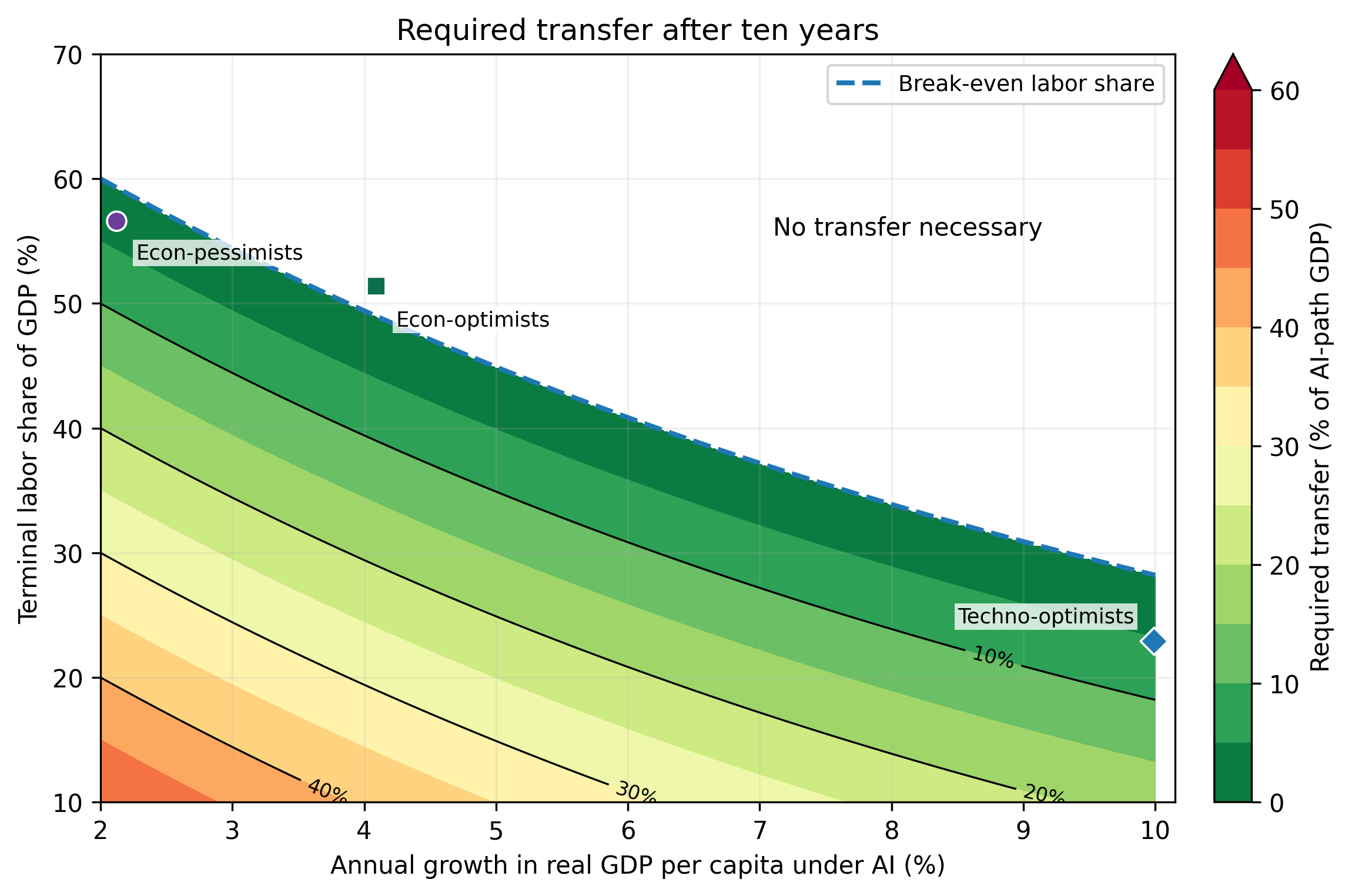
How much redistribution will AI require? A common scenario is that AI raises output enormously, but labor’s share of income collapses. GDP per capita goes up but workers get poorer, and making workers whole requires massive redistribution. In my latest paper, I run the numbers and conclude that this is probably incorrect. The idea is…
We provide the first direct estimates of the effects of minimum wages on low-wage workers in families at different points of the distribution of income-to-needs, using data from the Survey of Income and Program Participation, which oversamples low-income families. We find adverse – rather than beneficial – effects of minimum wages on the employment, hours,…
See Gender Disparities in College Enrollment and Marriage Patterns by Clara Chambers, Benjamin Goldman & Joseph Winkelmann.”Over the past half-century, the gender composition of American college campuses has shifted from predominantly male to predominantly female. Today, 1.6 million more women than men attend four-year colleges in the US. Over the same time period, the economic status…
Outgoing governments often try to craft a legacy for themselves by introducing policy traps that incoming governments find hard to undo, such as Rishi Sunak’s National Insurance cuts in 2024 or Gordon Brown’s introduction of the 50p top rate of income tax in 2010. Keir Starmer just did something similar by initiating a huge expansion in the […]
I’ve used the “most depressing chart” approach when writing about the United States, about Europe, about Japan, and about the western world. Today, let’s focus on Germany. And I’ll start with a caveat. I wrote about Germany earlier this month and that column included several charts that might qualify. Especially the last visual which showed […]
Why Evolution is True is a blog written by Jerry Coyne, centered on evolution and biology but also dealing with diverse topics like politics, culture, and cats.
In Hume’s spirit, I will attempt to serve as an ambassador from my world of economics, and help in “finding topics of conversation fit for the entertainment of rational creatures.”



Recent Comments