A Universal Basic Income, or UBI, is a superficially attractive idea. Under such a scheme, every adult would receive a regular payment from the government, regardless of income, employment or need. Supporters argue that it would reduce poverty, simplify welfare, provide security in an uncertain labour market and give people greater freedom to choose how […]
The Case Against a Universal Basic Income
The Case Against a Universal Basic Income
23 Jul 2026 1 Comment
in applied price theory, fiscal policy, income redistribution, labour economics, labour supply, macroeconomics, politics - New Zealand, poverty and inequality, Public Choice, welfare reform
Quarter of a million children are now dependent on welfare
18 Jun 2026 1 Comment
in labour economics, politics - New Zealand, poverty and inequality, welfare reform
It’s appalling that a quarter of a million children now need an income from the state to feed, clothe and house them.Data released under the Official Information Act shows over a quarter of a million children were dependent on welfare at December 2025.At 31 December 2025 there were 255,300 children aged 0-17 reliant on a…
Quarter of a million children are now dependent on welfare
Watermelon Economics
16 Jun 2026 Leave a comment
in development economics, fiscal policy, human capital, income redistribution, labour economics, labour supply, macroeconomics, poverty and inequality, Public Choice Tags: development aid, regressive left, taxation and entrepreneurship, taxation and investment, top 1%

Remember Thomas Piketty, the pro-class-warfare economist who is infamous for shoddy analysis and who also made a fool of himself by asserting back in 2023 that Javier Milei’s election in Argentina would lead to economic disaster? Yes, that Thomas Piketty. It turns out he’s also a “watermelon,” which is the derisive term for leftists who […]
Watermelon Economics
Europe’s War on Wealth
29 May 2026 Leave a comment
in applied price theory, economic growth, economic history, fiscal policy, income redistribution, industrial organisation, labour economics, labour supply, macroeconomics, occupational choice, P.T. Bauer, poverty and inequality, Public Choice, public economics Tags: European Union

Given the relative economic weakness that plagues most European nations (documented here, here, here, here, and here), a top priority for policy makers should be to improve incentives for wealth creation. But that assumes politicians care about the prosperity of citizens. Based on a new report from the European Commission, the answer is no. Instead of […]
Europe’s War on Wealth
Are Living Standards Higher in France or Mississippi?
25 May 2026 Leave a comment
in applied price theory, economic growth, economic history, income redistribution, labour economics, macroeconomics, poverty and inequality, Public Choice Tags: France

Earlier this month, in Part V of my series on the U.S. vs. Europe (previous versions available here, here, here, and here), I shared a chart showing the OECD calculations of “Actual Individual Consumption.” The AIC numbers are designed to give people an apples-to-apples comparison of living standards. I’m re-sharing the chart today, and I’ve […]
Are Living Standards Higher in France or Mississippi?
The (Amusingly) Destructive Economics of Wealth Taxation
24 May 2026 Leave a comment
in applied price theory, economic growth, entrepreneurship, fiscal policy, human capital, income redistribution, labour economics, labour supply, macroeconomics, poverty and inequality, Public Choice, public economics Tags: taxation and entrepreneurship, taxation and investment, taxation and labour supply
I’ve shared several columns (here, here, here, here, and here) reviewing scholarly research on the harmful economic impact of wealth taxation. From now on, however, I think I’ll simply share this clever video from the folks at Reason. The video uses humor to make very important points about how a wealth tax would diminish incentives […]
The (Amusingly) Destructive Economics of Wealth Taxation
The Laffer Curve and Limits to Class Warfare Tax Policy, Part II
19 Apr 2026 Leave a comment
in applied price theory, econometerics, entrepreneurship, fiscal policy, human capital, income redistribution, labour economics, labour supply, macroeconomics, poverty and inequality, Public Choice, public economics Tags: taxation and entrepreneurship, taxation and investment, taxation and labour supply
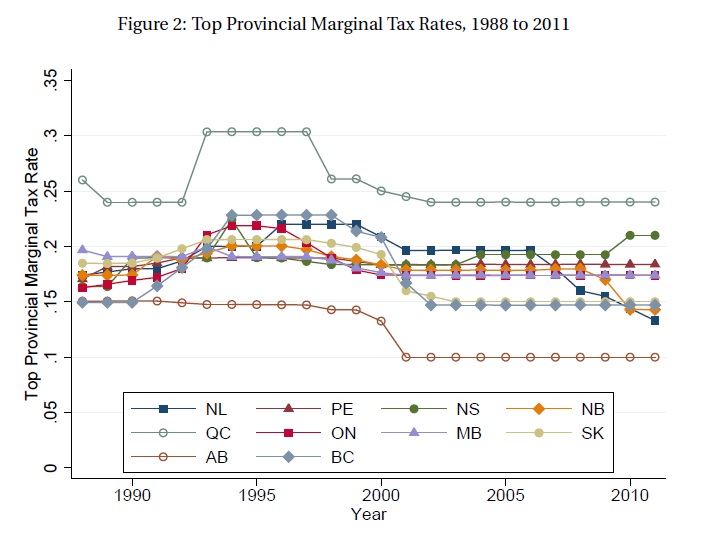
In Part I of this series back in 2014, we looked at some academic research from Canada showing that the revenue-maximizing tax rate on the richest taxpayers was 27.5 percent. A key insight from that research is that high-income taxpayers have considerable control over the timing, level, and composition of their income (just like in […]
The Laffer Curve and Limits to Class Warfare Tax Policy, Part II
The President(s) Fought the Law and the Law Won
18 Apr 2026 Leave a comment
in applied price theory, economic history, history of economic thought, income redistribution, industrial organisation, international economics, labour economics, labour supply, politics - USA, poverty and inequality, Public Choice, rentseeking, survivor principle Tags: creative destruction, free trade, tarrifs
In our textbook, Modern Principles, Tyler and I emphasize that Congress and the President are subject to a higher law, the law of supply and demand. In an excellent column, Jason Furman gives a clear example of how difficult it is to fight the law of inelastic demand: …Today a given number of autoworkers can…
The President(s) Fought the Law and the Law Won
Why “Gini Coefficients” Are Meaningless
09 Apr 2026 Leave a comment
in economics of education, entrepreneurship, financial economics, history of economic thought, human capital, industrial organisation, labour economics, labour supply, occupational choice, poverty and inequality
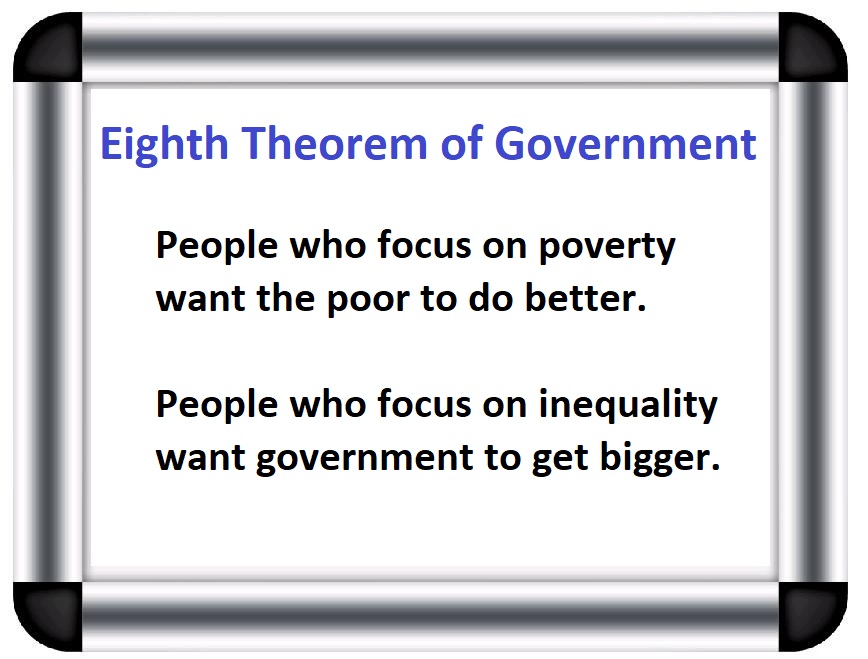
I created the 8th Theorem of Government because it’s important to distinguish between people who want to help the poor and people who want to punish the rich. The former group has good motives while the latter group has ignoble motivations. Envy (common among the leftist intelligentsia) Public choice (common among leftist politicians) Zero-sum illiteracy […]
Why “Gini Coefficients” Are Meaningless
Will Denmark and/or the Netherlands Copy Norway’s Failed Wealth Tax?
02 Mar 2026 1 Comment
in fiscal policy, human capital, income redistribution, labour economics, labour supply, macroeconomics, poverty and inequality, Public Choice, public economics Tags: Denmark, taxation and entrepreneurship

Class-warfare tax policy is always a bad idea. Economists generally don’t like class-warfare policies because it is foolish to impose high marginal tax rates on productive behaviors such as investment and entrepreneurship. Politicians should not like class-warfare policies because of the negative impact on jobs and wages for ordinary people as well as the potential negative […]
Will Denmark and/or the Netherlands Copy Norway’s Failed Wealth Tax?
Americans Are Getting Richer, Part IV
24 Jan 2026 Leave a comment
in applied price theory, economic growth, economic history, income redistribution, labour economics, macroeconomics, politics - USA, poverty and inequality

In 2016, here’s some of what I wrote about the economic outlook in Illinois. And I shared the same observation when writing about California in 2018. There’s a somewhat famous quote from Adam Smith (“there is a great deal of ruin in a nation“) about the ability of a country to survive and withstand lots of […]
Americans Are Getting Richer, Part IV
Part II: Oxfam Is a Leftist Joke, not a Real Charity
20 Jan 2026 1 Comment
in applied price theory, development economics, economic growth, economic history, growth miracles, income redistribution, labour economics, liberalism, macroeconomics, Marxist economics, poverty and inequality, Public Choice, technological progress Tags: regressive left, The Great Enrichment

As I wrote nine years ago, Oxfam is a pathetic organization. Originally created to help the poor, it has been captured by activists who peddle class warfare. But they play that role in an incredibly sloppy fashion. In all the debates I’ve been part of over the years, no left-leaning academic has been willing to […]
Part II: Oxfam Is a Leftist Joke, not a Real Charity
AI, labor markets, and wages
18 Jan 2026 Leave a comment
in applied price theory, econometerics, economic growth, industrial organisation, labour economics, labour supply, macroeconomics, poverty and inequality Tags: creative destruction, pessimist bias
There is a new and optimistic paper by Lukas Althoff and Hugo Reichardt: Artificial intelligence is changing which tasks workers do and how they do them. Predicting its labor market consequences requires understanding how technical change affects workers’ productivity across tasks, how workers adapt by changing occupations and acquiring new skills, and how wages adjust…
AI, labor markets, and wages
Reflections on the Caplan-Bruenig Poverty Debate
09 Jan 2026 Leave a comment
in applied price theory, history of economic thought, labour economics, labour supply, liberalism, libertarianism, Marxist economics, politics - USA, poverty and inequality, welfare reform Tags: child poverty, family poverty
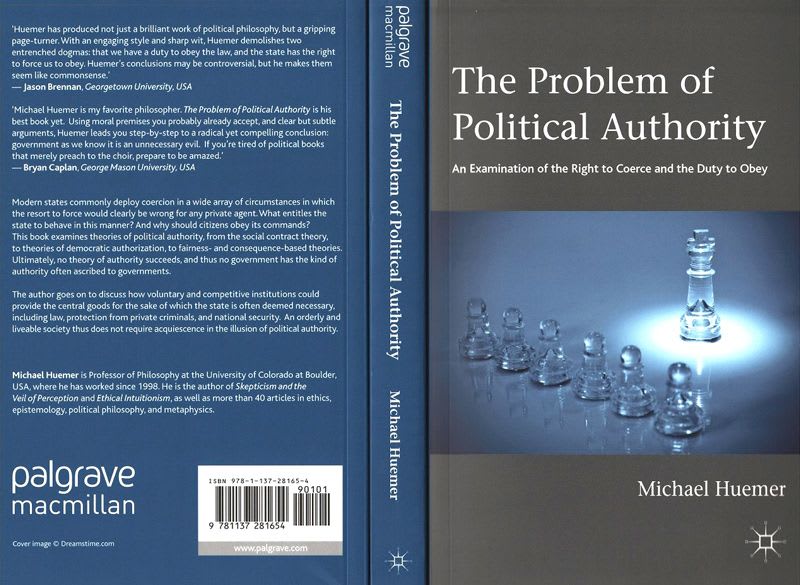
Last month, Econoboi hosted a debate on poverty between myself and Matt Bruenig. Here are my reflections on that debate.I was pleasantly surprised by Bruenig’s openness to most of my proposed supply-side reforms. He wasn’t just pro-immigration, but also pro-deregulation of housing and pro-nuclear. He was happy to admit that these policies aren’t just good…
Reflections on the Caplan-Bruenig Poverty Debate
Economic Inequality Does Not Cause Lower Subjective Ratings of Well-Being
03 Jan 2026 Leave a comment
in applied price theory, labour economics, poverty and inequality
It’s become a nearly standard claim that economics inequality makes people feel worse-off, or perhaps even leads to mental illness. However, Nicolas Sommet, Adrien A. Fillon, Ocyna Rudmann, Alfredo Rossi Saldanha Cunha and Annahita Ehsan did what is called a “meta-analysis” of the available studies–that is, they went back and looked at the underlying data, methods, and findings…
Economic Inequality Does Not Cause Lower Subjective Ratings of Well-Being


Recent Comments