Working population poverty is unchanged despite declines in elderly and child poverty #PovertyIs http://t.co/i7O7dTEUg2—
Political Line (@PoliticalLine) June 19, 2015
Child poverty certainly didn’t go up after the 1996 federal welfare reforms
01 Jul 2015 1 Comment
in gender, labour economics, labour supply, poverty and inequality, welfare reform Tags: 1996, child poverty, economics of fertility, single mothers, single parents, taxation and the labour supply, welfare reforms
What are alternatives to the minimum wage?
30 Jun 2015 Leave a comment
in labour economics, minimum wage, poverty and inequality, public economics Tags: earned income tax credit, family tax benefits, working for families
What are alternatives to the minimum wage, and how do they effect workers and taxpayers? buff.ly/1c4BYhd http://t.co/hf67ujjvOK—
MRUniversity (@MRevUniversity) May 20, 2015
Poverty rates in Canada, UK and USA since 1985
28 Jun 2015 Leave a comment
in labour economics, politics - USA, poverty and inequality, welfare reform Tags: British economy, Canada, top 1%
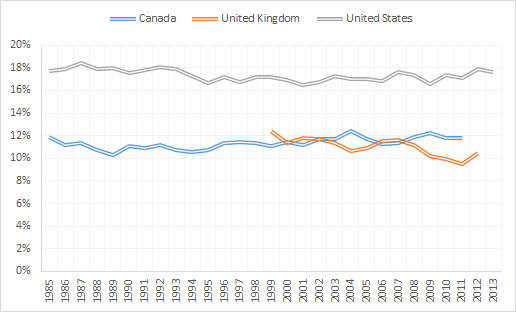
Despite 30 years of the ravages of neoliberalism, Reagan, Thatcher, and Blair, the whole lot, poverty has not gone up or down much at all.
Figure 1: relative poverty rate (% of persons living with less than 50% of equivalised disposable income), USA, UK and Canada
Source: In It Together – Why Less Inequality Benefits All – © OECD 2015
Child poverty across Europe
28 Jun 2015 Leave a comment
in Euro crisis, poverty and inequality Tags: child poverty, EU, Eurosclerosis, family poverty
Spain's lost decade: one in three Spanish kids live in poverty or at risk of social exclusion: gu.com/p/42yx7/tw http://t.co/qg8PDla19z—
Guardian Data (@GuardianData) October 28, 2014
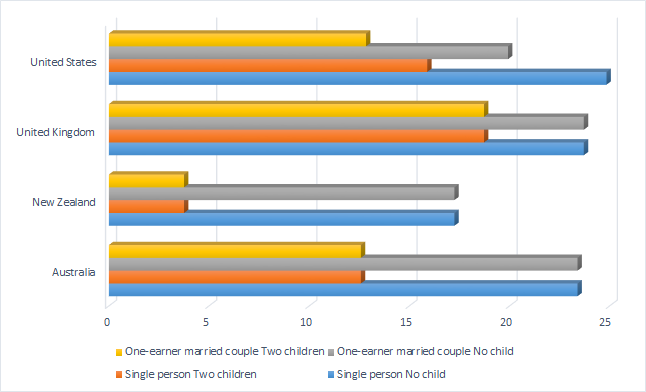
All in less cash transfers average income tax rates at average wage, USA, UK, Australia and New Zealand
27 Jun 2015 Leave a comment
in labour supply, politics - Australia, politics - New Zealand, politics - USA, poverty and inequality, public economics Tags: Australia, British economy, family tax credits, family taxation, in-work tax credits, social insurance, taxation and the labour supply, welfare state
Figure 1: All in less cash transfers average income tax rates at average wage, 2014
Source: OECD tax database
Why is the Australian top 0.1% far less greedy than the UK, US and Canadian top 0.1%?
26 Jun 2015 Leave a comment
in economic history, entrepreneurship, human capital, labour economics, labour supply, Marxist economics, occupational choice, politics - Australia, politics - USA, poverty and inequality Tags: Australia, British economy, Canada, Leftover Left, top 0.1%, top 1%
Figure 1: top 0.1% share of gross income, Australia, UK, USA and Canada since 1946

Source: Chartbook of Economic Inequality.
The top 0.1% in Australia is earning not much more than it did in 1946. For most of the post-war period, the Australian top 0.1% earned less than what it earned in 1946. The only spike in the earnings of the Australian top 0.1% occurred after the top tax rate of 66% was reduced to 49% in 1986.
There were major cuts in the top tax rates in Australia,the USA and UK in the early 1980s. Figure 1 shows that these top tax rate cuts were matched with a spike in the earnings of the top 0.1% subsequent to those large tax cuts.
@MaxRashbrooke The top 1% in New Zealand are lazy and incompetent as a ruling class
24 Jun 2015 1 Comment
in applied price theory, applied welfare economics, economic history, entrepreneurship, health and safety, human capital, industrial organisation, liberalism, Marxist economics, poverty and inequality, Rawls and Nozick, unions Tags: capitalism and freedom, Class war, Joan Robinson, Joseph Schumpeter, social insurance, The Great Enrichment, top 1%, welfare state, withering away in the proletariat
New work by Chris Ball and John Creedy shows substantial *declines* in NZ inequality.
initiativeblog.com/2015/06/24/ine… http://t.co/f94fw4Bhae—
Eric Crampton (@EricCrampton) June 24, 2015
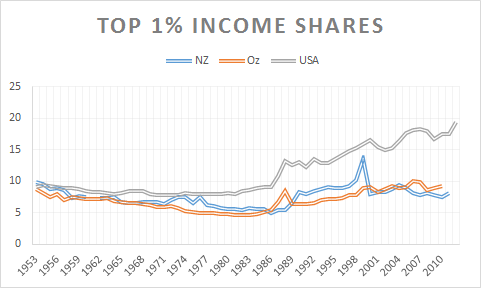
The top 1% in New Zealand really have been dropping the class war ball for at least a generation.
Source: The World Top Incomes Database.
Not only have the New Zealand top 1% been pretty miserable at increasing their share of incomes, hardly any change since 1990 and not much before that, the top 1% allowed inequality in both consumption and disposable income to actually fall since 1990 as shown by Treasury analysis published today.
Joan Robinson was on to this in the 1940s when she said the battle cry of Marxists would have to change from the 1848 version “rise up ye workers, rise up for you have nothing to lose but your chains” to “rise up ye workers, rise up for you have nothing to lose but the prospect of a suburban home and a motorcar”.

Today that battle cry of the Marxist revolution would have to be “rise up ye workers rise up for you have nothing to lose but your iPhone and your air points”. As Joan Robinson observed in the 1940s, that’s not much of a basis for a revolutionary movement.
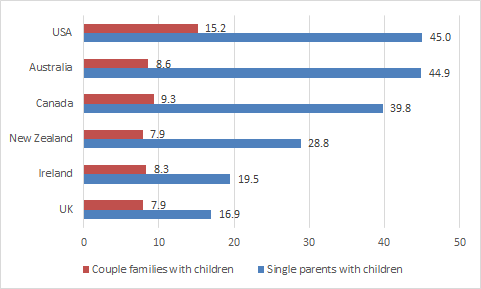
Child poverty rates in single parent and couple families, Anglo-Saxon countries
22 Jun 2015 Leave a comment
in labour economics, politics - Australia, politics - New Zealand, politics - USA, population economics, poverty and inequality, welfare reform Tags: Australia, British economy, Canada, child poverty, economics of the family, family poverty, Ireland, single mothers, single parents
Figure 1: Child poverty rates by family type, Anglo-Saxon countries, 2010
Source: OECD Family Database; Poverty thresholds are set at 50% of the median income of the entire population.
The impact of parental employment on child poverty in couple families, Anglo-Saxon countries
21 Jun 2015 Leave a comment
in economics of love and marriage, labour economics, labour supply, law and economics, politics - Australia, politics - New Zealand, politics - USA, population economics, poverty and inequality, welfare reform Tags: Australia, British economy, Canada, child poverty, economics of families, family poverty, Ireland, labour force participation, single parents
Figure 1: child poverty rates in couple families by employment status, Anglo-Saxon countries, 2010
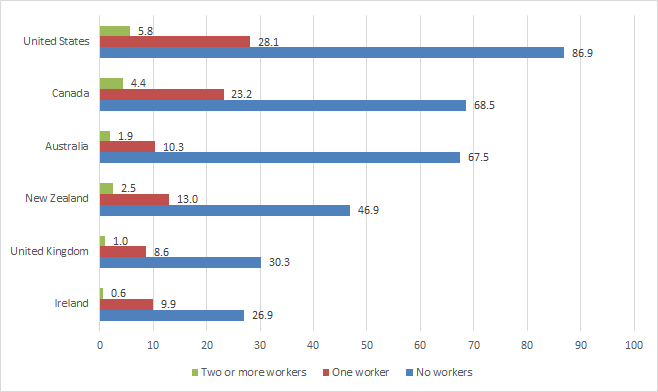
Source: OECD Family Database; Poverty thresholds are set at 50% of the median income of the entire population.
The impact of single parent employment on child poverty rates, Anglo-Saxon countries
20 Jun 2015 Leave a comment
in labour economics, politics - Australia, politics - New Zealand, politics - USA, poverty and inequality, welfare reform Tags: Australia, British economy, Canada, child poverty, economics of the family, family poverty, female labour force participation rates, Ireland, maternal labour supply, single mothers, single parents
Figure 1: Child poverty rate by employment status of single parent, Anglo-Saxon countries, 2010
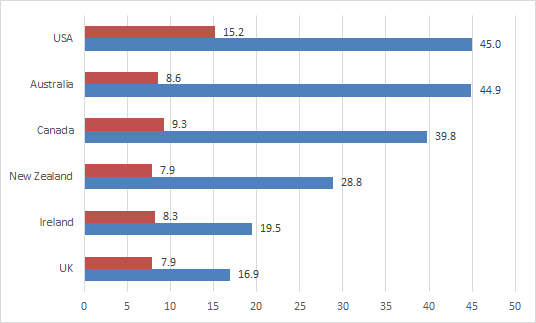
Source: OECD Family Database; Poverty thresholds are set at 50% of the median income of the entire population.
The education premium has immediate effects
17 Jun 2015 Leave a comment
in economics of education, human capital, labour economics, labour supply, occupational choice, poverty and inequality Tags: College premium, education premium, graduate premium, high school dropouts
http://t.co/t1Pym23Wgv—
EPI Chart Bot (@epichartbot) May 27, 2015
Why do these top 0.1 percenters get a pass from the Occupied Movement and Twitter Left?
15 Jun 2015 Leave a comment
in applied welfare economics, economics of media and culture, income redistribution, movies, politics - USA, poverty and inequality, Public Choice, TV shows Tags: comedy, Left-wing hypocrisy, Leftover Left, Occupy Wall Street, top 1%, Twitter left
The 25 richest comedians (or why not to go into standup comedy) from @randal_olson randalolson.com/2015/03/04/top… http://t.co/cp3lSnuPOf—
Tyler Vigen (@TylerVigen) March 17, 2015
Middle class stagnation versus food poverty
15 Jun 2015 Leave a comment
in politics - USA, population economics, poverty and inequality, technological progress Tags: good old days, middle class stagnation, The Great Enrichment, wage stagnation
CHART: As a share of income, spending on food has gone from 25% in 1930s to < 10% in 2013. http://t.co/pxRgf6tNOZ—
Mark J. Perry (@Mark_J_Perry) May 14, 2015
@phattonez Note that almost 50% of food expenditures are for now food away from home. http://t.co/zWAu0Zlw82—
Mark J. Perry (@Mark_J_Perry) May 18, 2015
 Utopia, you are standing in it!
Recent Comments