
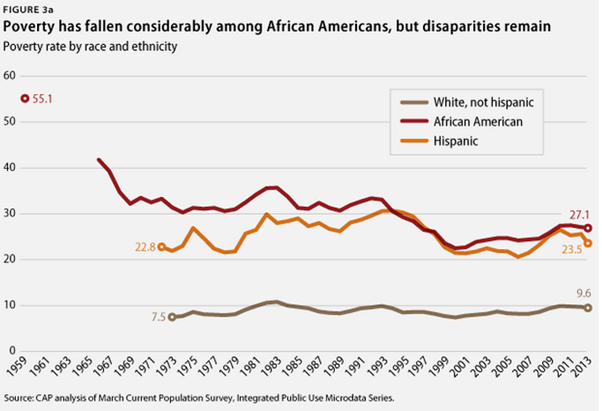
The big drop .in both child poverty and poverty in general was after the 1996 welfare reforms.


via Chart Book: The War on Poverty at 50, Section 1 | Center on Budget and Policy Priorities.
Celebrating humanity's flourishing through the spread of capitalism and the rule of law
16 May 2015 Leave a comment
in economic history, labour economics, labour supply, poverty and inequality, welfare reform Tags: 1996 US welfare reforms, child poverty, family poverty, war on poverty
The big drop .in both child poverty and poverty in general was after the 1996 welfare reforms.
via Chart Book: The War on Poverty at 50, Section 1 | Center on Budget and Policy Priorities.
13 May 2015 Leave a comment
in labour economics, labour supply, politics - USA, poverty and inequality, welfare reform Tags: 1996 welfare reforms, child poverty, family poverty, welfare state
13 May 2015 Leave a comment
in economics of love and marriage, gender, labour economics, labour supply, occupational choice, poverty and inequality, welfare reform Tags: child poverty, economics of marriage, family poverty, marriage and divorce, single mothers, single parents, welfare reform
Over half of all births to young adults in the U.S. now occur outside of marriage. bit.ly/1qONO10 http://t.co/KXl4sFd122—
Isabel Sawhill (@isawhill) September 17, 2014
Despite forgoing #marriage, young Americans are not forgoing parenthood. bit.ly/1sMG2bJ http://t.co/1aSELaJlfg—
Isabel Sawhill (@isawhill) October 31, 2014
Despite forgoing #marriage, young Americans are not forgoing #parenthood. bit.ly/1xLa1AJ http://t.co/fetnPAiCPG—
Isabel Sawhill (@isawhill) October 13, 2014
Almost 60% of births to women with only a high school degree occur out of wedlock. bit.ly/1sMG2bJ http://t.co/zomTFjZwA2—
Isabel Sawhill (@isawhill) October 14, 2014
12 May 2015 Leave a comment
in labour economics, labour supply, poverty and inequality Tags: child poverty, family poverty, labour force participation
The best defense against deep poverty is a paycheck: brook.gs/1IVXiTo http://t.co/BsermWSDZk—
Brookings (@BrookingsInst) May 10, 2015
Despite being a wealthy nation, extreme & deep poverty has become more prevalent in the U.S.: brook.gs/1IVVI3O http://t.co/cfnlkrXuw6—
Brookings (@BrookingsInst) May 09, 2015
More than 7.1 million U.S. children live in deep poverty. Get the facts on America's poor: brook.gs/1IWlK74 http://t.co/K4Uwrl5TOg—
Brookings (@BrookingsInst) May 08, 2015
12 May 2015 Leave a comment
in human capital, labour economics, labour supply, occupational choice, politics - USA, poverty and inequality Tags: CEO pay, top 1%
12 May 2015 Leave a comment
in labour economics, labour supply, politics - USA, poverty and inequality Tags: child poverty, family poverty, Leftover Left, neoliberalism, welfare reform, welfare state
How government reduces child poverty (SPM-measured) in the U.S. bit.ly/1D7eXjZ From: @aecfkidscount http://t.co/80m2jjXxvY—
Richard V. Reeves (@RichardvReeves) April 16, 2015
To tackle poverty, the Left says welfare, the Right says work. Guess what? They're both right: brook.gs/1zSabJI http://t.co/E4AZR05CQJ—
Richard V. Reeves (@RichardvReeves) February 13, 2015
The magic of (increasing) redistribution in one @EugeneSteuerle graph blog.metrotrends.org/2015/02/addres… http://t.co/lbtlM3zT5L—
Richard V. Reeves (@RichardvReeves) February 18, 2015
11 May 2015 Leave a comment
in economic history, labour economics, poverty and inequality Tags: poverty and inequality, top 1%, welfare reform, welfare state
How Gov. transfers (more than Federal taxes) reduce inequality cbo.gov/publication/49… http://t.co/3dMObjsykL—
Richard V. Reeves (@RichardvReeves) November 13, 2014
10 May 2015 Leave a comment
in labour economics, minimum wage, politics - Australia, politics - New Zealand, politics - USA, poverty and inequality Tags: capitalism and freedom, child poverty, family poverty, Left-wing hypocrisy, living wage, New Zealand Greens, New Zealand Labour Party, Simon Chapple
Where a 40-hour workweek doesn't lift families from poverty: bloom.bg/1AFOD0q http://t.co/eBoJSz1TkX—
Bloomberg VisualData (@BBGVisualData) May 23, 2015
An OECD chart that shows New Zealand parents only need to work a little over 40 hours a week on the minimum wage to lift a family out of poverty in New Zealand.

The figure above shows that a lone parent with two children needs to work about 25 hours a week stay out of poverty in 2013 in New Zealand Once taxes are taken into account as well as additional family benefits such as in-work tax credits. New Zealand is one of the easiest places in the world to get out of poverty by working part-time for a sole mother.
The figure above from the OECD shows that New Zealand couple with two children needs to work about 40 hours a week to stay out of poverty. Of course, what is poverty depends on the definition of the poverty line and in this case by the OECD, it is defined as 50% of the median wage after taxes and family benefits. Another common definition of poverty is earning less than 60% of the median wage
The minimum wage is $14.75 per hour in New Zealand while proposals for a living wage in New Zealand are now $19.25 an hour. The Labour Party wants to increase the minimum wage to $15 per hour.The Greens want to increase the minimum wage to the living wage.
Simon Chapple and Jonathan Boston pointed out in their excellent book last year on child poverty in New Zealand that full-time work by one parent and part-time work by the other in the same household is enough to lift families out of most definitions of poverty:
Sustained full-time employment of sole parents and the fulltime and part-time employment of two parents, even at low wages, are sufficient to pull the majority of children above most poverty lines, given the various existing tax credits and family supports.
The best available analysis, the most credible analysis, the most independent analysis in New Zealand or anywhere else in the world that having a job and marrying the father of your child is the secret to the leaving poverty is recently by the Living Wage movement in New Zealand.
According to the calculations of the Living Wage movement, earning only $19.25 per hour with a second earner working only 20 hours affords their two children, including a teenager, Sky TV, pets, international travel, video games and 10 hours childcare. This analysis of the Living Wage movement shows that finishing school so your job pays something reasonable and marrying the father of your child affords a comfortable family life.
The OECD’s analysis also showed that incentives for New Zealanders to work more and earn more is better than in most countries in terms of what happens if they earn a wage increase.
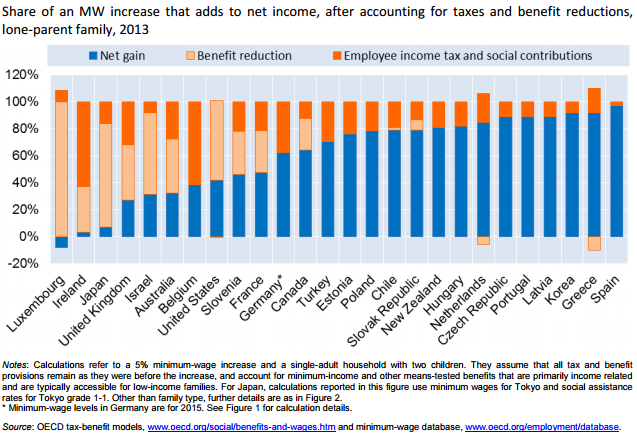
In New Zealand, when there is a 5% minimum wage increase, four percentage points of that wage increase actually stays in the hands of the worker.
In some countries such as Australia, the USA and UK, 60 to 80%of the minimum wage increase is gobbled up in reductions in benefits and taxes. At the same time, the minimum wage increase makes it less profitable for your employer to retain you so your job is more at risk.
The only explanation I have for why the Labour Party, NZ Greens and the living wage movement don’t highlight the success of the existing minimum wage in reducing family poverty in New Zealand is mass kidnappings.
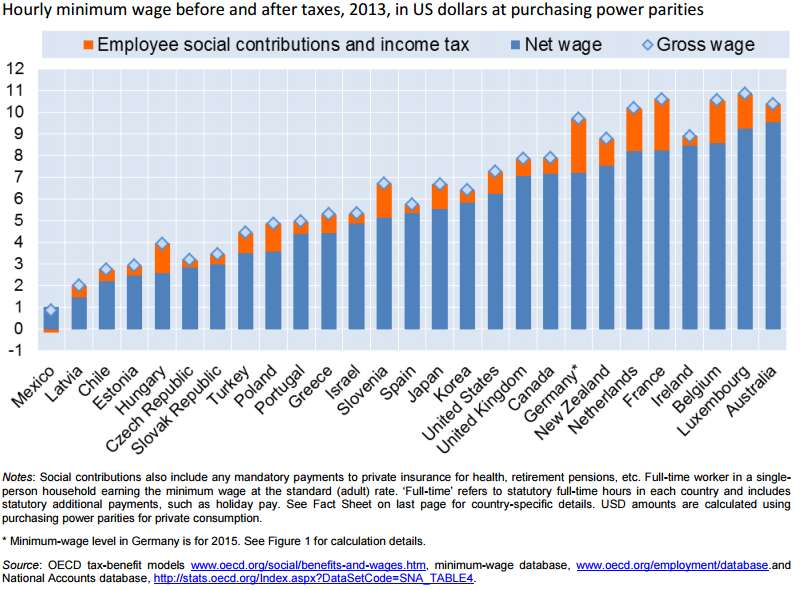
But for these abductions most fowl, I’m sure the Labour Party, NZ Greens and the living wage movement would be dancing in the street celebrating successes of capitalism and freedom in New Zealand in keeping families out of poverty through the minimum wage.
02 May 2015 Leave a comment
in economics of regulation, politics - New Zealand, poverty and inequality, urban economics
The Dominion Post had a front page story yesterday about an 80-year-old pensioner required to pay for fast broadband in her new social housing. Her new apartment happens to be in my same suburb. I can see the new apartments from my window as I type.

She didn’t have much use for this fast broadband, which cost an extra $20 a month, because she is legally blind. She cannot have a landline-only option because of the way her apartment is wired and the way in which fast broadband works.
The 27 flats have been fitted with fibre-optic cabling, and residents, many of whom are pensioners or have disabilities, cannot opt for a landline-only service.
National building standards require new apartments to be wired with fast broadband. A classic example of the inability of central planning to deal with the diversity of preferences and incomes.
In this case, the victim of central planning it is an old age pensioners obviously in poor circumstances as well as legally blind who is out of pocket. She is one of a number of old age pensioners who are similarly out-of-pocket when they living on a strictly limited budget.

01 May 2015 Leave a comment
in applied welfare economics, labour economics, poverty and inequality Tags: capitalism and freedom, Left-wing hypocrisy, mass kidnappings, Occupy Wall Street, The Great Enrichment, top 1%
Mass kidnappings is the only reason why the Occupy activists are not dancing seen in the streets to celebrate the steady fall of poverty in New Zealand over the last 20 years but for the hick-up of the GFC.

28 Apr 2015 Leave a comment
in labour economics, minimum wage, politics - Australia, politics - New Zealand, politics - USA, poverty and inequality Tags: labour demographics, living wage, poverty and inequality
28 Apr 2015 Leave a comment
in labour economics, labour supply, occupational choice, poverty and inequality, welfare reform Tags: 1996 US welfare reforms, female labour supply, labour demographics, welfare state
The share of single mothers without a high school degree with earnings rose from 49 percent to 64 percent between 1995 and 2000 but has since fallen or remained constant almost every year since then. At 55 percent, it’s now just slightly above its level in 1997, the first full year of welfare reform (see first graph).

TANF now serves only 25 of every 100 families with children that live below the poverty line, down from AFDC’s 68 of every 100 such families before the welfare law
Over the last 18 years, the national TANF average monthly caseload has fallen by almost two-thirds — from 4.7 million families in 1996 to 1.7 million families in 2013 — even as poverty and deep poverty have worsened.
The number of families with children in poverty hit a low of 5.2 million in 2000, but has since increased to more than 7 million. Similarly, the number of families with children in deep poverty (with incomes below half of the poverty line) hit a low of about 2 million in 2000, but is now above 3 million.

The employment situation for never-married mothers with a high school or less education — the group of mothers most affected by welfare reform — has changed dramatically over the last several decades.
In the early 1990’s, when states first made major changes to their cash welfare programs, only about half of these mothers worked.
Importantly, there was a very large employment gap between the share of these never-married mothers and single women without children with similar levels of education, suggesting that there was substantial room for these never-married mothers to increase their participation in the labour force.
By 2000, the employment gap between these two groups of women closed, and it has remained so. But in the years since, the employment rate for both groups has fallen considerably.
The employment rate for never-married mothers is now about the same as when welfare reform was enacted 18 years ago. This suggests that the economy and low education levels are now the causes of limited employment among never-married mothers — not the availability of public benefits or anything particular to never-married mothers.

The Centre on Budget and Policy Priorities, who hail clearly from the Left of American politics, scrupulously documented the following:
Welfare dependency down by two thirds, employment of never married mothers up to levels no one thought possible, family poverty down, and economic independence is much more widespread and all because of the 1996 US Federal welfare reforms. That sounds like success to me – a great success.
via Chart Book: TANF at 18 | Center on Budget and Policy Priorities.
24 Apr 2015 3 Comments
in economics of love and marriage, gender, labour economics, labour supply, poverty and inequality, welfare reform Tags: family demographics, single parents


via Was Moynihan Right? What happens to the children of unmarried mothers : Education Next
23 Apr 2015 Leave a comment
in economic history, labour economics, labour supply, poverty and inequality, welfare reform
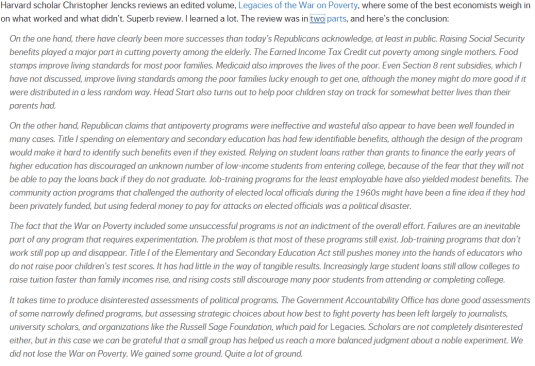
Via The war on poverty at age 50: What US social programs worked and which failed? – Chris Blattman.
Celebrating humanity's flourishing through the spread of capitalism and the rule of law
Celebrating humanity's flourishing through the spread of capitalism and the rule of law
Celebrating humanity's flourishing through the spread of capitalism and the rule of law
Celebrating humanity's flourishing through the spread of capitalism and the rule of law
Celebrating humanity's flourishing through the spread of capitalism and the rule of law
A History of the Alt-Right
Econ Prof at George Mason University, Economic Historian, Québécois
Celebrating humanity's flourishing through the spread of capitalism and the rule of law
Scholarly commentary on law, economics, and more
Beatrice Cherrier's blog
Celebrating humanity's flourishing through the spread of capitalism and the rule of law
Celebrating humanity's flourishing through the spread of capitalism and the rule of law
Celebrating humanity's flourishing through the spread of capitalism and the rule of law
Why Evolution is True is a blog written by Jerry Coyne, centered on evolution and biology but also dealing with diverse topics like politics, culture, and cats.
Celebrating humanity's flourishing through the spread of capitalism and the rule of law
A rural perspective with a blue tint by Ele Ludemann
DPF's Kiwiblog - Fomenting Happy Mischief since 2003
Celebrating humanity's flourishing through the spread of capitalism and the rule of law
The world's most viewed site on global warming and climate change
Tim Harding's writings on rationality, informal logic and skepticism
A window into Doc Freiberger's library
Let's examine hard decisions!
Commentary on monetary policy in the spirit of R. G. Hawtrey
Thoughts on public policy and the media
Celebrating humanity's flourishing through the spread of capitalism and the rule of law
Politics and the economy
A blog (primarily) on Canadian and Commonwealth political history and institutions
Reading between the lines, and underneath the hype.
Economics, and such stuff as dreams are made on
"The British constitution has always been puzzling, and always will be." --Queen Elizabeth II
Celebrating humanity's flourishing through the spread of capitalism and the rule of law
Celebrating humanity's flourishing through the spread of capitalism and the rule of law
WORLD WAR II, MUSIC, HISTORY, HOLOCAUST
Undisciplined scholar, recovering academic
Celebrating humanity's flourishing through the spread of capitalism and the rule of law
Res ipsa loquitur - The thing itself speaks
In Hume’s spirit, I will attempt to serve as an ambassador from my world of economics, and help in “finding topics of conversation fit for the entertainment of rational creatures.”
Researching the House of Commons, 1832-1868
Articles and research from the History of Parliament Trust
Reflections on books and art
Posts on the History of Law, Crime, and Justice
Celebrating humanity's flourishing through the spread of capitalism and the rule of law
Exploring the Monarchs of Europe
Cutting edge science you can dice with
Small Steps Toward A Much Better World
“We do not believe any group of men adequate enough or wise enough to operate without scrutiny or without criticism. We know that the only way to avoid error is to detect it, that the only way to detect it is to be free to inquire. We know that in secrecy error undetected will flourish and subvert”. - J Robert Oppenheimer.
 Utopia, you are standing in it!
Recent Comments