The Race Relations Commissioner Dame Susan Davoy has called forTe Reo Māori to be compulsory in New Zealand schools. She said being bilingual would be “a real added advantage” to young Kiwis and more people knowing Te reo Māori would help race relations.
Learning another language is not a priority for the Pākehā children or Māori mokupuna when you consider the poor literacy rates among Māori, Pasifika and Pākehā. The priority for children in an English speaking country is to master English. Too many children leave school with inadequate reading and writing skills.
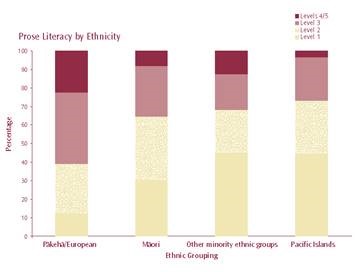
Lower levels of literacy and numerously are much higher among Māori and Pasifika children. Pākehā consistently having a larger proportion in the higher levels of prose literacy.
Figure 2: Prose literacy rates by ethnicity, 1996 and 2006
60%of Pākehā are above the minimum level of competence to meet the prose literacy requirements of a knowledge society. This contrasts with the majority of Māori and Pasifika who are below the minimum level of competence.
Furthermore, requiring children who do not have an aptitude for language or school in general to learn a language will reinforce in those who are not doing well that they are not very smart. This will give them more reasons to hate school and leave as soon as possible and never go back.
The key to helping children who do not have an aptitude to succeed greatly at school is to find the subjects where they do do well so they can get a good start to life. If students are not good at academic subjects, requiring them to do more academic studies such as study language is fool-hardy.
Taking resources, and more importantly, students learning time away from basic literacy skills will do little for a Māori economic development and race relations. This is because this taking resources and student learning time away from literacy and basic education will slow the closing of income gaps between Māori and others.
Language is a network good. It pays to join the largest network so you can communicate and do business with more people. The wage premium for immigrants learning English in English-speaking’s countries is about 15%.
Learning Te reo Māori will not help children in their other subjects. The psychology of the transfer of learning was founded 100 years ago to explore the hypothesis that learning Latin gave the student muscle to learn other subjects, both other languages and generally learn faster.
Educational psychologists found that Latin does not help much in studying other languages and other subjects. No significant differences were found in deductive and inductive reasoning or text comprehension among students with 4 years of Latin, 2 years of Latin or no Latin at all.
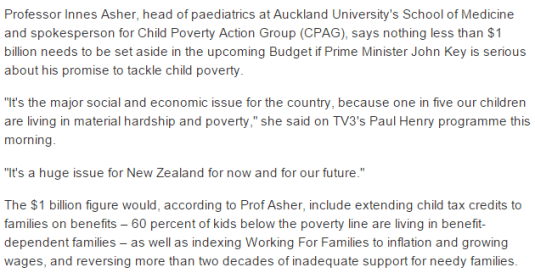
A local doctor thinks we can abolish child poverty in New Zealand with $1 billion in increases to welfare benefits and family allowances.
During the 1987 Australian Federal election campaign, Labour Party Prime Minister Bob Hawke announced a Family Allowance Supplement that would ensure no Australian child need live in poverty by 1990.
Child poverty was to be no more in Australia by 1990. These changes in social welfare benefits and family allowance supplements would ensure that every family would be paid one per week dollar more than the poverty threshold applicable to their family situation. I know child poverty was to be done in this way because I worked in the Prime Minister’s Department at this time.
It was a silly shorthand thing,” Mr Hawke has told News Limited newspapers. “I should have just said what was in the distributed speech.” “We set ourselves this first goal: by 1990 no Australian child will be living in poverty,” Mr Hawke said on June 23, 1987 at an election campaign launch. The comment entered Australian political folklore after it was supposed to improve the ALP’s major social welfare reform. The printed version had it as: “By 1990 no Australian child need live in poverty.” Mr Hawke’s words returned to haunt him as his pledge was impossible to keep.
About 580,000 Australian children lived in poverty in 1987. In 2007, at least 13 per cent of children, or 730,000 people, were poor. This was after social welfare benefits and family allowance supplements were increased to $1 above the child poverty threshold.
There is an infallible test of the practicality of Left over Left dreams such as the abolition of child poverty by writing bigger and bigger cheques to those currently poor.
If you could abolish child poverty simply by increasing welfare benefits and family allowances, the centre-right parties would be all over it like flies to the proverbial as a way of camping over the middle ground and winning the votes of socially conscious swinging voters for decades to come. Many people who would naturally vote for the centre-right parties on all other issues vote over to centre-left parties out of a concern for poverty and a belief that centre-left parties will give a better deal to the poor.
Countries all round the world have attempted to buy their way out of poverty by lifting welfare benefits and family allowance rates with no success. Simon Chapple is also quite clear that social welfare benefits reduce the incentive to work.
The payment of welfare benefits to families who do not work creates a number of potential issues. Firstly, as it guarantees an income to people not in paid employment, including those with children, it creates incentives not to work. While theoretically indisputable, much debate surrounds how large this effect is in practice, and how best to offset it.
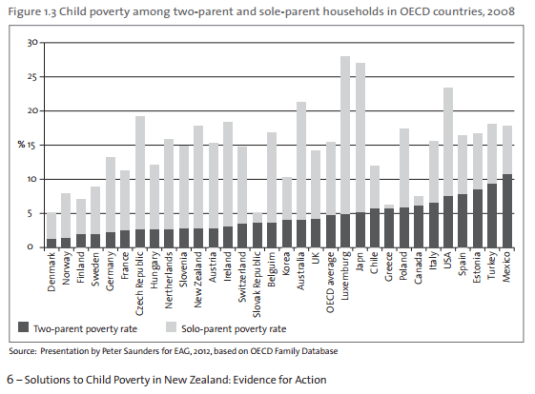
There is child poverty in northern European and Scandinavia despite the most generous possible welfare states. Most of this child poverty is among single parent families in all industrialised countries.
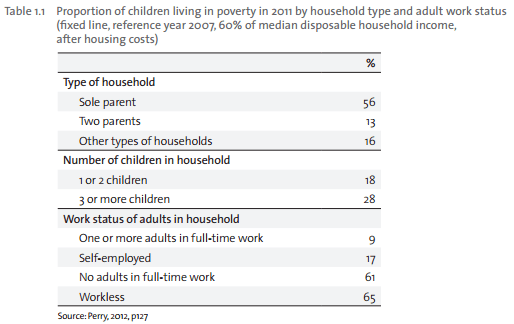
Around 60 percent of New Zealand children in poverty are in social welfare beneficiary households, and most of these are sole-parent households.
Child poverty rates are lower in the Nordic states but the Nordic states expectation that mothers will return to the workforce rapidly – when their child is 1 to 3 years old. Employment is front and centre in the Nordic welfare state strategy to reduce child poverty.
The notion that poverty is simply the result of a lack of money and giving people more money will abolish child poverty has never worked. As the OECD (2009, p. 171) observed:
It would be naïve to promote increasing the family income for children through the tax-transfer system as a cure-all to problems of child well-being.
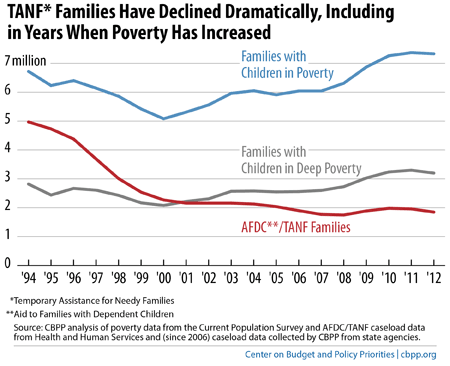
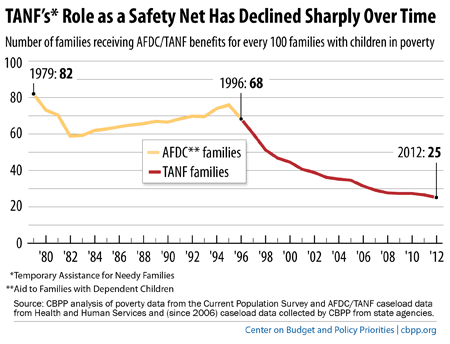
The only major success in reducing beneficiary numbers anywhere has been time limits in the USA in 1996. Time limits on welfare for single parents reduced caseloads by two thirds, 90% in some states.
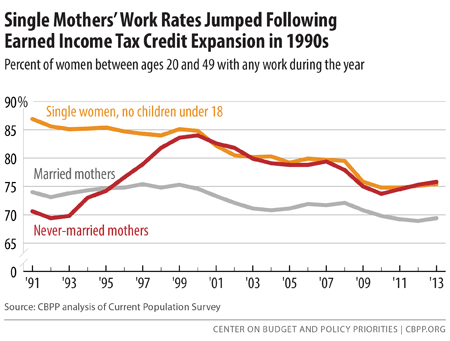
After the 1996 US Federal welfare reforms, the subsequent declines in welfare participation rates and gains in employment were largest among the single mothers previously thought to be most disadvantaged: young (ages 18-29), mothers with children aged under seven, high school drop-outs, and black and Hispanic mothers. These low-skilled single mothers were thought to face the greatest barriers to employment. Blank (2002) found that:
…nobody of any political persuasion predicted or would have believed possible the magnitude of change that occurred in the behaviour of low-income single-parent families.
Employment are never married mothers increased by 50% after the US well for a reforms: employment a single mothers with less than a high school education increased by two thirds: employment on-going single mothers string ages of 18 in 24 approximately doubled. With the enactment of welfare reform in 1996, black child poverty fell by more than a quarter to 30% in 2001. Over a six-year period after welfare reform, 1.2 million black children were lifted out of poverty. In 2001, despite a recession, the poverty rate for black children was at the lowest point in national history.
This great success of US welfare reforms was after a quarter of six century of no progress, poverty among single mothers and among black children declined dramatically.
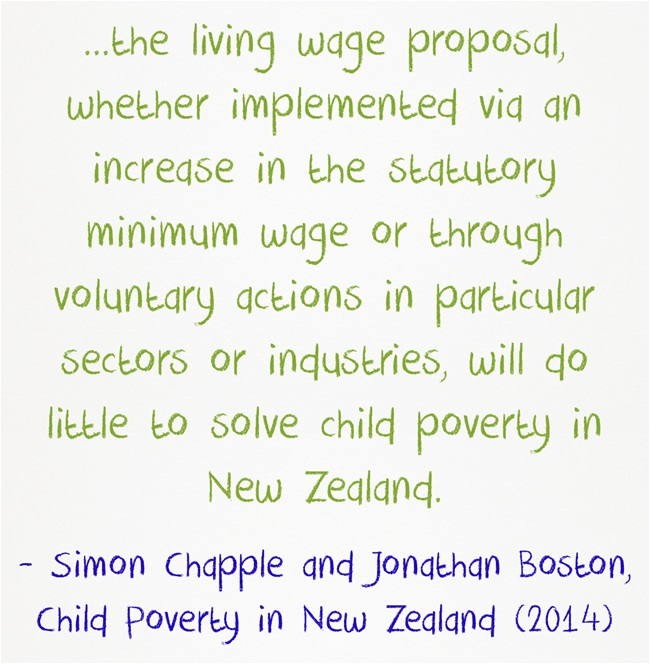
The best solution to child poverty is to move their parents into a job. Simon Chapple is also quite clear in his book last year with Jonathan Boston that a sole parent in full-time work, and a two parent family with one earner with one full-time and one part-time worker, even at low wages, will earn enough to lift their children above most poverty thresholds. Welfare benefits trap children in poverty.
Sustained full-time employment of sole parents and the fulltime and part-time employment of two parents, even at low wages, are sufficient to pull the majority of children above most poverty lines, given the various existing tax credits and family supports.
The best available analysis, the most credible analysis, the most independent analysis in New Zealand or anywhere else in the world that having a job and marrying the father of your child is the secret to the leaving poverty is recently by the Living Wage movement in New Zealand.
According to the calculations of the Living Wage movement, earning only $19.25 per hour with a second earner working only 20 hours affords their two children, including a teenager, Sky TV, pets, international travel, video games and 10 hours childcare. This analysis of the Living Wage movement shows that finishing school so your job pays something reasonable and marrying the father of your child affords a comfortable family life.
The welfare state has a long history of providing some of its support to the needy in kind rather than in cash. This can range from soup kitchens to public housing as well as food stamps.
In the USA, food stamps provide provide food-purchasing assistance for low- and no-income people living. Food stamps can only be exchanged for food.
Instead of requiring the poor and needy to attend a soup kitchen, they can be given vouchers to buy food at supermarkets and take it home and cook at themselves. These days some sort of debit card system can be used where purchases are restricted to food at supermarkets and other participating retailers.
A close parallel with food stamps, properly understood, is free school breakfast programs. The welfare state is providing in-kind support to hungry children. This is done at school, to ensure that the children eat the meals.
Rather than rely on their parents to spend their welfare benefits and income support on food for their children, the food is given directly to the children when they arrive at school in the morning. In New Zealand, these free school breakfast programs are restricted to schools in low income areas.
There is a Feed the Kids Bill in Parliament sponsored by the Green Party. I have frequently criticised this proposal as it doesn’t provide breakfast to needy children at the weekends and school holidays. They are left to go hungry. Abandoned by their so called social justice champions through lack of imagination and self-awareness.
If children are showing up at school without their breakfast on a regular basis, their parents should reported that the child protection authorities for intervention. This can start with budget advice and assistance with applying for any additional and emergency financial support they are eligible for from Work and Income New Zealand.
Soup kitchens not only provides people with food, it provides various other assistance to help people to get back on their feet.
If you were proposing a food stamps program in New Zealand because children are going hungry, you’ll be laughed at if you suggested it should only apply the part of the year such as during the school term.
That is precisely what the Greens are doing. The only difference is how they are organised the provision of in-kind support to children, this case, food. Instead of their parents collecting a debit card that can only be used to buy food, the food is eaten by their children at school.
In Mexico, most cash-based public social benefits go to households in the highest income quintile, per OECD. http://t.co/xykkPkDVZs— Catherine Rampell (@crampell) November 24, 2014
Why Evolution is True is a blog written by Jerry Coyne, centered on evolution and biology but also dealing with diverse topics like politics, culture, and cats.
In Hume’s spirit, I will attempt to serve as an ambassador from my world of economics, and help in “finding topics of conversation fit for the entertainment of rational creatures.”
“We do not believe any group of men adequate enough or wise enough to operate without scrutiny or without criticism. We know that the only way to avoid error is to detect it, that the only way to detect it is to be free to inquire. We know that in secrecy error undetected will flourish and subvert”. - J Robert Oppenheimer.





 Soup kitchens not only provides people with food, it provides various other assistance to help people to get back on their feet.


 Utopia, you are standing in it!

Recent Comments