Why are Europe’s strong employment protection laws still popular with the Left?

The countries with the more liberal labour markets are recovering fastest from the Great Recession and the Global Financial Crisis.

This includes Germany where there were major labour market reforms a couple of years before the onset of the Global Financial Crisis. For that reason, German unemployment rates didn’t rise much in 2008 and after and are now falling quite rapidly because of their labour market liberalisations. Germany has the lowest unemployment rate in Europe.

The minimum wage and youth unemployment across the European Union

Unemployment in the UK since 1860

https://twitter.com/MaxCRoser/status/582820401446715392

Image

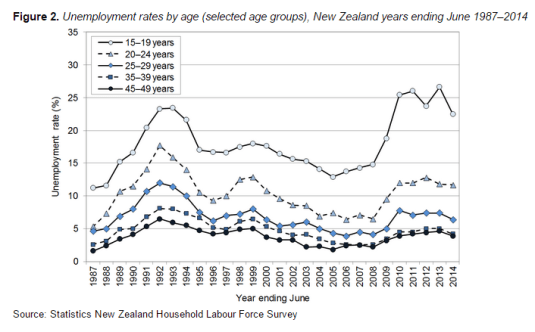
The Greens are determined to increase youth unemployment in New Zealand

Source: Short-Term Labour Market Statistics : Harmonised Unemployment Rates (HURs).

In New Zealand during June 1987–2014, unemployment rates were consistently higher for younger people aged 15–19 years than other age groups. Rates were lower for each age group, with those aged 45–49 years having the lowest). In the year ending June 2014, annual unemployment rates were 22.5% for those aged 15–19 years and to 11.7% for those aged 20–24 years – Child Poverty Monitor: Technical Report.

The time is not right, as they say, for New Zealand to increase its minimum wage rates after a sharp spike in the unemployment rates of youth and in particular of teenagers after the Global Financial Crisis.


Who gains and who loses from employment protection laws over the business cycle?

banerji chart 2

banerji chart 1

HT: IMF

Unemployment by education

Bryan Caplan on the economics of Star Trek replicators (that is, artificial intelligence)

replicator

Bryan Caplan wrote a blog a few years ago, explaining the labour economics of artificial intelligence, using an exam question he poses to his graduate students:

Suppose artificial intelligence researchers produce and patent a perfect substitute for human labour at zero MC.

Use general equilibrium theory to predict the overall economic effects on human welfare before AND after the Artificial Intelligence software patent expires.

He then gave the answer about a week later:

While the patent lasts, the patent-holder will produce a monopoly quantity of AIs. As a result, the effective labour supply increases, and wages for human beings fall – but not to 0 because the patent-holder keeps P>MC.

The overall effect on human welfare, however, is still positive! Since the AIs produce more stuff, and only humans get to consume, GDP per human goes up. How is this possible if wages fall?

Simple: Earnings for NON-labour assets (land, capital, patents, etc.) must go up. Humans who only own labour are worse off, but anyone who owns a home, stocks, etc. experiences offsetting gains.

When the patent expires, this effect becomes even more extreme. With 0 fixed costs, wages fall to MC=0, but total output – and GDP per human – skyrockets.

Human owners of land, capital, and other non-labour assets capture 100% of all output. Humans who only have labour to sell, however, will starve without charity or tax-funded redistribution.

His logic is quite good. Caplan drew attention in the responses to his blog of Capt J Parker and Alex Godofsky in the comments section of his blog.

James T. Kirk clear

My comments at the time were as follows:

  • An artificially intelligent  robot that was a perfect substitute for human labour sounds like the replicators on star trek?
  • Who operates the machines? who tells them what to do? what not to do?
  • After the patent expired, would anyone care if the poor stole/copied the AI machines and made them for for themselves. who cares if a free good is stolen?
  • Is it a crime to steal a replicator on star trek?

Milton Friedman on pre-Keynesian macroeconomics

Image

The simple reason Wal-Mart is handing out raises — people are quitting – Vox

Another blow to the inequality of bargaining power between workers and the bosses. Job quits are not supposed to undermine the grand cartel of employers grinding the workers down.


via The simple reason Wal-Mart & TJ Maxx are handing out raises — people are quitting – Vox.

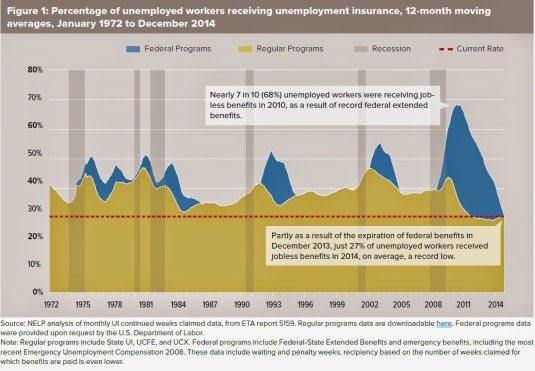
How many were on Unemployment Insurance

via CONVERSABLE ECONOMIST: The Disconnections of Unemployment Insurance.

Why Don’t More People Want a Job?

via Number of the Week: Why Don’t More People Want a Job? – Real Time Economics – WSJ.

Economic Rebounds in U.S. and Euro Zone: Deceivingly Similar, Strikingly Different

via Economic Rebounds in U.S. and Euro Zone: Deceivingly Similar, Strikingly Different – Dallas Fed.

A Balanced-Growth View of Men’s and Women’s Unbalanced Labor Market Recoveries

via A Balanced-Growth View of Men’s and Women’s Unbalanced Labor Market Recoveries – Dallas Fed.

Milton Friedman – Rights of Workers

Video

What is labour hoarding?

The fall and rebound in employment growth usually lags a few quarters behind the fall and later recovery in output growth in any recession because of labour hoarding. Hamermesh (1993) defined labour hoarding as

a less than proportionate decrease in worker hours in response to a negative demand shock

Firms may hoard or retain under-utilised employees despite falls in demand because of demand uncertainty.

Becker (1975) and Oi (1962) both refer to the fixed costs of employment as an incentive to retain experienced workers with firm-specific human capital during lulls in demand.

The fixed costs of employment are the costs of recruiting and training workers. These fixed costs meant that the demand for labour does not adjust instantly to changes in demand for the firm’s product:

The cyclical behaviour of labour markets reveals a number of puzzling features for which there are no truly satisfying explanations . . .

I believe that the major impediment to rational explanations for these findings lies in the classical treatment of labour as a purely variable factor (Oi 1962).

Hirings and layoffs are costly. Hiring costs include advertising vacancies, the time spent finding and screening applicants and training. Layoff costs include redundancy payments, legal procedures and, importantly, the capital loss of losing access to experienced employees with firm-specific training and then later having to train their replacements.

To reduce these current and capital costs early in recessions, employers will first adjust hours worked and rely on natural attrition of staff to defer laying off their more experienced employees. Only once these options have been exhausted, and demand for the firm’s product is still slack, the capital loss of laying off a worker may become necessary.

Labour hoarding is a speculative investment based on forecasts of demand. The decline in product demand must be seen as short. There will be more layoffs if the recession is expected to be deep or long.

If there is a quick recovery, unnecessary layoffs and the cost of training replacements are both avoided.

Previous Older Entries Next Newer Entries

Bassett, Brash & Hide

Celebrating humanity's flourishing through the spread of capitalism and the rule of law

Truth on the Market

Scholarly commentary on law, economics, and more

The Undercover Historian

Beatrice Cherrier's blog

Matua Kahurangi

Celebrating humanity's flourishing through the spread of capitalism and the rule of law

Temple of Sociology

Celebrating humanity's flourishing through the spread of capitalism and the rule of law

Velvet Glove, Iron Fist

Celebrating humanity's flourishing through the spread of capitalism and the rule of law

Why Evolution Is True

Why Evolution is True is a blog written by Jerry Coyne, centered on evolution and biology but also dealing with diverse topics like politics, culture, and cats.

Down to Earth Kiwi

Celebrating humanity's flourishing through the spread of capitalism and the rule of law

NoTricksZone

Celebrating humanity's flourishing through the spread of capitalism and the rule of law

Homepaddock

A rural perspective with a blue tint by Ele Ludemann

Kiwiblog

DPF's Kiwiblog - Fomenting Happy Mischief since 2003

The Dangerous Economist

Celebrating humanity's flourishing through the spread of capitalism and the rule of law

Watts Up With That?

The world's most viewed site on global warming and climate change

The Logical Place

Tim Harding's writings on rationality, informal logic and skepticism

Doc's Books

A window into Doc Freiberger's library

The Risk-Monger

Let's examine hard decisions!

Uneasy Money

Commentary on monetary policy in the spirit of R. G. Hawtrey

Barrie Saunders

Thoughts on public policy and the media

Liberty Scott

Celebrating humanity's flourishing through the spread of capitalism and the rule of law

Point of Order

Politics and the economy

James Bowden's Blog

A blog (primarily) on Canadian and Commonwealth political history and institutions

Science Matters

Reading between the lines, and underneath the hype.

Peter Winsley

Economics, and such stuff as dreams are made on

A Venerable Puzzle

"The British constitution has always been puzzling, and always will be." --Queen Elizabeth II

The Antiplanner

Celebrating humanity's flourishing through the spread of capitalism and the rule of law

Bet On It

Celebrating humanity's flourishing through the spread of capitalism and the rule of law

History of Sorts

WORLD WAR II, MUSIC, HISTORY, HOLOCAUST

Roger Pielke Jr.

Undisciplined scholar, recovering academic

Offsetting Behaviour

Celebrating humanity's flourishing through the spread of capitalism and the rule of law

JONATHAN TURLEY

Res ipsa loquitur - The thing itself speaks

Conversable Economist

Celebrating humanity's flourishing through the spread of capitalism and the rule of law

The Victorian Commons

Researching the House of Commons, 1832-1868

The History of Parliament

Articles and research from the History of Parliament Trust

Books & Boots

Reflections on books and art

Legal History Miscellany

Posts on the History of Law, Crime, and Justice

Sex, Drugs and Economics

Celebrating humanity's flourishing through the spread of capitalism and the rule of law

European Royal History

Exploring the Monarchs of Europe

Tallbloke's Talkshop

Cutting edge science you can dice with

Marginal REVOLUTION

Small Steps Toward A Much Better World

NOT A LOT OF PEOPLE KNOW THAT

“We do not believe any group of men adequate enough or wise enough to operate without scrutiny or without criticism. We know that the only way to avoid error is to detect it, that the only way to detect it is to be free to inquire. We know that in secrecy error undetected will flourish and subvert”. - J Robert Oppenheimer.

STOP THESE THINGS

The truth about the great wind power fraud - we're not here to debate the wind industry, we're here to destroy it.

Lindsay Mitchell

Celebrating humanity's flourishing through the spread of capitalism and the rule of law

Alt-M

Celebrating humanity's flourishing through the spread of capitalism and the rule of law

croaking cassandra

Economics, public policy, monetary policy, financial regulation, with a New Zealand perspective

The Grumpy Economist

Celebrating humanity's flourishing through the spread of capitalism and the rule of law

International Liberty

Restraining Government in America and Around the World