
The simple reason Wal-Mart is handing out raises — people are quitting – Vox
27 Feb 2015 Leave a comment
in great recession, job search and matching, labour economics, labour supply, macroeconomics, poverty and inequality, unemployment Tags: inequality of bargaining power between workers and employers, The meaning of competition, Walmart
Another blow to the inequality of bargaining power between workers and the bosses. Job quits are not supposed to undermine the grand cartel of employers grinding the workers down.
/cdn0.vox-cdn.com/uploads/chorus_asset/file/3445978/fredgraph.0.png)
/cdn0.vox-cdn.com/uploads/chorus_asset/file/3447398/Screen_Shot_2015-02-25_at_5.50.05_PM.0.png)
via The simple reason Wal-Mart & TJ Maxx are handing out raises — people are quitting – Vox.
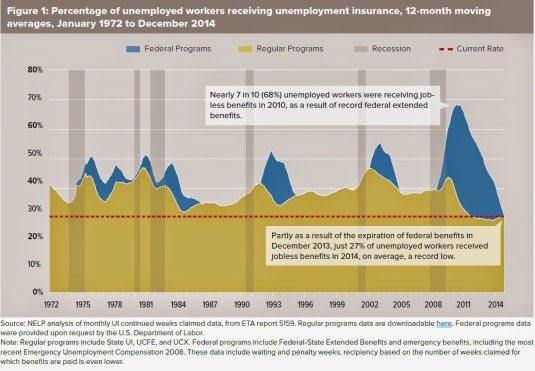
How many were on Unemployment Insurance
09 Feb 2015 Leave a comment
in labour economics, labour supply, unemployment Tags: unemployment insurance
Why Don’t More People Want a Job?
08 Feb 2015 Leave a comment
in labour economics, labour supply, unemployment Tags: ageing society, ageing workforce, labour force participation, labour market demographics

Economic Rebounds in U.S. and Euro Zone: Deceivingly Similar, Strikingly Different
20 Jan 2015 Leave a comment
in business cycles, Euro crisis, global financial crisis (GFC), great recession, labour economics, macroeconomics, unemployment Tags: Euroland


via Economic Rebounds in U.S. and Euro Zone: Deceivingly Similar, Strikingly Different – Dallas Fed.
A Balanced-Growth View of Men’s and Women’s Unbalanced Labor Market Recoveries
19 Jan 2015 Leave a comment
in global financial crisis (GFC), great recession, labour economics, labour supply, macroeconomics, unemployment Tags: jobless recovery


What is labour hoarding?
16 Dec 2014 Leave a comment
in business cycles, labour economics, macroeconomics, unemployment Tags: business cycles, labour hoarding

The fall and rebound in employment growth usually lags a few quarters behind the fall and later recovery in output growth in any recession because of labour hoarding. Hamermesh (1993) defined labour hoarding as
a less than proportionate decrease in worker hours in response to a negative demand shock
Firms may hoard or retain under-utilised employees despite falls in demand because of demand uncertainty.
Becker (1975) and Oi (1962) both refer to the fixed costs of employment as an incentive to retain experienced workers with firm-specific human capital during lulls in demand.

The fixed costs of employment are the costs of recruiting and training workers. These fixed costs meant that the demand for labour does not adjust instantly to changes in demand for the firm’s product:
The cyclical behaviour of labour markets reveals a number of puzzling features for which there are no truly satisfying explanations . . .
I believe that the major impediment to rational explanations for these findings lies in the classical treatment of labour as a purely variable factor (Oi 1962).
Hirings and layoffs are costly. Hiring costs include advertising vacancies, the time spent finding and screening applicants and training. Layoff costs include redundancy payments, legal procedures and, importantly, the capital loss of losing access to experienced employees with firm-specific training and then later having to train their replacements.
To reduce these current and capital costs early in recessions, employers will first adjust hours worked and rely on natural attrition of staff to defer laying off their more experienced employees. Only once these options have been exhausted, and demand for the firm’s product is still slack, the capital loss of laying off a worker may become necessary.

Labour hoarding is a speculative investment based on forecasts of demand. The decline in product demand must be seen as short. There will be more layoffs if the recession is expected to be deep or long.
If there is a quick recovery, unnecessary layoffs and the cost of training replacements are both avoided.
Further evidence of the dynamic, deregulated nature of the New Zealand labour market
15 Dec 2014 2 Comments
in economics of regulation, labour economics, law and economics, politics - Australia, politics - New Zealand, politics - USA, unemployment Tags: employment law, employment protection, labour market dynamics, labour market regulation
The chart below shows that New Zealand is far more flexible than Western Europe and is pretty near the USA in terms of people moving in and out of the unemployment pool every month with great ease. There are very high outflow rates from unemployment among the Anglo-Saxon and Nordic economies. The economies of Continental Europe stand in stark contrast. Unemployment outflow rates in these economies lie below 10% at a monthly frequency.
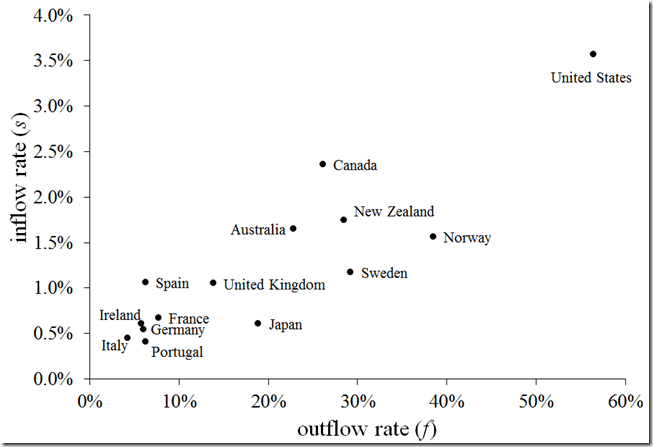
Source: Unemployment Dynamics in the OECD, Elsby, Hobijn and Şahin (2013).
WH Hutt on job search
14 Dec 2014 Leave a comment
in job search and matching, labour economics, macroeconomics, unemployment Tags: job search, search and matching, unemployment, voluntary unemployment
 Unemployment, job search, search and matching
Recessions as reorganisations
12 Dec 2014 Leave a comment
in business cycles, F.A. Hayek, history of economic thought, job search and matching, macroeconomics, Robert E. Lucas, unemployment Tags: FA Hayek, recessions, recoveries, Robert Lucas

Most models of the shape of recoveries draw on a learning process. A long tradition in business cycle theory holds that limited knowledge of relative price changes can temporarily disrupt labour demand and supply because of errors in wage and price perceptions (Alchian 1969; Sargent 2007; Hellwig 2008).
Pricing, investment and production plans are made on the basis of incomplete and conflicting knowledge of constantly changing aggregate, industry and local conditions. Firms and workers will over- or under-supply when they misperceive wages and prices.
With imprecise information, it takes time for employers and workers to sort out temporary from permanent shifts in demand and supply, inflation-driven changes from real changes in prices and input costs, and general changes from the local changes that may be more important to particular firms. As Hayek explained in his Nobel prize lecture:
The true, though untestable, explanation of extensive unemployment ascribes it to a discrepancy between the distribution of labour (and the other factors of production) between industries (and localities) and the distribution of demand among their products.
This discrepancy is caused by a distortion of the system of relative prices and wages. And it can be corrected only by a change in these relations, that is, by the establishment in each sector of the economy of those prices and wages at which supply will equal demand.
Recoveries are shaped by the speed of entrepreneurial learning about the new labour and product market conditions, the relative cost of adjusting capital and labour rapidly or slowly and the costs and benefits of labour market search. This new learning is necessary because the old constellation of prices and wages is no longer valid.
It was a misdirection of resources brought about by the initial inflationary firm, as Hayek explained in a visit to Australia in 1950:
During a process of expansion the direction of demand is to some extent necessarily different from what it will be after expansion has stopped.
Labour will be attracted to the particular occupations on which the extra expenditure is made in the first instance.
So long as expansion lasts, demand there will always run a step ahead of the consequential rises in demand elsewhere.
And in so far as this temporary stimulus to demand in particular sectors leads to a movement of labour, it may well become the cause of unemployment as soon as the expansion comes to an end…
If the real cause of unemployment is that the distribution of labour does not correspond with the distribution of demand, the only way to create stable conditions of high employment which is not dependent on continued inflation (or physical controls), is to bring about a distribution of labour which matches the manner in which a stable money income will be spent.
This depends of course not only on whether during the process of adaptation the distribution of demand is approximately what it will remain, but ‘also on whether conditions in general are conducive to easy and rapid movements of labour.
In a recession, employers and workers do not immediately know that demand has fallen elsewhere as well as in their own local markets and recognise the need to adjust to their poorer prospects everywhere, and it is not known how long the drop in demand will last (Alchian and Allen 1973).
The cost of learning about available opportunities restricts the speed of a recovery. Workers and entrepreneurs must gather information on the new state of demand and the location and nature of new opportunities. This information is costly and is quickly made obsolete by further changes, and the cost of acquiring information is more costly the faster the information is sought to be acquired (Alchian 1969; Alchian and Allen 1967).

The process of recovering from a recession would be a faster process if the new constellation of wages and prices that are the best alternative uses of resources was known immediately and was credible to firms and workers (Alchian and Allen 1973).
Workers and employers must first have sufficient time to discover what new knowledge they now need to know to serve their interests well, leave enough room for the unforeseeable and keep their knowledge fresh in ever-changing markets.
New wage levels must be created by workers and employers testing and retesting in the labour market the new relative scarcities of labour. Imbalances between the allocation of labour supply and demand to different firms and sectors and the new level and pattern of consumer demand are gradually remedied by changes in relative prices and wages, layoffs, business closures and job search.

Prices are a signal wrapped in an incentive. Growing demand induces higher employment and rising wages. Wages stagnate, and there are layoffs where there is an excess supply.
These changes give the unemployed an incentive to move to new uses and entrepreneurs to profitably hire the unemployed. The ensuing reorganisations are time-consuming and information-intensive because a job seeker and an employer with an apt vacancy take time to find each other.
Prices and wages must change sufficiently for firms to profitably create new jobs. New jobs require time to plan and build new job capital. This is the human, physical and organisational capital underlying a new job. There are also job creation costs when reopening existing positions that were mothballed during the downturn.
How is this to be done? Hayek explained again in 1950 in his speech in Australia:
Full employment policies as at present practised attempt the quick and easy way of giving men employment where they happen to be, while the real problem is to bring about a distribution of labour which makes continuous high employment without artificial stimulus possible.
What this distribution is we can never know beforehand. The only way to find out is to let the unhampered market act under conditions which will bring about a stable equilibrium between demand and supply.
Involuntary unemployment and the great vacation theories of the great depression and Eurosclerosis – updated again
10 Dec 2014 1 Comment
in economic growth, Edward Prescott, Euro crisis, great depression, job search and matching, labour economics, macroeconomics, Robert E. Lucas, unemployment Tags: Eurosclerosis, great depression, voluntary unemployment
Most Keynesian economists are convinced that something exists called involuntary unemployment and people can be unemployed through no fault of their own. They will accept the going wage but no employer is willing to offer it to them.
Lucas and Rapping’s (1969) paper, “Real Wages, Employment, and Inflation” provides the micro-foundations for an analysis of the labour suppl. They felt the need to reconcile the existence of unemployment with market clearing and referred to recent work of Armen Alchian (1969) on search explanations of unemployment.
Lucas and Rapping viewed unemployment as voluntary, including the mass unemployment during the great depression (Lucas and Rapping 1969: 748).
Lucas and-Rapping viewed current labour demand as a negative function of the current real wage. Current labour supply was a positive function of the real wage and the expected real interest rate, but a negative function of the expected future wage.
Under their framework, if workers expect higher real wages in the future or a lower real interest rate, current labour supply would be depressed, employment would fall, unemployment rise, and real wages increase.
Lucas and Rapping depicted labour suppliers as rational optimisers who engaged in inter-temporal substitution: working more when current wages were high relative to expected wages. The prevailing Keynesian approach assumed labour supply was passive, and movements in the demand for labour determined changes in employment.
Lucas and Rapping offered an unemployment equation relating the unemployment rate to actual versus anticipated nominal wages, and actual versus anticipated price levels. Unemployment could be the product of expectational errors about wages.
Lucas and Rapping’s model was poor at explaining unemployment after 1933 in terms of job search and expectational errors.
The graph below shows two different series for unemployment in the 1930s in the USA: the official BLS level by Lebergott; and a data series constructed famously by Darby. Darby includes workers in the emergency government labour force as employed – the most important being the Civil Works Administration (CWA) and the Works Progress Administration (WPA).
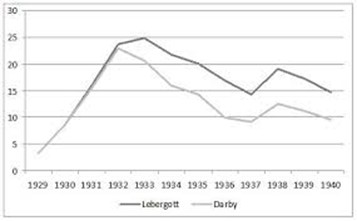
Once these workfare programs are accounted for, the level of U.S. unemployment fell from 22.9% in 1932 to 9.1% in 1937, a reduction of 13.8%. For 1934-1941, the corrected unemployment levels are reduced by two to three-and-a half million people and the unemployment rates by 4 to 7 percentage points after 1933.
Not surprisingly, Darby titled his 1976 Journal of Political Economy article Three-and-a-Half Million U.S. Employees Have Been Mislaid: Or, an Explanation of Unemployment, 1934-1941.
The corrected data by Darby shows stronger movement toward the natural unemployment rate after 1933. Darby concluded that his corrected date are suggests that the unemployment rate was well explained by a job search model such as that by Lucas and Rapping together with the wage fixing under the New Deal that kept real wages up and unemployment high.
Both the Keynesian approach to unemployment and the job search approach to unemployment view workers in emergency government work programs as employed and not as unemployed.
In the late 1970s, Modigliani dismissed the new classical explanation of the U.S. great depression in which the 1930s unemployment was mass voluntary unemployment as follows:
Sargent (1976) has attempted to remedy this fatal flaw by hypothesizing that the persistent and large fluctuations in unemployment reflect merely corresponding swings in the natural rate itself.
In other words, what happened to the U.S. in the 1930’s was a severe attack of contagious laziness!
I can only say that, despite Sargent’s ingenuity, neither I nor, I expect most others at least of the nonMonetarist persuasion,. are quite ready yet. to turn over the field of economic fluctuations to the social psychologist!
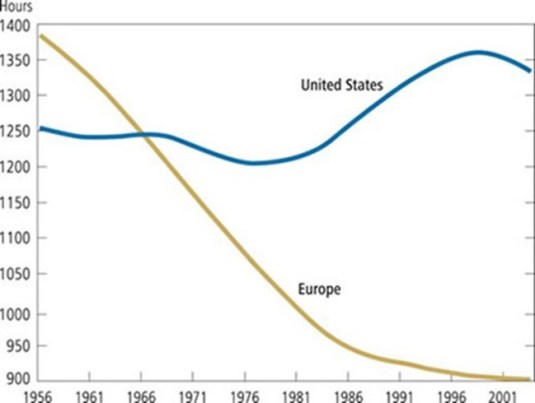
As Prescott has pointed out, the USA in the Great Depression and France since the 1970s both had 30% drops in hours worked per adult. That is why Prescott refers to France’s economy as depressed. The reason for the depressed state of the French (and German) economies is taxes, according to Prescott:
Virtually all of the large differences between U.S. labour supply and those of Germany and France are due to differences in tax systems.
Europeans face higher tax rates than Americans, and European tax rates have risen significantly over the past several decades.
In the 1960s, the number of hours worked was about the same. Since then, the number of hours has stayed level in the United States, while it has declined substantially in Europe. Countries with high tax rates devote less time to market work, but more time to home activities, such as cooking and cleaning. The European services sector is much smaller than in the USA.
Time use studies find that lower hours of market work in Europe is entirely offset by higher hours of home production, implying that Europeans do not enjoy more leisure than Americans despite the widespread impression that they do.
Richard Rogerson, 2007 in “Taxation and market work: is Scandinavia an outlier?” found that how the government spends tax revenues when assessing the effects of tax rates on aggregate hours of market work:
- Different forms of government spending imply different elasticities of hours of work with regard to tax rates;
- While tax rates are highest in Scandinavia, hours worked in Scandinavia are significantly higher than they are in Continental Europe with differences in the form of government spending can potentially account for this pattern; and
- There is a much higher rate of government employment and greater expenditures on child and elderly care in Scandinavia.
Examining how tax revenue is spent is central to understanding labour supply effects:
- If higher taxes fund disability payments which may only be received when not in work, the effect on hours worked is greater relative to a lump-sum transfer; and
- If higher taxes subsidise day care for individuals who work, then the effect on hours of work will be less than under the lump-sum transfer case.
Others such as Blanchard attribute the much lower labour force participation in the EU since the 1970s to their greater preference for leisure in Europe. An increased preference for leisure is another name for voluntary unemployment.
The lower labour force participation in higher unemployment in Europe is voluntary because of the higher demand for leisure among Europeans. According to Blanchard:
The main difference [between the continents] is that Europe has used some of the increase in productivity to increase leisure rather than income, while the U.S. has done the opposite.
An unusual left-right unity ticket emerged to explain the great depression in the 1930s and the depressed EU economies from the 1970s: the great vacation theory.
A favourite line from Seinfeld
03 Dec 2014 Leave a comment
in economics of love and marriage, gender, human capital, labour economics, TV shows, unemployment Tags: Seinfeld
Second law of supply and demand alert: There is no such thing as a skills shortage – updated
01 Dec 2014 Leave a comment
in applied price theory, labour economics, unemployment Tags: Alfred Marshall, Armen Alchian, comparative statics, labour market shortages, search and matching, second law of demand, second law of supply, skill shortages, unemployment
Could you define both a severe skills shortage and a skills shortage?
- How do these concepts differ from concepts such as rising demand, rapidly rising demand, and reduced and sharply reduced supply?
- Are the phrases severe skills shortage and a skills shortage more precise than the phrases rising demand, rapidly rising demand, and reduced and sharply reduced supply?
- Are the phrases severe skill shortage and a skill shortage more informative than referring to the short and long run elasticity of demand and supply as summed up in the second laws of demand and supply?
- Why are rising demand, rapidly rising demand, and reduced and sharply reduced supply considered to be social problems. What causes rising demand, rapidly rising demand, and reduced and sharply reduced supply?
- For whom are rising demand, rapidly rising demand, and reduced and sharply reduced supply considered to be problems? Employers? Employees? Others?
- Should governments intervene to stop employers from competing to set wages to reflect increases in the marginal revenue product of labour?
- Is not the purpose of short and long-term upward changes in relative prices or wages to induce people to buy less of a now scarcer resource and search for substitutes and additional sources of supply, and for new suppliers to enter the market in response to the higher prices or wages?
As a starter, I thought I would update Alchian and Arrow’s timeless 1958 analysis for the Rand Corporation of the purported shortage of engineers and scientists at the height of the missile gap in the cold war.
Alchian and Arrow tested the robustness of claims of a labour market shortage of scientists and engineers by investigating the sudden appearance of a servant shortage during World War II.
I will update this idea of a servant shortage to a purported shortage of nannies, as shown in figure 1 below which sets out the initial equilibrium and then an increase in demand.
Figure 1: the demand and supply for nannies by the old rich and power couples
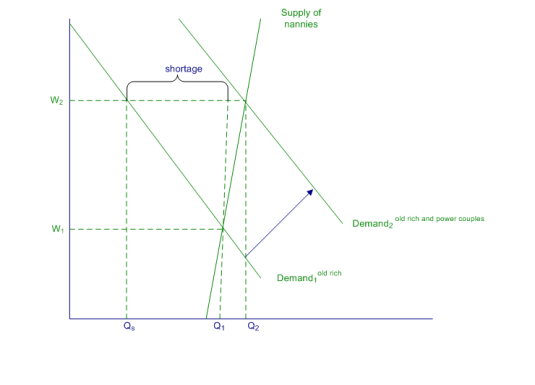
In the diagram above, the initial equilibrium has the old rich hiring Q1 nannies at a wage W1 with demand curve D1, and the supply curve for nannies.
- Power couples then enter the nannies market pushing total demand out to D2 with wages increasing to W2 and quantity supplied increasing a little to Q2;
- The old rich can now afforded to buy only Qs in nannies and power couples hire (Q2 – Qs) in nannies.
By construction, the quantity of nannies supplied increases slightly in the short-run, with a large increase in wages for nannies! (Q2 – Q1) new nannies enter the market, lured in by the higher wages.
The old rich now face a shortage of nannies equal to the quantity (Q1 – Qs). These nannies having switched to work for power couples on much better pay. (In the case of the original analysis Alchian and Arrow analysis, they switched into defence work or backfilled jobs of those that moved into defence work).
As with the wartime servant shortage, the old rich are unwilling to admit they are no longer able to keep themselves in the style they were accustomed too because the demand for domestic labour has increased.
Better to blame their loss of social status on a skills shortage in a poorly functioning market rather than accept the rise of middle class power couples outbidding them in the hire of domestic help. As Alchian and Arrow (1958, pp. 39-40) explain:
… Many people who formerly consumed some of the commodity or service in question and now find the price so high that they no longer want as much (or any) would describe the situation is one of “shortage”.
Actually, this is merely one way of saying that they can’t get the given commodity at its old price.
We can think of many examples of this use of the word “shortage”. For example, the “servant shortage” during World War II was a case in point.
Those with whom the increase in household servants wages were more than they could afford to pay, apparently found it more convenient to describe their change in circumstances as a result of a “shortage” than to admit baldly that they couldn’t afford to keep the servants…
It seems reasonable to explain a good deal of the current complaint about a shortage of scientists and engineers is a variant of the “servant shortage” phenomena.
Employers who find themselves losing engineers to other firms and at the same time find it uneconomic to try and keep these employees by offering them substantial salary increases may see the situation as a “shortage” rather than recognise that other firms can put these skills to more valuable uses…
While we lack specific evidence, we have the impression that the firms who have complained most consistently about “shortage” have been those whose demand has not increased or at least not increased as rapidly as that of other firms in their industry.
Why are people priced out of any market? Given a fixed income and the many other alternative uses of their incomes, any rise in price makes buying the old quantity no longer the best bargain.
Who will admit that they can no longer keep themselves in the style they were accustomed to when they complain of market failure, skill shortages and lack of government investment in skill formation.
Alfred Marshall’s comparative statics of price adjustment
The analysis of the time path of price adjustment for any commodity was developed by Alfred Marshall in 1890. He was concerned that time was an important factor in how the markets adjusted to demand and supply changes:
… markets vary with regard to the period of time which is allowed to the forces of demand and supply to bring themselves into equilibrium with one another, as well as with regard to the area over which they extend. And this element of Time requires more careful attention just now than does that of Space.
For the nature of the equilibrium itself, and that of the causes by which it is determined, depend on the length of the period over which the market is taken to extend.
We shall find that if the period is short, the supply is limited to the stores which happen to be at hand: if the period is longer, the supply will be influenced, more or less, by the cost of producing the commodity in question; and if the period is very long, this cost will in its turn be influenced, more or less, by the cost of producing the labour and the material things required for producing the commodity.
Marshall divided the price adjustment process into the market period, the short run, and the long run.
In the market period, production is fixed; and all factors of production are fixed in supply during this time period. The burden of price adjustment is on the demand side.

As the supply is fixed in the market period, it is shown as a vertical line SMP. It is also called as inelastic supply curve. When demand increases from DD to D1 D1, price increases from P to P1. Similarly, a fall in demand from DD to D2 D2 pull the price down from P to P2.
In the short run, supply to be partially adaptable, in the sense that increased production can occur but capital equipment and certain other overhead items are held constant.

SSP is elastic implying that supply can be increased by changing a variable input. Note that the corresponding increase in price from P to P1 for a given increase in demand from D to D1 is less than in the market period. It is because the increase in demand is partially met by the increase in supply from q to q1.
The short run is the conceptual time period in which at least one factor of production is fixed in amount and others are variable in amount. In the short run, a profit-maximising firm will:
- increase production if marginal cost is less than marginal revenue;
- decrease production if marginal cost is greater than marginal revenue;
- continue producing if average variable cost is less than price per unit, even if average total cost is greater than price;
- Shut-down if average variable cost is greater than price at each level of output.
In the long run, supply is fully flexible – there are no fixed factors of production. The Marshallian long-run allows for optimal capital stock adjustment.

The long period supply curve SLP is more elastic and flatter than that of the SSP. This implies the greater extent of flexibility of the firms to change the supply.
The price increases from P to P2 in response to an increase in demand from D to D1 and it is less than that of the market period (P1) and short period (P2). It is because the increase in demand is fully met by the required increase in supply. Hence, supply plays a significant role in determining the lower equilibrium price in the long run.
The market is cleared in the long run within a framework in which supply can be considered to be fully adaptable because all factors have adjusted to the new situation. Alfred Marshall explains:
In long periods on the other hand all investments of capital and effort in providing the material plant and the organization of a business, and in acquiring trade knowledge and specialized ability, have time to be adjusted to the incomes which are expected to be earned by them: and the estimates of those incomes therefore directly govern supply, and are the true long-period normal supply price of the commodities produced.
In addition, in the market period, the short run, and the long run, foresight is not perfect, information is not free, and the cost of adjusting something is not independent of the speed in which you wish to do so.
The 2nd laws of supply and of demand
Another way to discuss how time interacts with responsiveness of supply and demand are the second laws of supply and demand.
The Second Law of Supply states that supply is more responsive to price in the long run. The Second Law of Supply relates to how flexible producers are in terms of how much of a good they produce.
Supply is more elastic in the long run because given more time, producers can more easily adapt to the change in the price.
Within shorter periods of time, producers cannot as easily change the amount of a good they produce (since changes in production often require adjustments within factories, with workers etc.)
The Second Law of Demand states that demand is more responsive to price in the long run than in the short run. Initially, when the price of a good increases or decreases, consumption does not change drastically. However, when consumers are given more time to react to the change in price, consumption can either increase or decrease more dramatically. Demand is not only determined by price but also factors such as: income, tastes, and the price of related goods.
In the market period, any adjustment must be made through changes in price. This means that there could be initially a large price increase.
In the short run, there are some capability for more supply to come forward. This additional supply will temper the initial large price increase.
In the long run, producers are fully able to adapt their circumstances to the changing market conditions and higher prices. This will reduce prices as compared to the initial price spike when market conditions first changed.
In the long run, new firms can enter the industry and old firms can exit as required by the price change and their entrepreneurial expectations of the future of the industry.
Search and matching in a decentralised labour market
To cover off the bases, the simultaneous existence of vacancies and unemployed in a labour market is no evidence of either of surplus or shortage. It takes time for workers to locate vacancies and assess their competing job options. It takes time for employers to locate suitable workers to fill vacancies.
The simultaneous existence of vacancies and unemployed is the result of, as mentioned earlier, imperfect foresight, the fact that information is not free, nor freely available, and the costs of doing anything is not independent of the speed in which you wish to act. Searching for suitable vacancies, or suitable employees, is costly, and neither jobseeker nor employer knows whether any match will work out.
The one-price (one-wage) market that clears instantly will occur only where the cost of information about the prices (wages) offered by buyers and sellers is zero. As George Stigler observed in the opening paragraph of his famous 1961 paper The Economics of Information:
One should hardly have to tell academicians that information is a valuable resource: knowledge is power. And yet it occupies a slum dwelling in the town of economics.
Mostly it is ignored: the best technology is assumed to be known, the relationship of commodities to consumer preferences is a datum.
And one of the information producing industries, advertising, is treated with a hostility that economists normally reserve for tariffs or monopolists.
Job search cost are of two types: direct costs of gathering information about competing opportunities and the opportunity cost of being unemployed or staying in your current job at your current pay.
- The benefit from job search is the expected gain in earnings that will result from waiting for a better wage offer.
- The rational job searcher searches for better offers until the marginal benefit and cost of additional search are equal.
- A significant cost of continued job search is the earnings foregone by not taking the previous best opportunity.
Unemployment can be a cost-effective method of searching for better employment opportunities and higher wage offers as David Andolfatto observed:
One frequently reads that “unemployment represents wasted resources.”
But if job search is an information-gathering activity, designed to locate a high quality job match, in what sense does such an activity necessarily constitute wasted resources? (Does the existence of single people in the marriage market also represent wasted resources?)
If the unemployment rate were to suddenly plummet because a large number of workers aborted their job search activity–accepting crappy jobs, or exiting the labour force–is this a reason to celebrate?
The behavioural responses of employers and workers to change are so pronounced because the cost of acquiring new information is profound (Alchian 1969). Many such costs impede wages from instantly fluctuating to rebalance labour supply with demand. Hicks (1932) explained this uncertainty and state of flux as follows:
For although the industry as a whole is stationary, some firms in it will be closing down or contracting their sphere of operations, others will be arising or expanding to take their place.
Some firms then will be dismissing, others taking on, labour; and when they are not situated close together, so that knowledge of opportunities is imperfect, and transference is attended by all the difficulties of finding housing accommodation, and the uprooting and transplanting of social ties, it is not surprising that an interval of time elapses between dismissal and re-engagement, during which the workman is unemployed.
A job seeker does not initially know the location of suitable vacancies, the wages for various skills, differences in job security and other factors. Job seekers must search for this information, keep this knowledge current and forecast whether better vacancies may open soon. Employers must search to learn the location, availability and asking wages of applicants. There is a tendency for unpredicted wage changes to induce costly additional job search. Long-term contracts arise to share risks and curb opportunism over sunken investments in relationship-specific human and organisation capital. These factors all lead to queues, unemployment, spare capacity, layoffs, shortages, inventories and non-price rationing in conjunction with wage stability (Alchian 1969; Alchian and Allen 1967, 1973; Klein 1984; Hashimoto and Yu 1980; Hall and Lazear 1979).
By acquiring more information, a job seeker learns more about their options and can improve their prospects of finding better-paid job matches. Job seekers and employers invest time and resources to find one another, size each other up and form a job match or try their luck elsewhere. A job match is a pairing of a worker with a particular employer.
Job seekers will apply for a portfolio of job vacancies that reflect their asking wage and their known alternatives. An asking wage is the minimum that a job seeker is willing to accept given their options.
- The extent of job search depends on the costs of job-information production and acquisition, the income available to job seekers while searching, the frequency and the magnitude of shifts in the relative demand between different sectors, the costs of relocation and retraining, and the extent and frequency of declines in aggregate demand (Alchian and Allen 1967).
- The more varied will be the potential job opportunities and the greater will be the gains to job seekers from continued job search, the greater are the rate of change in tastes and demand, the greater are the differences in the skills of job seekers and the requirements of job vacancies, and the greater are the costs of moving (Alchian and Allen 1967).
Employers face an information dilemma as well. If they wait a bit longer, hold a job vacancy open, a better job applicant may come a long and a more profitable and longer lasting job match may result.
Of course, the employer is taking a chance here on the job applicant pool improving with time. There are elements of luck involved for both employers and job seekers when filling vacancies and finding jobs.
The employer must balance the costs of holding the vacancy open with his estimation of the value and probability of a better applicant applying at a later date if he searches further the prospective recruits. But reducing your ignorance has costs as Stigler (1961) explained:
Ignorance is like sub-zero weather: by a significant expenditure its effects upon people can be kept within tolerable or even comfortable bounds, but it would be wholly uneconomical entirely to eliminate all its effects.
The rate at which job vacancies are filled and the rate at which people leave unemployment and change jobs is determined by the job search decisions of job seekers and the recruitment decisions of employers. The way in which the process works is well explained by Andolfatto’s analogy to the marriage market:
In many ways, the labour market resembles a matching market for couples.
That is, one is generally aware that the opposite side of the market consists of better and worse matches (we seldom take the view that there are no potential matches).
The exact location of the better matches is unknown, but may be discovered with some effort.
In the meantime, it may make sense to refrain from matching with ‘substandard’ opportunities that are currently available.
But since search is costly, it will generally not be optimal to wait for ones “soul mate” to come along. Furthermore, since relationships are not perfectly durable, there is no reason to expect the stock of singles to converge to zero over time
As in the labour market, there are marriages and divorces and young people come of age and look for the first time; people also link up for short-term relationships; and some relationships do better than others.
To say there is involuntary unemployment is to say there is also involuntarily unmarried people. But we can always marry the first person we meet in the street, if they’ll have us. Search and matching is a two sided affair. I doubt that our first encounter in the street would accept this offer of marriage from a stranger. I doubt that anyone would want to marry a stranger who would so willingly marry a stranger. I think both sides suspect that such a random pairing would not last long because the pairing occurred after so little mutual scrutiny and measured assessment of alternatives, current and prospective. The same principles apply to search and matching in the labour market.
 Utopia, you are standing in it!
Recent Comments