Unemployed people are defined as those who report that they are without work, that they are available for work and that they have taken active steps to find work in the last four weeks.
The ILO Guidelines specify what actions count as active steps to find work; these include answering vacancy notices, visiting factories, construction sites and other places of work, and placing advertisements in the press as well as registering with labour offices.
Unemployed people are defined as those who report that they are without work, that they are available for work and that they have taken active steps to find work in the last four weeks. The ILO Guidelines specify what actions count as active steps to find work; these include answering vacancy notices, visiting factories, construction sites and other places of work, and placing advertisements in the press as well as registering with labour offices.
Our friends on the left at the Economic Policy Institute were good enough to remind us of the link between rapid unionisation of the US labour market in the early and mid-1930s and the petering out of the recovery from the great depression. That recession within a depression is the Roosevelt recession.
Harold Cole and Lee Ohanian analysed in depth this double-dip depression in the USA in a paper in the Journal of Political Economy titled “New Deal Policies and the Persistence of the Great Depression: A General Equilibrium Analysis” about 10 years ago:
The recovery from the Great Depression was weak… Real gross domestic product per adult, which was 39 percent below trend at the trough of the Depression in 1933, remained 27 percent below trend in 1939. Similarly, private hours worked were 27 percent below trend in 1933 and remained 21 percent below trend in 1939.
The weak recovery is puzzling because the large negative shocks that some economists believe caused the 1929–33 downturn—including monetary shocks, productivity shocks, and banking shocks—become positive after 1933. These positive shocks should have fostered a rapid recovery, with output and employment returning to trend by the late 1930s.
The focus of the paper by Cole and Ohanian in explaining the weak recovery – the double-dip depression in the 1930s – are the New Deal cartelisation policies designed to limit competition and increase labour bargaining power through extensive unionisation of workforce.
The recovery from the depths of the Great Depression was weak but real wages in several sectors rose significantly above trend despite mass unemployment.
The view that limiting competition in product markets and the labour market was essential for economic prosperity was influential in the 1920s and 1930s. Both FDR and Hoover believed high wages were the key to prosperity.
FDR’s recipe for economic recovery from the great depression when he came to office in 1933 was raising prices and wages and the promotion of unions:
Union membership rose from about 13 percent of employment in 1935 to about 29 percent of employment in 1939, and strike activity doubled from 14 million strike days in 1936 to about 28 million in 1937.
The result of this suppression of market competition and the encouragement of unions was real wages increase despite the weak recovery:
The coincidence of high wages, low consumption, and low hours worked indicates that some factor prevented labour market clearing during the New Deal.
The combination of government interference with competition and strong unions stifled the recovery from the great depression rather than speed it up as was the plan of FDR:
New Deal labour and industrial policies did not lift the economy out of the Depression as President Roosevelt had hoped.
Instead, the joint policies of increasing labour’s bargaining power and linking collusion with paying high wages prevented a normal recovery by creating rents and an inefficient insider-outsider friction that raised wages significantly and restricted employment.
Not only did the adoption of these industrial and trade policies coincide with the persistence of depression through the late 1930s, but the subsequent abandonment of these policies coincided with the strong economic recovery of the 1940s.
U.S. unemployment fell from 22.9% in 1932 to 9.1% in 1937, a reduction of 13.8%, but was back up to 13% by 1938. The Social Security payroll tax debuted in 1937 on top of tax increases in the Revenue Act of 1935. In 1937, the economy fell into recession again. Cooley and Ohanian argue that:
The economy did not tank in 1937 because government spending declined. Increases in tax rates, particularly capital income tax rates, and the expansion of unions, were most likely responsible.
Total hours worked per adult in 1939 remained about 21% below their 1929 level, compared to a decline of 27% in 1933… Per capita consumption did not recover at all, remaining 25% below its trend level throughout the New Deal, and per-capita non-residential investment averaged about 60% below trend.
After 1933, productivity growth was rapid, the banking system was stabilized, deflation was eliminated and there was plenty of demand stimulus as the Fed more than doubled the monetary base between 1933 and 1939. As Lee Ohanian noted:
Depressions are periods of low employment and low living standards. The normal forces of supply and demand should have reduced wages, which would have lowered business costs and increased employment and output. What prevented the normal forces of supply and demand from working?
Central to the faltering of this recovery by 1937 was the regime change when the Supreme Court finally upheld revised laws promoting unionisation:
The downturn of 1937-38 was preceded by large wage hikes that pushed wages well above their NIRA levels, following the Supreme Court’s 1937 decision that upheld the constitutionality of the National Labor Relations Act. These wage hikes led to further job loss, particularly in manufacturing.
The "recession in a depression" thus was not the result of a reversal of New Deal policies, as argued by some, but rather a deepening of New Deal polices that raised wages even further above their competitive levels, and which further prevented the normal forces of supply and demand from restoring full employment.
Lee Ohanian argues that the defining characteristic of the Great Depression was this failure of real wages to fall in the face of mass unemployment:
The defining characteristic of the Great Depression is a substantial and chronic excess supply of labour, with employment well below normal, and real wages in key industrial sectors well above normal.
Policies of Hoover and of FDR of propping up wages and encouraging unions and work sharing were the most important factors in precipitating and prolonging the Great Depression. The Great Depression was the first time U.S. wages did not fall in that you were administered a period of significant deflation.
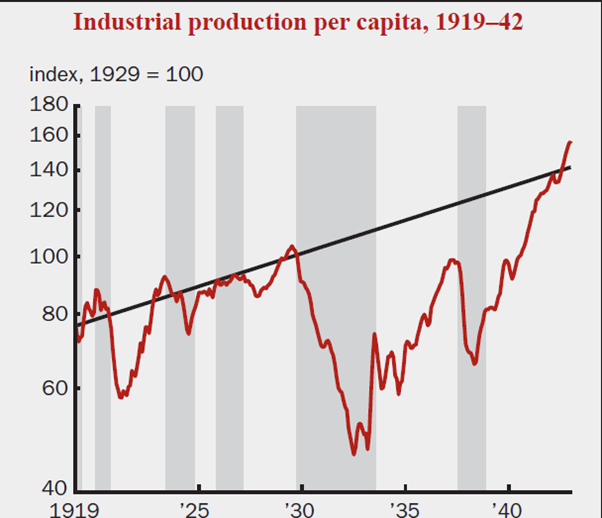
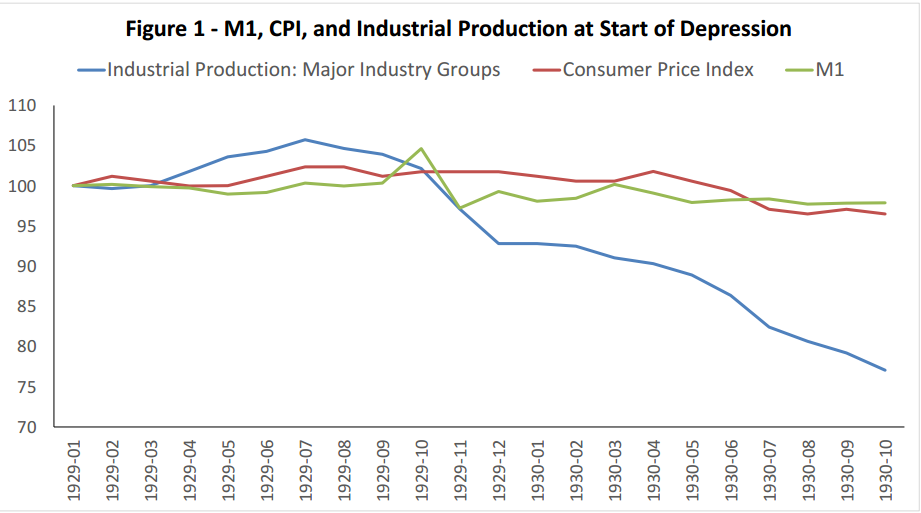
The manufacturing sector, where unions and the threat of unionisation was much stronger which was much harder hit initially than the agricultural sector both in terms of loss of jobs and wages not falling. The Great Depression did not start as an ordinary garden variety recession, as argued by Milton Friedman. It was immediately severe and sector specific with industrial production declining by about 35% between late 1929 and the end of 1930.
This decline in industrial production occurs before any banking crises. Despite this sector specific nature of the onset that Great Depression, monetary policy might have some role in explaining the start of the Great Depression but not in its prolongation:
any monetary explanation of the Depression requires a theory of very large and very protracted monetary non-neutrality. Such a theory has been elusive because the Depression is so much larger than any other downturn, and because explaining the persistence of such a large non-neutrality requires in turn a theory for why the normal economic forces that ultimately undo monetary non-neutrality were grossly absent in this episode.
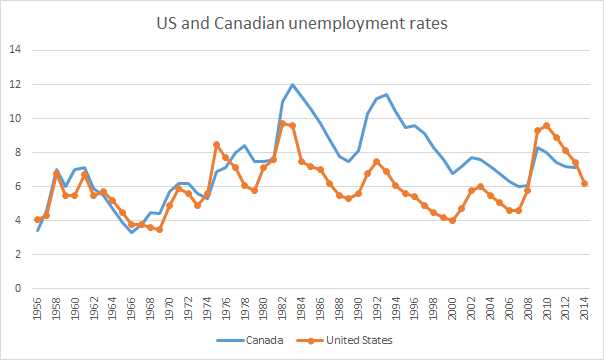
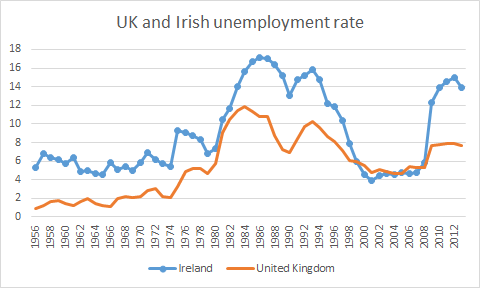
This includes Germany where there were major labour market reforms a couple of years before the onset of the Global Financial Crisis. For that reason, German unemployment rates didn’t rise much in 2008 and after and are now falling quite rapidly because of their labour market liberalisations. Germany has the lowest unemployment rate in Europe.
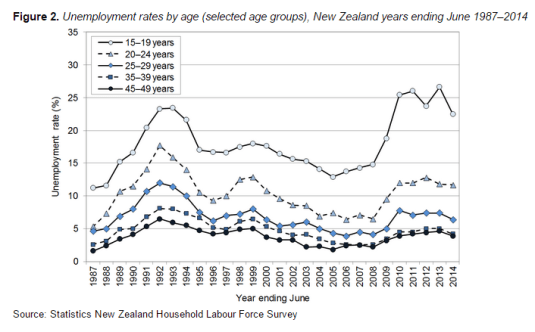
In New Zealand during June 1987–2014, unemployment rates were consistently higher for younger people aged 15–19 years than other age groups. Rates were lower for each age group, with those aged 45–49 years having the lowest). In the year ending June 2014, annual unemployment rates were 22.5% for those aged 15–19 years and to 11.7% for those aged 20–24 years – Child Poverty Monitor: Technical Report.
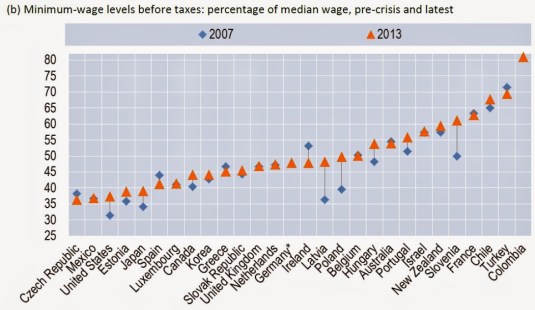
The time is not right, as they say, for New Zealand to increase its minimum wage rates after a sharp spike in the unemployment rates of youth and in particular of teenagers after the Global Financial Crisis.
Bryan Caplan wrote a blog a few years ago, explaining the labour economics of artificial intelligence, using an exam question he poses to his graduate students:
Suppose artificial intelligence researchers produce and patent a perfect substitute for human labour at zero MC.
Use general equilibrium theory to predict the overall economic effects on human welfare before AND after the Artificial Intelligence software patent expires.
He then gave the answer about a week later:
While the patent lasts, the patent-holder will produce a monopoly quantity of AIs. As a result, the effective labour supply increases, and wages for human beings fall – but not to 0 because the patent-holder keeps P>MC.
The overall effect on human welfare, however, is still positive! Since the AIs produce more stuff, and only humans get to consume, GDP per human goes up. How is this possible if wages fall?
Simple: Earnings for NON-labour assets (land, capital, patents, etc.) must go up. Humans who only own labour are worse off, but anyone who owns a home, stocks, etc. experiences offsetting gains.
When the patent expires, this effect becomes even more extreme. With 0 fixed costs, wages fall to MC=0, but total output – and GDP per human – skyrockets.
Human owners of land, capital, and other non-labour assets capture 100% of all output. Humans who only have labour to sell, however, will starve without charity or tax-funded redistribution.
His logic is quite good. Caplan drew attention in the responses to his blog of Capt J Parker and Alex Godofsky in the comments section of his blog.
My comments at the time were as follows:
An artificially intelligent robot that was a perfect substitute for human labour sounds like the replicators on star trek?
Who operates the machines? who tells them what to do? what not to do?
After the patent expired, would anyone care if the poor stole/copied the AI machines and made them for for themselves. who cares if a free good is stolen?
Why Evolution is True is a blog written by Jerry Coyne, centered on evolution and biology but also dealing with diverse topics like politics, culture, and cats.
In Hume’s spirit, I will attempt to serve as an ambassador from my world of economics, and help in “finding topics of conversation fit for the entertainment of rational creatures.”
“We do not believe any group of men adequate enough or wise enough to operate without scrutiny or without criticism. We know that the only way to avoid error is to detect it, that the only way to detect it is to be free to inquire. We know that in secrecy error undetected will flourish and subvert”. - J Robert Oppenheimer.






 Utopia, you are standing in it!
Recent Comments