Greece in 7 charts

How great was the Great Depression unemployment? The official and Darby estimates of US unemployment in the 1930s

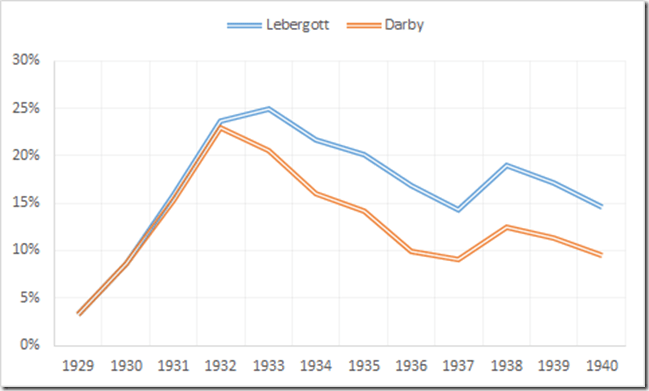
The graph below shows two different series for unemployment in the 1930s in the USA: the official BLS level by Lebergott; and a data series constructed famously by Michael Darby.

Figure 1: US unemployment rate, 1929 – 40: Darby and Lebergott estimates
image

Source: Robert Margot (1993).

Darby includes workers in the emergency government labour force as employed – the most important being the Civil Works Administration (CWA) and the Works Progress Administration (WPA). Once these workfare programs are accounted for, the level of U.S. unemployment fell from 22.9% in 1932 to 9.1% in 1937, a reduction of 13.8%.

For 1934-1941, the corrected unemployment levels are reduced by two to three-and-a half million people and the unemployment rates by 4 to 7 percentage points after 1933.

Not surprisingly, Darby titled his 1976 Journal of Political Economy article Three-and-a-Half Million U.S. Employees Have Been Mislaid: Or, an Explanation of Unemployment, 1934-1941. The corrected data by Darby shows stronger movement toward the natural unemployment rate after 1933.

From about 1935, the unemployment rate in the Great Depression in the USA is not much different from what it is in Europe in recent decades under Eurosclerosis.

In the 1930s in the USA, many unemployed were employed by the Civil Works Administration and the Works Progress administration. In contemporary Europe, the unemployed are simply paid not to work under their welfare state arrangements.

French, German and Italian unemployment rates, 1956 – 2013

Figure 1: French, German and Italian unemployment rates, 1956 – 2013

image

Source: OECD StatExtract.

Unemployment by educational level and degree level

Job finding rates and the unemployment benefit exhaustion spike

Long-term unemployment by sex, Australia, Canada, New Zealand, UK and USA, 1968 – 2013

image

Source: OECD StatExtract

image

Source: OECD StatExtract

Male labour force participation has been in a long-term decline

Youth unemployment in America by sex and education

The robots are coming, the robots are coming – been there, done that in Japan

When I was a kid, I used to like reading the Encyclopaedia Britannica. I read them from cover to cover.

One of the things I recalled from the Encyclopaedia Britannica was that in 1961 nearly half of the Japanese workforce worked in the agricultural sector.

image

I notice that anomaly when I was reading the Encyclopaedia Britannica entry on Japan in the 1970s. Japan had undergoing an economic transformation since my Encyclopaedia Britannica’s were written in 1961. It was very much out of date.

Australian manufacturing was being outcompeted in every direction from automobiles to clothing and footwear by the Japanese manufacturing sector back when I was a teenager.

The Japanese economic miracle absorbed the Japanese agricultural labour force without anybody having time to shout "the robots are coming, the robots are coming".

There is a lesson in there somewhere for the current breathless journalism, with far too many academic fellow travellers about "the robots are coming, the robots are coming".

When I was a student at graduate school in Japan, I visited a Japanese factory in 1996 that was completely automated bar one function. Only once did a human hand actually touch the electrical goods they were making. Naturally, at the Q&A session at the end of our visit, I asked when was his job going to be automated.

US and Canadian unemployment rates, 1956–2014

image

Source: OECD StatExtract

Unemployed people are defined as those who report that they are without work, that they are available for work and that they have taken active steps to find work in the last four weeks.

The ILO Guidelines specify what actions count as active steps to find work; these include answering vacancy notices, visiting factories, construction sites and other places of work, and placing advertisements in the press as well as registering with labour offices.

Unemployment isn’t much of an issue for the well educated in recessions

The sick men of Europe? British and Irish unemployment rates, 1956–2013

image

Source: OECD StatExtract

Ireland and Britain justly earned the name the sick man of Europe in the 1980s. Irish unemployment was  in the mid teens much of the 1980s because the Irish economy was in a great depression  from 1973 to 1992.

Unemployed people are defined as those who report that they are without work, that they are available for work and that they have taken active steps to find work in the last four weeks. The ILO Guidelines specify what actions count as active steps to find work; these include answering vacancy notices, visiting factories, construction sites and other places of work, and placing advertisements in the press as well as registering with labour offices.

New Zealand has one of the highest minimum wages

via CONVERSABLE ECONOMIST: Some International Minimum Wage Comparisons

New Zealand spends more than most on disability benefits

Image

College graduates don’t really notice recessions

Previous Older Entries Next Newer Entries

Fardels Bear

A History of the Alt-Right

Vincent Geloso

Econ Prof at George Mason University, Economic Historian, Québécois

Bassett, Brash & Hide

Celebrating humanity's flourishing through the spread of capitalism and the rule of law

Truth on the Market

Scholarly commentary on law, economics, and more

The Undercover Historian

Beatrice Cherrier's blog

Matua Kahurangi

Celebrating humanity's flourishing through the spread of capitalism and the rule of law

Temple of Sociology

Celebrating humanity's flourishing through the spread of capitalism and the rule of law

Velvet Glove, Iron Fist

Celebrating humanity's flourishing through the spread of capitalism and the rule of law

Why Evolution Is True

Why Evolution is True is a blog written by Jerry Coyne, centered on evolution and biology but also dealing with diverse topics like politics, culture, and cats.

Down to Earth Kiwi

Celebrating humanity's flourishing through the spread of capitalism and the rule of law

NoTricksZone

Celebrating humanity's flourishing through the spread of capitalism and the rule of law

Homepaddock

A rural perspective with a blue tint by Ele Ludemann

Kiwiblog

DPF's Kiwiblog - Fomenting Happy Mischief since 2003

The Dangerous Economist

Celebrating humanity's flourishing through the spread of capitalism and the rule of law

Watts Up With That?

The world's most viewed site on global warming and climate change

The Logical Place

Tim Harding's writings on rationality, informal logic and skepticism

Doc's Books

A window into Doc Freiberger's library

The Risk-Monger

Let's examine hard decisions!

Uneasy Money

Commentary on monetary policy in the spirit of R. G. Hawtrey

Barrie Saunders

Thoughts on public policy and the media

Liberty Scott

Celebrating humanity's flourishing through the spread of capitalism and the rule of law

Point of Order

Politics and the economy

James Bowden's Blog

A blog (primarily) on Canadian and Commonwealth political history and institutions

Science Matters

Reading between the lines, and underneath the hype.

Peter Winsley

Economics, and such stuff as dreams are made on

A Venerable Puzzle

"The British constitution has always been puzzling, and always will be." --Queen Elizabeth II

The Antiplanner

Celebrating humanity's flourishing through the spread of capitalism and the rule of law

Bet On It

Celebrating humanity's flourishing through the spread of capitalism and the rule of law

History of Sorts

WORLD WAR II, MUSIC, HISTORY, HOLOCAUST

Roger Pielke Jr.

Undisciplined scholar, recovering academic

Offsetting Behaviour

Celebrating humanity's flourishing through the spread of capitalism and the rule of law

JONATHAN TURLEY

Res ipsa loquitur - The thing itself speaks

Conversable Economist

In Hume’s spirit, I will attempt to serve as an ambassador from my world of economics, and help in “finding topics of conversation fit for the entertainment of rational creatures.”

The Victorian Commons

Researching the House of Commons, 1832-1868

The History of Parliament

Articles and research from the History of Parliament Trust

Books & Boots

Reflections on books and art

Legal History Miscellany

Posts on the History of Law, Crime, and Justice

Sex, Drugs and Economics

Celebrating humanity's flourishing through the spread of capitalism and the rule of law

European Royal History

Exploring the Monarchs of Europe

Tallbloke's Talkshop

Cutting edge science you can dice with

Marginal REVOLUTION

Small Steps Toward A Much Better World

NOT A LOT OF PEOPLE KNOW THAT

“We do not believe any group of men adequate enough or wise enough to operate without scrutiny or without criticism. We know that the only way to avoid error is to detect it, that the only way to detect it is to be free to inquire. We know that in secrecy error undetected will flourish and subvert”. - J Robert Oppenheimer.

STOP THESE THINGS

The truth about the great wind power fraud - we're not here to debate the wind industry, we're here to destroy it.

Lindsay Mitchell

Celebrating humanity's flourishing through the spread of capitalism and the rule of law

Alt-M

Celebrating humanity's flourishing through the spread of capitalism and the rule of law

croaking cassandra

Economics, public policy, monetary policy, financial regulation, with a New Zealand perspective