
The Best Minimum Wage Story Of The Day, Or, Yes, Wage Rises Really Do Kill Jobs
30 Oct 2014 Leave a comment
in labour economics, minimum wage, unemployment, unions Tags: living wage, minimum wage
Idiosyncratic Whisk: Teen Employment and the Minimum Wage, 60 years of experience
27 Sep 2014 Leave a comment
in applied price theory, applied welfare economics, labour economics, minimum wage, unemployment Tags: minimum wage

Is there any other issue where the data conforms so strongly to basic economic intuition, and yet is widely written off as a coincidence?
via Idiosyncratic Whisk: Teen Employment and the Minimum Wage, 60 years of experience.
The impact of unemployment insurance eligibility extensions on long-term unemployment rates
06 Sep 2014 Leave a comment

Recall and waiting unemployment
04 Aug 2014 Leave a comment
in business cycles, job search and matching, labour economics, labour supply, macroeconomics, occupational choice, unemployment Tags: recall unemployment, rest unemployment, temporary layoffs, waiting unemployment, work for the dole

Time use surveys in a range of countries show that the unemployed spend maybe a few hours per week looking for a new job. Krueger and Mueller (2008) found that:
…average search time is highest in the U.S.A., at 32.3 minutes per day, closely followed by Canada.
Europeans search much less, but there is considerable variation across countries.
In France the unemployed search around 21 minutes a day compared with 3 minutes in Finland
A small amount of job search per week is rational for many of the unemployed because a major form of job search doesn’t involve any job search any time soon. Instead, they are waiting for a call.
Also, Anglo-Saxon labour market are much more dynamic with many more vacancies opening every month as compared with the Eurosclerosis dual labour markets. In the European Union’s dual labour markets, it is not rational to search for vacancies that will never be there.
Job searches is an entrepreneurial venture that can involve a considerable amount of biding your time. Job seekers must choose between wider job search that may involve switching to a new industry or new occupation and investing in availability for suitable vacancies in their local labour markets or a recall to employment by old employers.
A spell of unemployment followed by a rehire by an old employer is known as recall unemployment or a temporary layoff.

Demand is less stable and more seasonal in industries such as construction, manufacturing and agriculture. When demand rebounds, recalling an old employee is a faster and cheaper hiring process than screening unfamiliar applicants of uncertain quality and training recruits.
Recall is not certain. Temporary layoffs will forecast their chances of recall and review these forecasts as they discover more about the length of drop in local labour demand and the general state of the rest of the labour market. the majority of unemployed who regard themselves as temporary layoffs are indeed recalled to their old job by their old employer after most downturns.
Better prospects of recall by old employers will reduce the intensity of job searches of temporary layoffs and increase their asking wages for other jobs. Workers with considerable industry and firm-specific human capital are likely to risk waiting longer for recall. Workers will search more intensively for other jobs as their forecasts of their chances of recall to old jobs become less encouraging.
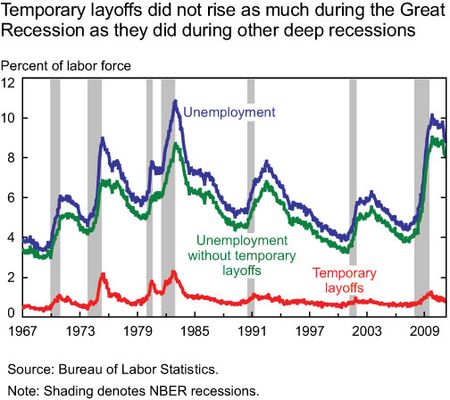
There are more temporary layoffs in milder recessions because the lull in demand is expected to be short and there are fewer business closures. The higher levels of recall unemployment will reduce downward pressure on asking wages and slow the filling of vacancies because many well qualified job applicants are waiting for recall to their old jobs rather than applying more widely for new jobs.
Dixon and Crichton (2006) found that 58% of New Zealand benefit-to-work transitions involved starting with a new employer, 30% continued with an employer for whom they worked part-time in the benefit spell and 12% returned to an employer they had worked for in the past 2 years. The prospect of a recall by an old employer has been important for unemployed workers in countries such as the US, Canada, Demark, Sweden, Austria and Norway.
In the context of work-for-the-dole schemes and activation programmes that involve intensive monitoring of job search by the unemployed on unemployment benefits, requiring workers who are temporarily laid off to search for jobs is in many ways counter-productive.
Developing a screening mechanism to find these temporary layoffs and distinguishing them from permanent layoffs would be quite challenging. Countries which have unemployment insurance premiums spend a lot of try trying to adjust those premiums for temporary layoffs. This is so employers and employees do not take advantage of unemployment insurance to have a week or two off work in slack periods at the expense of the unemployment insurance system and top up their wages in the interim.
A cousin of recall unemployment is rest unemployment or waiting unemployment – job seekers who are waiting for conditions in a depressed sector to improve (Hamilton 1988; Alvarez and Shimer 2008).

Some job seekers may wait for local labour market conditions to improve, rather than search for jobs in other industries and new occupations. A job seeker’s old industry may offer better wage and job finding prospects than other industries If the newly unemployed worker waits a while.
Rest unemployment or waiting unemployment strives to salvage as much of the occupation and industry-specific human capital of the newly unemployed worker as possible.
A significant share of job seekers have been found to be waiting for local labour market conditions to improve rather than searching further afield in different industries or new occupations (Alvarez and Shimer 2008).
Again, rest unemployment or waiting unemployment is a type of job search that cannot be well handled by work-for-the-dole schemes and intensive monitoring of the job search of unemployed workers.
How flexible is the New Zealand labour market
31 Jul 2014 1 Comment
in economics of regulation, labour economics, politics - New Zealand, unemployment, welfare reform Tags: 90 day trials, employment law, employment probation periods, employment protection, labour market regulation
The first chart below shows that NZ is the 4th most deregulated labour market for individual dismissals.
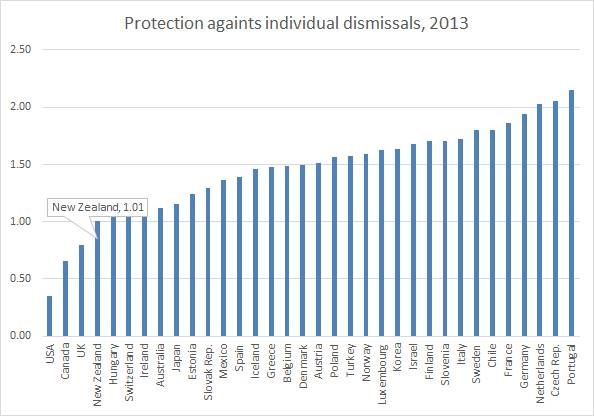
Source: OECD employment protection index
The next figure below shows that NZ is top of the world for deregulation of lay-offs and redundancies.
![clip_image002[7]](https://utopiayouarestandinginit.com/wp-content/uploads/2014/07/clip_image0027.jpg "clip_image002[7]")
Source: OECD employment protection index
The chart below shows that New Zealand is far more flexible than in Western Europe and is pretty near the USA in terms of people moving in and out of the unemployment pool every month with great ease.
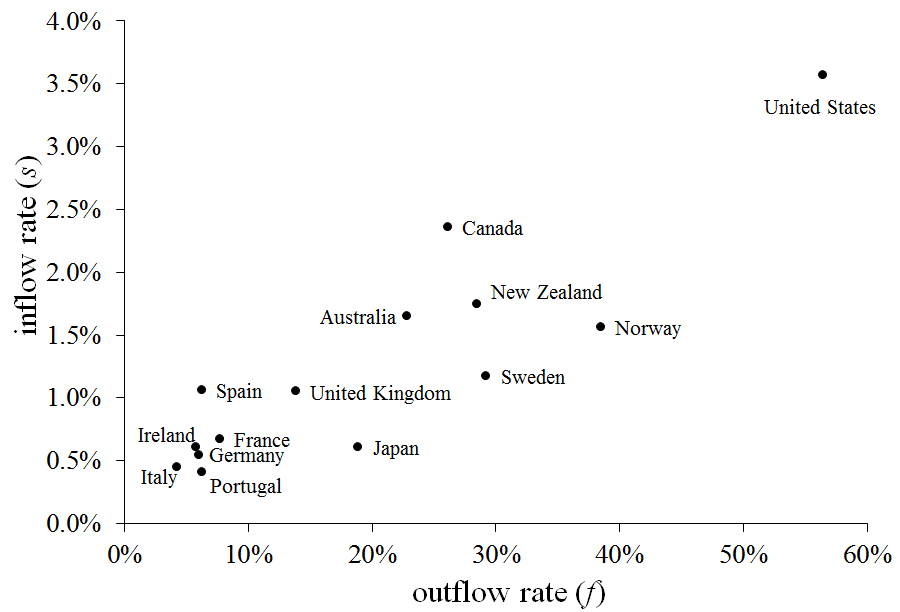
Source: Elsby, Hobijn and Şahin (2013).
There are very high outflow rates from unemployment among the Anglo-Saxon and Nordic economies. The economies of Continental Europe stand in stark contrast. Unemployment outflow rates in these economies lie below 10% at a monthly frequency.
A major labour market reform in recent years in New Zealand was introduction of the option of a 90 day trial for new employees, initially in small businesses and then in all businesses.
The UK recently extended its trial period from one-year to two-years. Trial periods are common in OECD member countries.
There is plenty of evidence to back-up the notion that increased job security leads to less employee effort and more absenteeism. Some examples are:
· Sick leave spiking straight after probation periods ended;
· Teacher absenteeism increasing after getting tenure after 5-years; and
· Academic productivity declining after winning tenure.
The MBIE research into the actual operation of 90-day trials was highly favourable in terms of increased employment, the hiring of riskier applicants and lower costs of ending bad job matches (about 15-20% of trials did not work out). These outcomes are the usual importance of a test drive argument for employment trial periods.
Interestingly, the MBIE research also found that some employers hired new employees on 90-day trials for positions about which these employers were uncertain might be profitable. But for the option of the trial period, these jobs never would have existed.
This suggests that in some firms, 90-day trials are a decisively cheaper alternative to hiring an employee and perhaps making them redundant later if the new position does not pay for itself. No one’s fault: the market just did not sustain the expansion in staff as expected.
The MBIE research shows that winners from 90-day trials are new labour force entrants, the unemployed and beneficiaries, migrants and labour force re-entrants such as mothers.
I kept note of an interesting press report adding to this where Hospitality New Zealand Wellington president Jeremy Smith said he had hired dozens of staff he would not otherwise have considered. Because of the transient nature of the hospitality industry, it was often difficult to check references so a trial period “levelled the playing field”.
Will work-for-the-dole work in Australia?
29 Jul 2014 12 Comments
in labour economics, labour supply, macroeconomics, unemployment, welfare reform Tags: benefit exhaustion spike, search and matching, unemployment insurance, US welfare reforms, welfare reform

One of the strongest empirical findings of modern labour economics is the benefit exhaustion spike. This is the large increase, shown in the diagram, in the probability of finding a job on the eve of exhausting unemployment benefits or unemployment insurance eligibility.
This benefit exhaustion spike is mobile: when unemployment insurance eligibility is lengthened, the benefit exhaustion spike moves out to the new benefit exhaustion date. For example, from 26 weeks, then to 39 weeks, then 52 weeks and then to 99 weeks. There is also a benefit exhaustion spike where the generosity of unemployment or other insurance decreases after a certain time. The alleged decay in the human capital of the long-term unemployed does not seem to affect this benefit exhaustion spike.
In addition, in the EU, the job finding probability of unemployment insurance recipients eligible for other welfare schemes are less sensitive to changes in the level and duration of their unemployment benefits benefits.
The benefit exhaustion spike shows that job seekers have much more control over their re-employment prospects than is commonly granted even in the worst of economic conditions such as in Pittsburgh in the early 1980s in a major recession and when US manufacturing industry industry was in a long-term decline.
The individual’s reservation wage (i.e. the lowest wage wage at which individuals will accept a job offer) decreases whilst search intensity increases as they approach unemployment benefit eligibility exhaustion.

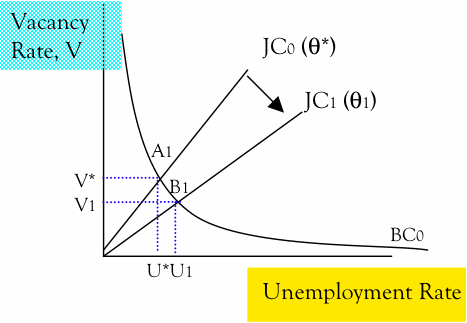
This reduction in reservation wages or the asking wages of job seekers increases the incentives for employers to post new vacancies because they can fill them at a lower cost. Both more intensive job search and more vacancies will see jobs filled faster, and more jobs created and filled.
A mechanism for reducing welfare programme entry rate while increasing welfare benefit exits is mandatory minimum job search and mandatory work requirements such as those proposed this week for Australia. These minimum hours can be spent working part time, in study and training, work preparation and job search assistance or volunteering. A work requirement is a screening device that removes any advantage of moving on to welfare in terms of more leisure time.
The proposals announced this week in Australia are most job seekers will be required to look for up to 40 jobs per month and work for the dole will be mandatory for all jobseekers younger than 50. Job seekers younger than 30 would have to work 25 hours a week under the expanded programme, while those between 30 and 49 will be asked to do 15 hours work a week, and those aged 50-60, 15 hours a week.
At least 13 OECD member countries require at least monthly visits to a local employment office by unemployment beneficiaries to present job-search evidence and also perhaps to receive advice and even referrals to specific job openings.
Reforms in a range of overseas countries that introduced more intensive monitoring of job search and stronger sanctions on benefits for non-compliance significantly reduced unemployment spells.
One of the surprising results of more intensive monitoring of job search and a requirement to sign on regularly at the local employment office or Social Security office is the sheer horror of having to sign-on and talk to caseworker for five minutes encourages 5 to 10% of unemployed beneficiaries to find a job. When unemployment and sickness beneficiaries are required to undergo a full reassessment of their eligibility, it is common for up to 30% of them simply to not reapply.
The stronger monitoring of job search and the real prospect of stiffer sanctions for non-compliance encourages all benefit claimants, current and future, and not just those actually sanctioned to search harder for jobs. This anticipation of stricter monitoring and more frequent eligibility reviews has a much larger effect of welfare dependency than the actual sanctioning of the non-complaint. People review their options and marshalled their resources to find or stay in work.
The welfare exit effect and welfare entry deterrence arises from mandatory work requirements from the relative non-financial rewards of working and not working having changed in favour of staying in full-time and semi-work for persistent workers temporarily on a welfare benefit.
Persistent workers gain from anticipating the onerous nature of work requirements and searching more intensively for jobs which are more stable and enduring. These job seekers may reduce their asking wage to win a lower paid but steadier job.
Seasonal and temporary jobs will be less attractive if there are work requirements. The incentive to cycle between the benefit and part-time and full-time work including seasonal and temporary jobs are reduce because work requirements make welfare receipt more onerous. Those job seekers with fewer outside of the workforce obligations such as young children are the most likely to move to (stable) full-time work because of work requirements.
A work requirement as a condition for a welfare benefit receive unambiguously increases net labour supply and reduces the number of people relying on the welfare system now and into the future.
The number of people working increase and some leave welfare rather than comply with the mandatory work programmes. Work requirements make welfare receipt unambiguously less attractive and will close the gap between earning full-time wages and the net rewards of not working or part-time work and partial benefit receipt.
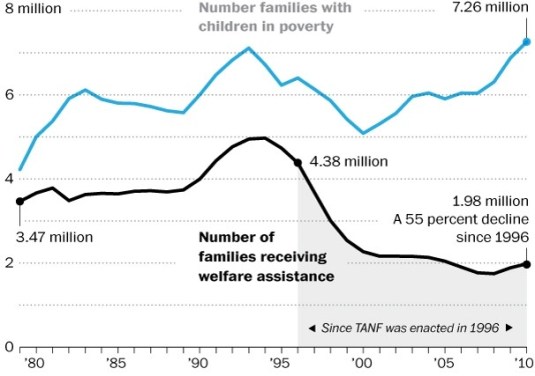
There was a more than 60% reduction in welfare caseloads after the 1996 federal welfare reform in the USA that introduced work requirement and five year lifetime federal welfare eligibility time limits on a national basis. In the four decades preceding the 1996 welfare reform, the number of Americans on welfare had never significantly decreased.
The gains in U.S. employment after the 1996 Federal welfare reform were largest among the single mothers previously thought to be most disadvantaged: young (ages 18-29), mothers with children aged under seven, high school drop-outs, and black and Hispanic mothers. These low-skilled single mothers in the USA were thought to face the greatest barriers to employment.

The U.S. literature has many competing estimates of the relative effects of work requirements, lifetime time limits and a far more generous earned income tax credit (EITC). It is agreed that work requirements and time limits reduced entry into welfare caseloads. The relative importance of time limits, work mandates and greater EITC generosity for exits is more disputed.

The Minnesota Family Investment Program (MFIP) had a more complex experimental design that allowed separate evaluation of the mandatory welfare-to-work program and the lower benefit reduction rate. The results indicated that the lower benefit abatement rates appear to have had little labour supply effect. The increase in labour supply seems to have come almost entirely from the mandatory welfare-to-work program and its associated sanctions.
Much was initially made in the US empirical literature of the strong state of the American economy in the 1990s as an explanation for part of the drop in welfare caseloads. The relevance of this faded when welfare caseloads did not increase again when the economy deteriorated after 2007 in the USA.
Is unemployment voluntary or involuntary?
27 Jun 2014 Leave a comment
in business cycles, job search and matching, labour economics, macroeconomics, unemployment Tags: Alan Manning, Armen Alchian, Robert Barro, Robert Lucas, unemployment

Robert Lucas in a famous 1978 paper argued that all unemployment was voluntary because involuntary unemployment was a meaningless concept. He said as follows:
The worker who loses a good job in prosperous time does not volunteer to be in this situation: he has suffered a capital loss. Similarly, the firm which loses an experienced employee in depressed times suffers an undesirable capital loss.
Nevertheless the unemployed worker at any time can always find some job at once, and a firm can always fill a vacancy instantaneously. That neither typically does so by choice is not difficult to understand given the quality of the jobs and the employees which are easiest to find.
Thus there is an involuntary element in all unemployment, in the sense that no one chooses bad luck over good; there is also a voluntary element in all unemployment, in the sense that however miserable one’s current work options, one can always choose to accept them.
I agree that we all make choices subject to constraints. To say that a choice is involuntary because it is constrained by a scarcity of job-opportunities information is to say that choices are involuntary because there is scarcity.
Alchian said there are always plenty of jobs because to suppose the contrary suggests that scarcity has been abolished. Lucas elaborated further in 1987 in Models of Business Cycles:
A theory that does deal successfully with unemployment needs to address two quite distinct problems.
One is the fact that job separations tend to take the form of unilateral decisions – a worker quits, or is laid off or fired – in which negotiations over wage rates play no explicit role.
The second is that workers who lose jobs, for whatever reason, typically pass through a period of unemployment instead of taking temporary work on the ‘spot’ labour market jobs that are readily available in any economy.
Of these, the second seems to me much the more important: it does not ‘explain’ why someone is unemployed to explain why he does not have a job with company X. After all, most employed people do not have jobs with company X either.
To explain why people allocate time to a particular activity – like unemployment – we need to know why they prefer it to all other available activities: to say that I am allergic to strawberries does not ‘explain’ why I drink coffee. Neither of these puzzles is easy to understand within a Walrasian framework, and it would be good to understand both of them better, but I suggest we begin by focusing on the second of the two.
Another way to understand unemployment is to use a device at the start of Alan Manning’s book on labour market monopsony:
What happens if an employer cuts the wage it pays its workers by one cent? Much of labour economics is built on the assumption that all existing workers immediately leave the firm as that is the implication of the assumption of perfect competition in the labour market.
In such a situation an employer faces a market wage for each type of labour determined by forces beyond its control at which any number of these workers can be hired but any attempt to pay a lower wage will result in the complete inability to hire any of them at all
Suppose workers offered to work for 1 cent. Would employers accept? Many do because they have intern and work experience programmes for students, but is this result of general application?
Understanding the reallocation of labour at the end of the recession requires careful attention to the 1980s writing of Alchian on the theory of the firm. Alchian and Woodward’s 1987 ‘Reflections on a theory of the firm’ says:
… the notion of a quickly equilibrating market price is baffling save in a very few markets. Imagine an employer and an employee. Will they renegotiate price every hour, or with every perceived change in circumstances?
If the employee is a waiter in a restaurant, would the waiter’s wage be renegotiated with every new customer? Would it be renegotiated to zero when no customers are present, and then back to a high level that would extract the entire customer value when a queue appears?
… But what is the right interval for renegotiation or change in price? The usual answer ‘as soon as demand or supply changes’ is uninformative.
Alchian and Woodward then go on to a long discussion of the role of protecting composite quasi-rents from dependent resources as the decider of the timing of wage and price revisions.
Alchian and Woodward explain unemployment as a side-effect of the purpose of wage and price rigidity, which is the prevention of hold-ups over dependent assets. They note that unemployment cannot be understood until an adequate theory of the firm explains the type of contracts the members of a firm make with one another.
My interpretation is the majority of employment relationships are capital intensive long-term contracts. Employers spend a lot of time searching and screening applicants to find those that will stay longer. In less skilled jobs, and in spot market jobs, employers will hire the best applicant quickly because job turnover costs are low. Back to Manning again:
That important frictions exist in the labour market seems undeniable: people go to the pub to celebrate when they get a job rather than greeting the news with the shrug of the shoulders that we might expect if labour markets were frictionless. And people go to the pub to drown their sorrows when they lose their job rather than picking up another one straight away. The importance of frictions has been recognized since at least the work of Stigler (1961, 1962).
Whatever may be among these frictions, wage rigidity is not one of them. Wages are flexible for job stayers and certainly new starters.
See What can wages and employment tell us about the UK’s productivity puzzle? by Richard Blundell, Claire Crawford and Wenchao Jin showing that in the recent UK recession 12% of employees in the same job as 12 months ago experienced wage freezes and 21% of workers in the same job as 12 months ago experienced wage cuts. Their data covered 80% of workers in the New Earnings Survey Panel Dataset.
Larger firms lay off workers; smaller firms tended to reduce wages. This British data showing widespread wage cuts dates back to the 1980s. Recent Irish data also shows extensive wage cuts among job stayers.
See too Chris Pissarides (2009), The Unemployment Volatility Puzzle: Is Wage Stickiness the Answer? arguing the wage stickiness is not the answer since wages in new job matches are highly flexible:
- wages of job changers are always substantially more procyclical than the wages of job stayers.
- the wages of job stayers, and even of those who remain in the same job with the same employer are still mildly procyclical.
- there is more procyclicality in the wages of stayers in Europe than in the United States.
- The procyclicality of job stayers’ wages is sometimes due to bonuses, and overtime pay but it still reflects a rise in the hourly cost of labour to the firm in cyclical peaks
How do existing firms who will not cut wages survive in competition with new firms who can start workers on lower wages? Industries with many short term jobs and seasonal jobs would suffer less from wage inflexibility.
Robert Barro (1977) pointed out that wage rigidity matters little because workers can, for example, agree in advance that they will work harder when there is more work to do—that is, when the demand for a firm’s product is high—and work less hard when there is little work. Stickiness of nominal wage rates does not necessarily cause errors in the determination of labour and production.
The ability to make long-term wage contracts and include clauses that guard against opportunistic wage cuts should make the parties better off. Workers will not sign these contracts if they are against their interests. Employers do not offer these contracts, and offer more flexible wage packages, will undercut employers who are more rigid. Furthermore many workers are on performance pay that link there must wages to the profitability of the company.
How can downward wage rigidity be a scientific hypothesis if extensive international evidence of widespread wage cuts since the 1980s and 30%+ of the workforce on performance bonuses is not enough to refute it?
Alchian and Kessel in “The Meaning and Validity of the Inflation-Induced Lag of Wages Behind Prices,” Amer. Econ. Rev. 50 [March 1960]:43-66) tested the hypothesis that workers suffered from money illusion by comparing the rates of return to firms in capital intensive industries with those of labour intensive industries. Labour intensive industries were not more profitable than capital intensive industries. Employers in labour intensive industries should profit from the misperceptions of workers about wages and future prices, but they did not. Alchian and Kessel found little evidence of a lag between wage and price changes.
In Canadian industries in the 1960s and 1970s, wage indexation ranged from zero to nearly 100%. Industries with little indexation should show substantial responses of real wage rates, employment and output to nominal shocks. Industries with lots of indexation would be affected little by nominal disturbances. Monetary shocks had positive effects but an industry’s response to these shocks bore no relation to the amount of indexation in the industry. Shaghil Ahmed (1987) found that those industries with lots of indexation were as likely as those with little indexation to respond to shocks.
If the signing of new wage contracts was important to wage rigidity, there should be unusual behaviour of employment and real wage rates just after these signings, but the results are mixed. Olivei and Tenreyro (2010) used the tendency of contracts to be signed at the start of years to show that monetary policy had significant effects in January but little effect in December because the effects were quickly undone.
Alchian (1969) lists three ways to adjust to unanticipated demand fluctuations:
• output adjustments;
• wage and price adjustments; and
• Inventories and queues (including reservations).
Alchian (1969) suggests that there is no reason for wage and price changes to be used regardless of the relative cost of these other options:
• The cost of output adjustment stems from the fact that marginal costs rise with output;
• The cost of price adjustment arises because uncertain prices and wages induce costly search by buyers and sellers seeking the best offer; and
• The third method of adjustment has holding and queuing costs.
There is a tendency for unpredicted price and wage changes to induce costly additional search. Long-term contracts including implicit contracts arise to share risks and curb opportunism over relationship-specific capital. These factors lead to queues, unemployment, spare capacity, layoffs, shortages, inventories and non-price rationing in conjunction with wage stability.
 Utopia, you are standing in it!
Recent Comments