The employment rates of sole parents with kindergarten age children, OECD, 2011
24 May 2015 Leave a comment
in gender, labour economics, labour supply, welfare reform Tags: child poverty, economics of families, female labour force participation, paternal labour force participation, single parents
Figure 1: percentage of sole parents not working with youngest child aged 3-5, OECD, 2011

Source: OECD family database
Figure 2: percentage of sole parents part-time with youngest child aged 3-5, OECD, 2011

Source: OECD family database
The employment rates of sole parents with school age children, OECD, 2011
23 May 2015 Leave a comment
in gender, labour economics, labour supply, welfare reform Tags: child poverty, economics of families, female labour force participation, paternal labour force participation, single parents
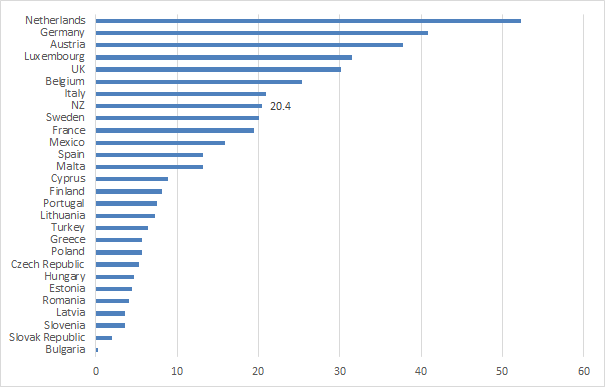
Figure 1: percentage of sole parents working with youngest child aged 6-14, 2011

Source: OECD family database
Figure 2: percentage of sole parents working part0time with youngest child aged 6-14, 2011
Source: OECD family database
The employment rates of sole parents with toddlers, OECD, 2011
22 May 2015 Leave a comment
in gender, labour economics, labour supply, welfare reform Tags: child poverty, economics of families, female labour force participation, paternal labour force participation, single parents
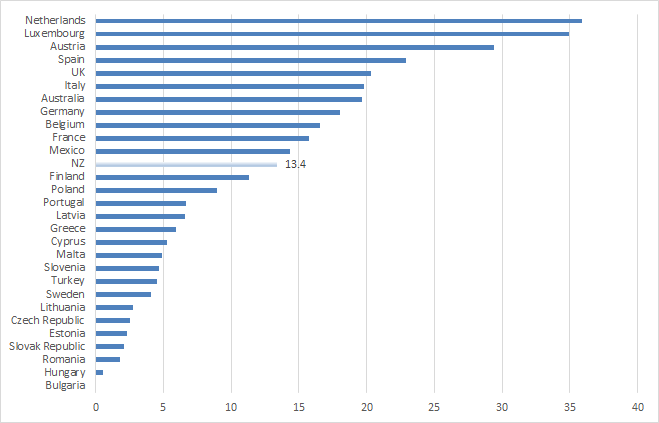
Figure 1: percentage of sole parents with youngest child aged under two not working, 2011

Source: OECD family database
Figure 2: percentage of sole parents with youngest child aged under two working part-time, 2011
Source: OECD family database
The three S’s in family policy
18 May 2015 Leave a comment
in economics of education, gender, human capital, labour economics, labour supply, occupational choice, poverty and inequality, welfare reform Tags: child poverty, economics of marriage, family poverty, female labour force participation, labour force participation, male labour force participation, marriage and divorce, single parents, welfare reform
Helpful distinctions for family thinking: structure, stability & strength (&.. how related) @inclusionist @mboteach http://t.co/zMi92WYUhi—
Richard V. Reeves (@RichardvReeves) January 13, 2015
The War on Poverty at 50
16 May 2015 Leave a comment
in economic history, labour economics, labour supply, poverty and inequality, welfare reform Tags: 1996 US welfare reforms, child poverty, family poverty, war on poverty

The big drop .in both child poverty and poverty in general was after the 1996 welfare reforms.


via Chart Book: The War on Poverty at 50, Section 1 | Center on Budget and Policy Priorities.
The main drivers of child poverty
15 May 2015 Leave a comment
in applied welfare economics, economics of love and marriage, gender, labour economics, labour supply, occupational choice, politics - Australia, politics - New Zealand, politics - USA, population economics, welfare reform Tags: child poverty, economics of the family, family poverty, marriage and divorce, single mothers, single parents
CHART: Black Illegitimacy Rate Went from < 20% in 1950 to 75.2% in 2010. Has Obama ever mentioned that? http://t.co/1UBUQ5aLRi—
Mark J. Perry (@Mark_J_Perry) May 12, 2015
Quotation of the Day from Charles Murray http://t.co/Y8W6xGjRPO—
Mark J. Perry (@Mark_J_Perry) May 12, 2015
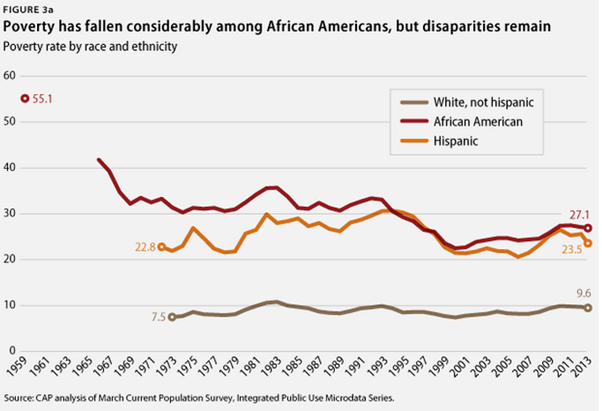
Black and Hispanic poverty dropped by a third after the 1996 US welfare reforms
13 May 2015 Leave a comment
in labour economics, labour supply, politics - USA, poverty and inequality, welfare reform Tags: 1996 welfare reforms, child poverty, family poverty, welfare state
Child poverty and single parenthood
13 May 2015 Leave a comment
in economics of love and marriage, gender, labour economics, labour supply, occupational choice, poverty and inequality, welfare reform Tags: child poverty, economics of marriage, family poverty, marriage and divorce, single mothers, single parents, welfare reform
Over half of all births to young adults in the U.S. now occur outside of marriage. bit.ly/1qONO10 http://t.co/KXl4sFd122—
Isabel Sawhill (@isawhill) September 17, 2014
Despite forgoing #marriage, young Americans are not forgoing parenthood. bit.ly/1sMG2bJ http://t.co/1aSELaJlfg—
Isabel Sawhill (@isawhill) October 31, 2014
Despite forgoing #marriage, young Americans are not forgoing #parenthood. bit.ly/1xLa1AJ http://t.co/fetnPAiCPG—
Isabel Sawhill (@isawhill) October 13, 2014
Almost 60% of births to women with only a high school degree occur out of wedlock. bit.ly/1sMG2bJ http://t.co/zomTFjZwA2—
Isabel Sawhill (@isawhill) October 14, 2014

Further evidence of the success of the 1996 US welfare reforms and a lack of wage stagnation
03 May 2015 1 Comment
in economic growth, economic history, labour economics, labour supply, politics - USA, welfare reform Tags: middle-class wage stagnation, top 1%, US welfare reforms, wage stagnation
http://t.co/l7NzR1byNF—
EPI Chart Bot (@epichartbot) April 27, 2015
http://t.co/VZTp2A0H8n—
EPI Chart Bot (@epichartbot) April 05, 2015
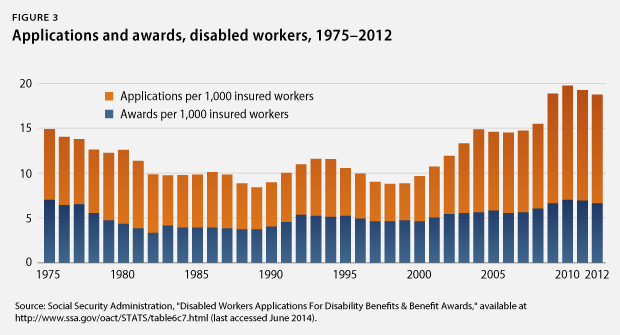
Disability benefit applications are counter cyclical and unaffected by improving health standards and rising life expectancy
29 Apr 2015 Leave a comment
in health and safety, health economics, labour economics, labour supply, welfare reform Tags: disability benefits
How to argue for welfare reform when sincerely arguing against the 1996 US Federal welfare reforms
28 Apr 2015 Leave a comment
in labour economics, labour supply, occupational choice, poverty and inequality, welfare reform Tags: 1996 US welfare reforms, female labour supply, labour demographics, welfare state
The share of single mothers without a high school degree with earnings rose from 49 percent to 64 percent between 1995 and 2000 but has since fallen or remained constant almost every year since then. At 55 percent, it’s now just slightly above its level in 1997, the first full year of welfare reform (see first graph).

TANF now serves only 25 of every 100 families with children that live below the poverty line, down from AFDC’s 68 of every 100 such families before the welfare law
Over the last 18 years, the national TANF average monthly caseload has fallen by almost two-thirds — from 4.7 million families in 1996 to 1.7 million families in 2013 — even as poverty and deep poverty have worsened.
The number of families with children in poverty hit a low of 5.2 million in 2000, but has since increased to more than 7 million. Similarly, the number of families with children in deep poverty (with incomes below half of the poverty line) hit a low of about 2 million in 2000, but is now above 3 million.

The employment situation for never-married mothers with a high school or less education — the group of mothers most affected by welfare reform — has changed dramatically over the last several decades.
In the early 1990’s, when states first made major changes to their cash welfare programs, only about half of these mothers worked.
Importantly, there was a very large employment gap between the share of these never-married mothers and single women without children with similar levels of education, suggesting that there was substantial room for these never-married mothers to increase their participation in the labour force.
By 2000, the employment gap between these two groups of women closed, and it has remained so. But in the years since, the employment rate for both groups has fallen considerably.
The employment rate for never-married mothers is now about the same as when welfare reform was enacted 18 years ago. This suggests that the economy and low education levels are now the causes of limited employment among never-married mothers — not the availability of public benefits or anything particular to never-married mothers.

The Centre on Budget and Policy Priorities, who hail clearly from the Left of American politics, scrupulously documented the following:
- Big gains in the employment of single mothers until a setback in the Great Recession but is still much better than in 1996;
- Welfare dependency dropped by two thirds;
- Despite this two third drop in welfare dependency, and earnest predictions of acute poverty and deprivation made in 1996, the number of families in deep poverty has not changed, and the number of families in poverty fell significantly and only rose again with the Great Recession; and
- There was a dramatic increase in the percentage of never married mothers in employment, so much so that there is no difference in the employment rate of single women with no children and never married mothers!
Welfare dependency down by two thirds, employment of never married mothers up to levels no one thought possible, family poverty down, and economic independence is much more widespread and all because of the 1996 US Federal welfare reforms. That sounds like success to me – a great success.
via Chart Book: TANF at 18 | Center on Budget and Policy Priorities.
Fact checking Gwyneth Paltrow on $29 of food stamps for a week
26 Apr 2015 Leave a comment
in labour economics, politics - USA, welfare reform Tags: food stamps, Gwyneth Paltrow, Left-wing hypocrisy, welfare state
Tony Atkinson’s ‘Inequality – What Can Be Done?’
24 Apr 2015 Leave a comment
in applied welfare economics, labour economics, minimum wage, Public Choice, Rawls and Nozick, welfare reform Tags: guaranteed minimum income, Leftover Left
I find proposal number 3 to target reducing unemployment rather perplexing because Atkinson in proposal number 5 wants to increase the minimum wage to the living wage, which will increase unemployment. He proposes a guaranteed child income, but he doesn’t appear to make proposals for a guaranteed family minimum income. A guaranteed family minimum income or an increase in the earned income tax credit, to use the American terminology, would increase the incomes of the low paid without threatening their job through a minimum wage increase.
Out Today: Tony Atkinson's new book 'Inequality – What Can Be Done?'
Here are his 14 proposals to reduce inequality: http://t.co/RPXmEBBFCR—
Max Roser (@MaxCRoser) April 23, 2015


Recent Comments