

via Was Moynihan Right? What happens to the children of unmarried mothers : Education Next
Celebrating humanity's flourishing through the spread of capitalism and the rule of law
24 Apr 2015 3 Comments
in economics of love and marriage, gender, labour economics, labour supply, poverty and inequality, welfare reform Tags: family demographics, single parents
via Was Moynihan Right? What happens to the children of unmarried mothers : Education Next
23 Apr 2015 Leave a comment
in economic history, labour economics, labour supply, poverty and inequality, welfare reform
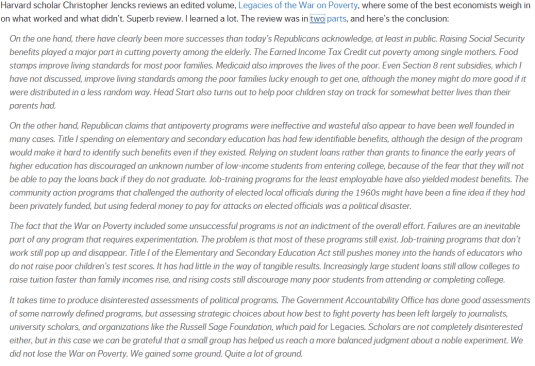
Via The war on poverty at age 50: What US social programs worked and which failed? – Chris Blattman.
18 Apr 2015 4 Comments
in gender, labour economics, labour supply, occupational choice, poverty and inequality, unemployment, welfare reform Tags: child poverty, demographics, family, single parents
17 Apr 2015 Leave a comment
in economics of crime, labour economics, labour supply, welfare reform
13 Apr 2015 Leave a comment
in labour economics, minimum wage, poverty and inequality, welfare reform Tags: living wage, poverty and inequality, welfare state
12 Apr 2015 Leave a comment
in welfare reform Tags: Director's Law, expressive voting, growth in government, welfare spending
12 Apr 2015 Leave a comment
in income redistribution, politics - New Zealand, politics - USA, welfare reform
The Treasury modelled a Guaranteed Minimum income (GMI) at the request of the Welfare Working Group in 2010. A GMI paying $300 per week – the mean benefit income among those on benefits – would cost $44.5 billion (model 1) or $52.6 billion if we extended it to super annuitants as a replacement for NZ Superannuation or old age pension (model 2). The former could be covered by a flat personal income tax rate of 45.4%; the latter, 48.6%.
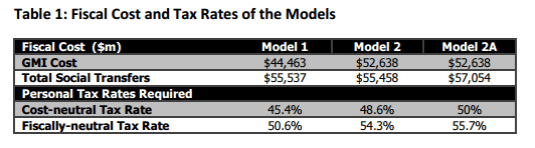
Full fiscal neutrality would require tax rates of 50.6% and 54.4% – the lower tax rates would be just enough to cover the transfers, but income tax revenues are currently also used to fund more than just transfers.
If we recognize that most parents are beneficiaries via Working for Families and compensate them for their loss with a $86 per child per week payment (model 3), we get a $57.1 billion fiscal cost and a personal tax rate of 50% (or 55.7% for fiscal neutrality).
Treasury noted that many beneficiaries (including the disabled, carers and sole parents) currently receive more than $300 per week and would be made financially worse off under a GMI scheme.
Treasury also warned about potential adverse labour supply responses to the necessary higher personal income tax rates. The large gap between company and personal tax rates would increase IRD’s enforcement costs.
In 1987, Finance Minister Roger Douglas announced a Guaranteed Minimum Family Income Scheme to accompany a new 22% flat income tax. The idea did not go ahead.
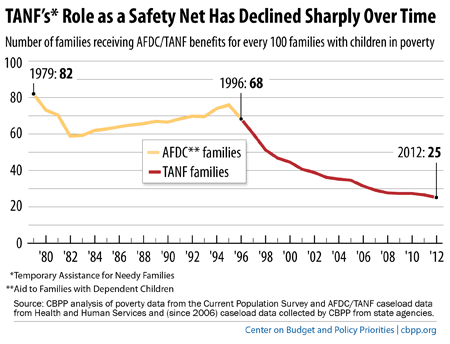
Richard Nixon also proposed a guaranteed minimum family income plan in 1969 to replace the Aid to Families with Dependent Children (AIDC) scheme at the behest of future Senator Daniel Patrick Moynihan. This was based on the negative income tax proposals of Milton Friedman and George Stigler. Nixon’s plan passed the House but not the Senate after 3 years of infighting.
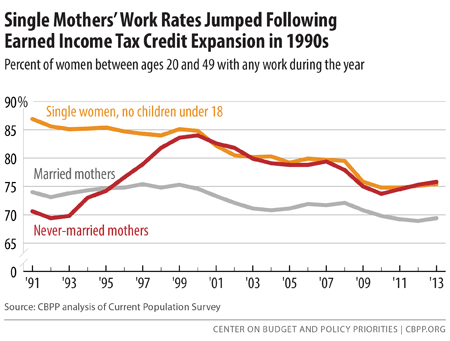
The final outcome was the earned income tax credit (EITC) in 1975 that was expanded significantly in the 1990s to become the largest single federal income transfer programme. One attraction of the EITC is that because its benefits rise positively with earnings up to the phase-out point, so it can have a positive rather than negative effect on work incentives for workers on a low wage.
10 Apr 2015 2 Comments
in politics - Australia, politics - New Zealand, politics - USA, poverty and inequality, welfare reform Tags: welfare state
In Mexico, most cash-based public social benefits go to households in the highest income quintile, per OECD. http://t.co/xykkPkDVZs—
Catherine Rampell (@crampell) November 24, 2014
05 Apr 2015 Leave a comment
in gender, health economics, labour economics, occupational choice, population economics, welfare reform Tags: single parents
03 Apr 2015 Leave a comment
in gender, labour economics, labour supply, poverty and inequality, welfare reform Tags: 1996 US welfare reforms, female labour force participation, single parents
02 Apr 2015 1 Comment
in income redistribution, labour economics, politics - Australia, politics - New Zealand, politics - USA, welfare reform Tags: social insurance, social safety nets, welfare reform, welfare state
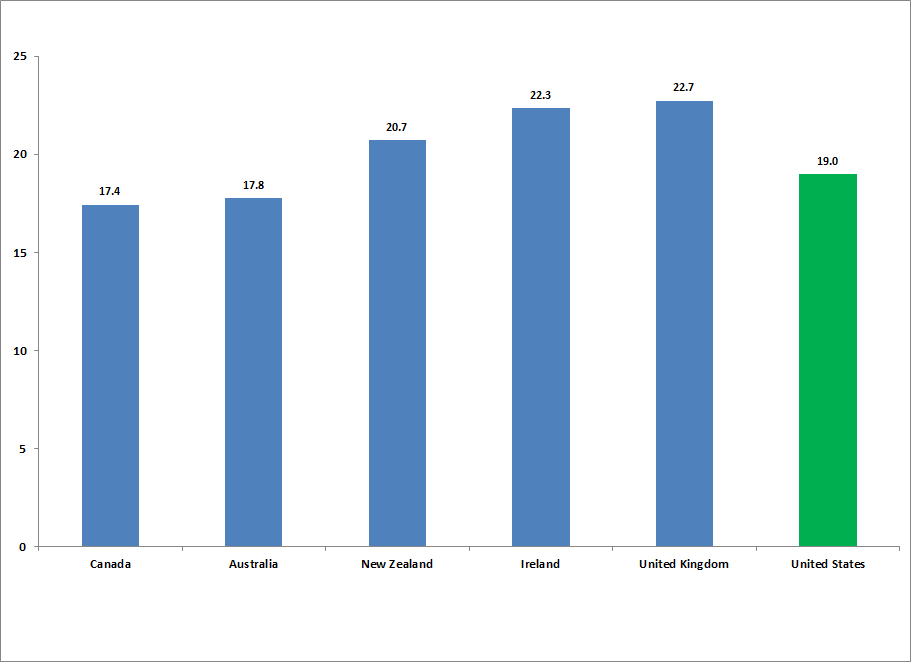
I have reanalysed data published by the Peterson Institute on the true levels of social expenditure across the industrialised countries for the Anglo-Saxon countries.
Figure 1: gross public social expenditures in OECD countries, 2011
Source: POLICY BRIEF 15-4: The True Levels of Government and Social Expenditures in Advanced Economies.
When you just look at gross public social expenditure, New Zealand is in the middle of the pack with the United Kingdom having the largest spending. There are not particularly large differences across social spending in the Anglo-Saxon welfare states.
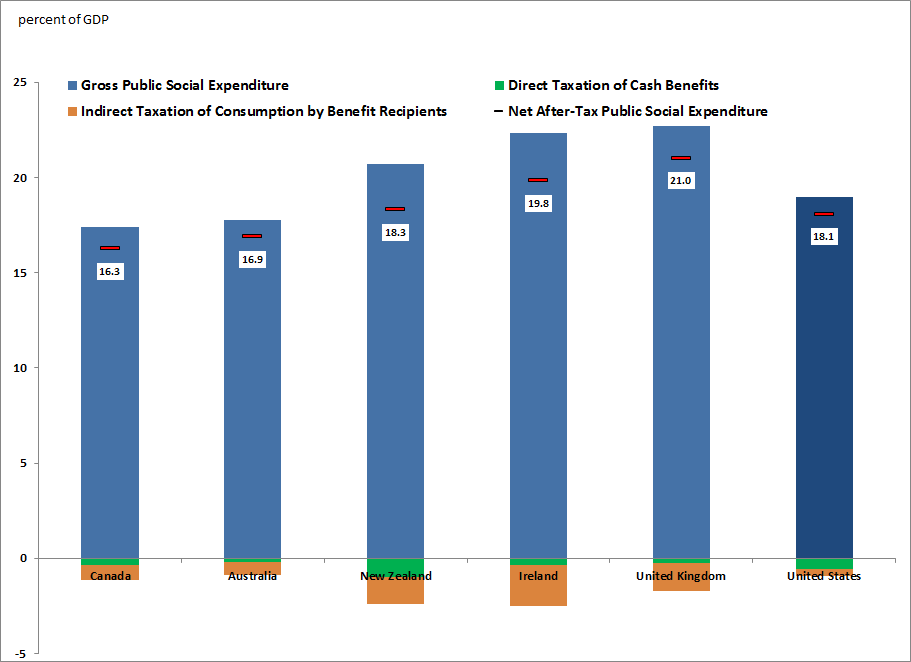
Figure 2: Gross public social expenditure and the effects of taxation in OECD countries, 2011
Source: POLICY BRIEF 15-4: The True Levels of Government and Social Expenditures in Advanced Economies.
There is not much change when you include the effects of taxation on consumption by benefit recipients.
Figure 3: Net after-tax public and private social expenditure in OECD countries, 2011
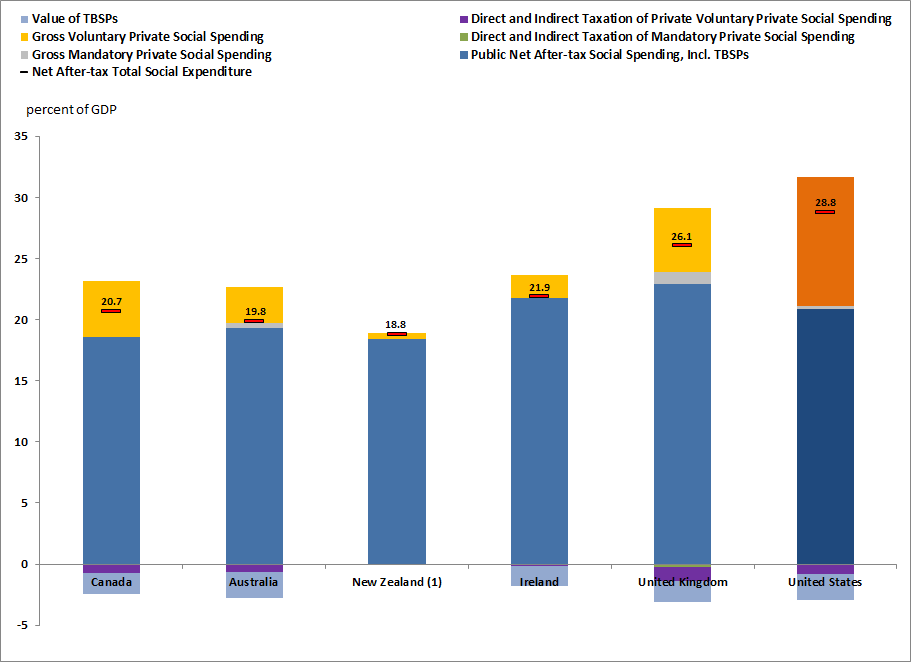
Source: POLICY BRIEF 15-4: The True Levels of Government and Social Expenditures in Advanced Economies.
When private mandatory social spending is included, such as employer sponsored health cover, there is considerable change with United States leaping to the front and New Zealand dropping to the bottom. The USA has the largest and most expensive is health sector in the world so they are leaping of the front, either because healthcare is expensive in United States or people in the United States are not constrained by government rationing to spend less than they would prefer on their own healthcare. Let’s leave that war of ideas for another day.
Figure 4: Net after-tax total social expenditures in OECD countries, 2011
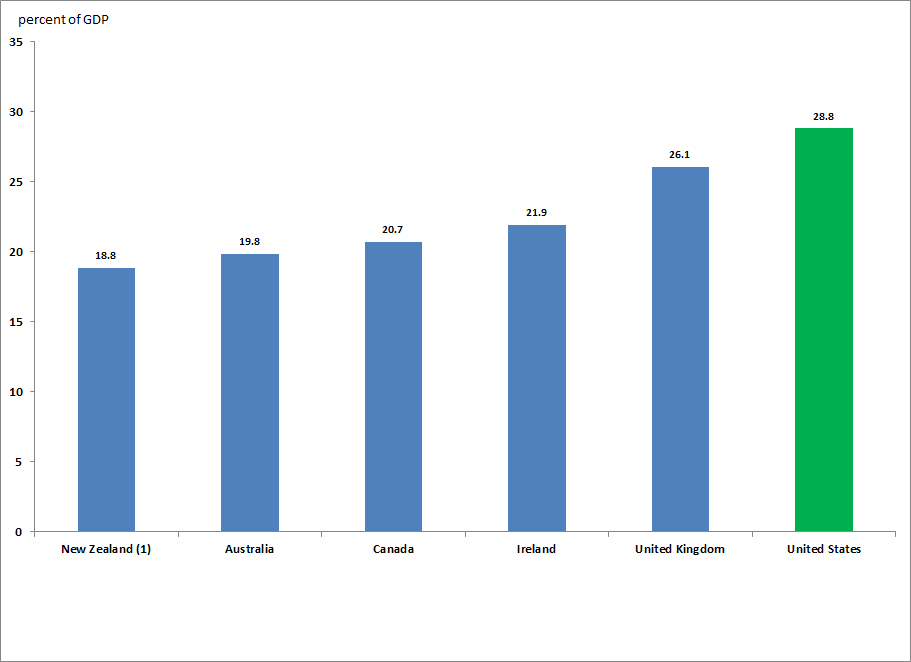
Source: POLICY BRIEF 15-4: The True Levels of Government and Social Expenditures in Advanced Economies.
On the face of it, New Zealand has the smallest Anglo-Saxon welfare state while the United States has the largest. A more accurate measure of the relative sizes of these Anglo-Saxon welfare states would require the wisdom of Solomon in measuring waste and underfunding in the respective systems and more trust than you should have in services sector in purchasing power parity adjustments.
For those that are interested, the OECD-wide gross social spending and net after-tax total social spending are reproduced below in figures 5 and 6.
Figure 5: Net after-tax total social expenditures in OECD countries, 2011
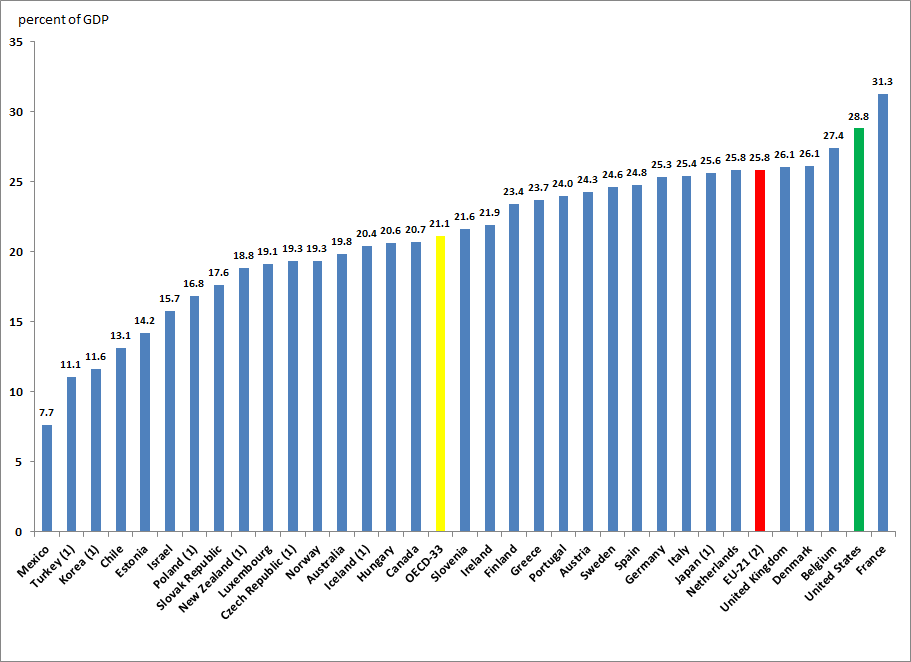
Source: POLICY BRIEF 15-4: The True Levels of Government and Social Expenditures in Advanced Economies.
The Figure 5 data on the OECD wide welfare state sizes shows that when you add private spending, including social spending mandated by law, the US has the second largest OECD social safety net as Kirkegaard said in his Peterson Institute paper:
Taking the full effects of tax systems and social spending from both private and public sources into account, the United States is seen to be devoting more resources toward social purposes than is generally acknowledged. In fact, only the French spend more than Americans, while the alleged welfare-addicted Scandinavians and Europeans spend less on average.
Figure 6: Gross public social expenditures in OECD countries, 2011
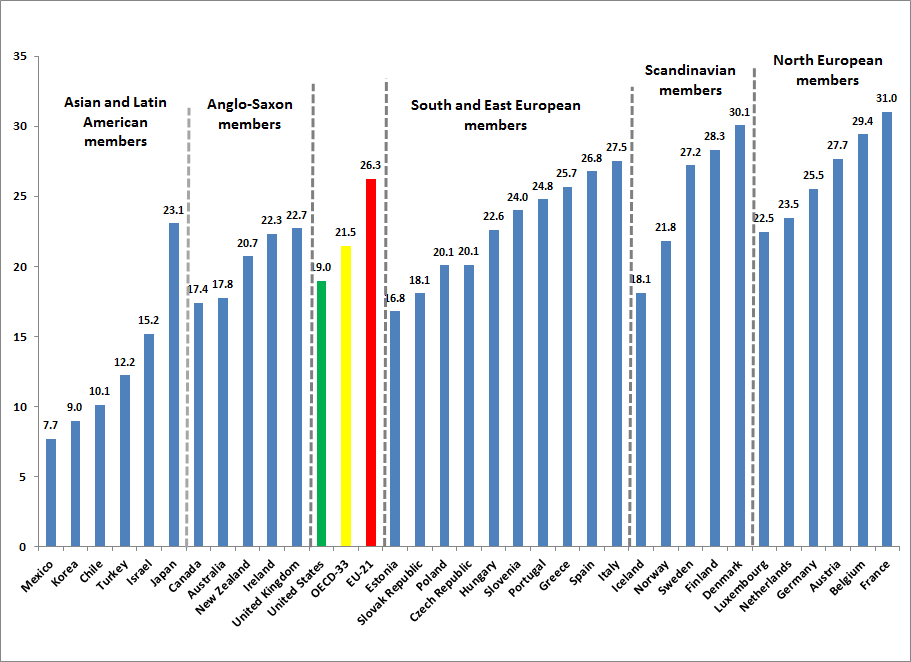
Source: POLICY BRIEF 15-4: The True Levels of Government and Social Expenditures in Advanced Economies.
Via The US welfare state and safety net are bigger than you think. But who are they helping? – AEI | Pethokoukis Blog » AEIdeas and POLICY BRIEF 15-4: The True Levels of Government and Social Expenditures in Advanced Economies
01 Apr 2015 Leave a comment
in economics of education, human capital, labour economics, labour supply, poverty and inequality, welfare reform Tags: educational attainment
@mattyglesias poverty trends a good example of why americanprogress.org/issues/poverty… http://t.co/tgn7RzBKzw—
Shawn Fremstad (@inclusionist) March 28, 2015
30 Mar 2015 Leave a comment
in human capital, labour economics, labour supply, occupational choice, politics - USA, population economics, poverty and inequality, welfare reform Tags: child poverty, family demographics, family structures, single parents
29 Mar 2015 Leave a comment
in discrimination, labour economics, politics - USA, poverty and inequality, welfare reform Tags: 1996 US welfare reforms, child poverty, poverty and inequality
23 Mar 2015 Leave a comment
in applied welfare economics, labour economics, politics - New Zealand, poverty and inequality, welfare reform Tags: activists, child poverty, Leftover Left, school breakfast programmes
Joe Trinder, the Mana News editor, today blogged about the great expense of feeding the kids for ordinary families. In the course of doing so, he showed how extremely cheap it was for parents to make their children breakfast. The Far Left has inadvertently capitulated on school breakfast programmes been outside the reach of ordinary families.

I completely agree with Joe. A 1 kg box of Weet-Bix costs $7 and a 2 L bottle of milk costs $5.55. I buy the cheaper brands of Weet-Bix than this myself.
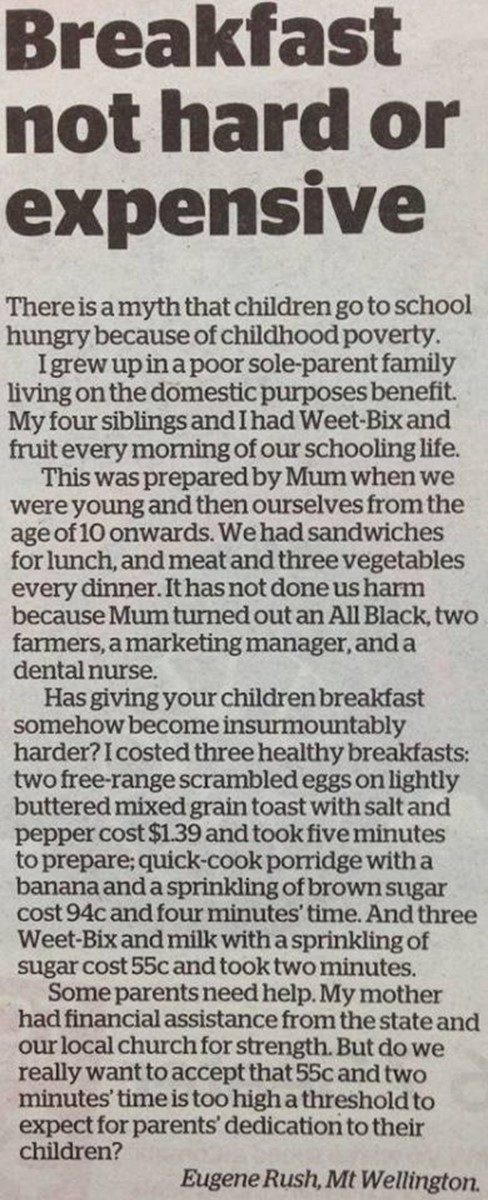
1 kg box of Weet-Bix will last maybe two weeks. 2 L of milk will last not much less than that if you pour the milk on Weet-Bix to the extent I do. Two weeks breakfast will cost much less than one dollar per breakfast as argued by Eugene Rush in her letter to the editor a few months ago.
If a family can’t find $.55 to make their children breakfast, they need targeted specific intervention from Work and Income New Zealand to see what additional financial assistance they need, including budget advice, and from the child protection agency, Child, Youth and Families.
No provision is made by the hard left in its Feed the Kids Bill to feed the parents of these hungry children who also go hungry every morning. There is no other charitable explanation as to why their children were not given breakfast. No one in the house can afford breakfast both during school days, at the weekend and in school holidays.
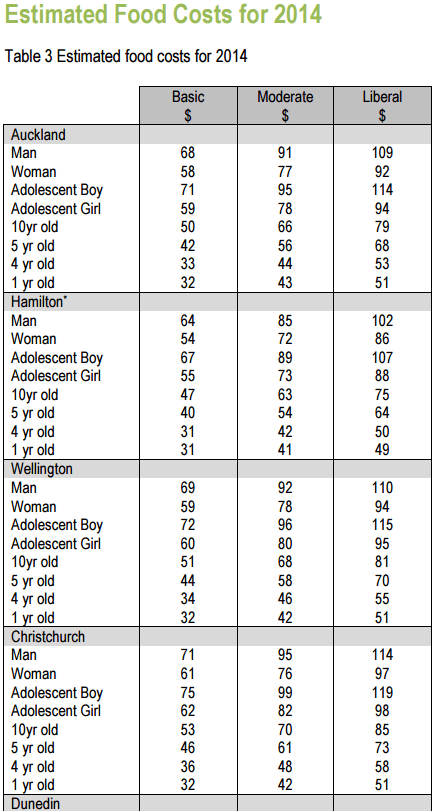
As shown from the screenshot above, the Otago University’s annual Food Cost Survey suggests that to meet basic needs, a family must spend $44 per week for a five-year-old and $34 per week for a four-year-old in Wellington, which is where I live. That is, it costs about five or six dollars per day per child to feed them. A liberal diet for a small child for a day costs not much more than a cup of coffee at a cafe where I’m going shortly. The real issue is the income of parents.
The best solution to poverty is to move people into a job. Simon Chapple is quite clear in his book in the middle of last year with Jonathan Boston that a sole parent in full-time work, and a two parent family with one earner with one full-time and one part-time worker, even at low wages, will earn enough to lift their children above most poverty thresholds.
Sustained full-time employment of sole parents and the fulltime and part-time employment of two parents, even at low wages, are sufficient to pull the majority of children above most poverty lines, given the various existing tax credits and family supports.
The best available analysis, the most credible analysis, the most independent analysis in New Zealand or anywhere else in the world that having a job and marrying the father of your child is the secret to escaping poverty is recently by the Living Wage movement in New Zealand.
According to the calculations of the Living Wage movement, earning only $18.80 per hour with a second earner working only 20 hours per week affords their two children, including a teenager, Sky TV, pets, international travel, video games and 10 hours childcare. This analysis of the Living Wage movement shows that finishing school so your job pays something reasonable and marrying the father of your child affords a comfortable family life.
Celebrating humanity's flourishing through the spread of capitalism and the rule of law
Celebrating humanity's flourishing through the spread of capitalism and the rule of law
Celebrating humanity's flourishing through the spread of capitalism and the rule of law
Celebrating humanity's flourishing through the spread of capitalism and the rule of law
Celebrating humanity's flourishing through the spread of capitalism and the rule of law
Celebrating humanity's flourishing through the spread of capitalism and the rule of law
Celebrating humanity's flourishing through the spread of capitalism and the rule of law
A History of the Alt-Right
Econ Prof at George Mason University, Economic Historian, Québécois
Celebrating humanity's flourishing through the spread of capitalism and the rule of law
Scholarly commentary on law, economics, and more
Beatrice Cherrier's blog
Celebrating humanity's flourishing through the spread of capitalism and the rule of law
Celebrating humanity's flourishing through the spread of capitalism and the rule of law
Celebrating humanity's flourishing through the spread of capitalism and the rule of law
Why Evolution is True is a blog written by Jerry Coyne, centered on evolution and biology but also dealing with diverse topics like politics, culture, and cats.
Celebrating humanity's flourishing through the spread of capitalism and the rule of law
A rural perspective with a blue tint by Ele Ludemann
DPF's Kiwiblog - Fomenting Happy Mischief since 2003
Celebrating humanity's flourishing through the spread of capitalism and the rule of law
The world's most viewed site on global warming and climate change
Tim Harding's writings on rationality, informal logic and skepticism
A window into Doc Freiberger's library
Let's examine hard decisions!
Commentary on monetary policy in the spirit of R. G. Hawtrey
Thoughts on public policy and the media
Celebrating humanity's flourishing through the spread of capitalism and the rule of law
Politics and the economy
A blog (primarily) on Canadian and Commonwealth political history and institutions
Reading between the lines, and underneath the hype.
Economics, and such stuff as dreams are made on
"The British constitution has always been puzzling, and always will be." --Queen Elizabeth II
Celebrating humanity's flourishing through the spread of capitalism and the rule of law
Celebrating humanity's flourishing through the spread of capitalism and the rule of law
WORLD WAR II, MUSIC, HISTORY, HOLOCAUST
Undisciplined scholar, recovering academic
Celebrating humanity's flourishing through the spread of capitalism and the rule of law
Res ipsa loquitur - The thing itself speaks
In Hume’s spirit, I will attempt to serve as an ambassador from my world of economics, and help in “finding topics of conversation fit for the entertainment of rational creatures.”
Researching the House of Commons, 1832-1868
Articles and research from the History of Parliament Trust
Reflections on books and art
Posts on the History of Law, Crime, and Justice
Celebrating humanity's flourishing through the spread of capitalism and the rule of law
Exploring the Monarchs of Europe
Cutting edge science you can dice with



/cdn0.vox-cdn.com/uploads/chorus_asset/file/3536970/Screen_Shot_2015-03-23_at_7.40.03_PM.0.0.png)


Recent Comments