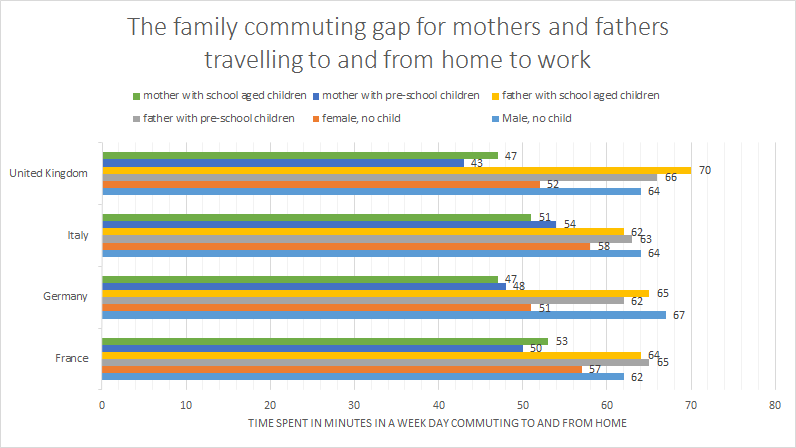
Few labour market statistics have any meaning unless broken down by gender. The compensating differentials that explain much of the family pay gap extend strongly to commuting times.
Mothers commute a good 15 to 20 minutes less than fathers in the UK, Italy, Germany and France. Single women commute 5 to 10 minutes further than mothers. Single men and fathers commute much the same distance.
Geoff Simmons attributes part of the gender wage gap to the reluctance especially among women in high-paying jobs to haggle over pay. These women at the top end of the labour market are more likely to accept the first offer.
This relative reluctance of women to haggle over their pay is important to explaining why the gender wage gap is much larger at the top end of the labour market than at the bottom according to Geoff Simmons. Women have to haggle more if the gender pay gap is to close further.
Haggling over the wage has costs as well as benefits as Richard Epstein explained 20 years ago within a search and matching framework when commenting on a paper written by Carol Rose in 1992:
If one party is known to gobble up virtually all the cooperative surplus, then that party will find it difficult to attract deals. People anticipate getting some portion of the gain and will have a tendency to migrate to other individuals and transactions when they do not have to be ever watchful of their fair share of the gain.
If women have the characteristics that Rose attributes to them, then they would be able to enter more deals and find jobs more easily than men. At this point it becomes an empirical question: whether the greater frequency of deals (or shorter periods of unemployment) offset the tendency to gain a larger share of the profits of any given transaction.
Women will find it easier to get a job because they haggle less and therefore negotiations are less likely to breakdown, which will increase their lifetime income. This reduction in the cost of search because of a greater prospect of a match offset the losses in wages from successful haggling.
Indeed, does not this reluctance to haggle among women make it more likely that employers will hire women and promote the because their reluctance to haggle makes them cheaper. This starts off a competition between employers that will slowly drive up the wages offered to women.
It is also the case that women invest in human capital that is more mobile between the jobs and they are more likely to quit the workforce and return again after motherhood.
The ability to quickly find a job after a career interruption is a competitive advantage rather than a disadvantage.
Men have more specialised human capital and are more likely to stay in one job so they have more to gain from haggling. In comparison, women invest in human capital that is more mobile between jobs because they anticipate downscaling or quitting because of motherhood.
In such a case, it is advantageous to have human capital that appeals to a wide range of employers and become can be quickly matched so that full-time or part-time employment and the associated income stream can start quick as quickly as possible. Workers who changed jobs more often and have shorter job tenures have less to gain and more to lose from haggling and not getting the job at all.
The propensity of women to seek or avoid jobs with performance pay in a more competitive workplace is an important question because up to 40% of jobs have some form of performance pay which would put women off if they do not like to haggle as Geoff Simmons implies.
Manning used jobs with performance pay in the the 1998 and 2004 British Workplace Employees Relations Survey as a proxy for the level of competition in the workplace.
If Geoff Simmons is right, women should shy away from jobs with performance pay. Women should be less likely to hold these jobs with performance pay, other things being equal. That is precisely the hypothesis that Alan Manning explored. He is a world-class labour economist. What did he find?
We find very modest evidence for differential sorting into performance pay schemes by gender, and small effects of performance pay on hourly wages. Furthermore, and unlike the laboratory studies, we find no significant effect of the gender mix in the job on the responsiveness to performance pay.
We do find some evidence for an effect of performance pay on a measure of work effort in line with the experimental evidence but the bottom line is that a very small part of the gender pay gap can be attributed to these factors.
The gender pay is already tiny in New Zealand and only a tiny part of that can be explained as any reluctance of women to compete in the workforce such as through signing on for performance pay.
Manning found that the gender mix of jobs in occupation is not affected by the presence of performance pay but it should be if women are reluctant to angle and to be competitive as suggested by Geoff Simmons.
— OECD ➡️ Better Policies for Better Lives (@OECD) January 18, 2016
The reluctance of women to sign on for performance pay maybe be an aspect of the asymmetric marriage premium and the marital division of effort. Mothers, unlike fathers, cannot afford to go home at the end of the workday completely exhausted if there are children to care for.
Women have a long history of carefully selecting education and other human capital and occupations to anticipate the responsibilities of motherhood and minimising human capital depreciation during the associated career interruptions. Anticipating that motherboard is a lot of work is no stretch on that occupational sorting by women.
That division of effort between the sexes has got nothing to do with the behaviour of employers and everything to do with the marital division of labour. As to what to do about that Richard Posner raised a very good conundrum in a paper from 20 years ago:
The idea the government should try to alter the decisions of married couples on how to allocate time to raising children is a strange mixture of the utopian and the repulsive. The division of labour within marriage is something to be sorted out privately rather than made a subject of public intervention.
Liberal and radical frameless can if they wanted women to stay in the labour force and have no children or fewer children, or, persuade their husbands to assume a greater role in child rearing. Others can search the contrary. The ultimate decision is best left to private choice.
I remember from decades ago a couple at work who were very modern and trying to share the child rearing equally. Their three-year-old daughter was not very cooperative because she found that her mother was much better at braiding her hair than a father. That tantrum by their three-year-old was the beginning of the end of a grand plan.
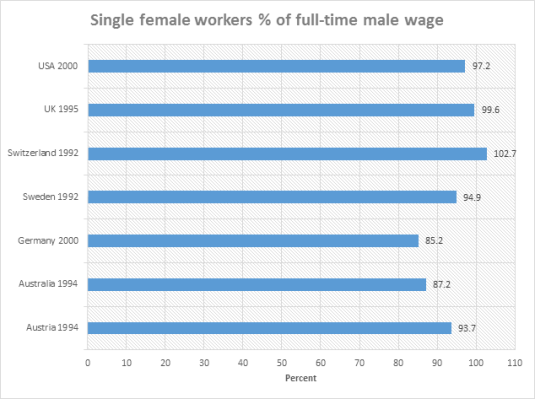
If victory is a zero gender wage gap, some countries have achieved it already for single female workers and long ago according to the data charted below is from the Luxembourg Income Study.
Discrimination cannot explain why the gender wage gap for single female is tiny relative to the family wage gap. As Solomon Polachek explains:
…the wage gap for married workers is between three and 30 times greater compared with single workers.
Employers cannot be to blame for the large difference between the single female worker gender wage gap and the family wage gap.
Aside from explaining why employers only discriminate against married women, you must explain how employers managed to find out which female applicants are married so they can discriminate against them.
Without that vital information on the marital status of female applicants and the presence and number of children as well is their spacing, the vast male chauvinistic conspiracy responsible for the glass ceiling and the sticky floors against promotion does not get off the ground.
How do employers actually pay married women less? Advertising jobs that pay women less has been unlawful for decades. Yet another hurdle to overcome for the vast male chauvinistic conspiracy.
Women move between the large number of jobs as do men accumulating human capital as they go? Somehow employers, including female owned firms, must sabotage the accumulation of human capital by married women as soon as they have children but without paying them lessen in their current jobs or advertising jobs that pay married women less.
The main drivers of the gender wage gap are unknown to employers such as:
whether the would-be female recruit or employee is married,
whether their partner is present,
how many children they have,
how many of children are under 12, and
how many years are there between the births of their children.
These are the main drivers of the gender wage gap – all of which are factors totally unknown to employers and of no relevance to them in making a profit.
Most explanations of the gender wage gap centre around human capital. In anticipation of time outside of the workforce for motherhood, women self-selecting to occupations that penalise career interruptions less.
Women invest in human capital that is more general, human capital that is more mobile between jobs and into spells of part-time work. Women anticipate home time after they have children so they invest in human capital that depreciations at a slower rate during career interruptions. Women also invest less overall in new capital because they expect to spend less time in the labour market.
All of these investments are made by women themselves in anticipation of motherboard rather than employers somehow paying them less after they marry and have children.
The solution to closing the family wage gap requires radical biological changes in who has children. There are more radical changes required than this because mothers actually like babies and enjoy spending time with them rather than going to work.
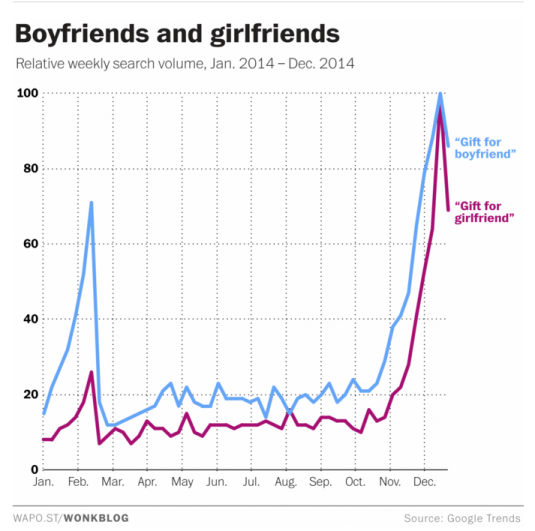
Equally challenging is the required changes in the dating market. There is an average age difference between boyfriends and girlfriends and husbands and wives of 2 to 3 years. As the husband or boyfriend is a few years older, he has usually accumulated more human capital and is more likely to be at a critical career point for promotion.
Because the husband or boyfriend is 2 to 3 years older, it pays off well in terms of the father investing more in market-related human capital and the mother devoting more time to childcare.
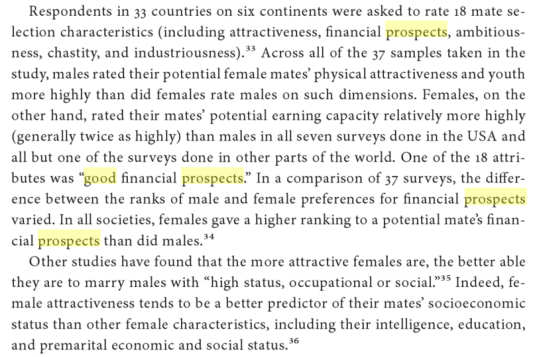
Another major driver of the gender pay gap is the dating market as identified by Richard McKenzie. He pointed out that evolutionary psychology has found that in every culture one of the factors of influencing pairing off in the dating market is that the boyfriend or husband must have good prospects although this preference is weakening over this last century.
One of the reasons for the increase in single parents is that low-paid men are not as inviting prospects as long-term boyfriends or husbands is a few generations ago. There are too few good men.
University educated couples are not called power couples for nothing – their earning power is this stunning compared to going it on your own. The emergence of power couples means that less educated women may prefer to stay single and raise children on their own rather than marry what is left in the marriage pool.
Because of the requirement among women across all cultures that husbands to be must have good prospects, men have an extra incentive to invest in human capital and work harder and longer hours because of the gender specific payoff in the marriage market.
‘Equal Pay Day’ this year is April 12; the next ‘Equal Occupational fatality day’ will be in the year 2027 https://t.co/tZrS2UFq1P
Men will also take more risks than women because risky jobs carry wage premiums. That risk premium is topped up in the mating market terms are marriage prospects because of the higher wages. Women get a wage premium for taking risky jobs but less of a payoff in the mating market for the higher wages. There is an evolutionary psychology explanation for the family wage gap.
All in all, a key requirement for the closing of the family wage gap and what little is left of the gender wage gap is women drop their standards in terms of who they choose as boyfriends and husbands. Not very likely.
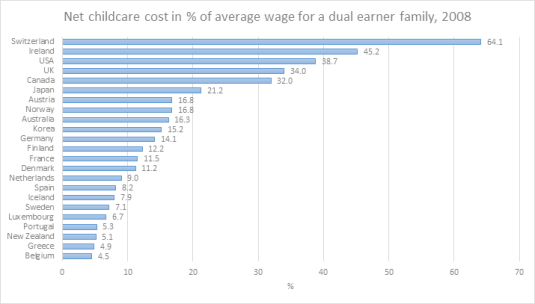
Closing the Gender Gap: Act Now -OECD 2012. Note: Net childcare costs among couple families where one adult earns 100% of the average wage and the other earns 50% of the average wage.
When I was studying in Japan, they were at the end of phasing out working on Saturdays. The staff at my university work on Saturday mornings for four hours and then went home.
That feud with strangers was about unconscious bias as a driver of the gender wage gap in New Zealand. The gender wage gap Japan is attributed to conscious prejudice.
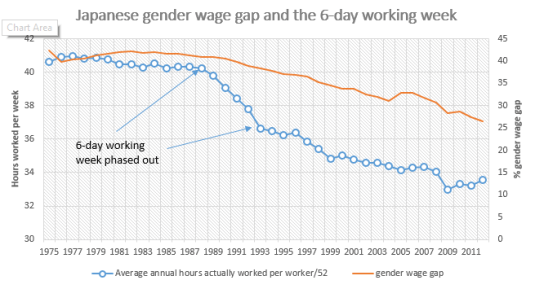
Source: OECD Stat.
In the above chart I have plotted the average weekly hours worked of Japanese workers and the Japanese gender wage gap. Two things can be noticed from the above chart:
there is a sharp reduction in the number of hours worked per week by Japanese workers when they stopped working on Saturdays; and
the gender wage gap started declining after the introduction of a five-day working week in Japan.
In a country where it is standard to work six days a week, the price of motherhood would be much higher than in other countries industrialised countries that phased out the 48-hour week decades previous. The asymmetric marriage premium would also be much higher if one partner to the marriage worked a six-day week while the other looked after the children.
Other drivers of the gender wage gap that arise from human capital specialisation and depreciation and from the differences of a few years in the marrying ages of men and women would be intensified if people worked another day per week. The payoff from a marital division of labour and human capital specialisation where one worked long hours and the other focused on investing in human capital that allow them to care for the children and move in and out of the workforce with less human capital depreciation would be much larger.
Much is made of the distinctiveness of Japanese culture and its sexism. In my time in Japan, the thing I notice most distinctively about Japanese culture was its extraordinary pragmatism and willingness to change rapidly. The Japanese economic miracle was founded on rapid industrialisation, innovation and repeated renewal of human capital. That requires an entrepreneurial spirit and open-mindedness.
Cultural and preference based explanations of the gender wage Including that in Japan underrate the rapid social change in the role of women in the 20th century in all countries in all cultures. As Gary Becker explains:
… major economic and technological changes frequently trump culture in the sense that they induce enormous changes not only in behaviour but also in beliefs. A clear illustration of this is the huge effects of technological change and economic development on behaviour and beliefs regarding many aspects of the family.
Attitudes and behaviour regarding family size, marriage and divorce, care of elderly parents, premarital sex, men and women living together and having children without being married, and gays and lesbians have all undergone profound changes during the past 50 years. Invariably, when countries with very different cultures experienced significant economic growth, women’s education increased greatly, and the number of children in a typical family plummeted from three or more to often much less than two.
Kuran suggests that political revolutions and large shifts in political opinion will catch us by surprise again and again because of people’s readiness to conceal their true political preferences under perceived social pressure:
People who come to dislike their government are apt to hide their desire for change as long as the opposition seems weak. Because of the preference falsification, a government that appears unshakeable might see its support crumble following a slight surge in the opposition’s apparent size, caused by events insignificant in and of themselves.
Kuran argues that everyone has a different revolutionary threshold where they reveal their true beliefs, but even one individual shift to opposition leads to many others to come forward and defy the existing order. Small concessions embolden the ground-swell of revolution.
Those ready to oppose social intolerance or who are lukewarm in their intolerance keep their views private until a coincidence of factors gives them the courage to bring their views into the open. They find others share their views and there is a revolutionary bandwagon effect.
Plenty of people have had personal experiences of this in the 1980s and the 1990s when there were rapid changes in social and political attitudes about racism, sexism and gay rights. This includes Japan.
In the case of the Japanese gender wage gap, the move from a six-day to a five-day working week radically changed the asymmetric marriage premium and the payoff from investing in both specialised human capital and in human capital that depreciates quickly when away from work.
This large shift in incentives to work and invest in human capital would embolden a change in social attitudes. This is because the previous views were no longer profitable and many would gain from the change. Others who prefer just to go along with crowd would quickly follow them in to stay in tune with whatever is now popular.
Much of Japanese sexism may be the preference falsification that was low-cost when there was a six-day working week. The move to a five-day working week greatly increased the cost of that sexism and the profits from finding new ways of organising the workplace that better matched motherhood and career in Japan.
Undervalued workers are an untapped business opportunity for more alert entrepreneurs to hire these undervalued workers. In the case of Japan, with a five-day working week, hiring women for jobs that involved considerable investment in firm-specific human capital became more profitable. Previously under a six-day working week it was more profitable to invest in men because they undertook few childcare responsibilities. Under a five-day working week, that payoff matrix favours women more than in the past.
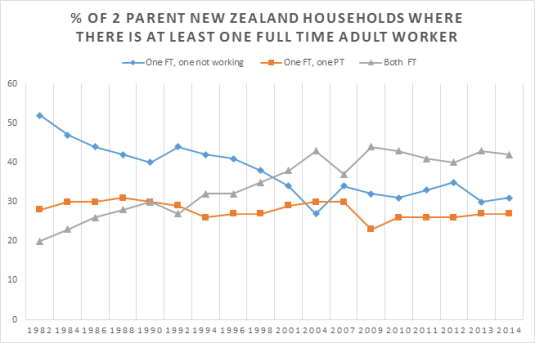
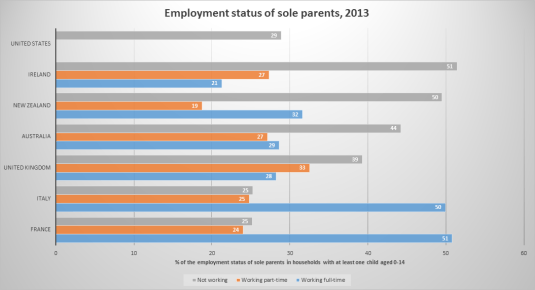
Despite supposedly having stingy welfare states, both New Zealand and Australia have a lot of sole parents who do not work at all. There is no separate breakdown of full-time and part-time work status in the USA. About 72% of sole parents in the USA either work full-time or part-time.
“The researchers looked at different variables to understand why divorces tend to be filed by women. They suggest three main explanations:
Over-exploited wives who do the majority of housework and parenting may feel that they have nothing to lose by leaving.
Wives may have already benefited from financial investments made by a husband (for example, paying for education) and no longer require his support.
Wives expect to get, and subsequently keep, custody of their children — if they didn’t, they probably wouldn’t file for divorce. (This is by far the most statistically significant explanation.)”
Why Evolution is True is a blog written by Jerry Coyne, centered on evolution and biology but also dealing with diverse topics like politics, culture, and cats.
“We do not believe any group of men adequate enough or wise enough to operate without scrutiny or without criticism. We know that the only way to avoid error is to detect it, that the only way to detect it is to be free to inquire. We know that in secrecy error undetected will flourish and subvert”. - J Robert Oppenheimer.






 Utopia, you are standing in it!
Recent Comments