#Seinfeld Economics: The Chinese Restaurant (Bribing Maitre d’)
09 Sep 2016 Leave a comment
in applied price theory, comparative institutional analysis, law and economics Tags: rationing, Seinfeld
#Seinfeld economics: The Muffin Tops (intellectual property rights)
08 Sep 2016 Leave a comment
in applied price theory, law and economics, television Tags: patents and copyrights, Seinfeld, trade secrets
How many British burglaries are home invasions?
06 Sep 2016 Leave a comment
in economics of crime, law and economics Tags: Burglary, law and order
People are aware that their house has been invaded in 1/3rd of British burglaries and in a quarter of burglaries, they see the offender. No wonder that burglary and the threat of a burglary are regarded as invasive crimes. We never locked the house when we were young. That changed.
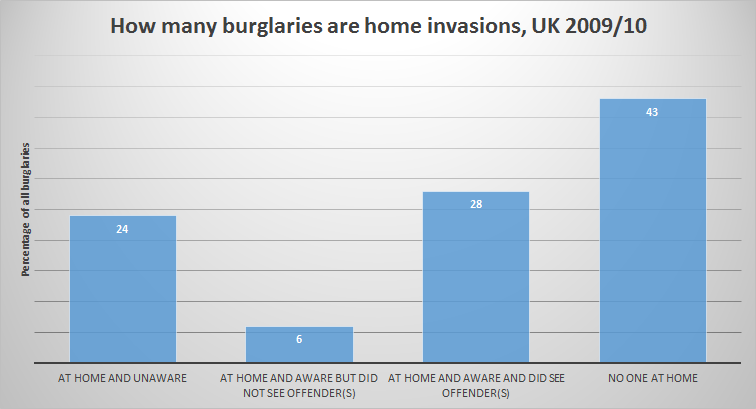
Source: Home Office via What burglars steal – and how they get in | News | theguardian.com.
How well do you know your local burglar?
05 Sep 2016 Leave a comment
in economics of crime, law and economics Tags: British economy, crime and punishment, law and order
Something is known about the burglar in 45% of cases. In this rather invasive crime, half of burglaries are betrayals of trust or familiarity. More than a few of these burglaries might be committed by family members and friends wanting money for drugs but that is speculation.

Source: Home Office via What burglars steal – and how they get in | News | theguardian.com.
What is stolen in British burglaries?
05 Sep 2016 Leave a comment
in economics of crime, law and economics Tags: burglaries, law and order
30% of British burglaries are completely unsuccessful. Many more are reliant on chancing across a wallet or a decent piece of electrical equipment. Back in the day, a TV or VCR was worth a week’s wages. Now the fencing value of these things would be quite minor. The data below is from 2010 so there has been plenty of time for cash to fade away as a item to steal.
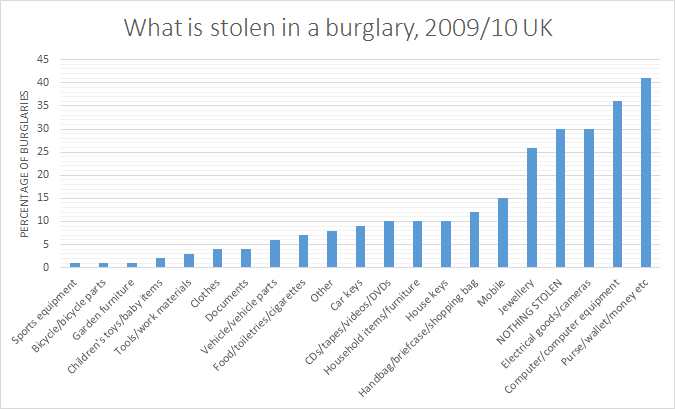
Source: Home Office via What burglars steal – and how they get in | News | theguardian.com.
David Friedman on “Future Imperfect”
02 Sep 2016 Leave a comment
in applied welfare economics, comparative institutional analysis, David Friedman, economics, law and economics
Free speech and the unnecessary caricatures of those who defend
02 Sep 2016 Leave a comment
in constitutional political economy, law and economics, liberalism, libertarianism Tags: free speech, political correctness
Doug Allen on same-sex divorce
30 Aug 2016 Leave a comment
in economics of love and marriage, law and economics Tags: child poverty, Doug Allen, family poverty, same-sex divorce, same-sex marriage, The fatal conceit, unintended consequences
Doug Allen argues that marriage is an institution designed and evolved to regulate incentive problems that arise between a man and a woman over the life cycle of procreation.
The real problem with same-sex marriage is same-sex divorce according to Allen. Marriage includes a set of exit provisions in terms of the possible grounds for divorce, rules for splitting property, alimony and child support rules, and custody rules. Allen also argues that:
- Many institutional rules within marriage are designed to restrict males from exploiting the specific investments women must make upfront in child bearing;
- Since same-sex marriages are not based as often on procreation, these restrictions are likely to be objected to and challenged in courts and legislatures;
- To the extent divorce laws are changed, they may hurt heterosexual marriages, and women in particular; and
- Given that same-sex relationships are often made up of two financially independent individuals, there will be litigation and political pressures for even easier divorce laws since the problem of financial dependency will be reduced.
Alterations in divorce laws to deal with issues of same-sex divorce necessarily apply to heterosexuals, and these new laws may not be optimal for heterosexuals, making marriage a more fragile institution for them. The actual outcomes of no-fault divorce laws, as an example, could hardly have been more different than what was expected and intended. The most obvious outcome was large increases in divorce rates.
No fault divorce laws influenced the rate at which women entered the workforce, the amount of hours worked in a week, the incidence of spousal abuse, the feminisation of poverty, and the age at which people married. No-fault divorce influenced a series of other laws related to spousal and child support, child custody, joint parenting, and the definition of marital property.
Marriage may provide a poor match for the incentive problems that arise in the relationships of gay and lesbian couples. Doug Allen is also of the view that putting all three relationships under the same law could lead to a sub-optimal law for all three types of marriages.
Allen in summary argues that marriage is an economically efficient institution moulded around the long-term interdependencies of child-rearing heterosexuals. He argues that homosexuals wishing to marry would be better served by a separate, gay-specific form of marriage.
I forgot to mention the second wives clubs which lobby for limits the length of time of alimony to the first wife. The British 2nd Wives club in their legal advice page starts with these points:
- Do you need to disclose your income or assets to an ex-wife?
- Should your income be taken into account when assessing child maintenance?
- Should child maintenance change when you and your husband have children of your own?
2nd wives clubs are natural allies for higher income gay divorcees wanting to pay less alimony. Nothing I have sent here is an argument against same-sex marriage willing as long as you are willing to live with the fact that it may have a few unintended consequences.
Antonin Scalia: The Rule of Law as a Law of Rules
28 Aug 2016 Leave a comment
in constitutional political economy, law and economics

The gender commuting gap between mothers and fathers
28 Aug 2016 Leave a comment
in discrimination, economics of love and marriage, gender, human capital, labour economics, labour supply, occupational choice, poverty and inequality, transport economics Tags: asymmetric marriage premium, commuting times, compensating differentials, female labour force participation, gender gap, gender wage gap
The first three bars in each cluster of bars are for men. in almost all countries mothers with dependent children spend less time commuting than childless women. This might suggest that working mothers have found workplaces closer to home than women without children. The gender gap in commuting where it is present in the country is larger than the gap between mothers and other women in their commuting time.
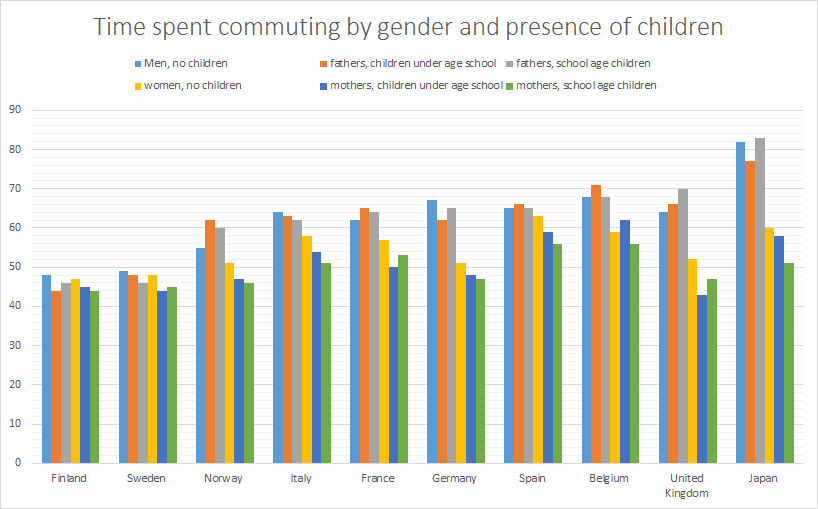
Source: OECD Family Database – OECD, Table LMF2.6.A.
Late switchers alert – when did Obama start supporting gay marriage
28 Aug 2016 Leave a comment
in economics of love and marriage, politics - USA, Public Choice
Bill Maher on the U.N. & Israel
19 Aug 2016 Leave a comment
in defence economics, economics, economics of crime, law and economics Tags: Israel, Left-wing hypocrisy, Middle-East politics, UN, war on terror
An adult start of a criminal career is uncommon
18 Aug 2016 Leave a comment
in economics of crime, human capital, labour economics, law and economics, occupational choice Tags: crime and punishment, criminal deterrence, law and order
Do you feel safe walking alone at night? OECD by gender
18 Aug 2016 Leave a comment
in economics of crime, law and economics Tags: law and order
The Japanese are surprisingly worried and New Zealanders too. I lived in both countries. People go about at night without many fears except when it comes to answering Gallup surveys. I use the reliable test that a mugging will get on the front page because they are so unusual.
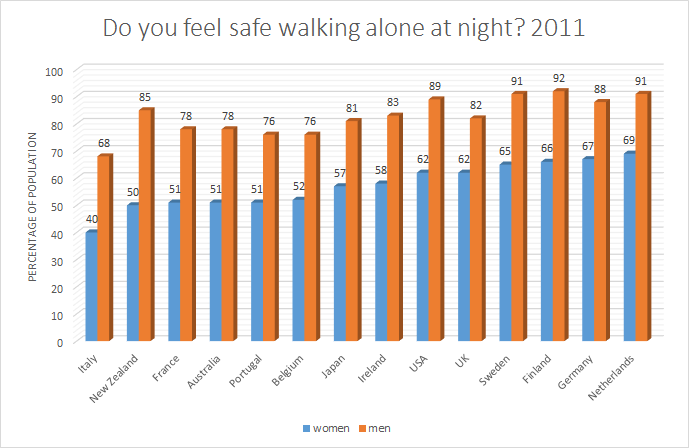
Source: Gallup.com Women Feel Less Safe Than Men in Many Developed Countries.
 Utopia, you are standing in it!
Recent Comments