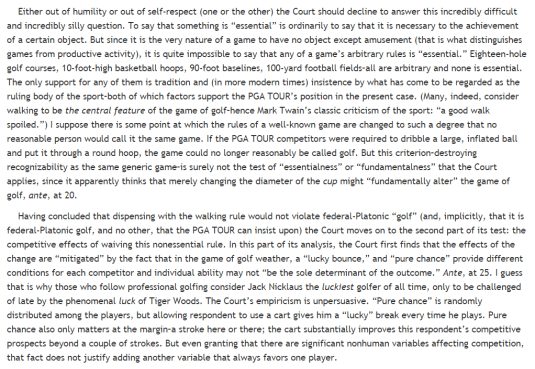
Source: PGA TOUR, INC. V. MARTIN via Jonathan Alder.
Celebrating humanity's flourishing through the spread of capitalism and the rule of law
14 Feb 2016 Leave a comment
in economics of bureaucracy, law and economics, sports economics
Source: PGA TOUR, INC. V. MARTIN via Jonathan Alder.
12 Feb 2016 Leave a comment
in constitutional political economy, law and economics, liberalism
12 Feb 2016 Leave a comment
in labour economics, law and economics, property rights, unemployment Tags: employment law, employment protection laws, employment regulation, mandatory notice, severance pay
Mandatory notice periods for layoffs put the very survival of troubled the business at risk. By having to give long periods of notice, a firm experiencing a downturn is less able to adjust quickly and more likely simply to go out of business because it cannot meet its larger payroll.
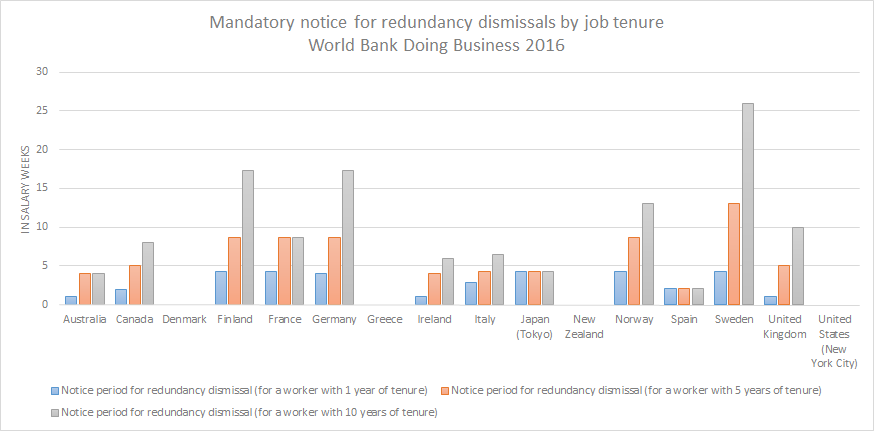
Source: Labor Market Regulation – Doing Business – World Bank Group.
11 Feb 2016 Leave a comment
in applied price theory, economics of love and marriage, gender, labour economics
Richard McKenzie wrote a couple of papers over the last 10 years pointing out that the connection between the labour market and the marriage market will entrench the gender wage gap.
Across all cultures, good financial prospects influence female choices of a partner. Because income influences the prospects of men more than it does women in the dating and marriage market in all cultures, men have an extra incentive to work hard and an additional reward to that of women when they invest in human capital, riskier jobs and longer hours.

Seinfeld had a simpler explanation of this: men are shallow, it goes with the territory.
The only way that men will stop investing in better economic prospects as a way of winning better girlfriends and wives, is for women to lower their standards.
The response of less educated women to more and more of the better educated men and women pairing off together was to stop marrying what was left in the dating pool and have children on their own rather than drop their standards.
11 Feb 2016 Leave a comment
in economics of crime, economics of regulation, international economics, law and economics Tags: drug trafficking, economics of prohibition, smuggling
11 Feb 2016 Leave a comment
in human capital, job search and matching, labour economics, labour supply, law and economics, managerial economics, organisational economics, personnel economics, property rights, unemployment Tags: employment law, employment protection laws, employment regulation, firm-specific human capital, job search, labour market regulation, severance pay
There are a wide differences across the OECD in mandatory severance pay in the event of a layoff.
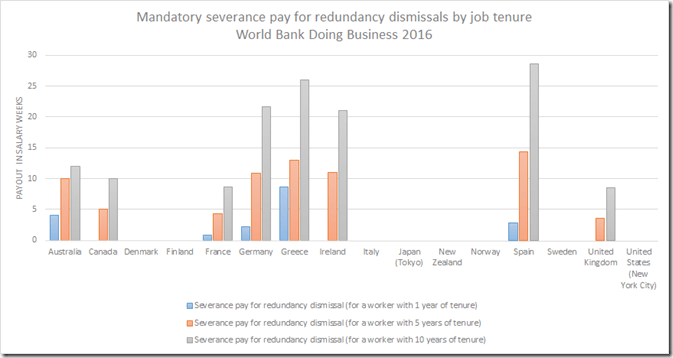
Source: Labor Market Regulation – Doing Business – World Bank Group.
Severance pay makes it more expensive to fire and therefore more expensive to hire. This means fewer job vacancies will be created but they will last longer.
The presence of mandatory severance pay could increase or reduce the unemployment rate but unemployment durations will increase because it takes longer to find a suitable job match among the fewer available vacancies.
Mandating severance pay does not make the job match inherently more profitable. It just redistributes some of the surplus from the job match to the end when it is terminated.
Employers and jobseekers may agree to severance pay where investments in firm specific and job specific human capital for the job is profitable.
Severance pay in these circumstances gives the employer and more reasons to invest in specific human capital. The promise to pay severance pay will make the employer hesitate to lay them off. The employer will instead retain them over a slack period or redeploy them within the company rather than pay them out. This pre-commitment encourages investment in firm specific and job specific human capital by both sides more secure, which makes the job match more profitable overall for both sides.
Of course, if it was possible to negotiate completely around severance pay mandated by law, there would be no effects on hiring, firing and unemployment durations. All it would mean is take-home pay would be less but in the event of a layoff, these employees would get that this wage reduction back as a lump sum.
11 Feb 2016 Leave a comment
in industrial organisation, law and economics, property rights Tags: doing business
In some countries, the official and legal fees of setting up a business are trivial but in other countries they start to mount up.
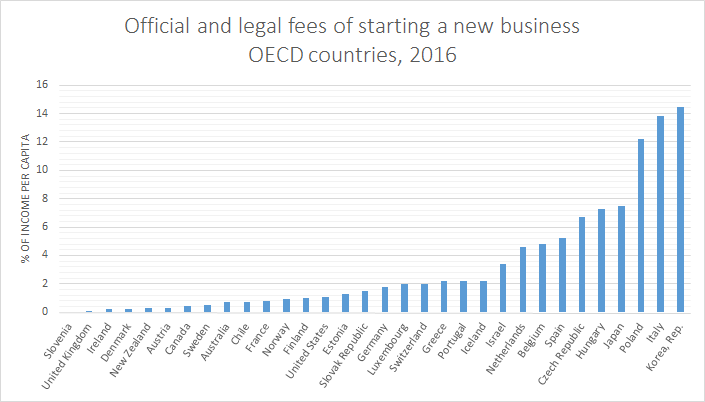
Source: Data from the Doing Business Project – World Bank Group.
10 Feb 2016 Leave a comment
in economics of bureaucracy, economics of regulation, law and economics, property rights, Public Choice Tags: doing business
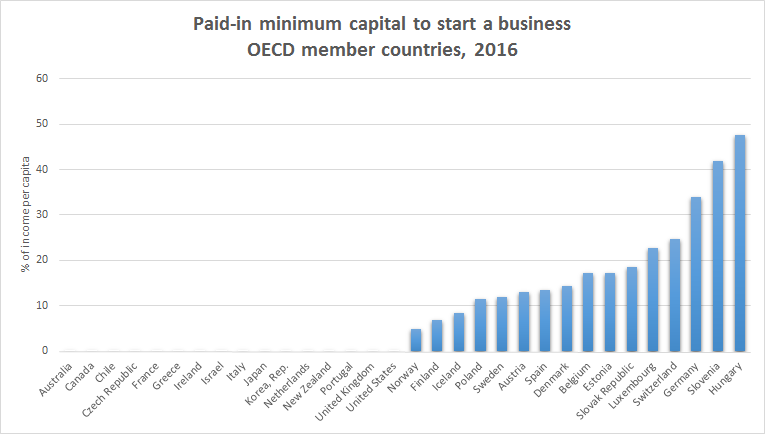
The most mystifying bureaucratic rule I have come across is in Western Europe. A number of these countries require entrepreneurs deposit a minimum sum of money in a bank or before a notary up to a month before registration and 3 months after incorporation. If they cannot do this, they cannot start their business lawfully.
Source: Historical Data – Doing Business- World Bank Group.
I am mystified as to what this regulation is designed to do other than make it difficult to start a new business. It is a private commercial matter as to whether trade credit is extended to new businesses. That indeed is one of the challenges facing every entrepreneur: discovering who are reliable business partners or not.
One of the functions of banks is to issue letters of credit. These vouch for the financial strength of a customer when seeking new business or export markets.
10 Feb 2016 Leave a comment
in applied price theory, industrial organisation, law and economics, property rights Tags: doing business, EU, Europe
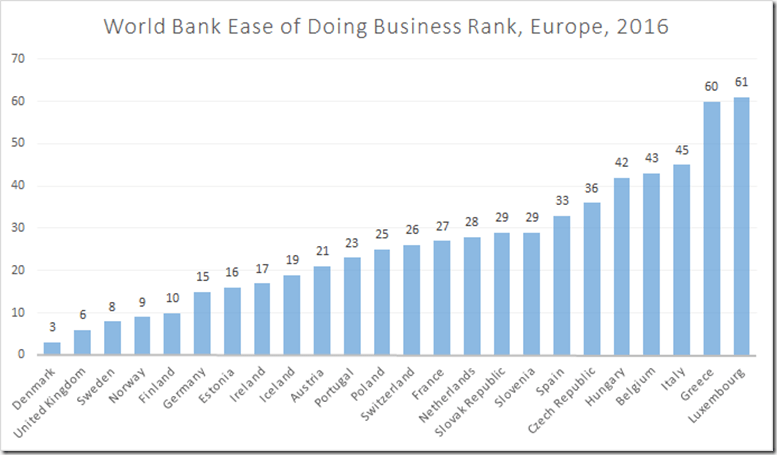
For a rich country, Luxembourg is a pretty crappy place to do business – worse than Greece. Mostly due to terrible rankings for the Luxembourg legal system. Italy is not much better.
Source: Ranking of economies – Doing Business – World Bank Group.
10 Feb 2016 Leave a comment
in Economics of international refugee law, International law
09 Feb 2016 Leave a comment
in applied price theory, economic history, economics of bureaucracy, economics of religion, industrial organisation, law and economics, Public Choice, rentseeking, survivor principle Tags: competition law, electricity industry, natural monopolies, network industries
08 Feb 2016 Leave a comment
in economics of crime, economics of media and culture, law and economics, property rights Tags: intellectual property, patents and copyrights, software piracy
07 Feb 2016 Leave a comment
in economics of crime, international economics, law and economics
07 Feb 2016 Leave a comment
in constitutional political economy, discrimination, economic history, law and economics, politics - Australia, politics - New Zealand, property rights, Public Choice Tags: Aboriginal land rights, Maori economic development, native title, racial discrimination
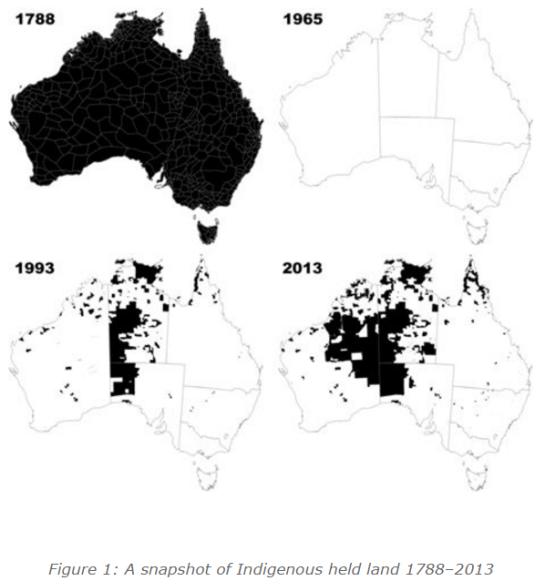
From 1965 onwards, 1/3rd of terrestrial Australia – 2.5 million sq kms of land – was returned to indigenous owners, with half of that since the Native Title decision in 1993. Tasmania pioneered aboriginal land rights with the Cape Barron Island Act 1912.
Source: Jon Altman, The political ecology and political economy of the Indigenous land titling ‘revolution’ in Australia, March 2014 Māori Law Review.
New Zealand extinguished native title twice in its history with the 2nd of these takings of Māori land by the last Labour government with the foreshore and seabed legislation. In her op-ed today, has Jacinda Ardern forgotten why the Māori party came into being?
Unlike New Zealand, Australia welcomed migrants from a wide range of ethnicities after the Second World War. It abolished the White Australia policy in the 1960s along with any discrimination in its Constitution against aboriginals.
Australia takes 8 times as many refugees as New Zealand on a per capita basis.
Sweden – the OECD's highest per capita recipient of asylum seekers bit.ly/1vfFEUh http://t.co/y6DmdJjAsE—
Guardian Data (@GuardianData) December 02, 2014
This redress of indigenous grievances was done out of the generosity of the Australian heart. Aboriginals are a tiny minority in Australia with little independent political pull.
07 Feb 2016 Leave a comment
in development economics, economics of regulation, growth disasters, law and economics, property rights Tags: bribery and corruption, capitalism and freedom, doing business, economics of corruption, Index of Economic Freedom, India, rule of law
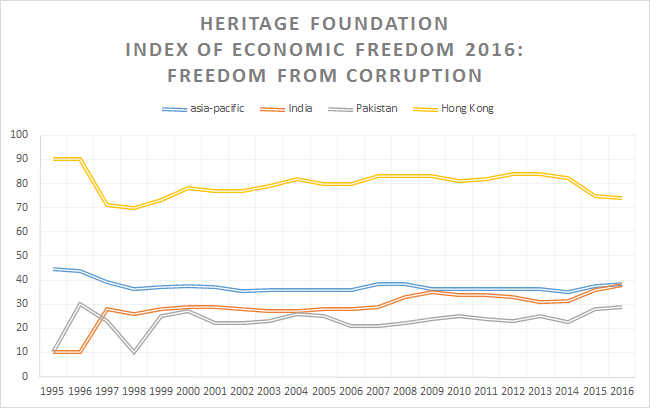
For a country riddled with corruption, Indians report the surprising amount of confidence in their courts despite the corruption in those courts as well.
Source: Index of Economic Freedom.

Econ Prof at George Mason University, Economic Historian, Québécois
Celebrating humanity's flourishing through the spread of capitalism and the rule of law
Scholarly commentary on law, economics, and more
Beatrice Cherrier's blog
Celebrating humanity's flourishing through the spread of capitalism and the rule of law
Celebrating humanity's flourishing through the spread of capitalism and the rule of law
Celebrating humanity's flourishing through the spread of capitalism and the rule of law
Why Evolution is True is a blog written by Jerry Coyne, centered on evolution and biology but also dealing with diverse topics like politics, culture, and cats.
Celebrating humanity's flourishing through the spread of capitalism and the rule of law
Celebrating humanity's flourishing through the spread of capitalism and the rule of law
A rural perspective with a blue tint by Ele Ludemann
DPF's Kiwiblog - Fomenting Happy Mischief since 2003
Celebrating humanity's flourishing through the spread of capitalism and the rule of law
The world's most viewed site on global warming and climate change
Tim Harding's writings on rationality, informal logic and skepticism
A window into Doc Freiberger's library
Let's examine hard decisions!
Commentary on monetary policy in the spirit of R. G. Hawtrey
Thoughts on public policy and the media
Celebrating humanity's flourishing through the spread of capitalism and the rule of law
Politics and the economy
A blog (primarily) on Canadian and Commonwealth political history and institutions
Reading between the lines, and underneath the hype.
Economics, and such stuff as dreams are made on
"The British constitution has always been puzzling, and always will be." --Queen Elizabeth II
Celebrating humanity's flourishing through the spread of capitalism and the rule of law
Celebrating humanity's flourishing through the spread of capitalism and the rule of law
WORLD WAR II, MUSIC, HISTORY, HOLOCAUST
Undisciplined scholar, recovering academic
Celebrating humanity's flourishing through the spread of capitalism and the rule of law
Res ipsa loquitur - The thing itself speaks
In Hume’s spirit, I will attempt to serve as an ambassador from my world of economics, and help in “finding topics of conversation fit for the entertainment of rational creatures.”
Researching the House of Commons, 1832-1868
Articles and research from the History of Parliament Trust
Reflections on books and art
Posts on the History of Law, Crime, and Justice
Celebrating humanity's flourishing through the spread of capitalism and the rule of law
Exploring the Monarchs of Europe
Cutting edge science you can dice with
Small Steps Toward A Much Better World
“We do not believe any group of men adequate enough or wise enough to operate without scrutiny or without criticism. We know that the only way to avoid error is to detect it, that the only way to detect it is to be free to inquire. We know that in secrecy error undetected will flourish and subvert”. - J Robert Oppenheimer.
The truth about the great wind power fraud - we're not here to debate the wind industry, we're here to destroy it.
Celebrating humanity's flourishing through the spread of capitalism and the rule of law
Celebrating humanity's flourishing through the spread of capitalism and the rule of law
Economics, public policy, monetary policy, financial regulation, with a New Zealand perspective
Celebrating humanity's flourishing through the spread of capitalism and the rule of law

 Utopia, you are standing in it!
Recent Comments