Negative Externalities and the Coase Theorem
06 Mar 2016 Leave a comment
in applied price theory, applied welfare economics, comparative institutional analysis, history of economic thought, law and economics, property rights Tags: Coase theorem
What animals are poached where?
05 Mar 2016 Leave a comment
in applied price theory, economics of crime
The anti-hunting choir has a lot to answer for. #auspol http://t.co/2FGgC11VZp—
David Leyonhjelm (@DavidLeyonhjelm) August 17, 2015
Effective marginal tax rates on single and dual earner families in the USA, Britain, France, Germany, Canada, Italy, Sweden, Denmark, Australia and New Zealand
05 Mar 2016 Leave a comment
in economics of love and marriage, fiscal policy, gender, labour economics, labour supply, law and economics, politics - Australia, politics - New Zealand, politics - USA, public economics Tags: Australia, British economy, Canada, Denmark, effective marginal tax rates, family tax benefits, family tax credits, France, Germany, in-work tax credits, Italy, poverty traps, rational irrationality, social insurance, Sweden, taxation and labour supply
Some countries including New Zealand and Australia do not give ordinary families much of an incentive to earn more. Effective marginal tax rates on low income families is one of the few times that the Left discovers supply-side economics.
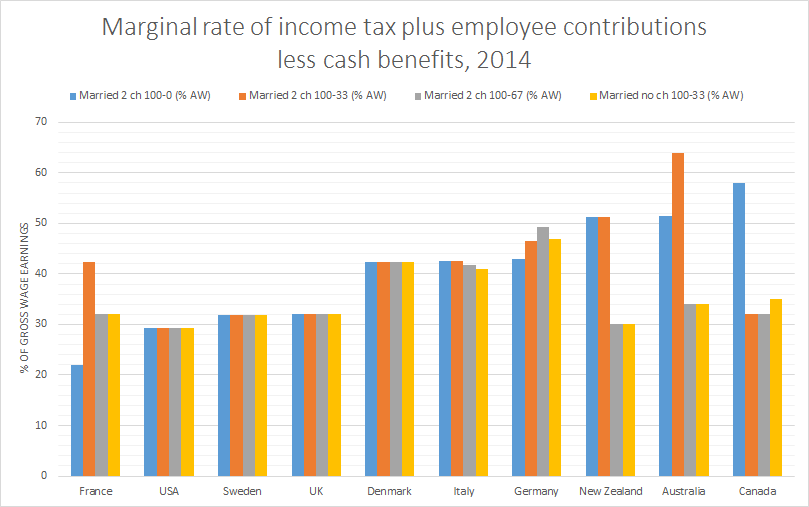
Source: Taxing Wages 2015 – OECD 2015.
A brave cashier fights off an armed robber in Georgia, US
04 Mar 2016 Leave a comment
in economics, economics of crime, law and economics
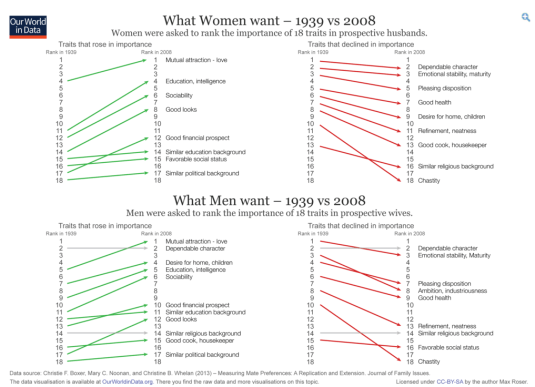
Yezhov’s ratio as the inspiration for modern witch-hunts
01 Mar 2016 Leave a comment
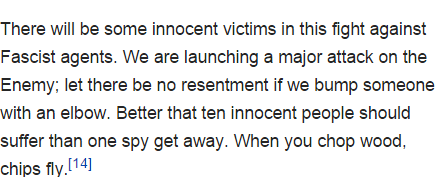
Nikolai Ivanovich Yezhov was head of the NKVD from 1936 to 1938, during the deadliest period of Stalin’s Great Purge.
Implicit tax on returning to work for a 2nd earner in ordinary US, Danish, British, New Zealand, Australian, Canadian, German and French families
26 Feb 2016 Leave a comment
in economics of love and marriage, gender, labour economics, labour supply
Not a lot of point for a 2nd earner in an ordinary family going back to work in the English-speaking countries once you consider the childcare fees for a 2-year-old and a 3-year-old. These calculations were released today in Paris in the OECD’s Going for Growth 2016.
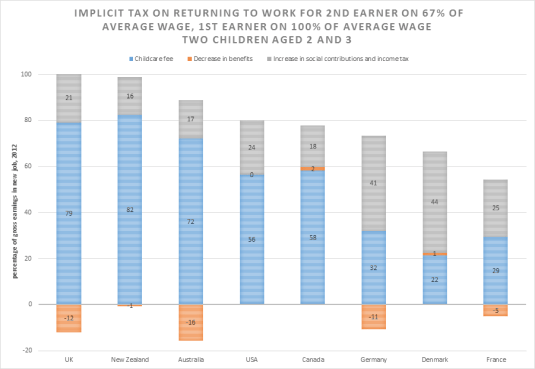
Source: Economic Policy Reforms: Going for Growth – OECD (2016).
Save Our Parks! How to Keep National Parks Open
25 Feb 2016 Leave a comment
in applied price theory, comparative institutional analysis, environmental economics, law and economics, property rights, resource economics Tags: contracting-out, free market environmentalism, national parks, privatisation
Megan McArdle’s iron law of commentary on refugee policy @GreenCatherine
24 Feb 2016 Leave a comment
in Economics of international refugee law, politics - Australia, politics - New Zealand, politics - USA Tags: asylum seekers, cognitive psychology, psychology of persuasion, refugee policy

Charges following fatal and serious injury New Zealand police crashes, 2003 – 2008
23 Feb 2016 Leave a comment
in economics of crime, law and economics, politics - New Zealand Tags: criminal deterrence, law and order, police chases, police killings, road safety

Source: Rodney Hide, “Pursuit culture skews police priorities”, National Business Review, 19 February 2016, p.28.
Deaths and serious injuries in New Zealand police chases, 2003 – 2008
22 Feb 2016 Leave a comment
in economics of crime, law and economics, politics - New Zealand Tags: criminal deterrence, law and order, police chases, police killings
Rodney Hide found that one in four New Zealand police chases ends in a crash. Of the 137 police pursuits that ended in death or serious injury between 2003 and 2008 there are 9 violence charges. Six were for manslaughter – all caused by crashes that ended the chase. There was also one charge of murder relating to the crash at the end of the chase. No violence charges arose from information known at the time of the start of the police chase. There was ambiguous information about a charge of kidnapping after a police chase. I could not determine if this kidnapping was known at the time the police chase started and therefore was its motive.

Source: Rodney Hide, “Pursuit culture skews police priorities”, National Business Review, 19 February 2016, p.28.
In all, 13 of the 137 police chases were motivated by the fleeing driver having committed a crime. The most serious of these was burglary. Rodney Hide also found that between 2005 and 2008 there are an average of 182 police chases a month.
I am all for police chasing kidnappers and armed criminals brandishing their weapons. As for the rest, they are not serious offenders. Chasing them puts the public at risk. Most of the fleeing drivers and their passengers are enthusiastic applicants for the Darwin awards.
@robinhanson The Changing Way Americans Meet Their Partners @Ednever @paul1kirby
21 Feb 2016 Leave a comment
in economics of love and marriage
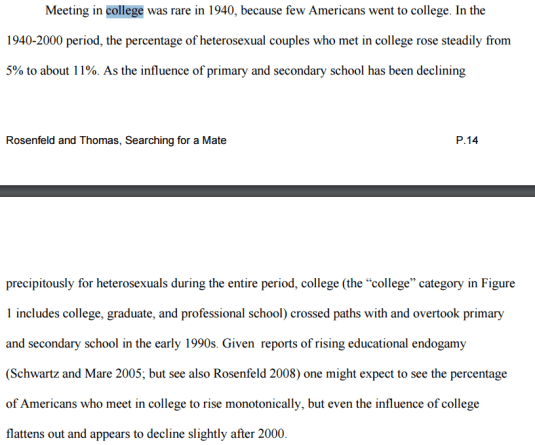
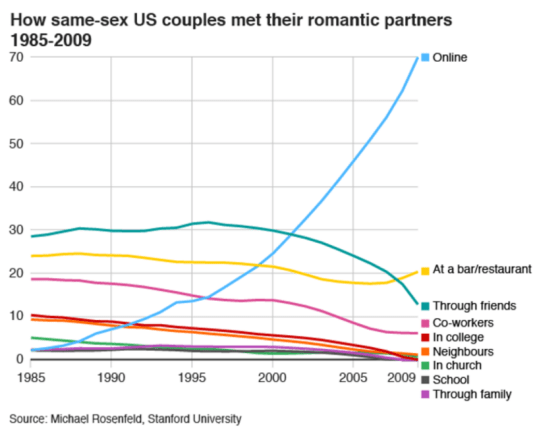
Here is the original data on how straight and gay couples meet. The BBC incorrectly coded their replotting of data to mix family with college.
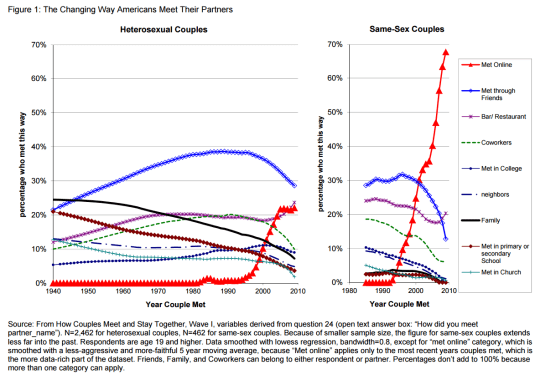
Source: Michael J. Rosenfeld, Dept of Sociology.
 Utopia, you are standing in it!
Recent Comments