


NZ’s greenhouse gas emissions are high per person and unit of GDP but have fallen since 1990 oe.cd/10z http://t.co/f5BMLMvTjq—
OECD Publications (@OECD_Pubs) June 10, 2015
Celebrating humanity's flourishing through the spread of capitalism and the rule of law
31 Jul 2015 Leave a comment
in David Friedman, environmental economics, global warming, international economics, Milton Friedman, Murray Rothbard, politics - New Zealand Tags: antiforeign bias, antimarket bias, carbon tax, carbon trading, climate treaties, expressive voting, free trade, global warming, left-wing double standards, Left-wing hypocrisy, New Zealand Greens, protectionism, rational ignorance, rational irrationality, unilateral free trade
NZ’s greenhouse gas emissions are high per person and unit of GDP but have fallen since 1990 oe.cd/10z http://t.co/f5BMLMvTjq—
OECD Publications (@OECD_Pubs) June 10, 2015
31 Jul 2015 Leave a comment
in energy economics, environmental economics, law and economics, property rights Tags: Big Wind, cracking, green hypocrisy, visual pollution, wind power
30 Jul 2015 Leave a comment
Before #CecilTheLion, hunter Kendall Jones said hunting is crucial to conservation. False. bit.ly/1tvr5wj http://t.co/SV5FeANMsE—
(@PolitiFact) July 30, 2015PHOTO: #ZebraLivesMatter http://t.co/fUGjFKfJXP—
Mark J. Perry (@Mark_J_Perry) August 03, 2015
| Peter Klein |
 No doubt you’ve heard about Walter Palmer, the American dentist who shot the lion, “Cecil,” in Zimbabwe, pushing aside Sir Tim Hunt as the Internet’s Most Hated Person. (Aside from calling Palmer cruel and depraved — even wishing his death by bow and arrow — some are labeling him a sociopath, which makes me wonder, are lions now considered members of society? Orgheads?)
I don’t hunt and have no particular emotional attachment to lions, so I find the outrage level bewildering. However, I think this can be a teachable moment. Specifically, there are lessons here about trophy hunting and endangered species. Not surprisingly to anyone who has studied property-rights economics, there is evidence that allowing trophy hunting is a good means of protecting endangered species. This is a version of the general argument that defining and enforcing property rights in scarce resources, including wildlife, provides incentives…
View original post 71 more words
30 Jul 2015 6 Comments
in applied price theory, applied welfare economics, comparative institutional analysis, constitutional political economy, economics of regulation, environmental economics, health economics, industrial organisation, international economic law, international economics, International law, law and economics, property rights, Public Choice Tags: climate treaties, copyrights, customs unions, environmental standards, free trade agreements, free trade zones, intellectual property law, ISDS, Jane Kelsey, Labour standards, Left-wing hypocrisy, neocolonialism, patents, preferential trading agreeents, regional trade agreements, regulatory harmonisation, TPA, TPPA, WTO
Jane Kelsey in a television interview said she opposes the reductions in sovereignty in trade agreements that result from investor-state dispute settlement (ISDS) provisions because they limit the democratic choices of future governments.
If so, she must oppose environmental and labour standards in trade agreements and, more importantly, binding the hands of future governments with climate treaties. All international treaties are about restrictions on sovereignty.
Environmental and labour clauses in trade agreements and climate treaties all limit the powers of governments to legislate on environmental and employment law in accordance with the will of the people as expressed in the most recent election and change of government. Power to the people.
https://twitter.com/rorymccourt/status/625540621457960960
Jane Kelsey would do better focusing on those parts of the TPPA deal that lowers the net value of the deal such as those extending the term of patents over the drugs. All international treaties are about trade-offs.

The most important reason for focusing on intellectual property law in trade agreements is Kelsey is likely to actually win people over that are not on the far left, including many on the right of politics over to her cause. Kelsey is too busy rounding up the usual suspects.

Ranting about big corporate conspiracies and the investor state dispute settlement clauses puts people off.
As copyright duration's at play in #TPPA, a reminder of the costs when copyright's too long.
offsettingbehaviour.blogspot.co.nz/2014/03/orphan… http://t.co/tOtihpDmSU—
Eric Crampton (@EricCrampton) July 29, 2015
These gusts of paranoia lose support on issues where there is common ground to be suspicious about the growing scope of trade agreements and their reach behind borders.

Regulatory harmonisation is advisable only when there are compelling reasons such as the prevention of hazards or technical compatibility of products – do the plugs fit into each other? As Sykes argues:
as a normative matter, harmonization is inferior to a legal system that tolerates regulatory differences subject to legal constraints, and that relies on mutual recognition where appropriate (the exception to this claim being matters of technical compatibility between products).
Related, as a positive manner, harmonization will often lack any political constituency and thus instances of true harmonization will be rare.
30 Jul 2015 Leave a comment
in defence economics, economics of crime, law and economics, war and peace Tags: ISIS, Middle-East politics, war against terror
https://twitter.com/nytgraphics/status/625780164610379777/photo/1
ISIS has inspired or directed attacks in at least 14 countries outside of Iraq and Syria nyti.ms/1Lfwbof http://t.co/ptDFG3EXRU—
NYT Graphics (@nytgraphics) July 27, 2015
30 Jul 2015 1 Comment
in economics of crime, law and economics, transport economics Tags: crime and punishment, law and order, law enforcement, police, trade-offs, unintended consequences
High-speed police chases kill 330 people per year, one-third of whom are innocent bystanders: priceonomics.com/the-case-for-b… http://t.co/uFmzxgcplk—
Zachary Crockett (@zzcrockett) July 22, 2015
29 Jul 2015 Leave a comment
in economic history, job search and matching, labour economics, labour supply, law and economics, minimum wage, politics - Australia, politics - New Zealand, politics - USA, unions Tags: Australia, British economy, employment law, employment law regulation
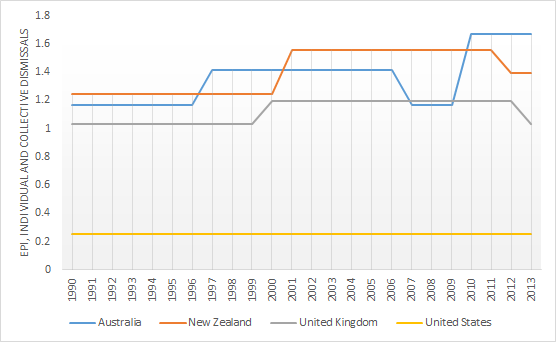
Major deregulations and re-regulations of the labour market in Australia and New Zealand did not move the employment protection inducts around that much in figure 1. All is been quiet on the labour market regulation front of the UK pretty much since the index was started.
Figure 1: OECD employment protection index (EPI), strictness of employment protection – individual and collective dismissals, USA, UK, Australia and New Zealand, 1990 – 2013
Source: OECD StatExtract.
The Work Choices legislation in Australia in 2006 was looked upon by the OECD as a somewhat minor deregulation not much more in scale than the deregulation introduced in 2008 with the election of the National Party led government.

Nobody told the unions that.
28 Jul 2015 1 Comment
in Euro crisis, job search and matching, labour economics, law and economics, macroeconomics Tags: British economy, employment law, employment law regulation, Eurosclerosis, France, Germany, Greece, Italy, Portugal, Spain
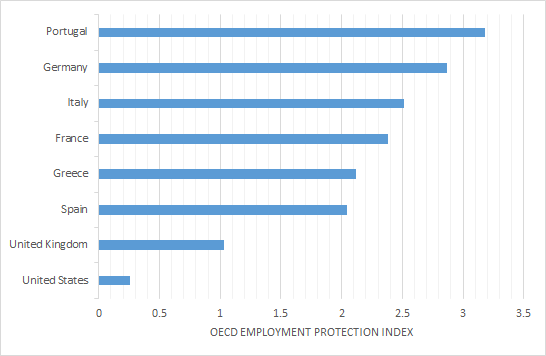
Much easier to fire someone in the USA or UK than on continental Europe. Greece and Spain aren’t that bad by continental European standards for employment law protections against dismissals of individuals.
Figure 1: Strictness of employment protection for individual dismissals, 2013
Source: OECD StatExtract.
27 Jul 2015 Leave a comment
in economics of crime, human capital, labour economics, labour supply, law and economics, occupational choice, politics - USA Tags: crime and punishment, criminal deterrence
26 Jul 2015 Leave a comment
in economics of crime, health and safety, labour economics, law and economics, politics - USA Tags: common law, crime and punishment, law enforcement, occupational health and safety, police, rule of law
More British English, Scottish and Welsh police (68) have been murdered by gunfire than British police have shot people dead (52) in over a century.
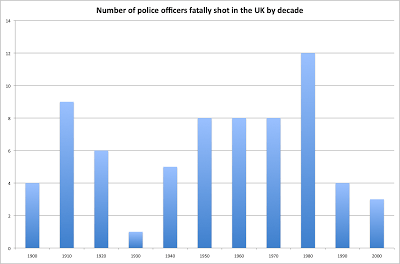
Source: Number of police officers shot dead in the UK by decade | John Graham-Cumming.
This suggests to me that the ledger is in the wrong direction. This list does not include British police stabbed or beaten to death nor are Northern Ireland deaths.
According to the FBI, from 1980–2014, an average of 55 law enforcement officers are feloniously killed per year in the USA. Those killed in accidents in the line of duty are not included in this number.
More law enforcement officers are murdered every year in the USA than ever murdered by gunfire in Britain. Police have the same common law right as any other to defend their own lives and the lives of others.
/cdn0.vox-cdn.com/uploads/chorus_asset/file/2849636/Screen_Shot_2014-12-21_at_1.42.15_PM.0.png)
26 Jul 2015 Leave a comment
in economics of crime, labour economics, law and economics, Marxist economics, minimum wage, poverty and inequality Tags: far left, Labour standards, Left-wing hypocrisy, Leftover Left, living wage, progressive left
26 Jul 2015 Leave a comment
in economics of religion, law and economics, liberalism Tags: free speech, Freedom of religion, Left-wing hypocrisy, political correctness
Venn Diagram: Double-standard on anti-religious art: Christian vs. Muslim http://t.co/YNUicxSBpY—
Mark J. Perry (@Mark_J_Perry) May 18, 2015
25 Jul 2015 Leave a comment
in politics - USA, property rights Tags: constitutional law, rule of law, takings
Econ Prof at George Mason University, Economic Historian, Québécois
Celebrating humanity's flourishing through the spread of capitalism and the rule of law
Scholarly commentary on law, economics, and more
Beatrice Cherrier's blog
Celebrating humanity's flourishing through the spread of capitalism and the rule of law
Celebrating humanity's flourishing through the spread of capitalism and the rule of law
Celebrating humanity's flourishing through the spread of capitalism and the rule of law
Why Evolution is True is a blog written by Jerry Coyne, centered on evolution and biology but also dealing with diverse topics like politics, culture, and cats.
Celebrating humanity's flourishing through the spread of capitalism and the rule of law
Celebrating humanity's flourishing through the spread of capitalism and the rule of law
A rural perspective with a blue tint by Ele Ludemann
DPF's Kiwiblog - Fomenting Happy Mischief since 2003
Celebrating humanity's flourishing through the spread of capitalism and the rule of law
The world's most viewed site on global warming and climate change
Tim Harding's writings on rationality, informal logic and skepticism
A window into Doc Freiberger's library
Let's examine hard decisions!
Commentary on monetary policy in the spirit of R. G. Hawtrey
Thoughts on public policy and the media
Celebrating humanity's flourishing through the spread of capitalism and the rule of law
Politics and the economy
A blog (primarily) on Canadian and Commonwealth political history and institutions
Reading between the lines, and underneath the hype.
Economics, and such stuff as dreams are made on
"The British constitution has always been puzzling, and always will be." --Queen Elizabeth II
Celebrating humanity's flourishing through the spread of capitalism and the rule of law
Celebrating humanity's flourishing through the spread of capitalism and the rule of law
WORLD WAR II, MUSIC, HISTORY, HOLOCAUST
Undisciplined scholar, recovering academic
Celebrating humanity's flourishing through the spread of capitalism and the rule of law
Res ipsa loquitur - The thing itself speaks
In Hume’s spirit, I will attempt to serve as an ambassador from my world of economics, and help in “finding topics of conversation fit for the entertainment of rational creatures.”
Researching the House of Commons, 1832-1868
Articles and research from the History of Parliament Trust
Reflections on books and art
Posts on the History of Law, Crime, and Justice
Celebrating humanity's flourishing through the spread of capitalism and the rule of law
Exploring the Monarchs of Europe
Cutting edge science you can dice with
Small Steps Toward A Much Better World
“We do not believe any group of men adequate enough or wise enough to operate without scrutiny or without criticism. We know that the only way to avoid error is to detect it, that the only way to detect it is to be free to inquire. We know that in secrecy error undetected will flourish and subvert”. - J Robert Oppenheimer.
The truth about the great wind power fraud - we're not here to debate the wind industry, we're here to destroy it.
Celebrating humanity's flourishing through the spread of capitalism and the rule of law
Celebrating humanity's flourishing through the spread of capitalism and the rule of law
Economics, public policy, monetary policy, financial regulation, with a New Zealand perspective
Celebrating humanity's flourishing through the spread of capitalism and the rule of law




 Utopia, you are standing in it!
Recent Comments