Short version — reforms Greece is being told to make, and what it's getting on debt relief. uk.businessinsider.com/greece-europea… http://t.co/eNrXu47Elc—
Mike Bird (@Birdyword) July 13, 2015
John Cochrane on a big hole in the Greek bailout (and media analysis of the bailout)
15 Jul 2015 Leave a comment
in currency unions, Euro crisis, global financial crisis (GFC), great recession, macroeconomics, monetary economics Tags: bank runs, banking panics, Greece, John Cochrane, lender of last resort, sovereign bailouts, sovereign default

An average of 41% of Greek bank assets are non-performing, with loan repayments 90 days overdue or more (Barclays). http://t.co/HfXV8uapkj—
Mike Bird (@Birdyword) July 13, 2015
Greek and US great depressions compared
14 Jul 2015 Leave a comment
in business cycles, currency unions, economic growth, economic history, Euro crisis, global financial crisis (GFC), great depression, great recession, job search and matching, labour economics, macroeconomics, unemployment Tags: Greece
https://twitter.com/ianbremmer/status/620570062538309632/photo/1
Greek Depression vs US Depression:
Unemployment http://t.co/81efYi5Ajy—
ian bremmer (@ianbremmer) July 13, 2015
Greece’s possible currency outcomes, from today’s euro to the drachma
13 Jul 2015 Leave a comment
in currency unions, economic history, macroeconomics Tags: currency reforms, EU, Euroland, Greece, sovereign defaults
Greece’s possible currency outcomes, from today's euro to the drachma (and several in between) on.wsj.com/1ew3Yvs http://t.co/nEWtz84WTG—
Sudeep Reddy (@Reddy) July 05, 2015

Major sovereign bond defaults in recent history
11 Jul 2015 Leave a comment
in currency unions, economic history, Euro crisis, international economics, law and economics, macroeconomics Tags: Argentina, Greece, Russia, sovereign defaults

via Defaulting Debtors.
Financial crises surprisingly common, but few countries close their banks
10 Jul 2015 Leave a comment
in business cycles, currency unions, economic history, economics of regulation, Euro crisis, financial economics, global financial crisis (GFC), law and economics, macroeconomics, monetary economics, property rights Tags: bank runs, banking crises, banking panic, financial crises, Greece, sovereign default
Financial crises surprisingly common, but few countries close their banks pewrsr.ch/1NQyz2P #Greece http://t.co/pK0sfB49Ka—
PewResearch FactTank (@FactTank) July 09, 2015
The left-wing solution to Greek bankruptcy
10 Jul 2015 Leave a comment
in applied price theory, applied welfare economics, comparative institutional analysis, constitutional political economy, currency unions, fiscal policy, global financial crisis (GFC), income redistribution, liberalism, macroeconomics, Marxist economics, Public Choice, public economics, rentseeking Tags: Eurosclerosis, expressive voting, Greece, rational ignorance, rational irrationality, sovereign default
Scotland already has its own currency ripe for a currency board?
07 Jul 2015 Leave a comment
in currency unions, economic history, macroeconomics, monetary economics Tags: British economy, British politics, currency boards, free banking, Ireland, Scotland, Scottish independence
Since 1844, the Bank of Scotland, Clydesdale Bank and The Royal Bank of Scotland have been allowed to issue banknotes in denominations of £5, £10, £20, £50 and £100. Only the Royal Bank of Scotland continues to issue a small volume of £1 notes. Two Northern Irish banks have similar prerogatives.

These Scottish banknotes are not legal tender in England. No banknotes have legal tender status in Scotland, whether issued by Scottish banks or the Bank of England. The Bank of England says:
Scottish and Northern Ireland banknotes are fully backed at all times by ring-fenced backing assets partly held in Bank of England notes and UK coin, and partly as balances on accounts maintained by the issuing banks at the Bank of England.
Consequently, holders of genuine Scottish and Northern Ireland banknotes have the same level of protection as that available to holders of genuine Bank of England notes.
The acceptability of any means of payment, including banknotes, is essentially a matter for agreement between the parties involved in a transaction in Scotland.

Bank of England keeps control Scottish bank notes in issue by stipulating that the issuing bank hold in their reserves the same amount of UK money (either in cash or on deposit at the Bank of England) as the Scottish notes they issue. These reserves could easily be converted to a currency board.
- A currency board issues local notes and coins anchored to a foreign currency (e.g. Sterling) backed by government bonds with 1 pound sterling pound sterling and British government bonds for every Scottish pound currency note issued.
- A currency board issues domestic notes and coins only when there are foreign-exchange reserves to back it. In the case of a Scottish currency board, there would be pounds Sterling reserves to back any Scottish pounds and currency notes on issue.
The Hong Kong currency board has operated successfully through 30 years of financial turbulence and radical constitutional change. There is no reason why a Scottish currency board could not do likewise, guaranteeing the convertibility of a Scots pound, initially at parity with the English pound sterling.

After independence, Ireland acted effectively as a currency board until the 1970s. Currency boards were commonplace throughout the British Empire and were highly successful.
- On the independence of the Irish Free State in 1922, the introduction of an independent currency was a low priority because 98% of exports and 80% of imports were with the UK.
- British banknotes and notes issued by Irish banks circulated (but only the first were legal tender) and coins remained in circulation.
Under the Currency Act 1927, the Saorstát Pound (Free State Pound) was created at parity with the British Pound Sterling. A Currency Commission kept British government securities, sterling cash, and gold to keep a 1:1 relationship between the two currencies.
Although a Central Bank of Ireland was created in 1943, the Irish punt remained linked to sterling with the central bank operated as a de facto currency board policy until joining the European Exchange Rate Mechanism in 1979.
A currency board has no capacity to act as a lender of last resort to a Scottish banking system.
Syriza vote shares and seats won since its formation
07 Jul 2015 Leave a comment
in currency unions, economic history, Euro crisis, Public Choice Tags: Greece, Greek elections
The Coalition of the Radical Left[(Syriza) was founded in 2004 as a coalition of left-wing and radical left Greek parties.
Figure 1: Syriza vote percentages and Parliamentary seats won in Greek national elections
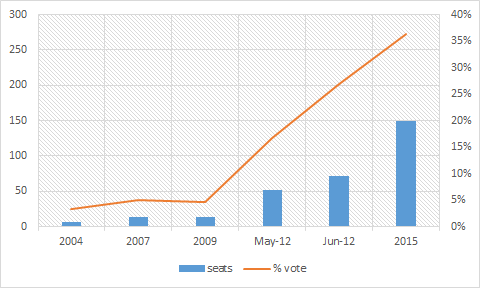
250 seats will be distributed on the basis of proportional representation, with a threshold of 3% required for entry into the Greek parliament. 50 additional seats are awarded as a majority bonus to the party that wins the largest number of votes.
Why Greece joined the Euro
06 Jul 2015 Leave a comment
in applied price theory, applied welfare economics, budget deficits, business cycles, comparative institutional analysis, constitutional political economy, currency unions, economic growth, economic history, Euro crisis, fiscal policy, fisheries economics, global financial crisis (GFC), international economics, macroeconomics, Public Choice, rentseeking Tags: Euro sclerosis, Greece, insurance attacks, sovereign defaults, speculative attacks
The roots of Greece’s crisis are simple. Before Greece joined the Eurozone, investors treated it as a middle-income country with poor governance — which is to say, a credit risk.
After Greece joined the Eurozone, investors thought that Greece was no longer a credit risk — they figured, if push came to shove, other Eurozone members like Germany would bail Greece out. They were wrong.

Michael Dooley put forward a theory of speculative attacks on currencies as insurance attacks on currencies for emerging markets after the East Asian financial crisis:
First generation models of speculative attacks show that apparently random speculative attacks on policy regimes can be fully consistent with rational and well-informed speculative behaviour.
Unfortunately, models driven by a conflict between exchange rate policy and other macroeconomic objectives do not seem consistent with important empirical regularities surrounding recent crises in emerging markets. This has generated considerable interest in models that associate crises with self-fulfilling shifts in private expectations.
In this paper we develop a first generation model based on an alternative policy conflict. Credit constrained governments accumulate reserve assets in order to self-insure against shocks to national consumption. Governments also insure poorly regulated domestic financial markets.
Given this policy regime, a variety of internal and external shocks generate capital inflows to emerging markets followed by successful and anticipated speculative attacks.
We argue that a common external shock generated capital inflows to emerging markets in Asia and Latin America after 1989. Country specific factors determined the timing of speculative attacks. Lending policies of industrial country governments and international organizations account for contagion, that is, a bunching of attacks over time.
His model was not within the context of a currency union but his basic theory is correct.
There are speculative attacks on a currency or a bank run after foreign markets revises their estimates of the available central bank reserves and international lines of credit to bail out the banking systems and/or foreign debt.
Michael Dooley was dealing with the emerging economies of Southeast Asia and their official lines of credit that insure their foreign exchange liabilities and domestic banking system. Greece is about lines of credit for similar purposes to other European union member states.
via 12 charts and maps that explain the Greek crisis – Vox and The Most Important Graphs of 2011 – The Atlantic.
The reason why New Zealand should rule out helping Greece!
06 Jul 2015 Leave a comment
in budget deficits, business cycles, currency unions, economic growth, Euro crisis, financial economics, fiscal policy, global financial crisis (GFC), macroeconomics Tags: bank runs, banking panics, Eurosclerosis, Germany, Greece, sovereign defaults
Greece is a tiny part of the European economies so it doesn’t matter that much to the rest of the European Union what happens to Greece. The only people will notice the sovereign default of Greece once the breathless journalism has died down are Greeks themselves as they rebuild their banking and monetary system against a background of a government run by coffee shop Marxists.

Greece in 7 charts
06 Jul 2015 3 Comments
in budget deficits, business cycles, currency unions, economic growth, Euro crisis, fiscal policy, labour economics, labour supply, macroeconomics, unemployment Tags: Eurosclerosis, Greece
The extreme economic outlier that is Greece, in 7 charts: 53eig.ht/1GMgIFU http://t.co/gb3zkgUqqJ—
(@FiveThirtyEight) July 04, 2015
Doing business in the PIGS (Portugal, Italy, Greece and Spain) – World Bank rankings
03 Jul 2015 Leave a comment
in applied price theory, applied welfare economics, currency unions, economic growth, economics of bureaucracy, economics of regulation, Euro crisis, health and safety, income redistribution, industrial organisation, labour economics, law and economics, minimum wage, occupational regulation, property rights, Public Choice, rentseeking, survivor principle, unions, welfare reform Tags: cost of doing business, Eurosclerosis, Greece, Italy, PIGS, Portugal, Spain
Figure 1: Doing Business rankings, PIGS, 2014
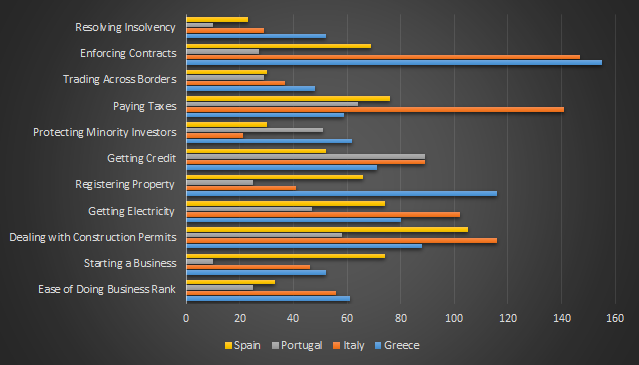
Source: World Bank Doing Business 2015.
All in all, Italy and Greece are a dog of a place to enforce a contract. The long-suffering taxpayer is better off paying taxes in Greece than in Italy! Not surprisingly, trading across borders is the greatest strength in doing business in the PIGS. The European Union does have some benefits.
Figure 2: Doing Business rankings, Greece and Italy, 2014
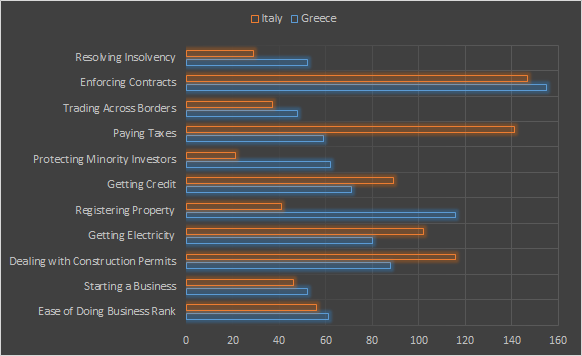
Source: World Bank Doing Business 2015.
All in all, Italy and Greece are equally bad places to do business and Italy is much worse when it comes to taxes. About the only saving graces of Italy is the registration of property and the protection of minority interests in companies.
Figure 3: Doing Business rankings, Spain and Portugal, 2014
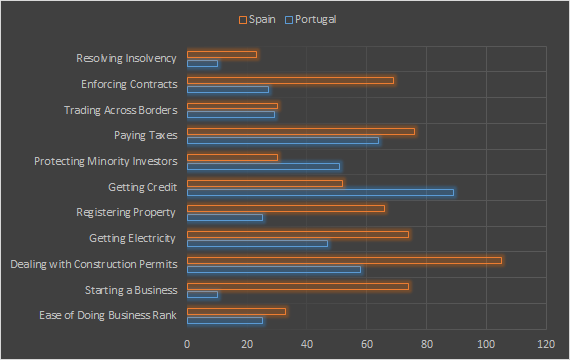
Source: World Bank Doing Business 2015.
Spain and in particular Portugal are much better places to do business than Italy and Greece.
 Utopia, you are standing in it!
Recent Comments