Involuntary unemployment and the great vacation theories of the great depression and Eurosclerosis – updated again

Most Keynesian economists are convinced that something exists called involuntary unemployment and people can be unemployed through no fault of their own. They will accept the going wage but no employer is willing to offer it to them.

Lucas and Rapping’s (1969) paper, “Real Wages, Employment, and Inflation” provides the micro-foundations for an analysis of the labour suppl. They felt the need to reconcile the existence of unemployment with market clearing and referred to recent work of Armen Alchian (1969) on search explanations of unemployment.

Lucas and Rapping viewed unemployment as voluntary, including the mass unemployment during the great depression (Lucas and Rapping 1969: 748).

Lucas and-Rapping viewed current labour demand as a negative function of the current real wage. Current labour supply was a positive function of the real wage and the expected real interest rate, but a negative function of the expected future wage.

Under their framework, if workers expect higher real wages in the future or a lower real interest rate, current labour supply would be depressed, employment would fall, unemployment rise, and real wages increase.

Lucas and Rapping depicted labour suppliers as rational optimisers who engaged in inter-temporal substitution: working more when current wages were high relative to expected wages. The prevailing Keynesian approach assumed labour supply was passive, and movements in the demand for labour determined changes in employment.

Lucas and Rapping offered an unemployment equation relating the unemployment rate to actual versus anticipated nominal wages, and actual versus anticipated price levels. Unemployment could be the product of expectational errors about wages.

Lucas and Rapping’s model was poor at explaining unemployment after 1933 in terms of job search and expectational errors.

The graph below shows two different series for unemployment in the 1930s in the USA: the official BLS level by Lebergott; and a data series constructed famously by Darby. Darby includes workers in the emergency government labour force as employed – the most important being the Civil Works Administration (CWA) and the Works Progress Administration (WPA).
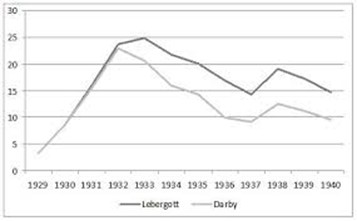
Once these workfare programs are accounted for, the level of U.S. unemployment fell from 22.9% in 1932 to 9.1% in 1937, a reduction of 13.8%. For 1934-1941, the corrected unemployment levels are reduced by two to three-and-a half million people and the unemployment rates by 4 to 7 percentage points after 1933.

Not surprisingly, Darby titled his 1976 Journal of Political Economy article Three-and-a-Half Million U.S. Employees Have Been Mislaid: Or, an Explanation of Unemployment, 1934-1941.

The corrected data by Darby shows stronger movement toward the natural unemployment rate after 1933. Darby concluded that his corrected date are suggests that the unemployment rate was well explained by a job search model such as that by Lucas and Rapping together with the wage fixing under the New Deal that kept real wages up and unemployment high.

Both the Keynesian approach to unemployment and the job search approach to unemployment view workers in emergency government work programs as employed and not as unemployed.

In the late 1970s, Modigliani dismissed the new classical explanation of the U.S. great depression in which the 1930s unemployment was mass voluntary unemployment as follows:

Sargent (1976) has attempted to remedy this fatal flaw by hypothesizing that the persistent and large fluctuations in unemployment reflect merely corresponding swings in the natural rate itself.

In other words, what happened to the U.S. in the 1930’s was a severe attack of contagious laziness!

I can only say that, despite Sargent’s ingenuity, neither I nor, I expect most others at least of the nonMonetarist persuasion,. are quite ready yet. to turn over the field of economic fluctuations to the social psychologist!

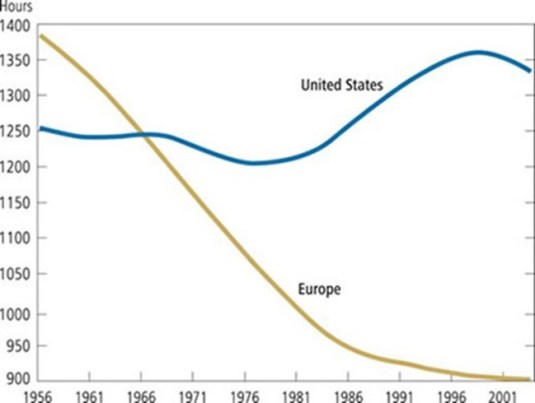
As Prescott has pointed out, the USA in the Great Depression and France since the 1970s both had 30% drops in hours worked per adult. That is why Prescott refers to France’s economy as depressed. The reason for the depressed state of the French (and German) economies is taxes, according to Prescott:

Virtually all of the large differences between U.S. labour supply and those of Germany and France are due to differences in tax systems.

Europeans face higher tax rates than Americans, and European tax rates have risen significantly over the past several decades.

In the 1960s, the number of hours worked was about the same. Since then, the number of hours has stayed level in the United States, while it has declined substantially in Europe. Countries with high tax rates devote less time to market work, but more time to home activities, such as cooking and cleaning. The European services sector is much smaller than in the USA.

Time use studies find that lower hours of market work in Europe is entirely offset by higher hours of home production, implying that Europeans do not enjoy more leisure than Americans despite the widespread impression that they do.
Richard Rogerson, 2007 in “Taxation and market work: is Scandinavia an outlier?” found that how the government spends tax revenues when assessing the effects of tax rates on aggregate hours of market work:

  1. Different forms of government spending imply different elasticities of hours of work with regard to tax rates;
  2. While tax rates are highest in Scandinavia, hours worked in Scandinavia are significantly higher than they are in Continental Europe with differences in the form of government spending can potentially account for this pattern; and
  3. There is a much higher rate of government employment and greater expenditures on child and elderly care in Scandinavia.

Examining how tax revenue is spent is central to understanding labour supply effects:

  1. If higher taxes fund disability payments which may only be received when not in work, the effect on hours worked is greater relative to a lump-sum transfer; and
  2. If higher taxes subsidise day care for individuals who work, then the effect on hours of work will be less than under the lump-sum transfer case.

Others such as Blanchard attribute the much lower labour force participation in the EU since the 1970s to their greater preference for leisure in Europe. An increased preference for leisure is another name for voluntary unemployment.

The lower labour force participation in higher unemployment in Europe is voluntary because of the higher demand for leisure among Europeans.  According to Blanchard:

The main difference [between the continents] is that Europe has used some of the increase in productivity to increase leisure rather than income, while the U.S. has done the opposite.

An unusual left-right unity ticket emerged to explain the great depression in the 1930s and the depressed EU economies from the 1970s: the great vacation theory.

Keynesian macroeconomics as a form of juvenile real business cycle theory (RBC)

Keynesian macroeconomics postulated that the economy slips into recessions for all sorts of reasons such as shifts and turns in the animal spirits and a loss of consumer confidence leading to a fall in autonomous investment and autonomous consumption. A collapse in autonomous investment and autonomous consumption is the Keynesian explanation for the great depression.

Both Keynesian macroeconomics and real business cycle theories, at least at the outset couldn’t explain why there were recessions. Both attributed to them to causes they were yet to explain. Keynesian macroeconomics  could not explain what drove the waves of optimism and pessimism that  either sharply increased or reduced investment.

Real business cycle theorists attributed recessions and booms to productivity drops in productivity surges, which initially were not explained in themselves. This theory sees productivity shocks as the cause of economic fluctuations. For example, if productivity falls, current returns to working and investing decline, so workers and firms choose to work and invest less and take more leisure. Real business-cycle theory views a recession as the optimal response by households and firms to a shift in productivity.

At least Prescott and other real business cycle theorists accepted that they must eventually unpack productivity drops and name causes that can be explored further and perhaps found persuasive or perhaps wanting.

Keynesian macroeconomics was quite happy to live with the waves of optimism and pessimism of the animal spirits that drove investors to push the economy into recessions. In his General Theory of Employment Interest and Money) Keynes puts it this way,

Most, probably, of our decisions to do something positive, the full consequences of which will be drawn out over many days to come, can only be taken as the result of animal spirits – a spontaneous urge to action rather than inaction, and not as the outcome of a weighted average of quantitative benefits multiplied by quantitative probabilities.

A far better explanation of the animal spirits is there is a productivity drop in one sector of the economy that leads that sector to reduce its demand for inputs supplied by the rest of the economy. This reduction in demand spreads across the economy. The slowdown in the economy is attributed to this  reduction in demand, rather than the forces behind it,  which is a fall in productivity in one sector of the economy.

Long and Plosser in 1983  wrote a famous article where they were able to generate business cycles in an economy  with rational expectations, complete current information, stable preferences,  no technical change,  no long-lived commodities, no frictions and adjustments cost,  no government, no money  and no serial dependence in the stochastic elements of the environment.

In response to a productivity disturbance in one sector this economy,  consumers will smooth a change in their consumption possibilities and production possibilities over a number of  quarters  by saving  and dissaving and varying the amount of time they devote to work and leisure and they will invest more or less in light of the changing situation.

This  consumption smoothing  is enough to generate a slowdown in the economy from changes in one sector. Laid-off workers in the sector subject to a disturbance will take time to find jobs in other sectors of the economy and  will be unemployed in this interim period of job search. Other workers who were previously employed in the sector subject to the productivity decline might wait for prospects to improve in that sector rather than search for a job in another occupation or location.

As research progressed, real business cycles were  viewed as recurrent fluctuations in an economy’s incomes, products, and factor inputs—especially labour—due to changes in technology, tax rates and government spending, tastes, government regulation, terms of trade, and energy prices. In his Nobel lecture Ed Prescott explained that:

We learned that business cycle fluctuations are the optimal response to real shocks.

The cost of a bad shock cannot be avoided, and policies that attempt to do so will be counterproductive, particularly if they reduce production efficiency.

During the 1981 and current oil crises, I was pleased that policies were not instituted that adversely affected the economy by reducing production efficiency. This is in sharp contrast to the oil crisis in 1974 when, rather than letting the economy respond optimally to a bad shock so as to minimize its cost, policies were instituted that adversely affected production efficiency and depressed the economy much more than it would otherwise have been.

By the time Keynesian macroeconomics papered over the flaws mighty exposed by the 1970s stagflation, it rebranded itself New Keynesian macroeconomics. This is no more than becoming monetarist macroeconomists without having to admit all of your previous criticisms of Friedman were wrong.

At bottom, Keynesian macroeconomics makes an unjustified assumption that technological progress unfolds at a relatively smooth rate, and changes in government regulation, terms of trade, and energy prices were not important sources of economic fluctuations. As for tax rates and government spending, Keynesian macroeconomists saw these is a solution to recessions rather than their cause.

In time, real business cycles theory and Schumpeterian theories of business cycles will merge. new inventions and processes that are, by the nature of research and development, stochastically discovered. Part of this randomness in discovery will be that the emergence from time to time of great interventions –  general purpose technologies -that result in economy wide changes and a wave of secondary inventions and the retraining of the workforce and reallocation of many workers into new sectors of the economy. These great inventions can be anything from electricity to information and computer technology and the Internet

Bob, this is the way labour markets works, Ed

Robert Lucas Edward C. Prescott

Bob,
This is the way labour markets work: v(s, y, λ) max{λ, R(s, y) min[ λ, β ∫ v(s′, y, λ) f(s′, s)ds′]}.
Ed

Robert Lucas went on to explain in his professional memoir about this exchange in the early 1970s that:

we had agreed on notation: s stood for the state of product demand at a particular location, y stood for the number of workers who were already at that location, R(s, y) was the marginal product of labour implied by these two numbers, and v(s, y) stood for the present value of earnings that one of these workers could obtain if he made his decision whether to stay at this location or leave optimally.

Other features of the equation were as novel to me as they are (I imagine) to you…

a single parameter—Ed’s λ—stood for two different things: the present value of earnings that all searching workers would have to expect in order to leave a location and the present value that a particular location would need to offer to receive new arrivals…

If I had to pick a single day to represent what I like about a life of research, it would be this one.

Ed’s note captures exactly why I think we value mathematical modelling: it is a method to help us get to new levels of understanding the ways things work.

Edward C Prescott – Restoring U.S. Prosperity – Brazil, 10 May 2014


Marginal tax rates and labour supply

Americans now work 50 per cent more than do the Germans, French, and Italians. This was not the case in the early 1970s, when the Western Europeans worked more than Americans.

Edward Prescott found that taxes accounted for these differences in labour supply across time and across countries; in particular, the effective marginal tax rate on labour income. The population of countries considered is the G-7 countries, which are major advanced industrial countries. Prescott concluded that

virtually all of the large differences between U.S. labour supply and those of Germany and France are due to differences in tax systems.

Prescott and many that followed him were truly puzzled by the lack of a role for employment mandates, employment protections and product market regulation in Europe’s poor economic performance

Richard Rogerson is a very sharp fellow who built on Prescott’s work. Most anything Rogerson writes is worth a look.

A non-technical note by Rogerson made these key points:

  1. Europe’s taxes punish working outside the home, so Europeans don’t work as much as they would otherwise;

  2. Dramatic differences in the overall change in hours worked per person aged 16 to 64 across countries between 1960 and 2000;

  3. at one extreme the U.S., with an increase of 10 per cent between these two dates;

  4. At the other extreme are Germany and France, with declines of more than 30 per cent;

  5. For the U.S. and France, the difference is staggering—more than 45 per cent;

  6. Richard Freeman and Ronald Schettkat (2001) studied time allocation by married couples in Germany and the United States.

  7. Their striking finding is about total time devoted to work (i.e., market work plus home production) turns out in the two countries is virtually the same.

In The Impact of Labor Taxes on Labor Supply: An International Perspective (AEI Press, 2010) Rogerson finds that:

• a 10 percentage point increase in the tax rate on labour leads to a 10 to 15 per cent decrease in hours of work.

• Even a 5 per cent decrease in hours worked would mean a decline in labour output equating to a serious recession.

• While recessions are temporary, permanent changes in government spending patterns have long-lasting repercussions.

• Although government spending provides citizens with important benefits, such benefits must be weighed against the disincentive effects of increased labour taxes.

• Policymakers who fail to account for the decrease in labour output risk expanding government programs beyond their optimal scale.

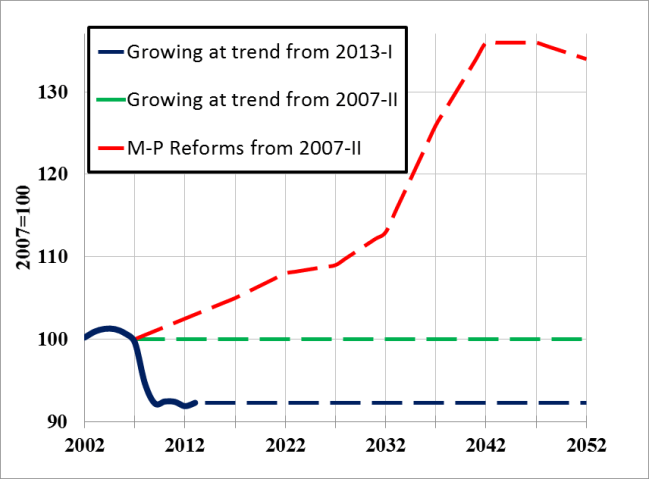
The path to higher U.S. prosperity

Suppose the USA:

  1. Had mandatory savings for retirement
  2. Eliminated capital income taxes
  3. Broadened tax base and lowered the marginal tax rate
  4. Phased in reforms so all birth-year cohorts are made better off
  5. Left welfare programs and local public good shares the same
  6. Savings not part of taxable income, saving withdrawals part of taxable income – with these changes U.S. income tax would be a consumption tax

US Detrended GDP per Capita

Source: Edward Prescott and Ellen McGrattan 2013.

Next Newer Entries

Bassett, Brash & Hide

Celebrating humanity's flourishing through the spread of capitalism and the rule of law

Truth on the Market

Scholarly commentary on law, economics, and more

The Undercover Historian

Beatrice Cherrier's blog

Matua Kahurangi

Celebrating humanity's flourishing through the spread of capitalism and the rule of law

Temple of Sociology

Celebrating humanity's flourishing through the spread of capitalism and the rule of law

Velvet Glove, Iron Fist

Celebrating humanity's flourishing through the spread of capitalism and the rule of law

Why Evolution Is True

Why Evolution is True is a blog written by Jerry Coyne, centered on evolution and biology but also dealing with diverse topics like politics, culture, and cats.

Down to Earth Kiwi

Celebrating humanity's flourishing through the spread of capitalism and the rule of law

NoTricksZone

Celebrating humanity's flourishing through the spread of capitalism and the rule of law

Homepaddock

A rural perspective with a blue tint by Ele Ludemann

Kiwiblog

DPF's Kiwiblog - Fomenting Happy Mischief since 2003

The Dangerous Economist

Celebrating humanity's flourishing through the spread of capitalism and the rule of law

Watts Up With That?

The world's most viewed site on global warming and climate change

The Logical Place

Tim Harding's writings on rationality, informal logic and skepticism

Doc's Books

A window into Doc Freiberger's library

The Risk-Monger

Let's examine hard decisions!

Uneasy Money

Commentary on monetary policy in the spirit of R. G. Hawtrey

Barrie Saunders

Thoughts on public policy and the media

Liberty Scott

Celebrating humanity's flourishing through the spread of capitalism and the rule of law

Point of Order

Politics and the economy

James Bowden's Blog

A blog (primarily) on Canadian and Commonwealth political history and institutions

Science Matters

Reading between the lines, and underneath the hype.

Peter Winsley

Economics, and such stuff as dreams are made on

A Venerable Puzzle

"The British constitution has always been puzzling, and always will be." --Queen Elizabeth II

The Antiplanner

Celebrating humanity's flourishing through the spread of capitalism and the rule of law

Bet On It

Celebrating humanity's flourishing through the spread of capitalism and the rule of law

History of Sorts

WORLD WAR II, MUSIC, HISTORY, HOLOCAUST

Roger Pielke Jr.

Undisciplined scholar, recovering academic

Offsetting Behaviour

Celebrating humanity's flourishing through the spread of capitalism and the rule of law

JONATHAN TURLEY

Res ipsa loquitur - The thing itself speaks

Conversable Economist

Celebrating humanity's flourishing through the spread of capitalism and the rule of law

The Victorian Commons

Researching the House of Commons, 1832-1868

The History of Parliament

Articles and research from the History of Parliament Trust

Books & Boots

Reflections on books and art

Legal History Miscellany

Posts on the History of Law, Crime, and Justice

Sex, Drugs and Economics

Celebrating humanity's flourishing through the spread of capitalism and the rule of law

European Royal History

Exploring the Monarchs of Europe

Tallbloke's Talkshop

Cutting edge science you can dice with

Marginal REVOLUTION

Small Steps Toward A Much Better World

NOT A LOT OF PEOPLE KNOW THAT

“We do not believe any group of men adequate enough or wise enough to operate without scrutiny or without criticism. We know that the only way to avoid error is to detect it, that the only way to detect it is to be free to inquire. We know that in secrecy error undetected will flourish and subvert”. - J Robert Oppenheimer.

STOP THESE THINGS

The truth about the great wind power fraud - we're not here to debate the wind industry, we're here to destroy it.

Lindsay Mitchell

Celebrating humanity's flourishing through the spread of capitalism and the rule of law

Alt-M

Celebrating humanity's flourishing through the spread of capitalism and the rule of law

croaking cassandra

Economics, public policy, monetary policy, financial regulation, with a New Zealand perspective

The Grumpy Economist

Celebrating humanity's flourishing through the spread of capitalism and the rule of law

International Liberty

Restraining Government in America and Around the World