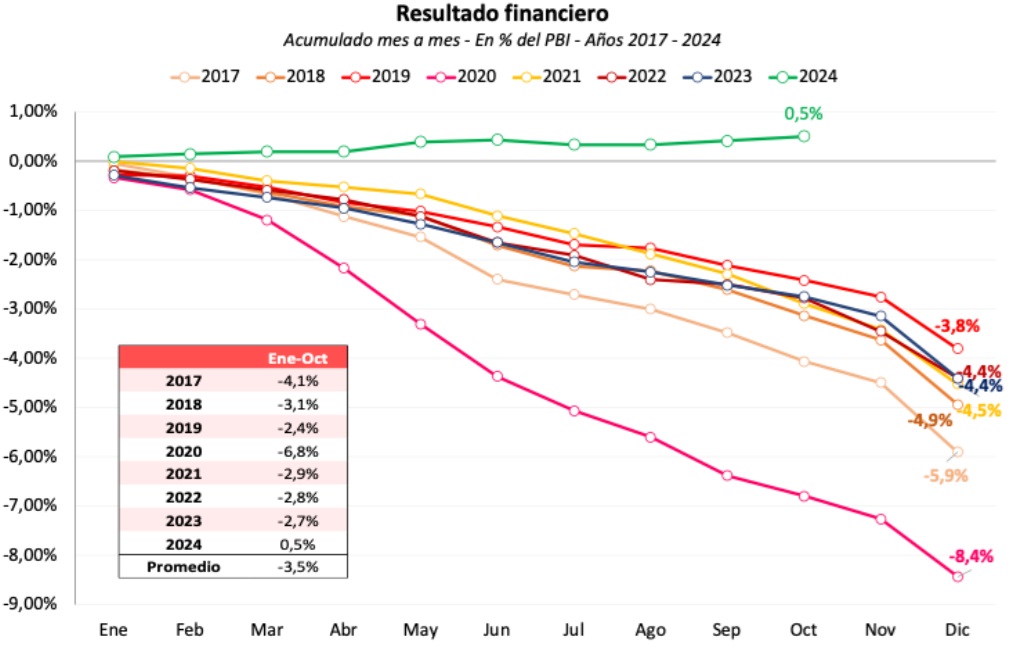
It’s easy to mock economists. Consider the supposedly prestigious left-leaning academics who asserted in 2021 that Biden’s agenda was not inflationary. At the risk of understatement, they wound up with egg on their faces.* Today, we’re going to look at another example of leftist economists making fools of themselves. It involves Argentina, where President Javier […]
Argentina’s bonds have already rallied dramatically. One gauge of the nation’s hard-currency debt, the ICE BofA US Dollar Argentina Sovereign Index, has generated a total return of about 90% this year. Meanwhile, the S&P Merval Index has risen more than 160% this year through Monday, far outpacing stock benchmarks in developed, emerging and frontier markets […]
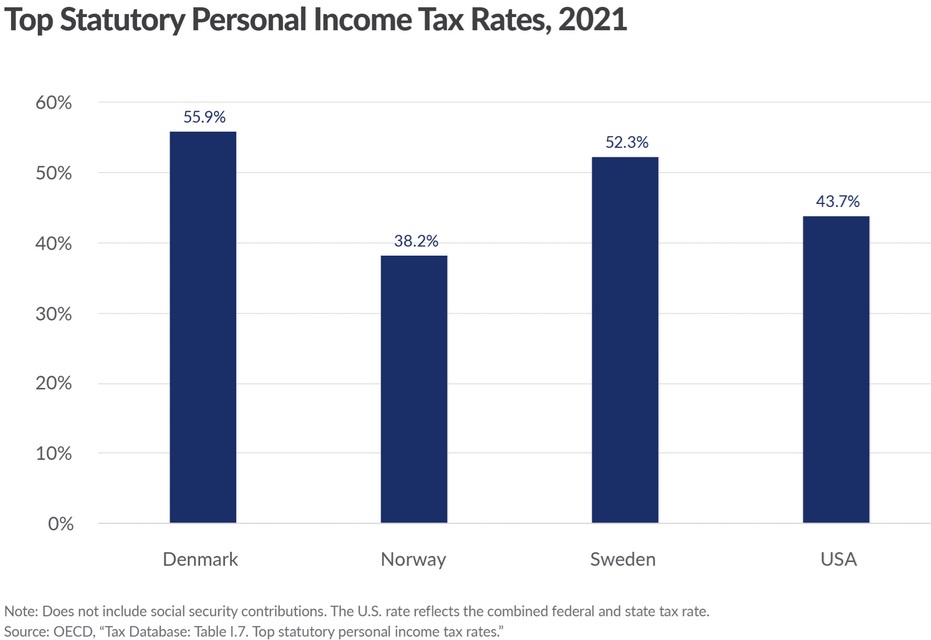
Scandinavian nations are not socialist, at least if we’re using the technical definition (government ownership, central planning, and price controls). But those countries do have big welfare states. And that means stifling tax burdens. And those harsh taxes don’t just apply to rich taxpayers. Lower-income and middle-class people also get pillaged. I’ve already explained that punitive value-added […]
I wasn’t envisaging writing anything more for a while, but….Welllington’s weather certainly isn’t conducive to either the beach or the garden, and the Herald managed to get an interview with Iain Rennie, the new Secretary to the Treasury (not usually the sort of stuff for 27 December either). I’ve always been rather uneasy about heads […]
Washington State’s unofficial state motto has long been “Al-ki” which means either “bye and bye” or “by and by” in Chinook. The former meaning now seems official as Gov. Jay Inslee pushed for a “wealth tax.” Wealthy citizens are already saying bye to the state in anticipation of what one Democratic billionaire recently called a […]
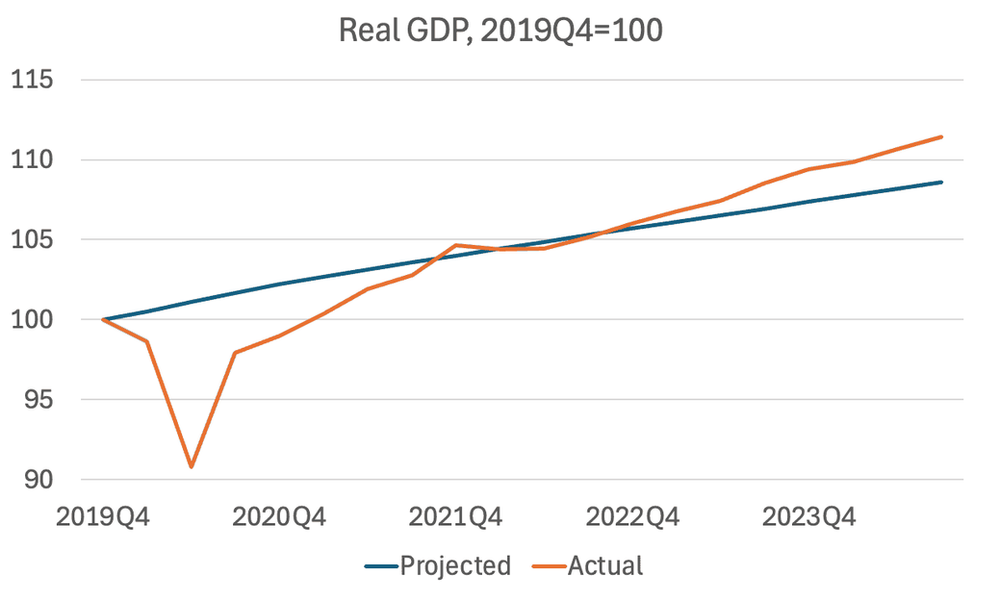
High profile US Economist Paul Krugman has written a New York Times article in which he shows in one graph the incredible resilience and performance of the American Economy. The dark blue line below tracks the pre-pandemic long-run trend in Real GDP. Meanwhile the orange line is actual real GDP. Krugman remarks that now, in…
The prediction of inflation dynamics—how prices change over time—has increasingly confounded modern macroeconomists. Throughout much of the twentieth century, there seemed to be clear relationships linking the money supply, economic slack, and price levels. Monetarism, the school of thought that posits a stable connection between the growth rate of a money aggregate and the subsequent […]
Here is a gloomy account from Vladimir Mirov: Ruble depreciation will contribute to inflation even further, as Russia is continued to be heavily reliant on imports – this is a kind of self-sustaining spiral. I also strongly disagree with those who say that cheaper ruble is “good” for exporters and the budget. Exporters have yet […]
The French National Assembly is scheduled to vote tomorrow (4 Dec.) on a vote of no confidence against the government of Premier Michel Barnier. The premier has been in office only three months, having been appointed following (with some lag) the snap election President Emmanuel Macron had called in July, and which–predictably, given the timing–did […]
We study the tax payment and innovation consequences of limiting the tax deductibility of research and development (“R&D”) expenditures. Beginning in 2022, U.S. companies are required to capitalize and amortize R&D rather than immediately deduct these expenditures. We utilize variation in U.S. firms’ fiscal year ends to test the effects of the R&D tax change […]
A group of economists have written to Nicola Willis complaining about the modest fiscal restraint imposed on the public sector. Grant Robertson grew government expenditure by $76 billion/year or a massive 7.6% of GDP, leaving NZ with a structural deficit. Many were champions of his policies or worked for him, and now they complain his […]
Bryan Caplan and Daniel Klein both opine on Milei and populism, Dan being very enthusiastic, while Bryan praising Milei but more reserved in his praise of populism. I too am a big fan of Milei, and I think he is still on a good track. If his reforms do not succeed, likely it will not […]
My dear friend and colleague Dan Klein wrote this. He loves feedback, so please share your thoughts in the comments. And he’d especially appreciate reactions from friends Shikha Dalmia and Nils Karlson, which I’d definitely be glad to run.P.S. Dan asked me to link to the latest Milei news.I define popuphobe as someone who propagates…
Oliver Hartwich writes – In his victory speech, Donald Trump promised Americans a new “golden age”. While he had the numbers to win the election, the economic realities he faces will make delivering on his promise challenging. Trump’s victory reflects many Americans’ frustrations with living standards and inflation during the Biden-Harris administration. Vice President Kamala […]
By Paul Homewood The OBR is very explicit about the new budget!! Spending up by £70 billion (so much for “black holes”!), tax up by £36 billion and borrowing by £32 billion. https://obr.uk/ But the bit we are concerned with is their updated projections for Environmental Levies, aka subsidies for renewable energy.
Why Evolution is True is a blog written by Jerry Coyne, centered on evolution and biology but also dealing with diverse topics like politics, culture, and cats.
In Hume’s spirit, I will attempt to serve as an ambassador from my world of economics, and help in “finding topics of conversation fit for the entertainment of rational creatures.”





Recent Comments