Jobless rates by education
Less than HS: 8.4%
HS: 5.4%
Some college: 5.1%
College: 2.7%http://t.co/jjj1v9Pxol pic.twitter.com/1IZYLdcjsi— Josh Zumbrun (@JoshZumbrun) March 6, 2015
Unemployment by education
11 Mar 2015 Leave a comment
in business cycles, great recession, human capital, job search and matching, labour economics, labour supply, occupational choice, politics - USA, unemployment Tags: labour demographics
Yes, Some Companies Are Cutting Hours In Response To ‘Obamacare’
28 Feb 2015 Leave a comment
in great recession, health economics, labour economics, labour supply, macroeconomics, politics - USA Tags: Obamacare, taxation and the labour supply
…the evidence suggests that the health law has likely led a few hundred thousand workers to see their hours cut or capped. That’s small in the context of an economy with 150 million workers.
But it isn’t a minor issue for those workers. Most of them are among the economy’s most vulnerable: low-wage, part-time workers who likely have few other options.


The simple reason Wal-Mart is handing out raises — people are quitting – Vox
27 Feb 2015 Leave a comment
in great recession, job search and matching, labour economics, labour supply, macroeconomics, poverty and inequality, unemployment Tags: inequality of bargaining power between workers and employers, The meaning of competition, Walmart
Another blow to the inequality of bargaining power between workers and the bosses. Job quits are not supposed to undermine the grand cartel of employers grinding the workers down.


via The simple reason Wal-Mart & TJ Maxx are handing out raises — people are quitting – Vox.
Edmund Phelps on Keynesian macroeconomic policy
25 Feb 2015 2 Comments
in budget deficits, business cycles, economic growth, F.A. Hayek, fiscal policy, global financial crisis (GFC), great recession, macroeconomics, monetary economics Tags: Austrian real business cycle theory, Edmund Phelps, FA Hayek, Keynes in macroeconomic policy

The economic performance of the USA, Japan and the European Union prior to the global financial crisis
23 Feb 2015 Leave a comment
in business cycles, economic growth, Edward Prescott, Euro crisis, global financial crisis (GFC), great recession, macroeconomics, politics - USA Tags: Euroland, GFC, global financial crisis

Source: Edward Prescott

The Affordable Care Act and the Labor Market
15 Feb 2015 Leave a comment
in fiscal policy, great recession, labour economics, labour supply, macroeconomics Tags: Casey Mulligan, Obamacare, taxation and the labour supply

Everyone is richer in the USA and the middle class is moving up
09 Feb 2015 Leave a comment
in economic growth, great recession, macroeconomics, poverty and inequality Tags: The Great Enrichment
The middle class is shrinking in the USA because most of of 10% shrinkage is due to them becoming rich.

Everyone is wealthier than in the past and would have been wealthier but for the Great Recession and the countless tax rises of Obama.


A clickable timeline of central banking activity during the 2008 financial crisis
05 Feb 2015 Leave a comment
Deflation and Depression: Is There an Empirical Link?
31 Jan 2015 Leave a comment
in budget deficits, business cycles, economic growth, Euro crisis, great depression, great recession, macroeconomics, monetary economics, politics - Australia, politics - New Zealand, politics - USA Tags: deflation, fiscal policy, liquidity traps, monetary policy, stabilisation policy
Deflation has a bad reputation. People blame deflation for causing the great depression in the 1930s. What worse reputation can you get as a self-respecting macroeconomic phenomena?
The inconvenient truth for this urban legend is empirical evidence of deflation leading to a depression is rather weak.
The most obvious is confounding evidence, is up until the great depression, deflation was commonplace. In the late 19th century, deflation coincided with strong growth, growth so strong that it was called the Industrial Revolution.
For deflation to be a depressing force, something must have happened in the lead up to the Great Depression to change the impact of deflation on economic growth.
Atkeson and Kehoe in the AER looked into the relationship between deflation and depressions and came up empty-handed.
Deflation and depression do seem to have been linked during the 1930s. But in the rest of the data for 17 countries and more than 100 years, there is virtually no evidence of such a link.
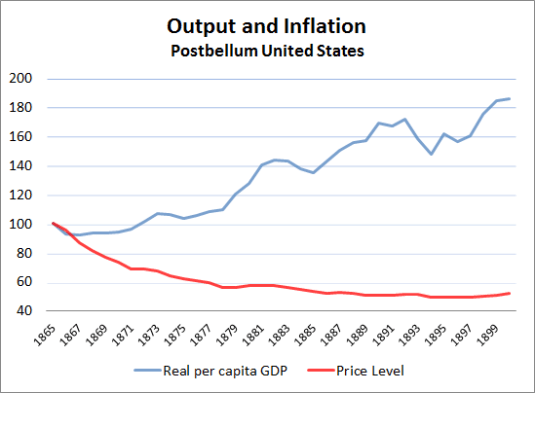

Deflation and Depression: Is There an Empirical Link?
Andrew Atkeson, and Patrick J. Kehoe, 2004.
Are deflation and depression empirically linked? No, concludes a broad historical study of inflation and real output growth rates. Deflation and depression do seem to have been linked during the 1930s. But in the rest of the data for 17 countries and more than 100 years, there is virtually no evidence of such a link.
View original post 1,842 more words
Has the USA moved to lower trend GDP growth path?
26 Jan 2015 Leave a comment
in business cycles, economic growth, great recession, macroeconomics, politics - USA Tags: great recession, Jagadeesh Gokhale, prosperity and depression

Robert Lucas interview in Brazil, 2nd November 2012
24 Jan 2015 Leave a comment
in applied welfare economics, business cycles, comparative institutional analysis, development economics, economic growth, global financial crisis (GFC), great recession, growth disasters, growth miracles, inflation targeting, macroeconomics, monetarism, Robert E. Lucas Tags: Robert E. Lucas


Recent Comments