To avert a financial panic, central banks should lend early and freely to solvent banks against good collateral but at penal rates

First. That these loans should only be made at a very high rate of interest. This will operate as a heavy fine on unreasonable timidity, and will prevent the greatest number of applications by persons who do not require it. The rate should be raised early in the panic, so that the fine may be paid early; that no one may borrow out of idle precaution without paying well for it; that the Banking reserve may be protected as far as possible.

Secondly. That at this rate these advances should be made on all good banking securities, and as largely as the public ask for them. The reason is plain. The object is to stay alarm, and nothing therefore should be done to cause alarm. But the way to cause alarm is to refuse some one who has good security to offer… No advances indeed need be made by which the Bank will ultimately lose. The amount of bad business in commercial countries is an infinitesimally small fraction of the whole business…

The great majority, the majority to be protected, are the ‘sound’ people, the people who have good security to offer. If it is known that the Bank of England is freely advancing on what in ordinary times is reckoned a good security—on what is then commonly pledged and easily convertible—the alarm of the solvent merchants and bankers will be stayed. But if securities, really good and usually convertible, are refused by the Bank, the alarm will not abate, the other loans made will fail in obtaining their end, and the panic will become worse and worse.

Walter Bagehot Lombard Street: A Description of the Money Market (1873).

The classical theory of the lender of last resort stressed

(1) protecting the aggregate money stock, not individual institutions,

(2) letting insolvent institutions fail,

(3) accommodating sound but temporarily illiquid institutions only,

(4) charging penalty rates,

(5) requiring good collateral, and

(6) preannouncing these conditions in advance of crises so as to remove uncertainty.

Did anyone follow these rules in the global financial crisis? The Fed violated the classical model in at least seven ways:

  1. Emphasis on Credit (Loans) as Opposed to Money
  2. Taking Junk Collateral
  3. Charging Subsidy Rates
  4. Rescuing Insolvent Firms Too Big and Interconnected to Fail
  5. Extension of Loan Repayment Deadlines
  6. No Pre-announced Commitment
  7. No Clear Exit Strategy

…{the Fed’s} policies are hardly benign, and that extension of central bank assistance to insolvent too-big-to-fail firms at below-market rates on junk-bond collateral may, besides the uncertainty, inefficiency, and moral hazard it generates, bring losses to the Fed and the taxpayer, all without compensating benefits. Worse still, it is a probable prelude to a severe inflation and to future crises dwarfing the current one.

Thomas Humphrey (2010)

2014 Homer Jones Memorial Lecture – Robert E. Lucas Jr.

The first part of his lecture discusses how the Fed can influence inflation and financial stability.

Central banks can control inflation. Can central banks maintain economic stability’s financial stability? This is still an open question as to whether central banks can do that. The quantity theory of money makes certain sharp predictions about monetary neutrality which are well borne out by the cross country evidence.

In the second part of this lecture, Lucas discusses how central banks around the world have used inflation targeting to keep inflation under control.

What is the Fed to do with the stable relationship between money and prices? Inflation targeting is superior to a fixed growth monetary supply growth rule. This always pushes policy in the direction of the inflation rate you want. Central banks around the world have succeeded in keeping inflation low by explicitly or implicitly targeting the inflation rate.

In the last part of his lecture, Lucas discusses financial crises. he agrees with Gary Gordon’s analysis that 2008 financial crisis was a run on Repo. A run on liquid assets accepted as money because they can be so quickly changed into money. The effective money supply shrank drastically when there was a run on these liquid assets.

Lucas favoured the Diamond and Dybvig of bank runs as panics. The logic of that model applies to the Repo markets now was well as to the banking system. How to extend Glass–Steagall Act type regulation of bank portfolios to the Repo market is a question for future research.

Inflation targeting is working well but the lender of last resort function is yet to be fully understood.

Note: The Diamond-Dybvig view is that bank runs are inherent to the liquidity transformation carried out by banks. A bank transforms illiquid assets into liquid liabilities, subject to withdrawal.

Because of this maturity mismatch, if depositors suspect that others will run on the bank, it is optimal for each depositor to run to the bank to withdraw his or her deposit before the assets are exhausted. The bank run is not driven by some decline in the fundamentals of the bank. Depositors are spooked for some reason, panic, and attempt to withdraw their funds before others get in first. In this case, the provision of deposit insurance and lender of last resort facilities reassures depositors and stems the bank run

In the Kareken and Wallace model of bank runs, deposit insurance is problematic because of the incentives it gives to deposit taking institutions that are insured to take much greater risks. When there is deposit insurance, depositors don’t care about the greater risk in the portfolios of their banks. The greater risk taking leads to higher returns at no extra cost because if these risky investments do fail, the deposit insurance covers their losses

It is therefore necessary to regulate the portfolio of insured banks to ensure that they do not do this. That is the great dilemma for banking regulation because quasi-banks and other liquidity transformation intermediaries such as a Repo market spring up just outside the regulatory net.

Image

Lee Ohanian: Economic Priorities and Restoring Prosperity

Video

The U.S. Economic Growth Gap Revisited

Robert Lucas has asked:

Is it possible that by imitating European policies on labor markets, welfare, and taxes that the U.S. has chosen a new, lower GDP trend?

If so, it may be that the weak recovery we have had so far is all the recovery we will get.

via The Economic Growth Gap Revisited.

The U.S. and Euro-zone non-recoveries

Screen_shot_2014-06-13_at_11.50.26_am

HT: Vox.com from oecd.org

How Does The U.S. Jobs Recovery Compare?

US comparison

Image

Employment losses after financial crises

FinanacialCrises0514

HT: oregoneconomicanalysis.com

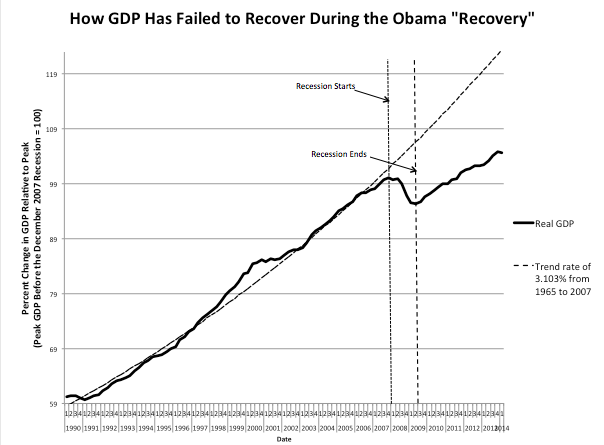
The Obama recovery

image

The deviation from trend is widening.

HT: John Lott

Edward C Prescott – Restoring U.S. Prosperity – Brazil, 10 May 2014


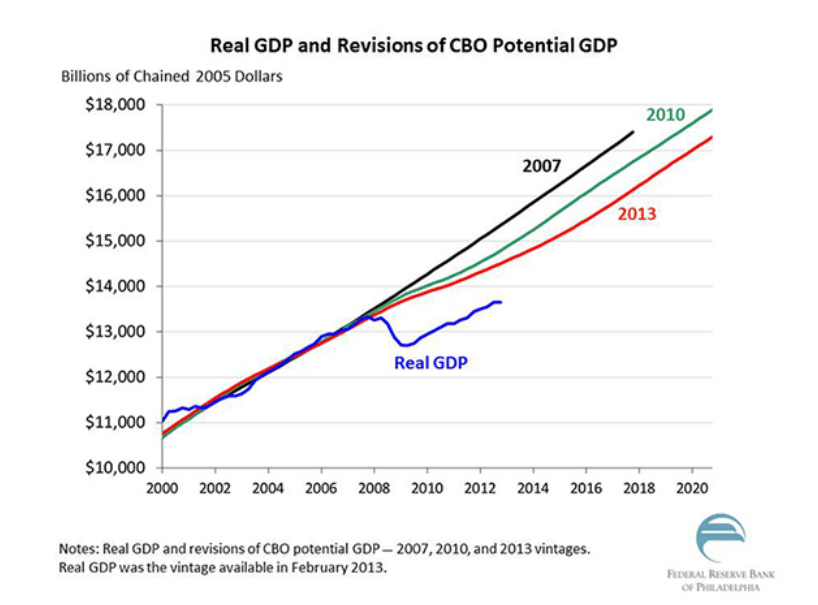
A Great Recession or a permanent move to a lower U.S. growth path?

Philadelphia Fed President Charles Plosser made this nice graph on official views of potential GDP and trends in actual GDP.

via The Grumpy Economist: Declining expectations.

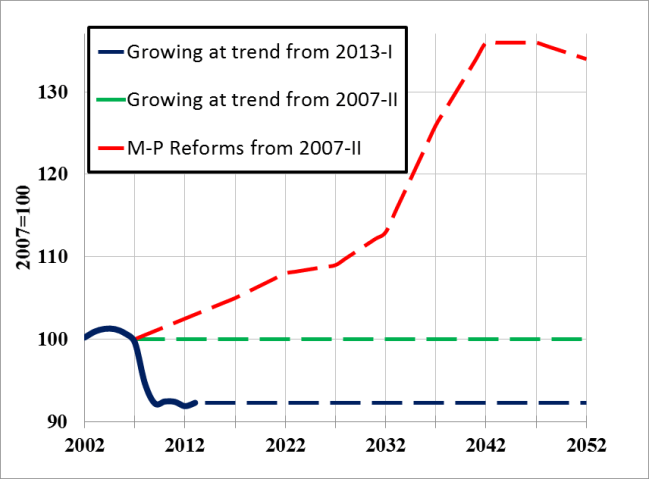
The path to higher U.S. prosperity

Suppose the USA:

  1. Had mandatory savings for retirement
  2. Eliminated capital income taxes
  3. Broadened tax base and lowered the marginal tax rate
  4. Phased in reforms so all birth-year cohorts are made better off
  5. Left welfare programs and local public good shares the same
  6. Savings not part of taxable income, saving withdrawals part of taxable income – with these changes U.S. income tax would be a consumption tax

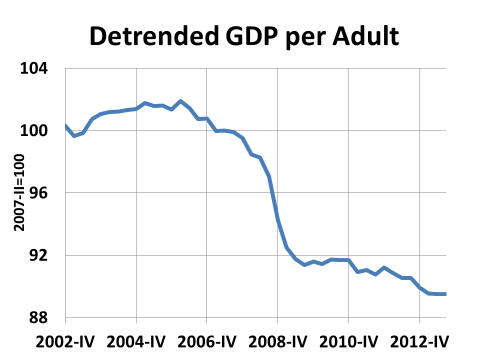
US Detrended GDP per Capita

Source: Edward Prescott and Ellen McGrattan 2013.

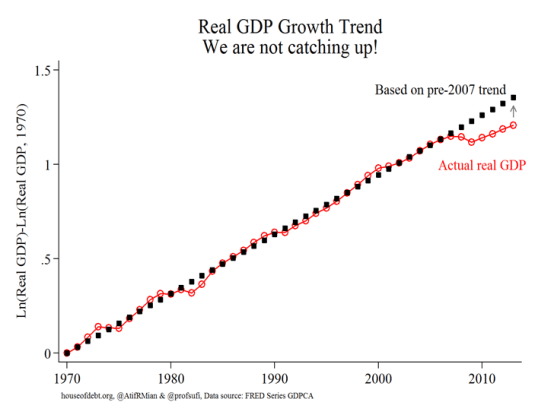
A Great Recession or dropping to a lower long-term growth path

Ed Prescott and Robert Lucas are several of many who use variations of the chart below to show that the USA has moved to a lower long-term growth path.

Source: House of Debt

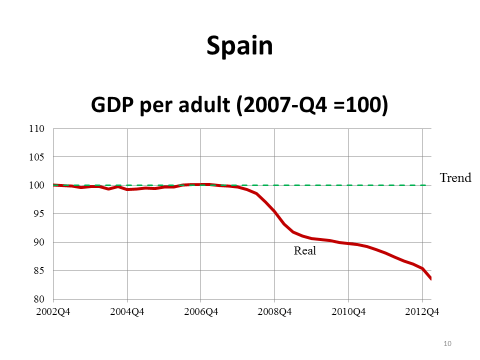
The chart below for output per working age American (ages 15 to 64) is just as depressing.

Source: Edward Prescott

At least Spain with its 25% unemployment rate is doing a little worse.

Source: Edward Prescott

Uncertainty and Ambiguity in American Fiscal and Monetary Policies – Tom Sargent

Macroeconomic forecasting has had a turbulent history

Most early discussions argued against econometric forecasting in principle:

  • Forecasting was not properly grounded in statistical theory,
  • It presupposed that causation implies predictability, and
  • The forecasts themselves were invalidated by the reactions of economic agents to them.

A long tradition argued that social relationships were too complex, too multifarious and too infected with capricious human choices to generate enduring, stable relationships that could be estimated.

These objections came before Hayek’s point that much of all social knowledge is not capable of summation in statistics or even language.
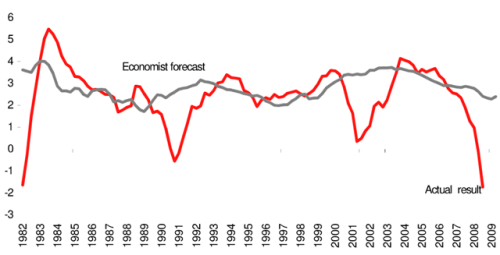
The limitations of forecasting are well-known. Forecasts are conditional on a number of variables; there are important unresolved analytical differences about the operation of the economy; and large uncertainties about the size and timing of responses to macroeconomic changes. Shocks to the output, prices, employment and other variables are partly permanent and partly transitory.

At the practical level, forecasting requires that there are regularities on which to base models, such regularities are informative about the future and these regularities are encapsulated in the selected forecasting model.

We have very little reliable information about the distribution of shocks or about how the distributions change over time. Forecast errors arise from changes in the parameters in the model, mis-specification of the model, estimation uncertainty, mis-measurement of the initial conditions and error accumulation.

In the 1980s, data mining and publications bias were so strong and statistical inferences were so fragile that Ed Leamer’s 1983 Let’s Take the Con out of Econometrics paper made up-and-coming applied economists despair for their professional field and for their own careers:

The econometric art as it is practiced at the computer terminal involves fitting many, perhaps thousands, of statistical models. One or several that the researcher finds pleasing are selected for reporting purposes.

This search for a model is often well intentioned, but there can be no doubt that such a specification search invalidates the traditional theories of inference….

[A]ll the concepts of traditional theory…utterly lose their meaning by the time an applied researcher pulls from the bramble of computer output the one thorn of a model he likes best, the one he chooses to portray as a rose.

… This is a sad and decidedly unscientific state of affairs we find ourselves in.

Hardly anyone takes data analyses seriously.

Or perhaps more accurately, hardly anyone takes anyone else’s data analyses seriously.

Like elaborately plumed birds who have long since lost the ability to procreate but not the desire, we preen and strut and display our t-values [which measure statistical significance].

Leamer still doubts the progress towards techniques that separate sturdy from fragile inferences. Economists by and large simply do not want to hear that they cannot make major conclusions from the data sets. But not that they really do, but that is for a forthcoming post.

Before the great moderation spread wide, Brunner and Meltzer found that in the 1970s and 1980s, the 95% confidence intervals on next year’s forecasts for Gross Domestic Product and the Consumer Price Index are such that government and private forecasters in the USA and Europe could not distinguish between a recession and a boom, nor say whether inflation will be zero or ten per cent.

A review this week by Ahir and Lounganishows found that recent forecasting by the private and public sector has not improved:

none of the 62 recessions in 2008–09 was predicted as the previous year was drawing to a close.

Figure 1. Number of recessions predicted by September of the previous year

Source: Ahir and Loungani 2014, “There will be growth in the spring”: How well do economists predict turning points?” http://www.voxeu.org/

A policy-maker who adjusts policy based on forecasts for the following year has little reason to be confident that he has changed policy in the right direction.

While at graduate school, I wrote what was published as Official Economic Forecasting Errors in Australia 1983-96.

Australian Treasury forecasting errors were so large relative to the mean annual rate of change in real GDP and the inflation rate that, on average, forecasters could not distinguish slow growth from a deep recession or stable prices from moderate inflation.

The biography of Paul Keating by Edwards suggested that the Government of the day was well aware of the poor value of forecasts. So much so that forecasts may not have actually played a significant role in monetary policy making in Australia in the late 1980s onwards. John Stone said this to Keating when he assumed office as Treasurer in 1983:

As you know, we (and I in particular) have never had much faith in forecasting.

Not infrequently, our forecasts turn out to be seriously wrong.

… We simply do the best we can, in as professional manner as we can — and, if it is any consolation, no one seems to be able to do any better, at least in the long haul.

We always emphasize the uncertainties that attach to the forecasts — but we cannot ensure that such qualifications are heeded and plainly they often are not

To cast my results in Milton Friedman’s nomenclature for monetary lags, the recognition lag on a forecasting based monetary policy appears to be infinite because forecasters do not know if there will be a recession or 10% inflation afoot when their monetary policy changes take hold in 18 to 24 months.
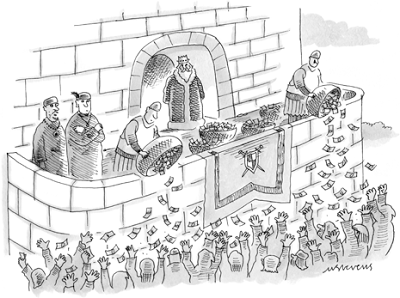
Was the global economic crisis unforeseen?

Plenty of people warned of dark days ahead. An essay anyone can read with profit is Ross Levine’s "An Autopsy of the U.S. Financial System: Accident, Suicide, or Negligent Homicide?"

The paper studies five important policies:

  • Securities and Exchange Commission (SEC) policies toward credit rating agencies,
  • Federal Reserve policies concerning bank capital and credit default swaps,
  • SEC and Federal Reserve policies about over-the-counter derivatives,
  • SEC policies toward the consolidated supervision of major investment banks, and government policies toward Fannie Mae and Freddie Mac.

Levine concludes that

  • The evidence is inconsistent with the view that the collapse of the financial system was caused only by the popping of the housing bubble ("accident") and the herding behaviour of financiers rushing to create and market increasingly complex and questionable financial products ("suicide").
  • Rather, the evidence indicates that senior policymakers repeatedly designed, implemented, and maintained policies that destabilized the global financial system in the decade before the crisis.
  • Moreover, although the major regulatory agencies were aware of the growing fragility of the financial system due to their policies, they chose not to modify those policies, suggesting that "negligent homicide" contributed to the financial system’s collapse
  • Although influential policymakers presumed that international capital flows, euphoric traders, and insufficient regulatory power caused the crisis, the paper shows that these factors played only a partial role.
  • Current reforms represent only a partial and incomplete step in establishing a stable and well-functioning financial system.
  • Since systemic institutional failures helped cause the crisis, systemic institutional reforms must be a part of a comprehensively effective response.

The most interesting morsels are:

  • The New York Times warned in 1999 that Fannie Mae was taking on so much risk that an economic downturn could trigger a “rescue similar to that of the savings and loan industry in the 1980s,” and again emphasized this point in 2003; and
  • Alan Greenspan testified before the Senate Banking Committee in 2004 that the increasingly large and risky GSE portfolios could have enormously adverse ramifications! A rare occasion on which Greenspan did not talk in riddles.


Stern and Feldman’s Too Big to Fail in 2004 used insights gleaned from the formal economic literature to frame warnings in 2004 about the time bomb for a financial crisis set by current regulations and government promises.

The prediction of the Kareken and Wallace moral hazard model of deposit insurance is if a government sets up deposit insurance and doesn’t regulate bank portfolios to prevent them from taking too much risk, the government is setting the stage for a financial crisis. If financial intermediaries do not bear the full consequences of their actions (because they are insured) then profit maximising portfolios will be too risky. The Kareken-Wallace model makes you very cautious about lender-of-last-resort facilities and very sensitive to the risk-taking activities of banks.

Tom Sargent said that Jose Scheinkman made a list of the ten academic papers that the Reagan administration should have looked at. Number one on his list was Kareken and Wallace.

The idea that deposit insurance leads to more financial crises even troubled FDR before he signed the 1934 U.S. bill to introduce deposit insurance.

Previous Older Entries Next Newer Entries

Bassett, Brash & Hide

Celebrating humanity's flourishing through the spread of capitalism and the rule of law

Truth on the Market

Scholarly commentary on law, economics, and more

The Undercover Historian

Beatrice Cherrier's blog

Matua Kahurangi

Celebrating humanity's flourishing through the spread of capitalism and the rule of law

Temple of Sociology

Celebrating humanity's flourishing through the spread of capitalism and the rule of law

Velvet Glove, Iron Fist

Celebrating humanity's flourishing through the spread of capitalism and the rule of law

Why Evolution Is True

Why Evolution is True is a blog written by Jerry Coyne, centered on evolution and biology but also dealing with diverse topics like politics, culture, and cats.

Down to Earth Kiwi

Celebrating humanity's flourishing through the spread of capitalism and the rule of law

NoTricksZone

Celebrating humanity's flourishing through the spread of capitalism and the rule of law

Homepaddock

A rural perspective with a blue tint by Ele Ludemann

Kiwiblog

DPF's Kiwiblog - Fomenting Happy Mischief since 2003

The Dangerous Economist

Celebrating humanity's flourishing through the spread of capitalism and the rule of law

Watts Up With That?

The world's most viewed site on global warming and climate change

The Logical Place

Tim Harding's writings on rationality, informal logic and skepticism

Doc's Books

A window into Doc Freiberger's library

The Risk-Monger

Let's examine hard decisions!

Uneasy Money

Commentary on monetary policy in the spirit of R. G. Hawtrey

Barrie Saunders

Thoughts on public policy and the media

Liberty Scott

Celebrating humanity's flourishing through the spread of capitalism and the rule of law

Point of Order

Politics and the economy

James Bowden's Blog

A blog (primarily) on Canadian and Commonwealth political history and institutions

Science Matters

Reading between the lines, and underneath the hype.

Peter Winsley

Economics, and such stuff as dreams are made on

A Venerable Puzzle

"The British constitution has always been puzzling, and always will be." --Queen Elizabeth II

The Antiplanner

Celebrating humanity's flourishing through the spread of capitalism and the rule of law

Bet On It

Celebrating humanity's flourishing through the spread of capitalism and the rule of law

History of Sorts

WORLD WAR II, MUSIC, HISTORY, HOLOCAUST

Roger Pielke Jr.

Undisciplined scholar, recovering academic

Offsetting Behaviour

Celebrating humanity's flourishing through the spread of capitalism and the rule of law

JONATHAN TURLEY

Res ipsa loquitur - The thing itself speaks

Conversable Economist

Celebrating humanity's flourishing through the spread of capitalism and the rule of law

The Victorian Commons

Researching the House of Commons, 1832-1868

The History of Parliament

Articles and research from the History of Parliament Trust

Books & Boots

Reflections on books and art

Legal History Miscellany

Posts on the History of Law, Crime, and Justice

Sex, Drugs and Economics

Celebrating humanity's flourishing through the spread of capitalism and the rule of law

European Royal History

Exploring the Monarchs of Europe

Tallbloke's Talkshop

Cutting edge science you can dice with

Marginal REVOLUTION

Small Steps Toward A Much Better World

NOT A LOT OF PEOPLE KNOW THAT

“We do not believe any group of men adequate enough or wise enough to operate without scrutiny or without criticism. We know that the only way to avoid error is to detect it, that the only way to detect it is to be free to inquire. We know that in secrecy error undetected will flourish and subvert”. - J Robert Oppenheimer.

STOP THESE THINGS

The truth about the great wind power fraud - we're not here to debate the wind industry, we're here to destroy it.

Lindsay Mitchell

Celebrating humanity's flourishing through the spread of capitalism and the rule of law

Alt-M

Celebrating humanity's flourishing through the spread of capitalism and the rule of law

croaking cassandra

Economics, public policy, monetary policy, financial regulation, with a New Zealand perspective

The Grumpy Economist

Celebrating humanity's flourishing through the spread of capitalism and the rule of law

International Liberty

Restraining Government in America and Around the World