Unemployment rates across OECD member countries

Greek and US great depressions compared

https://twitter.com/ianbremmer/status/620570062538309632/photo/1

John Rawls on the limits of inequality

Image

How to argue against employment protection laws while arguing for additional employment regulation

The Centre for American Progress recently published an excellent survey of the costs to employers of hiring and training new recruits. As the paper notes:

it is costly to replace workers because of the productivity losses when someone leaves a job, the costs of hiring and training a new employee, and the slower productivity until the new employee gets up to speed in their new job.

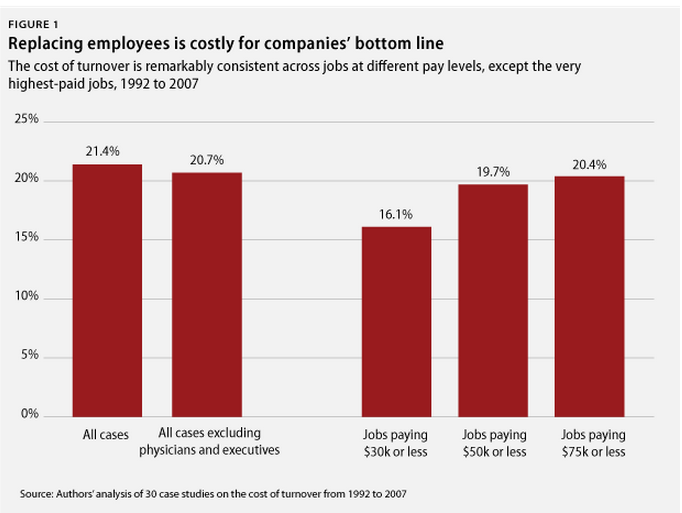
Our analysis reviews 30 case studies in 11 research papers published between 1992 and 2007 that provide estimates of the cost of turnover, finding that businesses spend about one-fifth of an employee’s annual salary to replace that worker.

The purpose of the research published by the Centre for American Progress was to argue there were large costs to employers from replacing even low paid workers and there are a workplace policies such as paid family leave and workplace flexibility will reduce these job turnover costs to employers.

image

Similar arguments are used to justify a living wage on efficiency grade wage grounds. A living wage would reduce job turnover and therefore the costs to employers of job turnover in the jobs.

The research published by the Centre for American Progress also illustrates the bargaining power of workers. Employers who failed to treat workers fairly and pay them the going wage risk an increase in job quit rates. These large costs of job turnover have been carefully documented by the Centre for American Progress.

Employers incur fixed costs of employment when they recruit and train new employees. These recruits must be expected to stay long enough to work sufficient hours for the firm to expect to recover these investments (Oi (1962, 1983a, 1990), Idson and Oi (1999), Hutchens (2010), Hutchens and Grace-Martin (2006)).

These costs are fixed costs because they do not vary with how many hours the employee works or with how long an employee stays with their employer. These fixed employment costs must be recouped over the expected job tenure of the employee with the firm. Employers will not hire an additional worker unless they anticipate recovering the costs of doing do including fixed employment costs and other overheads.

Central to arguments such as by Richard Epstein for employment at will is the threat of the employee to quit imposes a real cost on employers which the employer will seek to avoid by treating their employees well.

The best way to prevent exploitation of workers is to make hiring and firing easy, facilitate new entry by firms into all markets and promote full employment – a worker with other available job opportunities is difficult to exploit.

With large fixed costs of recruitment and training, employers cannot afford to behave whimsically if they wish to survive in competition with the rival firms with more competitive wage and employment policies.

By the same token, the large fixed costs of employment documented by the Centre for American Progress illustrate the large investments employers must risk to recruit a new employee.

If this large investment in recruitment doesn’t turn out well, but is difficult to get out of because of strict employment laws, employers will be more reluctant in the first instance to risk this investment because they are risking several months wages in fixed costs of employment. As Richard Epstein explained:

A second great advantage of the at-will system is that it supplies an informal method of bonding that keeps both sides in line.

The employer who tries to take advantage of the employee by altering working conditions for the worse will be met by the threat to quit, for now the deal is worth less to the employee than the wage received.

So long as markets are competitive the switching costs will be relatively low – lower in fact than they are in a highly regulated world where employers have to think twice before taking on a worker whom they may be unable to fire if things do not work out.

Yet on the other side, the employee who takes it easy on the job is faced with dismissal because he is no longer worth his wages.

But even here management will hesitate to dismiss for good reasons. One is the very substantial costs of recruiting and training a replacement who might or might not turn out to be better than the worker who was dismissed. The second is that unjust dismissals could induce other workers to leave while the going is good, thereby compounding the problem of recruitment and retention.

The Centre for American Progress was good enough to document the very substantial costs of recruiting and training a replacement employee. As the Centre for American Progress explained in their paper, employers have every reason to protect their investments in training and recruitment by minimising job turnover costs.

French, German and Italian unemployment rates, 1956 – 2013

Figure 1: French, German and Italian unemployment rates, 1956 – 2013

image

Source: OECD StatExtract.

Unemployment by educational level and degree level

Job finding rates and the unemployment benefit exhaustion spike

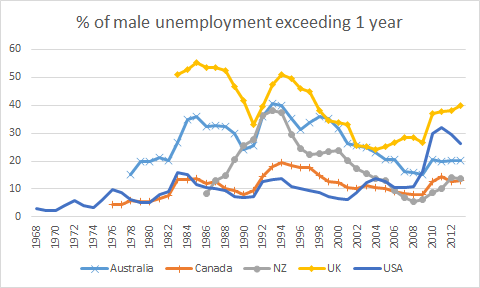
Long-term unemployment by sex, Australia, Canada, New Zealand, UK and USA, 1968 – 2013

image

Source: OECD StatExtract

image

Source: OECD StatExtract

@WJRosenbergCTU How the unions argued for the Employment Contracts Act when arguing strongly against it

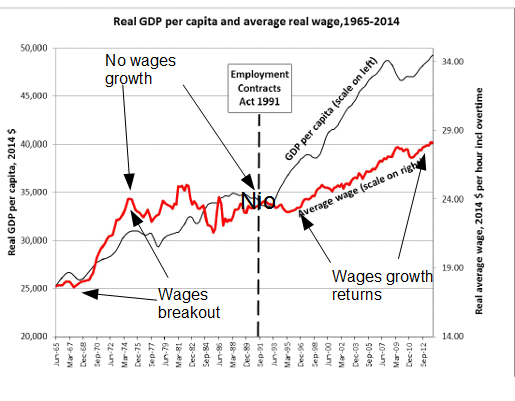
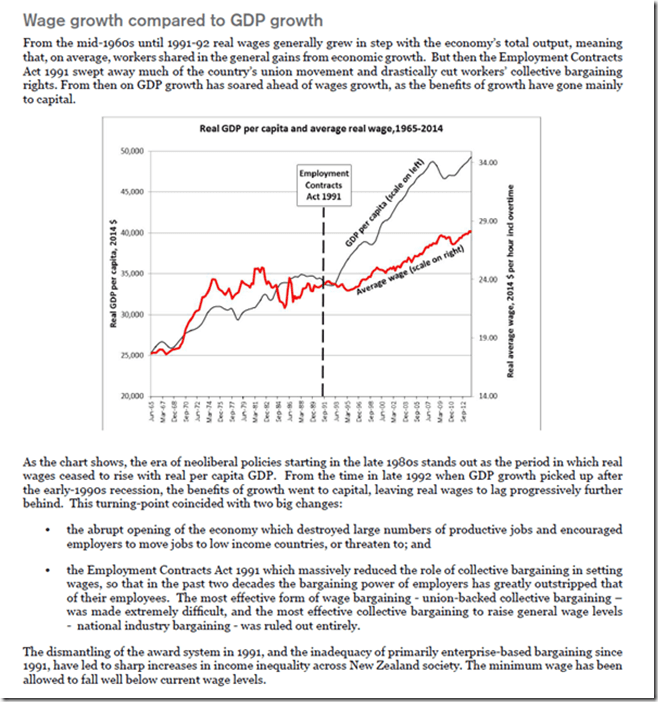
The Council of Trade Unions scored something of an own goal in the 2014 election campaign when it was denouncing the Employment Contracts Act 1991 as the reason for wages growth have not kept up with GDP per capita growth since its passage in 1991. Its evidence in chief against the deregulation of the New Zealand labour market is in the snapshot below showing their graph of real GDP per capita and average real wages from 1965 to 2014.
image

Source: Low Wage Economy | New Zealand Council of Trade Unions – Te Kauae Kaimahi.

The chart selected by the Council of Trade Unions shows several distinct trends in wages growth and real GDP growth  per capita in New Zealand. None of these trends nor breaks in trends support the hypothesis that the days prior to the Employment Contracts Act 1991 were the good old days where workers shared generally in gains from economic growth.

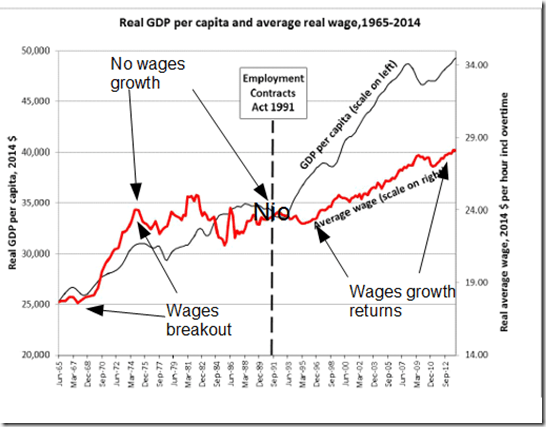
From about 1970 to 1975 in the snapshot below of the Council of Trade Unions chart there was rapid real wages growth, well in excess of real growth in per capita GDP. This wages breakout was followed by some ups and downs but essentially wages in 1995 were no different from what they were in 1975. Real wages were about $24 per hour in real terms in New Zealand for about 20 years – from 1975 to 1995.
image

These are the good old days in the eyes of the Council of Trade Unions. No real wages growth for 20 years. There was no real GDP per capita growth from 1975 until 1979 nor in the five years leading up to the passage of the Employment Contracts Act 1991 in the chart selected by the Council of Trade Unions in the snapshot above.

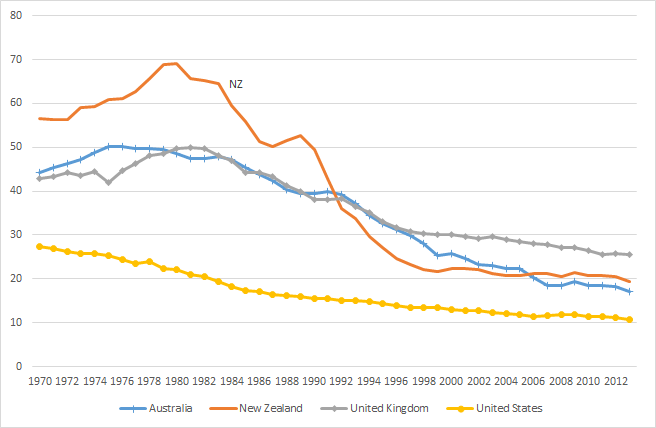
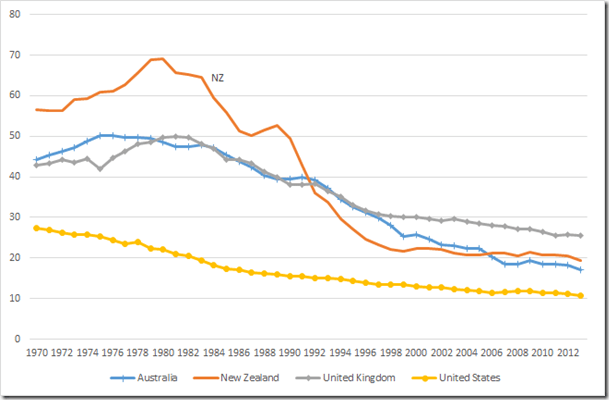
The period leading up to 1975  in the preceding wages breakout was the zenith of union membership with nearly 70% of all workers belonging to a union – see figure 1. What followed from 1975 was a long declining in trade union membership that did not end until just after the Employment Contracts Act in 1991 – see figure 1.

Figure 1: Trade union densities, New Zealand, Australia, United Kingdom and United States, 1970–2013
image

Source:  OECD StatExtract.

Whatever happened to union power in New Zealand happened before the passage of the Employment Contracts Act 1991 and with it the deregulation of the New Zealand labour market. 20 years of no real wages growth and economic stagnation may explain part of the decline of unions in New Zealand.

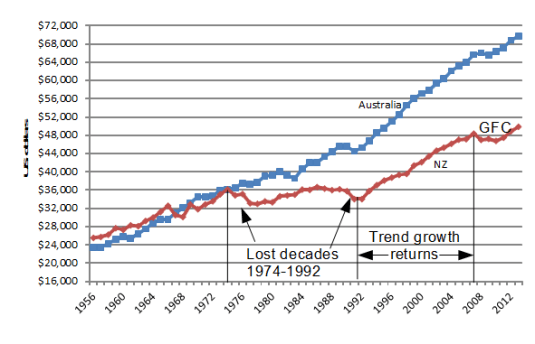
Real GDP per capita growth was pretty stagnant after 1975 to 1994 in the chart of data selected by the  Council of Trade Unions, which is why I have previously referred to 1974 to 1992 as New Zealand’s Lost Decades – see figures 2 and 3.

Figure 2: Real GDP per New Zealander and Australian aged 15-64, converted to 2013 price level with updated 2005 EKS purchasing power parities, 1956-2013, $US
Source: Computed from OECD Stat Extract and The Conference Board, Total Database, January 2014, http://www.conference-board.org/economics

Figure 2 shows that New Zealand lost two decades of productivity growth between 1974 and 1992 after level pegging with Australia for the preceding two decades.

These lost decades of growth are the unions’ good old days but workers cannot share in the general gains of economic growth when there isn’t any economic growth as the chart selected by the Council of Trade Unions and figure 2 both show.

New Zealand returned to trend growth  in real GDP per working age New Zealander between 1992 and 2007, which is straight after the passage of the Employment Contracts Act 1991 – see figure 2. Coincidence?

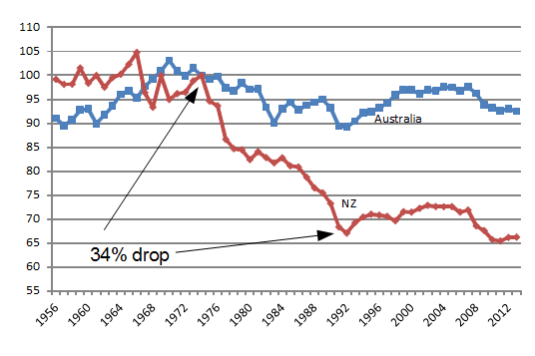
Figure 3: Real GDP per New Zealander and Australian aged 15-64, converted to 2013 price level with updated 2005 EKS purchasing power parities, 1.9 per cent detrended, base 100 = 1974, 1956-2013, $US
Source: Computed from OECD Stat Extract and The Conference Board, Total Database, January 2014, http://www.conference-board.org/economics

In Figure 3, a flat line equates to a 1.9% annual growth rate in real GDP per working age person; a falling line is a below trend growth rate; a rising line is an above 1.9% growth rate of real GDP per working age person. The trend growth rate of 1.9% per working age person is the 20th century trend growth rate that Edward Prescott currently estimates for the global industrial leader, which is the United States of America.

Figure 3 shows that there was a 34% drop against trend growth in real GDP per working age New Zealander between 1974 and 1992; a return to trend growth between 1992 and 2007; and a recession to 2010. this 34% drop against trend productivity growth is looked upon by the Council of Trade Unions as some sort of good old days.

A long period of no labour productivity growth and little real GDP per capita growth are pretty good reasons to rethink New Zealand’s economic policies at a fundamental level, which is exactly what happened after 1984 with the election of a Labour Government.

The unions have conveniently provided another explanation for the Lost Decades of growth in New Zealand from 1974 to 1992. That is the rapid growth of real wages ahead of real GDP per capita in the seven years before growth stalled in New Zealand in 1974 in the snapshot above. This real wages breakout was followed by two decades of lost growth.

Most ironically of all, steady growth in real wages in New Zealand did not return until after the passage of the Employment Contracts Act in 1991! After nearly 20 years of no real wages growth, real wages growth returned at long last in 1995.

After staying at about $24 per hour for 20 years from 1975 in the good old days of union power and collective bargaining, average wages in New Zealand have increased from $24 an hour to about $28 per hour by 2014 in one of the most deregulated labour markets in the world.

The Council of Trade Unions regards the return of real wages growth after a 20 year hiatus as an unwelcome development or something to complain about.

How motherhood in America has changed

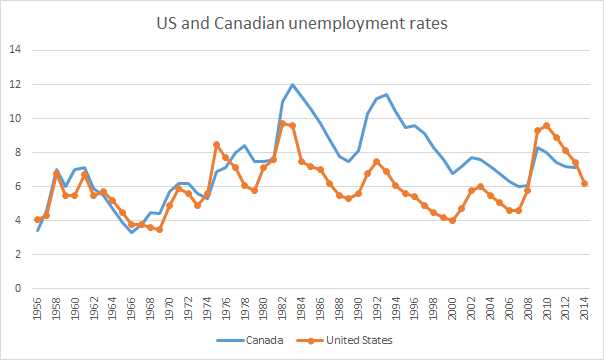
US and Canadian unemployment rates, 1956–2014

image

Source: OECD StatExtract

Unemployed people are defined as those who report that they are without work, that they are available for work and that they have taken active steps to find work in the last four weeks.

The ILO Guidelines specify what actions count as active steps to find work; these include answering vacancy notices, visiting factories, construction sites and other places of work, and placing advertisements in the press as well as registering with labour offices.

Unemployment isn’t much of an issue for the well educated in recessions

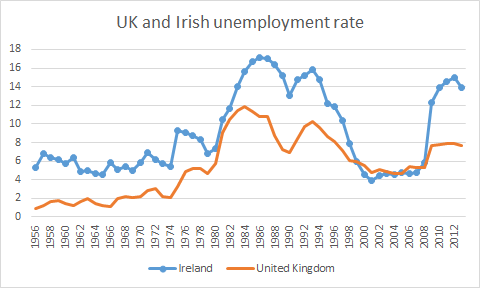
The sick men of Europe? British and Irish unemployment rates, 1956–2013

image

Source: OECD StatExtract

Ireland and Britain justly earned the name the sick man of Europe in the 1980s. Irish unemployment was  in the mid teens much of the 1980s because the Irish economy was in a great depression  from 1973 to 1992.

Unemployed people are defined as those who report that they are without work, that they are available for work and that they have taken active steps to find work in the last four weeks. The ILO Guidelines specify what actions count as active steps to find work; these include answering vacancy notices, visiting factories, construction sites and other places of work, and placing advertisements in the press as well as registering with labour offices.

British economic recoveries compared

Why are Europe’s strong employment protection laws still popular with the Left?

The countries with the more liberal labour markets are recovering fastest from the Great Recession and the Global Financial Crisis.

This includes Germany where there were major labour market reforms a couple of years before the onset of the Global Financial Crisis. For that reason, German unemployment rates didn’t rise much in 2008 and after and are now falling quite rapidly because of their labour market liberalisations. Germany has the lowest unemployment rate in Europe.

Previous Older Entries Next Newer Entries

Bassett, Brash & Hide

Celebrating humanity's flourishing through the spread of capitalism and the rule of law

Truth on the Market

Scholarly commentary on law, economics, and more

The Undercover Historian

Beatrice Cherrier's blog

Matua Kahurangi

Celebrating humanity's flourishing through the spread of capitalism and the rule of law

Temple of Sociology

Celebrating humanity's flourishing through the spread of capitalism and the rule of law

Velvet Glove, Iron Fist

Celebrating humanity's flourishing through the spread of capitalism and the rule of law

Why Evolution Is True

Why Evolution is True is a blog written by Jerry Coyne, centered on evolution and biology but also dealing with diverse topics like politics, culture, and cats.

Down to Earth Kiwi

Celebrating humanity's flourishing through the spread of capitalism and the rule of law

NoTricksZone

Celebrating humanity's flourishing through the spread of capitalism and the rule of law

Homepaddock

A rural perspective with a blue tint by Ele Ludemann

Kiwiblog

DPF's Kiwiblog - Fomenting Happy Mischief since 2003

The Dangerous Economist

Celebrating humanity's flourishing through the spread of capitalism and the rule of law

Watts Up With That?

The world's most viewed site on global warming and climate change

The Logical Place

Tim Harding's writings on rationality, informal logic and skepticism

Doc's Books

A window into Doc Freiberger's library

The Risk-Monger

Let's examine hard decisions!

Uneasy Money

Commentary on monetary policy in the spirit of R. G. Hawtrey

Barrie Saunders

Thoughts on public policy and the media

Liberty Scott

Celebrating humanity's flourishing through the spread of capitalism and the rule of law

Point of Order

Politics and the economy

James Bowden's Blog

A blog (primarily) on Canadian and Commonwealth political history and institutions

Science Matters

Reading between the lines, and underneath the hype.

Peter Winsley

Economics, and such stuff as dreams are made on

A Venerable Puzzle

"The British constitution has always been puzzling, and always will be." --Queen Elizabeth II

The Antiplanner

Celebrating humanity's flourishing through the spread of capitalism and the rule of law

Bet On It

Celebrating humanity's flourishing through the spread of capitalism and the rule of law

History of Sorts

WORLD WAR II, MUSIC, HISTORY, HOLOCAUST

Roger Pielke Jr.

Undisciplined scholar, recovering academic

Offsetting Behaviour

Celebrating humanity's flourishing through the spread of capitalism and the rule of law

JONATHAN TURLEY

Res ipsa loquitur - The thing itself speaks

Conversable Economist

Celebrating humanity's flourishing through the spread of capitalism and the rule of law

The Victorian Commons

Researching the House of Commons, 1832-1868

The History of Parliament

Articles and research from the History of Parliament Trust

Books & Boots

Reflections on books and art

Legal History Miscellany

Posts on the History of Law, Crime, and Justice

Sex, Drugs and Economics

Celebrating humanity's flourishing through the spread of capitalism and the rule of law

European Royal History

Exploring the Monarchs of Europe

Tallbloke's Talkshop

Cutting edge science you can dice with

Marginal REVOLUTION

Small Steps Toward A Much Better World

NOT A LOT OF PEOPLE KNOW THAT

“We do not believe any group of men adequate enough or wise enough to operate without scrutiny or without criticism. We know that the only way to avoid error is to detect it, that the only way to detect it is to be free to inquire. We know that in secrecy error undetected will flourish and subvert”. - J Robert Oppenheimer.

STOP THESE THINGS

The truth about the great wind power fraud - we're not here to debate the wind industry, we're here to destroy it.

Lindsay Mitchell

Celebrating humanity's flourishing through the spread of capitalism and the rule of law

Alt-M

Celebrating humanity's flourishing through the spread of capitalism and the rule of law

croaking cassandra

Economics, public policy, monetary policy, financial regulation, with a New Zealand perspective

The Grumpy Economist

Celebrating humanity's flourishing through the spread of capitalism and the rule of law

International Liberty

Restraining Government in America and Around the World