09 Aug 2015
by Jim Rose
in business cycles, economic history, global financial crisis (GFC), job search and matching, labour economics, labour supply, macroeconomics, unemployment
Tags: British disease, British economy, equilibrium unemployment rate, Margaret Thatcher, natural unemployment rate, unemployment duration, unemployment rates
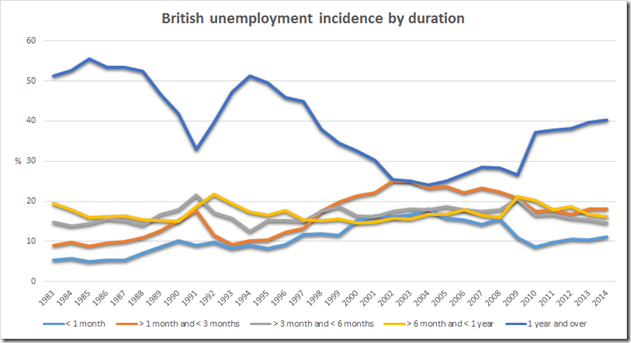
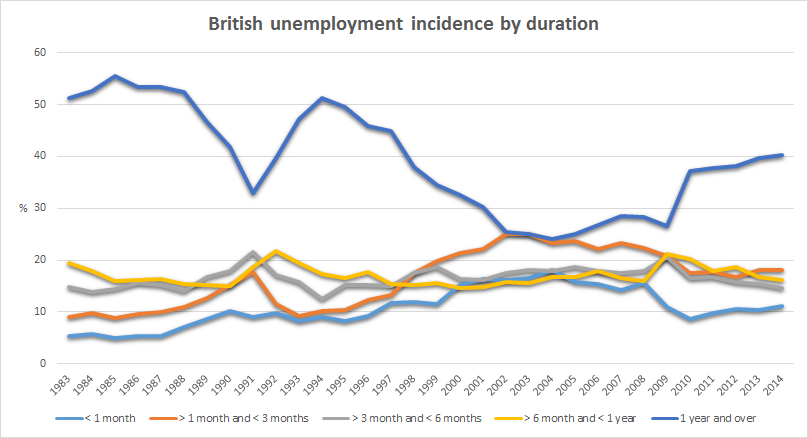
In contrast to the USA, there is been a long-term decline in long-term unemployment, that is unemployment of more than a year, in the British economy over the 1990s. The situation then stabilised and then increased after the global financial crisis. There is also a rather rapid fall in long-term unemployment in the mid-1980s as the British economy recovered under Thatchernomics
Source: OECD StatExtract.
08 Aug 2015
by Jim Rose
in budget deficits, great recession, job search and matching, labour economics, labour supply, macroeconomics, politics - USA, unemployment, welfare reform
Tags: natural unemployment rate, taxation and labour supply, unemployment duration, unemployment insurance, unemployment rates, welfare state
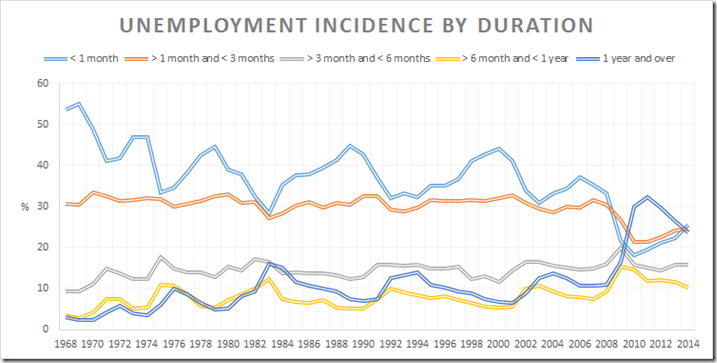
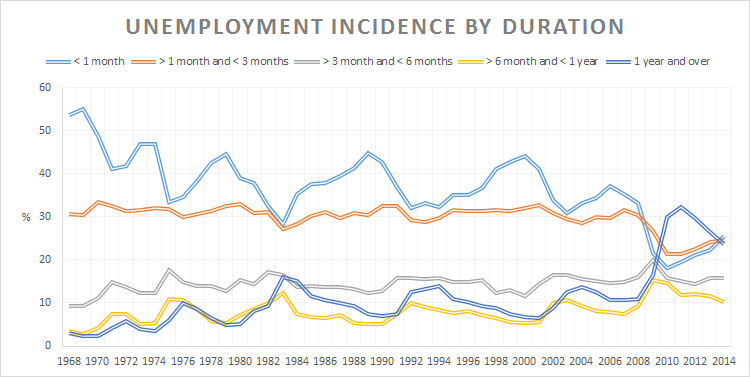
The Great Recession was the first recession in the USA in a good 40 to 50 years where the composition of employment changed by much. Even the big recession at the beginning of the 1980s did not do much to the composition of unemployment by duration in the USA.
Source: OECD StatExtract.
Those unemployed for more than a year moved from barely double digits even in a bad recession prior to 2008 to coming on one-third of all unemployed. Likewise, those unemployed for less than a month halved from 40% to 20%. Something changed in the US labour market with the Great Recession and the long extensions of unemployment insurance from 26 weeks to 52 weeks and then 99 weeks.
08 Aug 2015
by Jim Rose
in business cycles, economic history, global financial crisis (GFC), great recession, job search and matching, labour economics, labour supply, macroeconomics, unemployment
Tags: Australia, Canada, unemployment rates
Source: OECD StatExtract.
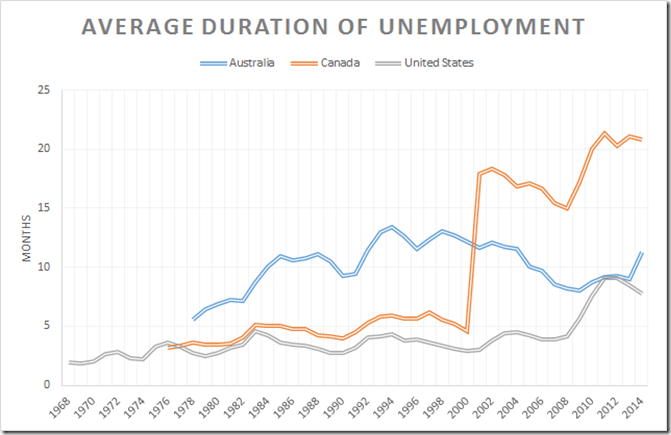
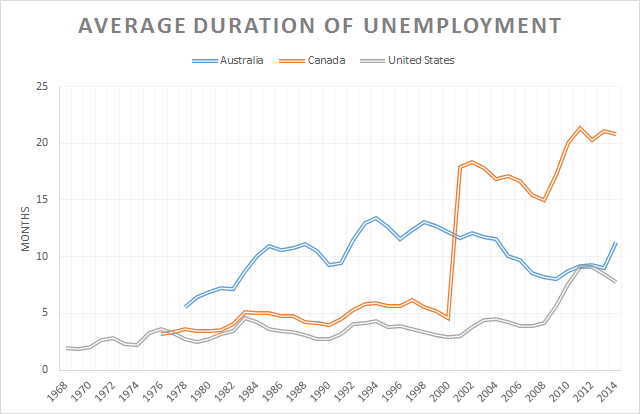
I have no information as to why there is a sudden surge in the Canadian unemployment duration rate in 2001.
08 Aug 2015
by Jim Rose
in Euro crisis, job search and matching, labour economics, macroeconomics, minimum wage, unemployment
Tags: employment law, equilibrium unemployment rates, Eurosclerosis, expressive voting, labour market regulation, natural unemployment rate, offsetting behaviour, rational irrationality, unintended consequences
07 Aug 2015
by Jim Rose
in economic history, global financial crisis (GFC), job search and matching, labour economics, labour supply, macroeconomics, politics - New Zealand, unemployment
Tags: Australia, equilibrium unemployment rate, natural unemployment rate, unemployment duration
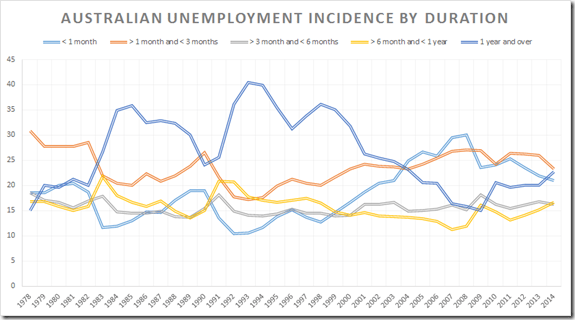
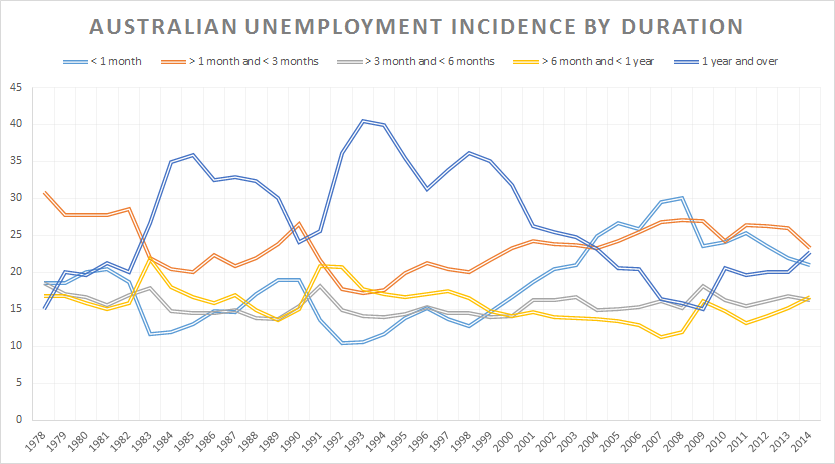
As with New Zealand, Australian long-term unemployment seems to go up and down quite a lot with recessions such as those in the early 1980s and early 1990s but not after the global financial crisis.
Source: OECD StatExtract.
05 Aug 2015
by Jim Rose
in economic history, Euro crisis, job search and matching, labour economics, labour supply, macroeconomics, unemployment
Tags: employment law, equilibrium unemployment rate, France, labour market regulation, natural unemployment rate, unemployment duration
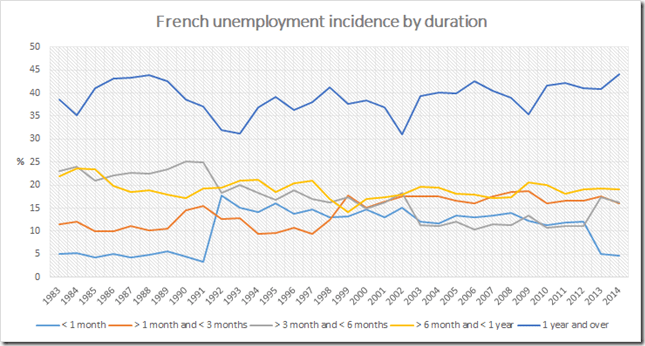
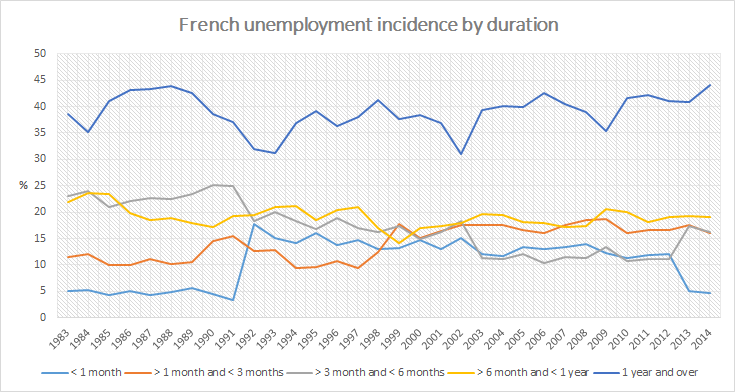
Nothing really changes in France recently unemployment duration. Italian labour market is notorious for having very low inflows and outflows from employment and unemployment.
Source: OECD StatExtract.
30 Jul 2015
by Jim Rose
in business cycles, currency unions, economic growth, Euro crisis, job search and matching, labour economics, labour supply, macroeconomics, unemployment
Tags: employment law, employment regulation, EU, Euro sclerosis, Euroland, Eurosclerosis, Japan, labour market regulation
29 Jul 2015
by Jim Rose
in economic history, job search and matching, labour economics, labour supply, law and economics, minimum wage, politics - Australia, politics - New Zealand, politics - USA, unions
Tags: Australia, British economy, employment law, employment law regulation
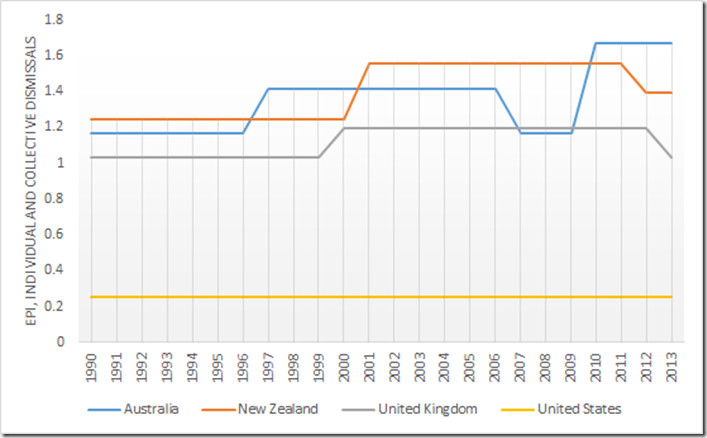
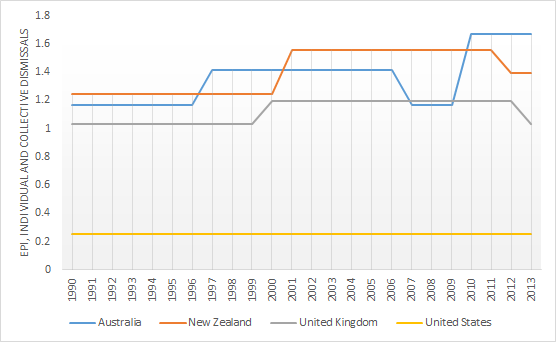
Major deregulations and re-regulations of the labour market in Australia and New Zealand did not move the employment protection inducts around that much in figure 1. All is been quiet on the labour market regulation front of the UK pretty much since the index was started.
Figure 1: OECD employment protection index (EPI), strictness of employment protection – individual and collective dismissals, USA, UK, Australia and New Zealand, 1990 – 2013
Source: OECD StatExtract.
The Work Choices legislation in Australia in 2006 was looked upon by the OECD as a somewhat minor deregulation not much more in scale than the deregulation introduced in 2008 with the election of the National Party led government.

Nobody told the unions that.
28 Jul 2015
by Jim Rose
in Euro crisis, job search and matching, labour economics, law and economics, macroeconomics
Tags: British economy, employment law, employment law regulation, Eurosclerosis, France, Germany, Greece, Italy, Portugal, Spain
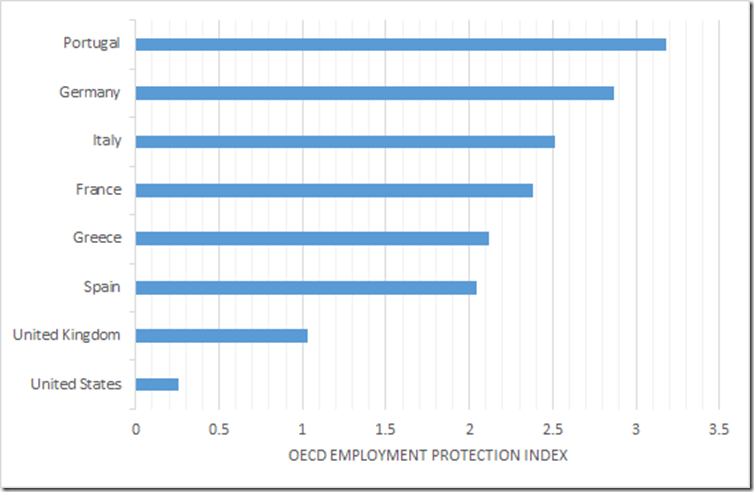
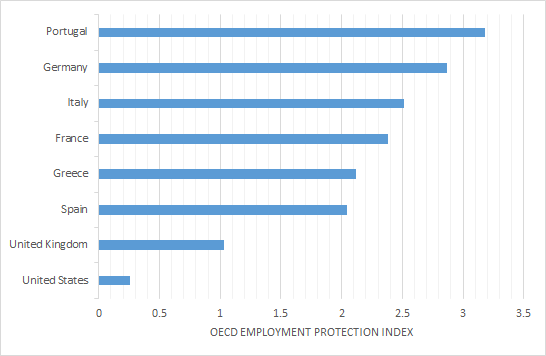
Much easier to fire someone in the USA or UK than on continental Europe. Greece and Spain aren’t that bad by continental European standards for employment law protections against dismissals of individuals.
Figure 1: Strictness of employment protection for individual dismissals, 2013
Source: OECD StatExtract.
24 Jul 2015
by Jim Rose
in business cycles, econometerics, economic growth, economic history, job search and matching, labour economics, labour supply, macroeconomics, politics - New Zealand, Public Choice, unemployment, unions, welfare reform
Tags: antimarket bias, Don Brash, economic reform, expressive voting, Homer Simpson, Leftover Left, lost decades, makework bias, neoliberalism, rational ignorance, rational irrationality, Sir Roger Douglas, Twitter left
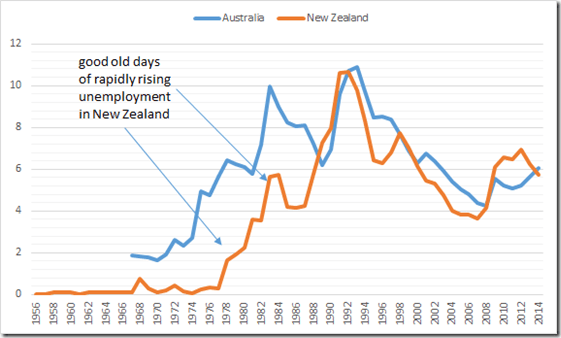
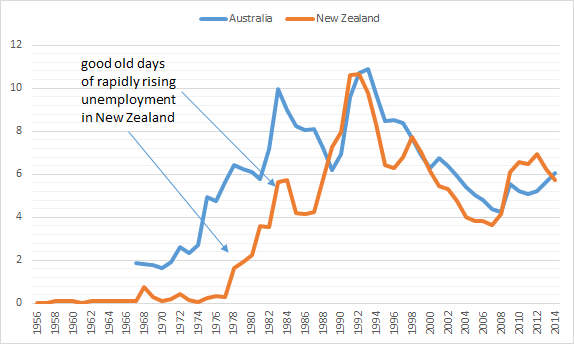
Today, Closing The Gap – The Income Inequality Project boldly claimed today that there was next to no unemployment in New Zealand prior to the onset of the curse of neoliberalism.

There is an Internet on computers now where it is easy to find data showing that the unemployment rate was rising rapidly in New Zealand in the 1970s and in double digits by the end of the 1980s – see figure 1.
Figure 1: harmonised unemployment rates, Australia and New Zealand, 1956-2014
Source: OECD StatExtract.
Figure 1 shows unemployment was rising rapidly in the 1970s and wasn’t much different by the end of the 1970s to the unemployment rates recorded after about 2000 in New Zealand.

One of the reasons that Sir Roger Douglas wrote There’s Got To Be A Better Way was the rapidly rising unemployment in New Zealand and the stagnant economic growth in the late 1970s and early 1980s.

New Zealand was one of the most regulated economies, so much so that Prime Minister David Lange said:
We ended up being run very similarly to a Polish shipyard.
As for those jobs on the railways, the then Reserve Bank Governor Don Brash said in 1996:
Railways cut its freight rates by 50 percent in real terms between 1983 and 1990, reduced its staff by 60 percent, and made an operating profit in 1989/90, the first for six years.
21 Jul 2015
by Jim Rose
in business cycles, economics of education, global financial crisis (GFC), great recession, human capital, job search and matching, labour economics, labour supply, macroeconomics, unemployment
Tags: education premium, labour market demographics
21 Jul 2015
by Jim Rose
in economic history, economics of regulation, global financial crisis (GFC), job search and matching, labour economics, labour supply, law and economics, minimum wage, politics - USA, unions
Tags: British economy, employment law, employment regulation, Eurosclerosis, France, Germany, Index of Economic Freedom
The writers of the Index of Economic Freedom at the Heritage foundation really loves the USA and didn’t think much of the Conservative Party – Liberal Democratic Party coalition government because labour market freedom actually fell in the UK during their administration. Bring back Tony Blair, all is forgiven. The information on their website throws no insight into why this reduction in labour market freedom in Britain happened.
Figure 1: Index of Economic Freedom, Argentina, Brazil, Chile and Venezuela, 95 – 2015 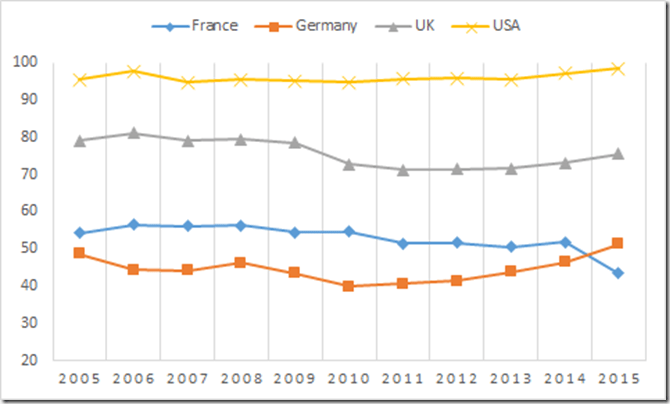
Source: Index of Economic Freedom 2015.
Fortunately for Germany, labour market freedom increased over the course of the global financial crisis and its aftermath. This helps explains low unemployment in Germany during that period. Nothing much happened in France in regard to labour market freedom.
19 Jul 2015
by Jim Rose
in business cycles, economic growth, economic history, fiscal policy, job search and matching, labour economics, macroeconomics, unemployment
Tags: Celtic Tiger, equilibrium unemployment rate, Eurosclerosis, Germany, Ireland, Italy, natural unemployment rate, Rance, Spain
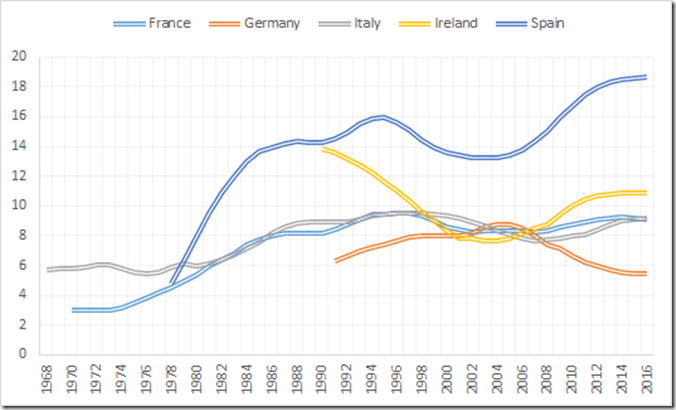
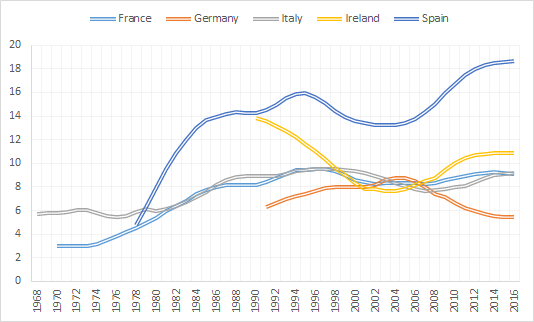
Figure 1 shows large contrasts in time path of equilibrium unemployment rates. For example, French and Italian equilibrium unemployment rates haven’t changed much since about 1986.
Figure 1: equilibrium unemployment rates, France, Germany, Italy, Ireland and Spain, 1968 – 2016
Source: OECD Economic Outlook June 2015 via OECD StatExtract..
Figure 1 also shows some fortuitous ups and downs in the German equilibrium unemployment rate. This estimate was available only from after German unification.
The equilibrium German unemployment rate rose from 6% to above 8% on the eve of the global financial crisis. Fortunately for Germany, major labour market reforms brought the equilibrium unemployment rate down as Germany moved into the global financial crisis.
The Spanish equilibrium unemployment rate had been terrible since about 1980, started to fall in the 1990s, then skyrocketed even before the onset of the global financial crisis – see figure 1.
There have been ups and downs in the Irish equilibrium unemployment rate – see figure 1. It was as high as 14% at the end of the Irish great depression of the 1970s and 1980s. The equilibrium Irish unemployment rate was 8% at the heyday of the Celtic tiger then slowly rose in the lead up to the global financial crisis.
18 Jul 2015
by Jim Rose
in business cycles, job search and matching, labour economics, labour supply, macroeconomics, unemployment
Tags: British economy, Canada, equilibrium unemployment rate, natural unemployment rate
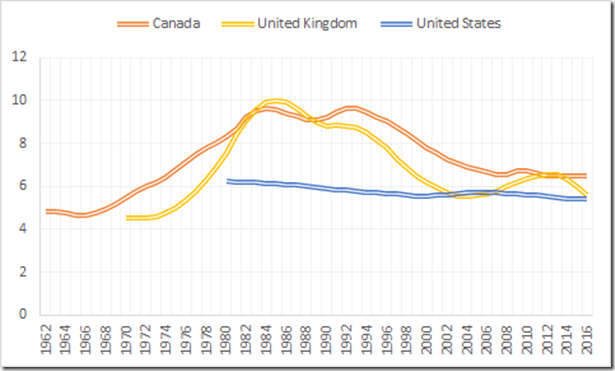
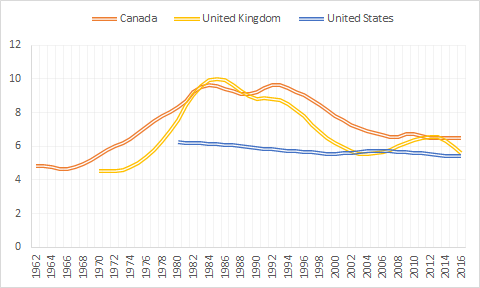
Figure 1 suggests a lot more structural change in the Canadian and British labour market in the 1970s and 1980s.
Figure 1: equilibrium unemployment rates, Canada, USA and UK, 1962 – 2016
Source: OECD Economic Outlook June 2015 via OECD StatExtract.
Nothing much at all seems to have happened to the equilibrium unemployment rate in the USA since the OECD first started calculating it. I doubt that so that will be subject of a future blog. Namely, the large changes in natural unemployment rates in the post-war period, largely to demographic changes such as the baby boom.
Previous Older Entries Next Newer Entries



Recent Comments