
Financial regulation and financial crisis | Sam Peltzman Oct 19, 2014
17 Nov 2014 Leave a comment
in economics of regulation, global financial crisis (GFC), macroeconomics, monetary economics, Sam Peltzman Tags: economics of regulation, financial crises, offsetting behaviour, Sam Peltzman
Friday graph: why Ireland is broke
31 Oct 2014 5 Comments
in fiscal policy, global financial crisis (GFC), macroeconomics, monetary economics Tags: GFC, Ireland
I am planning to blog on why the Irish economic crisis of recent years was caused exclusively by government, and in particular, government responses that made an ordinary recession into a depression

This is a graph courtesy of the Institute of Public Affairs in Melbourne, an impressive Australian thinktank.
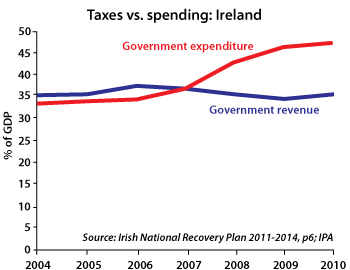
It comes from the Irish government’s own 140 page ‘National Recovery Plan‘ published last week.
It is amazing reading.
- From 2000 to 2009 average public sector salaries increased 59%
- In 2004, 34% of income earners were exempt from tax. In 2010, 45% were exempt
- In 2007 property taxes generated 6.7 billion euros. In 2010 that figure will be 1.6 billion
- In 2009 interest on government debt was 8% of tax revenues. In 2014 it will be 20%.
Naysayers try to tell you that the Celtic Tiger was a myth and that free-market policies brought the Irish economy down.
The truth is exactly the opposite. Liberalisation caused the Irish economy to surge until a return to big government crushed it. Membership of the eurozone, poor banking regulation and the government guarantee of…
View original post 34 more words
Earl A. Thompson on fiscal and monetary policy in the Great Recession
09 Oct 2014 Leave a comment
in budget deficits, business cycles, economic growth, fiscal policy, great recession, macroeconomics, monetary economics Tags: crowding out, Earl A. Thomson, fiscal policy, great depression, great recession, permanent income hypothesis, Ricardian equivalence

The Reserve Bank of New Zealand is hinting at exchange rate intervention!!
27 Sep 2014 Leave a comment
in inflation targeting, macroeconomics, monetary economics, politics - New Zealand Tags: exchange rate interventions, rules versus discretion, sterilised interventions


Time I want back on my deathbed: listening to social credit and other monetary cranks
02 Sep 2014 1 Comment
in Austrian economics, business cycles, economic growth, inflation targeting, monetarism, monetary economics, Murray Rothbard Tags: Austrian school of economics, business cycle, fractional reserve banking, hyperinflation, inflation, monetary business cycle, monetary cranks, quantity theory of money
I lost a good 15 minutes of my life that I will not get back on my deathbed listening to some monetary cranks at a Meet the Candidates forum last night for the New Zealand general election.

Monetary cranks advocate boundless inflation and credit expansion as the patent medicine for all our economic ills:
those who have Found the Light about Money take up their pens and write, with a conviction, a persistence and a devotion otherwise only found among the disciples of a new religion.
It is easy to scoff at these productions: it is not so easy always to see exactly where they go wrong. It is natural that practical bankers, vaguely conscious that the projects of monetary cranks are dangerous to society, should cling in self-defence to the solid rock, or what they believe to be so, of tradition and accepted practice. But it is not open to the detached student of economics to take refuge from dangerous innovation in blind conservatism.
D.H. Robertson (1928)
Listening to these monetary cranks in the audience last night rates with the worst movies I have ever ever seen for time I want back my deathbed. I think the worst movie I have ever seen was Absolute Beginners starring David Bowie. After that it, might be Last Tango in Paris.

These particular monetary cranks with their obsessions about factional reserve banking are from the social credit party in New Zealand. They are followers of Major C.H. Douglas, whom Keynes referred to as a:
private, perhaps, but not a major in the brave army of heretics
Social credit and other monetary cranks believe that all the world’s problems will be sold if the reserve bank prints money and they seem to think that was really easy because there is a fractional reserve banking system.
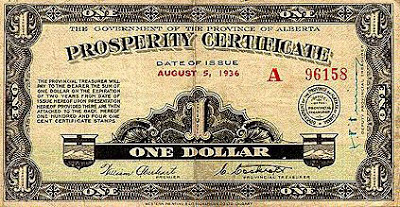
No one in the room who knew better wanted to lose more time that they wanted back on their deathbed explaining why printing money doesn’t make you richer. The “money is wealth” error is the defining affliction of the monetary crank.

The good economist will know that money creation is no short-cut to wealth. Only the production of valued goods and services in a market which reflects the consumer’s willingness to pay can relieve poverty and promote prosperity. A people are prosperous to the extent they possess goods and services, not money. All the money in the world—paper or metallic—will still leave one starving if goods and services are not available.
Obviously, none of them were persuaded by the quantity theory of money: if you increase the supply of money without a matching increase in the rate of real growth in the production of goods and services, you’ll have more money chasing the same amount of goods so prices will go up. It’s called inflation. Printing money creates inflation.

There is a school of thought in economic school, the Austrian school of economics, does get excited about fractional reserve banking. The reason it does is to explain how fractional reserve banking creates inflation and promotes the business cycle.

A cycle of booms and busts is not looked upon as a good thing by the Austrian school of economics.

The Austrian school wants to get rid of fractional reserve banking as a way of reducing inflation and reducing the possibility of a loose monetary policy causing booms and busts in the economy.

These monetary cranks from social credit party honestly believed that printing more money will make you wealthier. Thankfully no one asked them to explain their position.

A few supporters of the monetary cranks in the audience asked other members of their views on the ideas of these monetary cranks. Sensibly, they all gave short answers that did not provoke them further and waste more of their precious life listening to them talk nonsense.

If printing money was a winner, as with any populist policy that has a half a chance of working, the parties of the centre-left and centre right would be all over it like flies to s…
Was this Milton Friedman’s monetary policy dashboard?
19 Aug 2014 1 Comment
in macroeconomics, Milton Friedman, monetarism, monetary economics Tags: Milton Friedman, monetarism, rules versus discretion

I am not so sure the above would be mimicking Milton Friedman’s monetary policy dashboard as claimed.
Milton Friedman advocated a fixed monetary policy growth where the monetary supply would grow at 4% year in, year out no matter what happened in the economy. Towards the end of his career, he advocated replacing the Fed with a computer.


“Inflation is always and everywhere a monetary phenomenon”
31 Jul 2014 Leave a comment
in budget deficits, fiscal policy, macroeconomics, monetarism, monetary economics Tags: Joan Robinson
Joan Robinson thought German hyperinflation was not caused by monetary policy!!

Almost, but not quite.
Back in the days when dinosaurs roamed the earth, and Cambridge economists kept guard at the Temple of Keynes, Milton Friedman’s focus on inflation as a monetary phenomenon was a revelation—and an excellent one. Next to Joan Robinson’s surreal claims that printing money was not responsible for the German hyperinflation, Friedman’s version of monetary economics provided a very healthy dose of sanity. And as central banks across the world learned from the mistakes of the 70s and brought inflation under control, it became clear that the monetary authority indeed had the power to contain the price level via control of the money supply.
But it’s important to know what this account leaves out: how, exactly, do prices adjust? And over what length of time does this happen?
The modern view, backed up by impressive (though not entirely conclusive) empirical evidence, is that most prices are…
View original post 301 more words
The leads and lags on monetary policy are long and variable
25 Jul 2014 Leave a comment
in business cycles, inflation targeting, macroeconomics, Milton Friedman, monetarism, monetary economics Tags: leads and lags on monetary policy, Milton Friedman, monetary policy

Many Keynesians, Friedman notes, advocate “leaning against the wind.” By this they mean, in some sense, that the monetary (and fiscal) authorities should try to balance out the private sector’s excesses rather than passively hope that it adjusts on its own.
There are large uncertainties about the size and timing of responses to changes in monetary policy. There is a close and regular relationship between the quantity of money and nominal income and prices over the years. However, the same relation is much looser from month to month, quarter to quarter and even year to year.

Monetary policy changes take time to affect the economy and this time delay is itself highly variable. The lags on monetary policy are three in all:
- The lag between the need for action and the recognition of this need (the recognition lag)
-
The lag between recognition and the taking of action (the legislation lag)
-
the lag between action and its effects (the implementation lag)
These delays mean that is it difficult to ascertain whether the effects of monetary policy changes in the recent past have finished taking effect. Secondly, it is difficult to ascertain when proposed changes in monetary policy will take effect. Thirdly, feedbacks must be assessed. The magnitude of the monetary adjustment necessary to deal with the problem at hand is thus never obvious. It is common for a central bank to act incrementally. The central bank makes small adjustments to monetary conditions over time as more information is available on the state of the economy and forecasts are updated.
The existence of lags may mean that by the time policy has its full effect, the problem with which it was meant to deal may have disappeared.
Milton Friedman (1959) tested the Fed’s success at leaning “against the wind” by checking whether the rate of money growth has truly been lower during expansions and higher during contractions. He admits that this method of grading he Fed’s performance is open to criticism, but he decided to go ahead and see what turns up. Friedman found that Fed has – for the periods surveyed – been unsuccessful.
By this criterion, for eight peacetime reference cycles from March 1919 to April 1958. Actual policy was in the ‘right’ direction in 155 months, in the ‘wrong’ direction in 226 months; so actual policy was ‘better’ than the [constant 4% rate of money growth] rule in 41% of the months.
Nor is the objection that the inter-war period biased his study is good since Friedman found that:
For the period after World War II alone, the results were only slightly more favourable to actual policy according to this criterion: policy was in the ‘right’ direction in 71 months, in the ‘wrong’ direct in 79 months, so actual policy was better than the rule in 47% of the months.
One of the best ways to parry a metaphor is with another metaphor. Keynesians have a host of metaphors in their rhetorical arsenal; one frequently voiced is that a wise government should “lean against the wind” when choosing policy. Friedman counters:
We seldom know which way the economic wind is blowing until several months after the event, yet to be effective, we need to know which way the wind is going to be blowing when the measures we take now will be effective, itself a variable date that may be a half year or a year or two from now. Leaning today against next year’s wind is hardly an easy task in the present state of meteorology.
Friedman’s remarks, as even his strong critics admit, are mighty and strike at the heart of any activist stabilisation policy. By meeting Keynesians on their own theoretical turf and scrutinising their practice, Friedman manages to produce objections that both Keynesians and non-Keynesians must take seriously. A key part of any response to Friedman rests on the ability of forecasters to do their jobs with tolerable accuracy.
Keynesian policies do not necessarily follow even if the Keynesian theory of the business cycle were conclusively proved. It must also be demonstrated that the government has the ability and willingness of the government to act as the theory prescribes. Friedman’s critique does not depend on the quantity theory of money.


Recent Comments