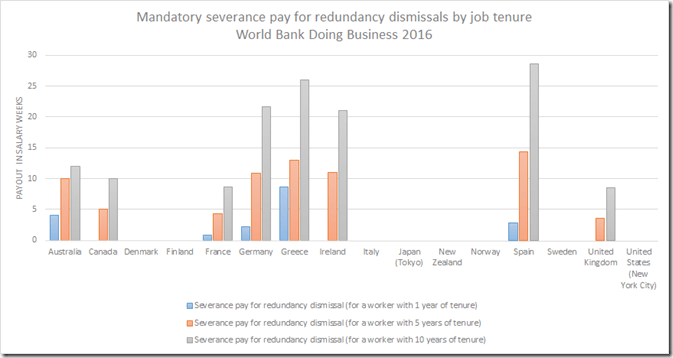
Mandatory severance pay by length of job tenure in the G7, Australia, New Zealand, Ireland, Scandinavia, Greece and Spain

There are a wide differences across the OECD in mandatory severance pay in the event of a layoff.

image

Source: Labor Market Regulation – Doing Business – World Bank Group.

Severance pay makes it more expensive to fire and therefore more expensive to hire. This means fewer job vacancies will be created but they will last longer.

The presence of mandatory severance pay  could increase or reduce the unemployment rate but unemployment durations will increase because it takes longer to find a suitable job match among the fewer available vacancies.

Mandating severance pay does not make the job match inherently more profitable. It just redistributes some of the surplus from the job match to the end when it is terminated.

Employers and jobseekers may agree to severance pay where investments in firm specific and job specific human capital for the job is profitable.

Severance pay in these circumstances gives the employer and more reasons to invest in specific human capital. The promise to pay severance pay will make the employer hesitate to lay them off. The employer will instead retain them over a slack period or redeploy them within the company rather than pay them out. This pre-commitment encourages investment in  firm specific and job specific human capital by both sides more secure, which makes the job match more profitable overall for both sides.

Of course, if it was possible to negotiate completely around severance pay mandated by law, there would be no effects on hiring, firing and unemployment durations. All it would mean is take-home pay would be less but in the event of a layoff, these employees would get that this wage reduction back as a lump sum.

@LivingWageUK documents the Achilles heel of the #livingwage

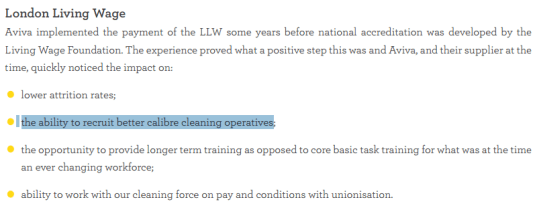
Research publicised by a Living Wage UK highlighted the Achilles heel of any living wage proposal. This Achilles heel applies to the voluntary adoption of the living wage and a living wage mandated through minimum wage laws.

The critique to follow accepts pretty much everything claimed by the living wage movement about the benefits of the living wage but simply traces out the consequence of this one promised benefit.

Source: New evidence of business case for adopting Living Wage   Living Wage Foundation.

The living wage is substantially above the minimum wage. Offering the living wage will change the composition of the recruitment pool of low-wage employers. This is the Achilles heel of the living wage which Living Wage UK documents in its study it tweeted about and from which I have taken the above snapshot.

Jobseekers would not have considered vacancies by these employers will now apply because of the living wage increase. These better calibre applicants will win those jobs ahead of the jobseekers whose current productivity levels are less than that to justify the cost of the living wage.

Central to the living wage rhetoric is that somehow employees will be more productive because of the adoption of the living wage.

The simplest way of doing that for an employer is to hire more qualified, more productive employers are no longer a hire the type of people you currently hire. They will be unemployed or pushed into the non-living wage sector of the low-wage market.

A living wage is an exclusionary policy where ordinary workers, often with families who are not productive enough to produce $19.25 per hour living wage plus overheads will never be interviewed.

The workers with the type of skills that currently win those jobs covered by a living wage increase will not be shortlisted because the quality of the recruitment pool will increase because of the living wage.

There will be an influx of more skilled workers attracted by the higher wages for living wage jobs. They will go to the head of the queue and displaced workers who currently apply for and win these jobs before the adoption of the living wage.

Any extra labour productivity from paying a living wage increase is in doubt because low skilled service sectors are notorious for their low potential for productivity gains. They are the bread-and-butter of Baumol’s disease.

The modern theories of the firm focus, in part or in full on reducing opportunistic behaviour, cheating and fraud in employment relationships. The cost of discovering prices and making and enforcing contracts and getting what you pay for are central to Coase’s theory of the firm put forward in 1937.

The profits of entrepreneurs for running a firm is directly linked from their successful policing of the efforts of employees and sub-contractors to ensure the team and each member perform as promised and individual rewards matched individual contributions (Alchian and Demsetz 1972; Barzel 1987). Alchian and Demsetz’s (1972) theory of the firm focused on moral hazard in team production. As they explain:

Two key demands are placed on an economic organization-metering input productivity and metering rewards.

The main rationale in personnel economics from everything ranging from employer funding of retirement pensions to the structure of promotions and executive pay including stock options is around better rewarding self-motivating employees who strive harder and reducing the costs of monitoring employee effort.

At bottom, the efficiency wage hypothesis is entrepreneurs are unaware of the higher quality and greater self-motivation of better paid recruits for vacancies but wise bureaucrats and farsighted politicians notice these gaps in the market. Bureaucrats and politicians notice these gaps in the market before those who gain from superior entrepreneur alertness to hitherto untapped opportunities for profit do so and instead leave that money on the table.

It’s kicking the living wage movement when it is down to mention that low paid workers with families will lose a considerable part of the living wage increase because of reductions in family tax credits and in-kind assistance from the government that are linked to their pay.

Their jobs are put at risk because of a large increase in the cost of employing them to their employers. Their take-home pay after taxes, family tax credits and other government assistance increases by much less. This is a pointless gamble with job security because of the much small increase in the take-home pay of many breadwinners on the living wage.

Do they have academic tenure anymore?

https://twitter.com/mileskimball/status/541219532032212993/photo/1

Public opinion about the profit margin of Wal-Mart

Labour productivity growth in the New Zealand retail services confounds Baumol’s cost disease

Are CEOs denied their labour surplus?

Bang Dang Nguyen and Kasper Meisner Nielsen looked at how share prices reacted to 149 cases of the chief executive or another prominent manager dying suddenly in American companies between 1991 and 2008.

If the shares rise on an executive’s death, he was overpaid; if they fall, he was not. Only 42% of the bosses studied were overpaid. Those with the bigger pay packages gave the best value for money as measured by the share-price slump when they passed away unexpectedly.

Share prices do speak to the value of the company and the contribution of its CEO. The share price of Apple went up and down by billions on the back of rumours about the health of Steve Jobs.

In terms of splitting of what some call the labour surplus increase from a firm hiring an executive, these employees retain on average about 71% and their employer keeps 29%. Others call this rent sharing.

71% going to the CEO might initially sound high, “but it’s not like he’s taking home more than he produced for the company,” says Nguyen.

The exploitation of CEOs gets worse when you consider the extensive use of promotion tournaments by their employers when setting their wages. They are thrust into rat races. Promotion tournaments are an integral and often invisible part of their workplaces.

Executive level employees are often ranked by their employers relative to each other and promoted not for being good at their jobs but for being better than their rivals. These promotion tournaments sent one employee against another – one worker against another – to the  profit of the owners of the firm.

The rat race set up by the owners of the firm are so cutthroat that in competitions to determine promotions the capitalists who own the firm may find that their employees discover that the most efficient way of winning a promotion is by sabotaging the efforts of their rivals.

Lazear and Rozen’s tournament theory of executive pay has stood the test of time. The key to this rat race is the larger is your boss’s pay, the bigger the motivation for you as an underling to work for a promotion. As Lazear wrote in his book, Personnel Economics for Managers

The salary of the vice president acts not so much as motivation for the vice president as it does as motivation for the assistant vice presidents.

Are women just too smart to be computer scientists?

Jim Rose's avatarUtopia, you are standing in it!

Women started drifting away from computer science in the mid-1980s. The interpretation put forward by the professional grievance industry, that is, by National Public Radio in the USA is:

The share of women in computer science started falling at roughly the same moment when personal computers started showing up in U.S. homes in significant numbers.

These early personal computers weren’t much more than toys. You could play pong or simple shooting games, maybe do some word processing.

And these toys were marketed almost entirely to men and boys. This idea that computers are for boys became a narrative. It became the story we told ourselves about the computing revolution. It helped define who geeks were, and it created techie culture.

Source: NPR

Another interpretation is there are systematic differences between teenage boys and teenage girls in verbal and written skills. Young women moved away from enrolling in computer…

View original post 224 more words

Management hierarchies explained

Unconscious bias and the gender wage gap

Just testified before a parliamentary committee on zero hours contracts

My submission to the Transport and Industrial Relations Committee today on the Employment Standards Bill is there should be no regulation of zero hours contracts:

  1. Workers sign these contracts because they are to their net advantage;

  2. Always knowing your working hours in advance is known only to about 30% of shift workers; and

  3. Workers command a wage premium when they sign zero hours contracts.

The obvious question is why do jobseekers sign a zero hours contract if it is not in their interests? Most of all, why would a worker who already has a job quit to work on a zero hours contract unless it is to their advantage?

If zero hours contracts are oppressive, the only workers hired on them would be the unemployed. Anyone who has a job would refuse such offers. Those unemployed that do sign a zero hours contract would quit as soon as a better offer comes along. 50% of job offers to British welfare beneficiaries to work on a zero hours contract are turned down.

This frequent refusal of zero hours contracts not only suggests there are options for jobseekers including the unemployed but there are costs to employers. The most likely employer response to reduce these costs of rejection is a offer to pay more to sign a zero hours contract. Everyone in this room knows contractors who work in much more than those in regular employment.

Unless labour markets are highly uncompetitive with employers having massive power over employees, employers should have to pay a wage premium if zero-hour contracts are a hassle for workers. It is standard for unusual, irregular or casual work to come with a wage premium. If you want regular hours, fixed hours, that comes at a price – a lower wage per hour.

Zero hours contracts is creative destruction in the labour market. Plenty of new ways of working have emerged in recent years: the proliferation of part-time work, temporary workers, leased workers, working from home, teleworking and contracting. Employment laws  rest on the now decaying assumption that workers have long, stable relationships with single employers.

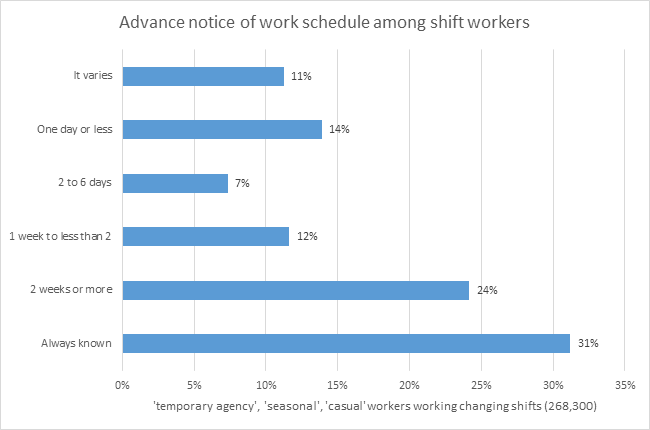
At least a quarter of a million New Zealanders already work shifts often with little notice of changes. Work schedules are always known in advance only to 31% of temporary, seasonal and casual employees. Another quarter of these have about two weeks or more notice of shifts. Hundreds of thousands of New Zealand workers freely sign on for variable hours.

image

Source: Survey of Working Life December Quarter 2012, Statistics New Zealand, Table 13.

Something new and innovative such a zero hours contract should not be regulated because it is not well understood. Zero hours contracts don’t come cheap for employers because of the risk of job offer rejection. There must be offsetting advantages that allow this practice to survive in competition with other ways of hiring a cost competitive labour force.

The fixed costs of recruitment and training are such that one 40-hour worker is cheaper than hiring and training two 20-hour workers. Zero hour contracts would be most likely in jobs with low recruitment costs, few specialised training needs and highly variable customer flows.

This business variability can be borne by the employer with the worker on regular hours but paid less. The alternative is the employee shares this risk with a wage premium for their troubles.

Workers with low fixed costs of working at different times profit from a move onto zero-hours contracts. Those with higher fixed costs of changing their working hours will stay on lower hourly rates but more certain working times

To summarise my points today:

  1. workers sign zero hours contracts because they are to their advantage to do so;

  2. Advance notice of working hours is not as common as people think for shift workers; and

  3. Irregular and unusual working arrangements usually command a wage premium.

Employers must pay a wage premium to induce in workers to sign zero hours contracts. This Bill undermines the right of workers to seek those higher wages. Thanks for your time and attention.

More than half of start-ups fail within the first five years

Why does Housing New Zealand pay dividends? @chrishipkins @metiria

The current controversy over payment of dividends by Housing New Zealand is misplaced because of the subtle connections between payment of dividends and greater value for money.

By paying dividends, the investment priorities of Housing New Zealand are subject to additional ministerial scrutiny. Its capital program is scrutinised in greater detail by the Cabinet because ministers must fund it against competing bids across the entire budget and parliamentary scrutiny process.

Each budget bid is championed by a minister, each of whom must make their case every year against all-comers. This annual competition for a central pool of capital filters out lower value investment bids.

If dividends were not paid but were instead retained as free cash flows in the agency, there would be less ministerial scrutiny of Housing New Zealand because it would have a smaller role in annual budget rounds. Ministers and the Parliament sit up and pay attention when money is to be spent, as they should, and the larger is the sum in the budget, the more attention is paid to value for the money sought. Funding projects with retained dividends may reduce ministerial and parliamentary scrutiny.

Payment of dividends does not reduce the ability of Housing New Zealand to engage in new capital spending. If the dividends were not paid, the amount of new capital spending from budget appropriations would be reduced dollar for dollar.

Why isn’t everyone on a zero hours contract?

I was chatting with a friend in the pub the other night about the proliferation of contractors in New Zealand in the government sector. It was observed that many of them simply perform the jobs of employees and bring no special skills for them but are very expensive to hire. They are paid a premium because that they are supposedly hired on short notice for short periods of time to fill gaps. They are paid a premium for their availability and willingness to leave on short notice without fuss.

I had no experience of contractors in Australia. If a gap needed to be filled within an agency quickly, you went to a manager higher up the hierarchy. The decision was made then to reallocate through secondments staff from another part of the agency from an area that was less busy than normal at the moment. In the interim, staff are recruited to fill any gap that is anything more than short-term with the secondments filling the gap until the recruits arrive.

The conversation then turned to the issues as to why any employees are guaranteed a minimum number of hours or continuity of employment. Why isn’t everyone on a zero hours contract and only come in when they are needed and are paid accordingly.

The reason for long-term employment agreements with fixed hours and weekly wages irrespective of how busy the business is arises from the fixed costs of employment, and the costs of search and matching in the labour market.

The difference between zero hours contracts and permanent employment may be a overstated. Advance notice of work schedules is always known only to a minority of temporary and permanent employees in New Zealand. There is not much difference between that advance notice between temporary and in permanent employees.
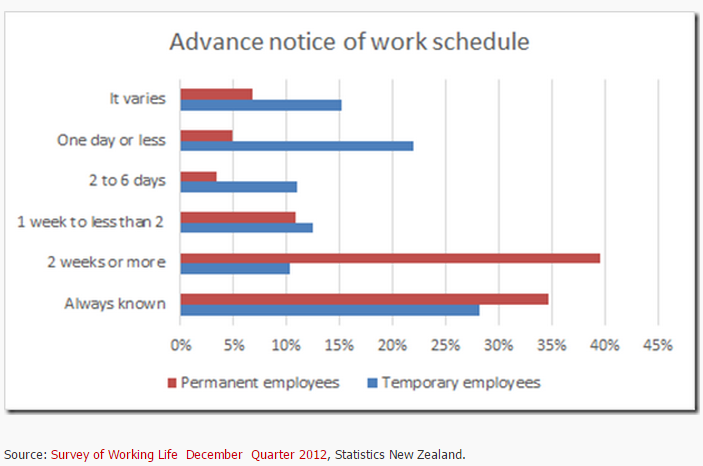
Critics overplay their hand if they suggest that somehow workers a very much disadvantaged and employers are holding all the cardsJob turnover and recruitment problems are a serious cost to a business. Workers will not sign contracts, such as zero hours contracts or casual work contracts if they are not to their advantage.

The question that must always be asked is why do people who are deemed competent to vote and drive cars sign zero hours contract? What is in it for them? David Friedman asked this question about the economics of restraint of trade agreements for employees:

…the employer who insists on an employee signing a non- competition agreement will find that he must pay, in additional wages or other terms of employment, the cost that the agreement imposes upon the employee, as measured by the employee and revealed in his actions. It follows that the employer will insist on such an agreement only if he believes that its value to him is greater than its cost to the employee… The contract is designed, after all, with the objective of getting the other party to sign it. If I am designing the contract and offering it to many other parties, that may put me in a position to commit myself to insisting on terms that give me a large fraction of the benefit that the contract produces. But it is still in my interest to maximize the size of that net benefit-which I do by only insisting on terms that are worth at least as much to me as they cost the other party.

Critics overplay their hand if they suggest that somehow workers are very much disadvantaged and employers are holding all the cards. Job turnover and recruitment problems are a serious cost to a business. Workers will not sign zero hours contracts if they are not to their advantage.

Unless labour markets are highly uncompetitive with employers having massive power over employees, employers should have to pay a wage premium if zero-hour contracts are a hassle for workers.

The fixed costs of employment are such that you shouldn’t expect zero-hour contracts: you’ll typically do better with one 40-hour worker over two 20-hour workers because of these costs. Zero hour contracts would be most likely in jobs with low recruitment costs and where specialised training needs are low. Workers with low fixed costs of working will move into the zero-hour sector while those with higher fixed costs would prefer lower hourly rates but more guaranteed hours. Again, read lower here as meaning relative to what they could elsewhere earn.

Most workers, the majority of workers are on conventional employment agreements. They work five days a week, 40 hours a week for a fixed pay.

Anyone I know who decides to work as a contractor expects to be paid much more than a conventional employee. They command a large premium for not having certainty of hours and ongoing employment. The same goes for any job that is particularly risky, has unsocial hours or involves weekend work or anything else that departs from the standard working week. All these jobs command a wage premium.

Employers incur fixed costs of employment when they recruit and train new employees. These recruits must be expected to stay long enough to work sufficient hours for the firm to expect to recover these investments [Oi (1962, 1983a, 1990), Idson and Oi (1999), Hutchens (2010), Hutchens and Grace-Martin (2006)].

These costs are fixed costs because they do not vary with how many hours the employee works or with how long an employee stays with their employer. On-going supervision, office space and other overheads can increase with the number of employees, not the hours they work per week. These fixed employment costs must be recouped over the expected job tenure of the employee with the firm.

Employers will not hire an additional worker unless they anticipate recovering the costs of doing do including fixed employment costs and other overheads.

Hiring one more worker for 40 hours per week is cheaper than hiring two workers to work 20 hours per week each. These two part-timers would about double the recruitment and training costs to secure the same total additional supply of hours worked per week. Profits are a small share of the revenue earned on selling the output of each worker.

Zero hour contracts would be most likely in jobs with low recruitment costs and where specialised training needs are low. Workers with low fixed costs of working will move into the zero-hour sector while those with higher fixed costs would prefer lower hourly rates but more guaranteed hours. Again, read lower here as meaning relative to what they could elsewhere earn.

The literature on the economics of the fixed costs of work arose out of the economics of retirement and the economics of the labour supply of married women, and in particular of young mothers. This literature was attempting to explain why older workers, or young mothers either worked a minimum number of hours, or not at all.

Fixed costs of working constrain the choices that employees make about how many hours and days that are worthwhile working part-time. For employees, the fixed costs of going to work limit the numbers of days and number of hours per day that a worker is willing to work part-time. The timing costs of working at scheduled times and a fixed number of days per week can make working fewer full-time days, rather than fewer hours per day less disruptive to the leisure and other uses of personal time.

The fixed costs of working induced older workers to retire completely, and young mothers to withdraw from the workforce for extended periods of time, unless these workers worked either full-time or enough hours part-time each day and through the week to justify the costs of commuting and otherwise disrupting their day and week.

There are fixed costs to workers and employers finding each other as a suitable job match. They commit to a long-term relationship rather than risk that good job match dissolving and they are not able to recruit the fixed cost of initially finding such a good match.

Employers choose not to lay off workers during recessions because they want to retain their job specific human capital and recoup the fixed costs of employing them. If the employer lets them go in a downturn that is mild, they risk having to spend considerable money on finding our suitable replacement down the road.

It’s costly for employers to lose good employees. It’s equally costly for them to find good employees and quickly lose them again because they are unhappy or not as well-paid as elsewhere. There is much to be made on both sides of the employment relationship through long-term relationships. That’s why not everyone is on a zero-hours contract.

Zero hours contract doesn’t make it any cheaper for an employer to find a suitable recruit then train that recruit. A wage premium must be paid to induce the would-be recruit to prefer that working arrangement with no fixed hours over the others available to them including staying in their existing job.

Regulation of zero hours contracts will deny workers the option of higher wages by accepting uncertain hours. Hundreds of thousands of New Zealanders already work on employment agreements where there hours are not fixed but a variable on relatively short notice.
Milton Friedman on the social responsibility of business

Image

@NZGreens @GreenpeaceNZ why does @PAKnSAVE charge for plastic bags?

The 40 PAKnSAVE supermarkets on the North Island charge for plastic bags which you pack for yourself. The 100 New World supermarkets owned by Foodstuffs on the North Island do not charge for plastic bags and the bags are packed for you. The reason is supply and demand that takes account of the full price of groceries including the time cost of shopping and the incomes of their respective customers.

My New World supermarket is just down the road for me – I can see it from my window as I type. The nearest PAKnSAVE is a short drive to a slightly rougher part of town. The PAKnSAVE supermarkets are warehouse style supermarkets rather than a shopping experience made as pleasant as possible and convenient to where you live. PAKnSAVE supermarkets are much larger supermarkets required to be a hub for a number of suburbs rather than one or two.

The type of people who shop at PAKnSAVE are people that the New Zealand Greens pretend to be concerned about. PAKnSAVE customers are lower income people sensitive to prices, willing to go to the trouble of recycling bags.

As you expect under capitalism and freedom, a supermarket chain emerged through market competition to service that more price sensitive niche. The New World supermarket caters more for people in a hurry rather than people on a budget. People on a budget go to PAKnSAVE.

The customers of New World supermarkets are nice members of the middle class who are much more likely to vote Green. They are busy people who do not have the time to keep their bags for next time, much less pack them for themselves. That is before we discuss how unhygienic the recycling of plastic bags is.

Typical of your middle-class Green disposed voter, they are cheapies in a small way as well. When my local supermarket started charging for plastic bags, they quickly dropped the idea because of hostile customer reactions.

The charges are nominal but the people on budgets particularly low income people struggling to with the budget, every cent counts. Naturally the New Zealand Greens are quite dismissive of the cost to shoppers of paying for bags because hardly any of their voters are on a budget.

Typical of the nanny state attitude of the New Zealand Greens, they are happy to compel people to pay for plastic bags and not compensate them for the loss even when they are on low incomes. Do the New Zealand Greens believe plastic bags should be free for low income families?

This same New Zealand Greens pretend to care about poor people who cannot afford to feed their children breakfast, but are happy to make the poor pay for plastic bags.

Let the market sorted it out. There are already supermarkets are charge for plastic bags. Most do not because their customer is uninterested in wasting time paying or bringing their own bags.

I well remember wanting to get time back on my deathbed as we waited behind some arrogant young Green who was packing his own bag after paying for his goods so he kept us waiting for a minute or two.

That is another reason why middle-class supermarkets pack your bags for you. They get you out of the supermarket and away from the lines at the checkouts faster if they pack the bags for you rather than let you do it in a more leisurely pace or perhaps after you have paid.

Again, this is a case about entrepreneurial alertness in the organisation of supermarkets. When your customers are time sensitive, the supermarket does things for them because the supermarket staff can do it faster than they do as they chat to each other and deal with their children.

Previous Older Entries Next Newer Entries

David Andolfatto

Celebrating humanity's flourishing through the spread of capitalism and the rule of law

Monetary Non-Neutrality

Celebrating humanity's flourishing through the spread of capitalism and the rule of law

Reason Magazine

Celebrating humanity's flourishing through the spread of capitalism and the rule of law

Coyote Blog

Celebrating humanity's flourishing through the spread of capitalism and the rule of law

Thoughts from the North

Celebrating humanity's flourishing through the spread of capitalism and the rule of law

Fardels Bear

A History of the Alt-Right

Vincent Geloso

Econ Prof at George Mason University, Economic Historian, Québécois

Bassett, Brash & Hide

Celebrating humanity's flourishing through the spread of capitalism and the rule of law

Truth on the Market

Scholarly commentary on law, economics, and more

The Undercover Historian

Beatrice Cherrier's blog

Matua Kahurangi

Celebrating humanity's flourishing through the spread of capitalism and the rule of law

Temple of Sociology

Celebrating humanity's flourishing through the spread of capitalism and the rule of law

Velvet Glove, Iron Fist

Celebrating humanity's flourishing through the spread of capitalism and the rule of law

Why Evolution Is True

Why Evolution is True is a blog written by Jerry Coyne, centered on evolution and biology but also dealing with diverse topics like politics, culture, and cats.

NoTricksZone

Celebrating humanity's flourishing through the spread of capitalism and the rule of law

Homepaddock

A rural perspective with a blue tint by Ele Ludemann

Kiwiblog

DPF's Kiwiblog - Fomenting Happy Mischief since 2003

The Dangerous Economist

Celebrating humanity's flourishing through the spread of capitalism and the rule of law

Watts Up With That?

The world's most viewed site on global warming and climate change

The Logical Place

Tim Harding's writings on rationality, informal logic and skepticism

Doc's Books

A window into Doc Freiberger's library

The Risk-Monger

Let's examine hard decisions!

Uneasy Money

Commentary on monetary policy in the spirit of R. G. Hawtrey

Barrie Saunders

Thoughts on public policy and the media

Liberty Scott

Celebrating humanity's flourishing through the spread of capitalism and the rule of law

Point of Order

Politics and the economy

James Bowden's Blog

A blog (primarily) on Canadian and Commonwealth political history and institutions

Science Matters

Reading between the lines, and underneath the hype.

Peter Winsley

Economics, and such stuff as dreams are made on

A Venerable Puzzle

"The British constitution has always been puzzling, and always will be." --Queen Elizabeth II

The Antiplanner

Celebrating humanity's flourishing through the spread of capitalism and the rule of law

Bet On It

Celebrating humanity's flourishing through the spread of capitalism and the rule of law

History of Sorts

WORLD WAR II, MUSIC, HISTORY, HOLOCAUST

Roger Pielke Jr.

Undisciplined scholar, recovering academic

Offsetting Behaviour

Celebrating humanity's flourishing through the spread of capitalism and the rule of law

JONATHAN TURLEY

Res ipsa loquitur - The thing itself speaks

Conversable Economist

In Hume’s spirit, I will attempt to serve as an ambassador from my world of economics, and help in “finding topics of conversation fit for the entertainment of rational creatures.”

The Victorian Commons

Researching the House of Commons, 1832-1868

The History of Parliament

Articles and research from the History of Parliament Trust

Books & Boots

Reflections on books and art

Legal History Miscellany

Posts on the History of Law, Crime, and Justice

Sex, Drugs and Economics

Celebrating humanity's flourishing through the spread of capitalism and the rule of law

European Royal History

Exploring the Monarchs of Europe

Tallbloke's Talkshop

Cutting edge science you can dice with

Marginal REVOLUTION

Small Steps Toward A Much Better World

NOT A LOT OF PEOPLE KNOW THAT

“We do not believe any group of men adequate enough or wise enough to operate without scrutiny or without criticism. We know that the only way to avoid error is to detect it, that the only way to detect it is to be free to inquire. We know that in secrecy error undetected will flourish and subvert”. - J Robert Oppenheimer.