Tom Sargent Honorary Degree Lecture on the Eurocrisis
16 May 2019 Leave a comment
in budget deficits, business cycles, comparative institutional analysis, currency unions, economic growth, economic history, economics of bureaucracy, Euro crisis, financial economics, global financial crisis (GFC), great recession, history of economic thought, law and economics, macroeconomics, monetary economics, politics - USA, Public Choice, public economics, rentseeking Tags: banking panics, moral hazard
The secrets of North Korea’s Office 39 | FT World
16 May 2019 Leave a comment
in defence economics, economics of bureaucracy, economics of crime, international economic law, International law, law and economics, Public Choice, war and peace Tags: North Korea
Why drugs cost more in America
16 May 2019 Leave a comment
in health economics, politics - USA Tags: health insurance
Greenpeace Co-Founder Tears Apart Green New Deal
15 May 2019 Leave a comment

Greenpeace co-founder Dr. Patrick Moore joined Mike Huckabee to discuss the Green New Deal. Moore did not mince words with how he felt about the plan and its proponents.
Stigler and Arrow on advertising (1990)
15 May 2019 Leave a comment
in applied price theory, economics of information, entrepreneurship, industrial organisation, law and economics Tags: economics of advertising

“I’ll Tell You What Happens With Impossible Promises”: When Kinnock Faced Down Militant
15 May 2019 Leave a comment
Living/minimum wage: what we know
15 May 2019 Leave a comment

Version 1.0 (April 24, 2019)
A couple of weeks ago, I got ensnarled in one of these debates on Facebook that do not go anywhere; it was triggered by the Australian Labor Party’s recent Living Wage policy proposal and the related discussion about the merits of minimum wages, and there specifically whether increases in minimum wages have negative employment effects and even more specifically whether such detrimental employment effects hit those at the low end of the wage distribution. These debates tie into other current debates like the one about lacking wages growth about which even the RBA is now concerned; see also Fig 17.17 here, or the one about wage theft which even the current government — not known for its charitable inclinations — says it wants to address, or the one about growing inequality which, as it affects aggregate demand, has to be a growing concern…
View original post 3,878 more words
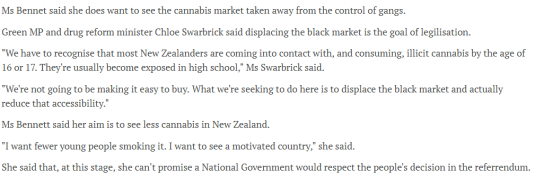
How on earth will legalising marijuana make it less accessible? If it does, why would the black market go away?
15 May 2019 Leave a comment
in economics of crime, economics of regulation, health economics, law and economics, politics - New Zealand
Green co-leader will be led by science – but GM is not yet a Shaw thing
15 May 2019 Leave a comment

The Ardern government wants to lead the world in implementing measures to combat climate change. Prime Minister Jacinda Ardern put her personal stamp on this by saying it will be her government”s “nuclear-free” moment.
The science on global warming is clear, say both Labour and the Greens. So shouldn’t every kind of science be used to combat it?
Well, no, says the Green Party. It refuses to contemplate genetic modification as an instrument for example in the campaign to make NZ-predator free.
Predator Free 2050 is forbidden from carrying out any research which could lead to the use of genetic modification or gene editing, a letter written by Conservation Minister Eugenie Sage shows.
View original post 502 more words

Prohibition reduced alcohol consumption but at what price? Was the trade-off worth it?
15 May 2019 Leave a comment
in economic history, economics of crime, economics of regulation, health economics, law and economics, politics - USA

steven lubet vs. the entire field of ethnography
15 May 2019 Leave a comment

Contexts magazine recently published an article by Northwestern law professor Professor Steven Lubet where he argued that ethnographers should seriously be interested in verifying claims reported in ethnographies. This is part of his bigger effort to critique ethnographic practices, not only in terms of truth making but also in terms of research ethics. Here are the links, some critics of Lubet, and then I’ll give you my brief opinion:
- His book –Interrogating Ethnography.
- His article in Contexts.
- A response by Michael Burawoy in Contexts.
- Lubet’s rejoinder on the Contexts blog.
- A blog response by Mikalia Arthur on Scatterplot.
- Lubet’s response on Scatterplot.
My take: Overall, I am on “Team Lubet.” I won’t relitigate earlier issues, but I will say that ethnographies are not exempt from the ethical principles that govern human behavior in general and social research in particular.
In terms of his specific…
View original post 315 more words
How much of this meme would have to change if the good samaritan was a man?
15 May 2019 Leave a comment
in economics of crime, economics of religion, law and economics Tags: political correctness, regressive left

How the Japanese Carriers were so effective
15 May 2019 Leave a comment
in defence economics, war and peace Tags: World War II


Recent Comments