How Planes Land Sideways In High Winds
13 Feb 2019 Leave a comment
in transport economics Tags: Air safety
@AOC Embarrasses Self on Green New Deal
13 Feb 2019 Leave a comment
in energy economics, environmental economics, global warming, politics - USA, transport economics Tags: The fatal conceit
Major Union Boss UNLOADS on AOC’s New Green Deal: “Will Destroy Workers’ Livelihoods”
12 Feb 2019 Leave a comment
Nightcap
12 Feb 2019 Leave a comment
Good set of book review links

- Intellectuals and a century of political hero worship William Anthony Hay, Modern Age
- John Stuart Mill: a not so secular saint James Smith, Los Angeles Review of Books
- Irving Babbitt’s history of ideas Simon Brown, JHIBlog
- Classical knowledge, lost & found: a history in seven cities David Abulafia, Literary Review
The Half-life of Facts
12 Feb 2019 Leave a comment


I enjoyed this book and I believe it provides an important insight. It fits well with Thinking, fast and slow (Kahneman). The author starts with a deliberately fuzzy/loose pragmatic definition of “fact” and proceeds to explore the quantitative aspects of evolution (or temporal characteristics) of knowledge and information. He uses mathematical and statistical tools to explore patterns, suggesting common or universal mechanisms. In addition, the pitfalls and biases of dissemination of knowledge, the persistence of misinformation and the inertia for “changing our minds, when the facts change” are also explored.
I learned a lot from this book. However, I found the repetition of the statement underlying regularity not an argument. I felt that the underlying potential mechanisms that lead to these regularities were tantalizingly suggested but not explored. The patterns, which I agree we do not usually consider for information/knowledge, are important but I would have liked more…
View original post 146 more words
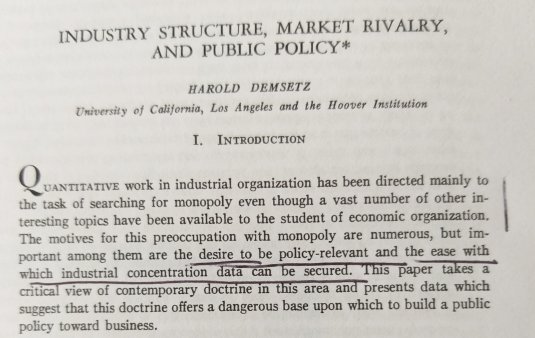
Spot on antitrust economics as academic rentseeking
12 Feb 2019 Leave a comment
in economics of education, industrial organisation, law and economics, politics - USA, Public Choice, rentseeking Tags: antitrust economics, competition law
The Garden of Forking Paths
12 Feb 2019 Leave a comment
Stephen Stigler on the seven pillars of statistical wisdom
The post title relates to a phrase (from Andrew Gelman) quoted in “The Seven Pillars of Statistical Wisdom” by Stephen Stigler. It refers to the frequently hidden, frequently unrecognized (or recognized) decisions in the path from hypothesis to conclusion.
I enjoyed and learned a lot from this book. It provides a historical framework under-pinning the authors construction of a framework to understand statistical science. This naturally includes misconceptions, personalities and unintended sources of progress or innovation.
The seven pillars are:
- aggregation
- information
- likelihood
- intercomparison
- regression
- design
- residual
Professor Stigler also hints at an emerging eighth pillar.
I particularly enjoyed this excerpt (quote from Alfred Marshall 1885):
the most reckless and treacherous of all theorists is he who professes to let facts and figures speak for themselves, who keeps in the background the part he has played, perhaps unconsciously, in selecting and grouping them and in suggesting the argument post hoc…
View original post 19 more words
Why Is Bottled Water So Expensive?
12 Feb 2019 Leave a comment
in economics of media and culture, health economics, industrial organisation
A Brief History of Moon Hoaxes – Why do people still believe in them?
12 Feb 2019 Leave a comment
in economics of media and culture Tags: conspiracy theories, moon landing
Students Love the Green New Deal… Until Hearing What’s In It
12 Feb 2019 Leave a comment
in economic growth, economics of regulation, energy economics, environmental economics, fiscal policy, global warming, health economics, income redistribution, labour economics, law and economics, monetary economics, politics - USA, poverty and inequality, Public Choice, rentseeking, transport economics Tags: The fatal conceit
Caplan Hanson Debate: Robots will eventually dominate the world
12 Feb 2019 Leave a comment
in applied price theory, economic history, industrial organisation, labour economics, labour supply, survivor principle Tags: automation
Here’s a Useful Visual Illustration
11 Feb 2019 Leave a comment


This graph represents our energy resources in 2006. There’s been a lot of fracking since then, and a lot more discoveries, so it would probably be different today, but not all that much. It is, however, a good visual to illustrate the utter absurdity of Ms. Ocasio-Cortez’s assumptions about eliminating fossil fuels and replacing them with “renewables.” Eliminate the Nuclear energy, the Natural Gas., the Petroleum, and Coal. Ignore the Hydro because that will not grow — and O-C assumes that tiny pink 2.4% can not only power our industrial society, but also all the high-speed rail she has in mind to replace all the automobiles and airplanes she plans to eliminate.
Lots of worried talk about the “greenhouse gasses” in the atmosphere, but the primary “greenhouse gas” is water vapor – clouds. The carbon dioxide is the same stuff we exhale –a natural fertilizer for plants. The slight rise…
View original post 17 more words
Day 42 of @Eugeniesage’s #plasticbagfascism: 16th and 17th bag
11 Feb 2019 Leave a comment
in environmental economics, politics - New Zealand Tags: recycling

The Temperature and the True Believers
11 Feb 2019 Leave a comment
This graph was published on January 2nd, 2019 by Roy W. Spencer PhD. Dr. Spencer runs the satellite program that measures worldwide temperatures, with Dr. John Christy at the University of Alabama at Huntsville. It’s the closest we can get to an official global temperature.

The 2018 globally averaged temperature anomaly, adjusted for the number of days in each month, is +0.23 deg. C, making 2018 the 6th warmest year in the now-40 year satellite record of global lower tropospheric temperature variations. The 2018 globally averaged temperature anomaly, adjusted for the number of days in each month, is +0.23 deg. C, making 2018 the 6th warmest year in the now-40 year satellite record of global lower tropospheric temperature variations.
To clarify, that’s 25 100ths of one degree, and 23 100ths of one degree. Run for the hills!
Temperatures didn’t use to be such a big deal. There were certain vocations where people…
View original post 281 more words


Recent Comments