
My mistake: 18 sentenced to prison for illicit drug use, not 18 for marijuana use. Three sentenced for cannabis use.
29 Jan 2019 Leave a comment
in economics of crime, law and economics, politics - New Zealand Tags: marijuana decrimilization
The Great Escape from energy poverty
29 Jan 2019 Leave a comment
in development economics, energy economics Tags: The Great Escape

Can Indirect Questioning Induce Honest Responses on Bribery Experience Surveys?
29 Jan 2019 Leave a comment

As I noted in my last post, bribery experience surveys – of both firms and citizens – are increasingly popular as a tool not only for testing hypotheses about corruption’s causes and effects, but for measuring the effectiveness of anticorruption policies, for example in the context of assessing progress toward the Sustainable Development Goals’ anticorruption targets. Bribery experience surveys are thought to have a number of advantages over perception-based indicators, greater objectivity chief among them.
I certainly agree that bribery experience surveys are extremely useful and have contributed a great deal to our understanding of corruption’s causes and effects. They’re not perfect, but no indicator is; different measures have different strengths and weaknesses, and we just need to use caution when interpreting any given set of empirical results. In that spirit, though, I do think the anticorruption community should subject these experience surveys to a bit more critical…
View original post 1,447 more words
Political Epidemiology, History, and the Evolutionary Psychology of Outrage.
29 Jan 2019 Leave a comment
in defence economics, economics of crime, law and economics, property rights Tags: evolutionary psychology
Guardian ‘photos of the week’: Gaza and Syria. A case study in ‘disproportionality’
29 Jan 2019 Leave a comment

The Guardian’s institutional hostility to Israel is in part driven by their near obsession with the plight of the Palestinians – a story almost always framed, regardless of the facts, in terms of the latter’s suffering at the hands of the former. This disproportionate focus was evident in our review of their ‘Photos of the Week‘ series, which they describe as “The best photographs in news and culture from around the world”.
Our survey of this series since March 31st – when the Hamas-led ‘Great March of Return’ began – found that 31 photos depicted scenes from the weekly Gaza border riots.
(This count doesn’t include photos related to other non-protest related Gaza violence – such as IDF responses to Hamas rocket attacks – or events in the West Bank. If we were to include such photos, the count would be significantly higher.)
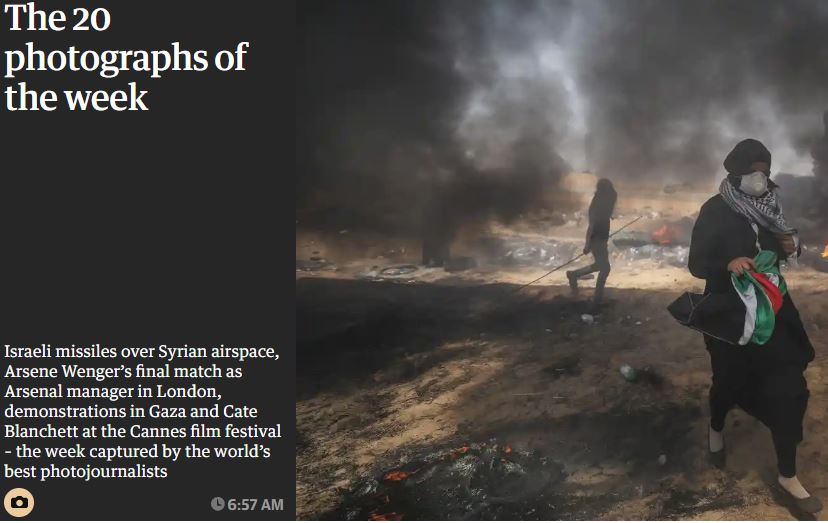
In contrast, the Guardian published a…
View original post 488 more words
WRITER, SAILOR, SOLDIER, SPY: ERNEST HEMINGWAY’S SECRET ADVENTURES, 1936-1961 by Nicholas Reynolds
29 Jan 2019 Leave a comment


(Ernest Hemingway in Spain during the Civil War)
In Nicholas Reynolds new book, WRITER, SAILOR, SOLDIER, SPY: ERNEST HEMINGWAY’S SECRET ADVENTURES, 1935-1961, the author, the CIA Museum’s historian poses the question as to why Hemingway, who tried all forms of spying, before and during World War II would sign on with Stalin’s henchmen at the NKVD. Reynolds relates that he had been working on an OSS (Office of Strategic Services) exhibit at the museum when he came across the links between Soviet intelligence and Hemingway and wondered how this could have happened, and what it means for Hemingway’s legacy. Reynolds thesis is clear; Hemingway’s relationship with the NKVD was impactful, and this chapter in his life has often been overlooked. According to the author it influenced Hemingway’s decision making the last fifteen years of his life and played a role in his eventual suicide in 1961. With the Cold…
View original post 1,507 more words
IN EXTREMIS: THE LIFE AND DEATH OF WAR CORRESPONDENT MARIE COLVIN by Lindsey Hilsum
29 Jan 2019 Leave a comment

(Marie Colvin in the Chechen Mountains, 1999)
“Why do I cover wars…. It is a difficult question to answer. I did not set out to become a war correspondent. It has always seemed to me what I write about is humanity in extremis, pushed to the unendurable, and that it is important to tell people what really happens in war—declared and undeclared.” (Marie Colvin, The Sunday Times, Sri Lanka, April 22, 2001)
Lindsey Hilsum’s new biography of Marie Colvin is a stark reminder of the plight of journalists in our ever-dangerous world. According to the Washington Post at least 43 journalists were killed in 2018 with another 12 deaths whose causes are not totally clear. The role of a journalist is to report the news as accurately as possible so citizens can make intelligent judgements about world events. The life of Colvin presented in IN EXTREMIS: THE LIFE AND…
View original post 1,218 more words
Wrong, @AOC says it is 12 years
29 Jan 2019 Leave a comment
in environmental economics, global warming, politics - USA Tags: climate alarmism

Another gender gap
29 Jan 2019 Leave a comment
in development economics, gender, health economics Tags: reversing gender gap


CHINESE TIBETAN MASTIFF – The World’s Most Expensive Dog
29 Jan 2019 Leave a comment
in economics of media and culture Tags: dogs
Andrew Denny: Would a Bill Seeking an Article 50 Extension Require a Money Resolution Proposed by the Government?
28 Jan 2019 Leave a comment

 Introduction
The on-going constitutional laboratory experiment that is Brexit has now turned to the question of whether a bill proposed by a backbench MP can be passed into law against the express opposition of the Government. This scenario gives rise to a number of issues, including whether Parliamentary rules in the form of its standing orders, will need to be amended to enable this. A number of commentators, including on this blog, have even considered the question of whether in those circumstances, ministers could advise the Queen to refuse Royal Assent to such a bill. One of the most eminent of these, Sir Stephen Laws, has argued here such a situation might arise if the Speaker endorsed “… an attempt to bypass the financial Standing Orders and allowed a Bill to pass that contravened them”, a situation he describes as “potentially horrific”.
In particular he considers that legislation to…
View original post 1,366 more words
TIM FLANNERY – Professor of Dud Predictions and Climate Falsehoods
28 Jan 2019 Leave a comment
He did do well financially out of alarmism


TIM FLANNERY, former Climate Commissioner of Australia from 2011-2013 earned $180,000 per year for a three-day working week to make predictions and decisions that affected billions upon billions of dollars of Australian taxpayers’ money.
AFTER being rightly sacked by the Abbott government in 2013, Flannery began his own go-fund-me version of the Climate Commission, the Climate Council, which continues the propagandised rollout of catastrophic climate predictions and unreliable-energy pipe dreams.
NEVER far from the government teat, Flannery is regularly wheeled out by Australia’s government run media monolith their ABC, appearing as resident climate ‘expert’ whenever a catastrophic weather event hits the news cycle, or simply to inject a dose of hysteria into the conversation when climate alarm is waning.
TONIGHT, Flannery appears on Q&A, the ABC’s TV panel discussion program…

TO understand why the ABC and Q&A are so ‘impressed’ by the…
View original post 1,271 more words


Recent Comments